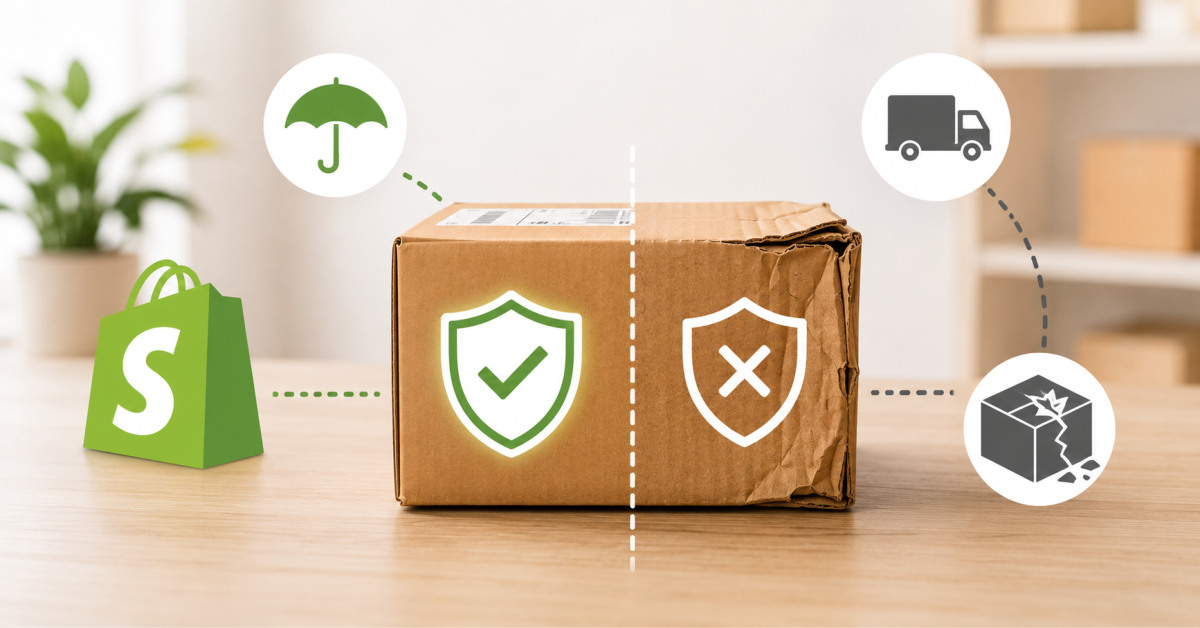
Carrier declared value limits a carrier’s financial liability, while parcel insurance or package-protection programmes may cover qualifying loss, damage, or theft under separate policy terms. Shopify merchants should evaluate coverage by exclusions, claim process, payout basis, service eligibility, and customer-resolution speed, not by the default dollar amount shown on a shipping label.
The expensive mistake is not choosing the wrong protection provider. It is assuming a carrier’s liability limit will reimburse the customer experience and margin loss your business actually carries.
Most Shopify merchants believe their shipments are insured. They are not. What they have is a liability cap, and the difference between the two is where margins quietly disappear.
Every major carrier includes a standard liability limit of $100 per package at no extra charge. It is easy to read that as “my orders are covered up to $100.” In practice, it means something much narrower, and once your average order value climbs past a pair of sneakers, that gap becomes a real line item on your P&L.
Here is what actually sits behind carrier coverage, why declaring a higher value does not solve the problem, and how a growing Shopify store can close the gap without adding friction to checkout.
Carriers are explicit about this, even if merchants rarely read the fine print: declared value is not an insurance policy. It is the maximum amount the carrier will consider paying if a package is lost or damaged, and it only pays when you can prove the carrier was at fault.
That single condition changes everything. With true insurance, a covered loss is paid. With carrier liability, the burden of proof sits with you. You have to demonstrate negligence, survive an investigation, and hope the claim is approved. Many are not.
Three details make the default weaker than it looks:
USPS is the one exception that proves the rule: it offers actual insurance rather than declared value on many services, but with lower ceilings. For everyone else, “coverage” is a conditional cap.
The carrier’s relationship is with you, the shipper. Your customer’s relationship is with your brand. When a parcel goes missing, the buyer does not file a carrier claim. They email you, open a dispute, or leave a review.
That means the financial and reputational risk lands on the merchant first, regardless of who was at fault. You reship or refund immediately to protect the customer experience, then you are left to chase the carrier for a partial, slow, uncertain recovery.
It gets worse after the delivery scan. If a package is marked delivered and then stolen off a porch, carrier liability typically ends there. The carrier did its job; the loss is yours. For a Shopify store running paid acquisition, every one of these events erases the margin on the order and part of the next one.
The intuitive fix is to declare a higher value on high-ticket orders. It helps, but it does not change the mechanics. You still have to prove fault. Claims can still be denied for packaging or prohibited-item reasons. Payout is still based on actual cash value. And you are now paying incremental fees on every valuable shipment while inheriting extra operational rules, such as high-value handoff requirements that void coverage if a step is missed.
Declaring value raises the ceiling. It does not remove the conditions attached to getting paid, and it does not speed anything up.
Set the category aside for a second and describe the outcome a merchant actually wants. Protection that:
This is the model we built Claisy around, and it is the standard worth holding any solution to. The test is simple: does it pay because the goods were lost or damaged, or does it pay only if someone else is proven at fault? The first is protection. The second is a cap with paperwork. For a fuller breakdown of how parcel coverage works alongside carrier liability, this analysis of shipping insurance for Shopify stores is a good starting point.
The reason many merchants tolerate the gap is that “getting properly insured” sounds like manual work: deciding order by order what to cover, remembering to declare value, filing claims one at a time. At any real volume, that does not happen consistently, and inconsistent coverage is the same as no coverage on the day it matters.
The better pattern is to let your store data drive it. Shopify emits events when an order is fulfilled and a tracking number is attached. That server-side moment, after the buyer has paid and the label exists, is exactly where coverage should be applied automatically to every eligible shipment.
Two things make this approach work for a growing store:
You keep your existing carriers and your existing workflow. The coverage layer simply reads what you already ship.
Before you commit to any approach, run it through five questions:
If the answers point to conditional, slow, depreciated, and manual, you have a liability cap dressed up as insurance.
Coverage is one side of protecting margin. Packaging is the other, and the two are linked: inadequate packaging is one of the most common reasons a claim gets denied in the first place. Tightening how you pack is the cheapest way to reduce the number of claims you ever need to file, and it is worth treating with the same rigor. Our practical guide to packing parcels that survive transit goes through it category by category.
The takeaway for Shopify merchants is not that carriers are the enemy. It is that carrier liability was never designed to protect your margin, and reading it as insurance is an expensive assumption. Close the gap deliberately, automate it so it applies every time, and a lost parcel stops being a hit to the P&L and becomes a routine, quickly settled event.
Eric Gaudinot is the Founder and CEO of Claisy, a parcel insurance and transport dispute platform that indemnifies merchants within 48 to 72 hours, independent of the carrier’s decision, across e-commerce and logistics.
No, carrier declared value is not necessarily the same as shipping insurance. Declared value generally sets the carrier’s maximum liability for a shipment under its transportation terms, while insurance is governed by a separate policy with its own covered events, exclusions, limits, and claim process. FedEx explicitly states that declared value is not shipping insurance. Merchants should read the terms for their carrier service and any third-party coverage programme rather than relying on the label used at checkout or on a shipping platform.
No, not every UPS, FedEx, and USPS shipment has the same default protection or claims terms. FedEx commonly states a $100 default declared-value limit for eligible shipments, while USPS includes up to $100 insurance on selected services such as Priority Mail, Priority Mail Express, and Ground Advantage. UPS Ground Saver has a $20 liability limit per package under UPS terms. Verify the exact carrier, service, destination, and shipping-platform agreement for every lane your business uses.
A Shopify store should offer package protection at checkout only if the customer value, programme terms, support experience, and conversion impact are clear. Customer-paid protection can make shipment risk visible and may reduce merchant-funded replacement costs, but it adds a decision at checkout and can confuse customers about responsibility for failed delivery. Merchant-funded automatic coverage avoids that checkout friction but becomes a margin expense. Test both models against your actual loss rate, average order value, customer-support load, and repeat-purchase economics.
When a package is marked delivered but the customer cannot find it, follow a predefined customer-resolution workflow rather than improvising case by case. Confirm the address, ask the customer to check safe locations and with household members, review carrier tracking, and assess whether the order qualifies for replacement, refund, carrier investigation, or third-party protection. Keep the communication empathetic and timely. The customer does not distinguish between your fulfilment partner, carrier, and insurer, so your response becomes part of the brand experience.
Merchants should compare parcel-insurance providers by covered events, exclusions, payout basis, limits, policy geography, claim evidence, settlement timing, automation options, pricing, and customer-service workflow. Ask whether the provider covers theft after delivery, whether claims pay retail or cost value, whether packaging rules apply, and who communicates with the customer. Also confirm the provider’s legal and insurance structure in your operating region. The best option is the one that matches your real shipment exposure and customer-remedy standard, not simply the lowest price per package.