

Trade shows can generate online sales when shoppers experience a product in person, then have a clear, trackable path back to the store. A striking booth display helps start conversations, but the event earns its budget through qualified leads, useful follow-up, and attributable purchases.
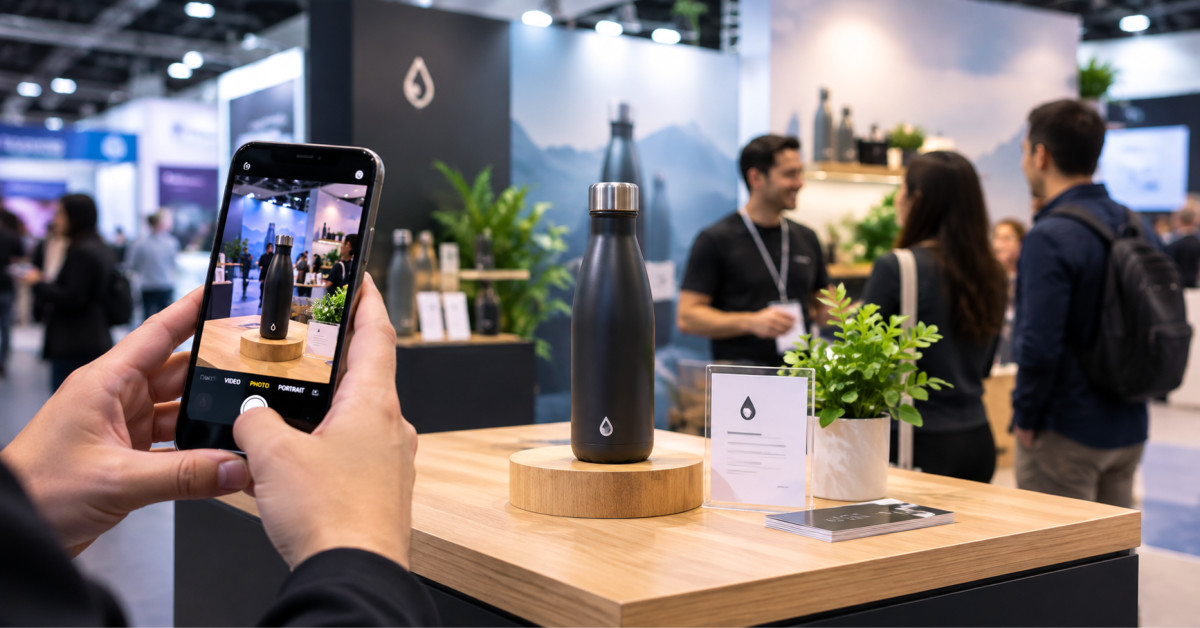
A booth visitor who stops to film your product has given you attention. The sale depends on what happens after the phone goes back in their pocket.
Plenty of ecommerce brands treat trade shows as a separate world from their store. The booth is for handshakes and business cards, and the real selling happens on the website. That split misses what a good show actually does for online sales.
A product page asks a stranger to trust a photo. A trade show lets them skip that step. They see the product at its real size and in real light, and they get answers to the questions a listing never quite covers. When they get home and search for it, they aren’t comparing unknown brands any more. They’re looking for the one they already saw, and that visit has a much better chance of ending at checkout instead of in an abandoned cart.
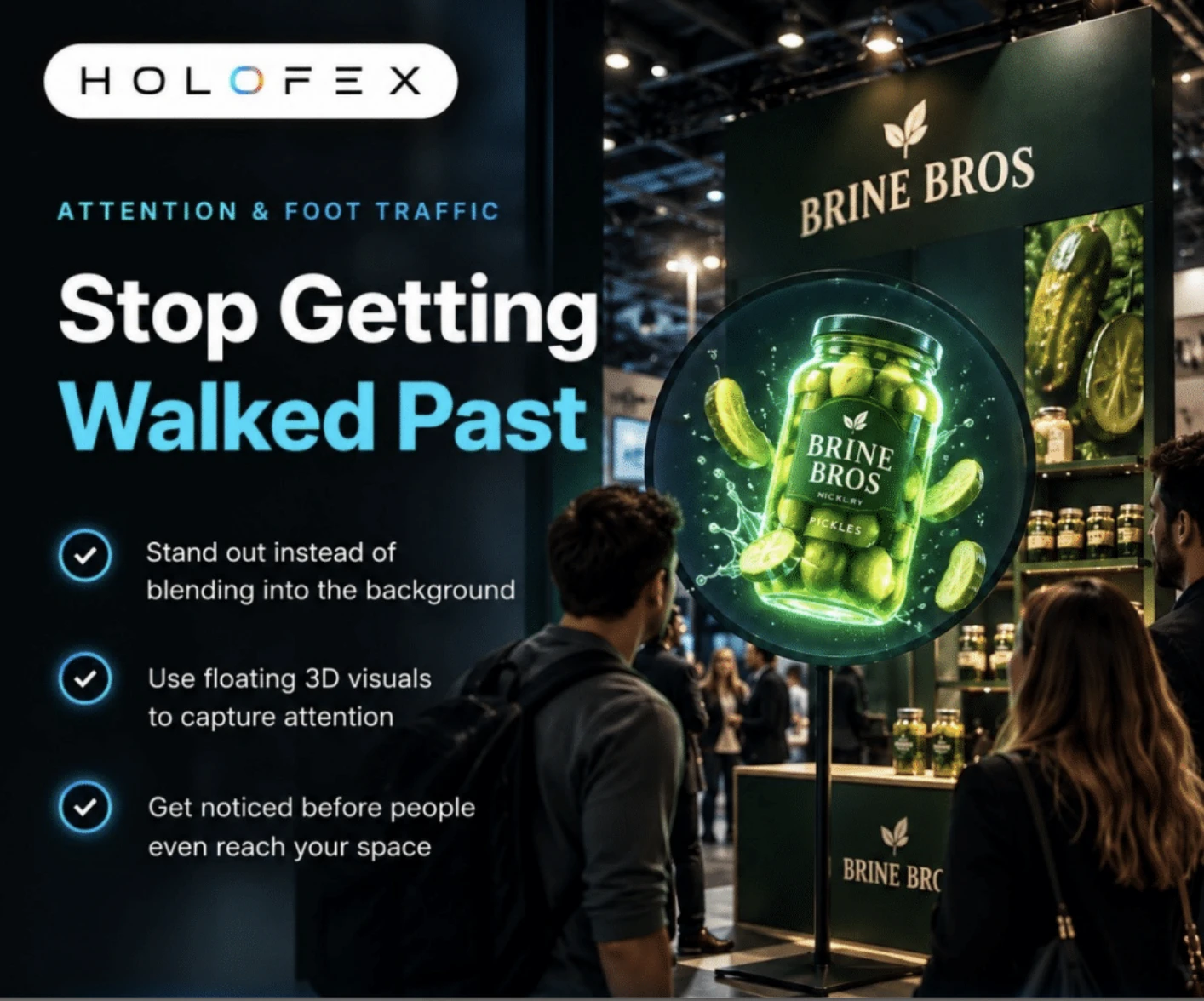
The hard part is getting people to stop in the first place. A busy expo floor is packed with stands, and visitors make up their minds quickly about which ones deserve a closer look. The brands that win that moment usually show something rather than say something: a live demo, a product in motion, or something visitors can’t quite explain from the aisle. This is where a hologram really stops people in there tracks. Regardless of what product or service you have the first step is being at the tradeshow to meet new customers a hologram will make them stop. After all who wouldn’t stop if the see a hologram regardless of what it is displaying?
Holofex, which has sold LED hologram fans through Shopify since it was founded in Australia in 2021, built a good part of its growth on that idea. Its product is a floating image that looks far more impressive in person than it does inside a phone screen, so the plan was simple. Put the display where buyers could see it with their own eyes.
Trade shows as the product demo
Walk the aisle at a retail expo and you’ll see the same moment play out over and over. Someone glances at the booth and keeps walking. Two steps later they stop and turn back. A sneaker is rotating above the counter with no screen around it, lit in sharp detail, the laces and stitching clear from across the aisle. They lean in, look for a projector, crouch to check the base. Then the phone comes out.
That phone clip is worth more than any booth banner. It travels, and because a stranger shot it, the people who watch it later tend to believe it.
For a Shopify brand with a visual product, events do a job the website can’t. Buyers judge the image with their own eyes, under real lighting, at real distances. Someone who has stood in front of the display doesn’t need to be told it’s bright enough. They’ve seen it.
Expo halls are hard on displays. Overhead floods run all day, the stand next door has a video wall, and anything dim looks tired by mid-morning. A hologram that dazzles in a dark showroom can go pale under that glare.
This is where the hardware earns its place. Holofex’s HoloU65 Ultra runs 1280 LEDs on a 65 cm fan, so logos have crisp edges and fine product detail stays readable at booth distance. The Ultra Series is up to four times brighter than Holofex’s Basic Series, with LEDs reaching 2800 cd/m². Colours stay rich, the black around the image stays black, and the picture holds up in a lit hall or a shopfront window facing a sunny street.
At a trade show, that brightness is what turns a glance into a conversation with your sales team.
Early on, it’s tempting to sell the biggest, brightest unit to everyone who asks. Holofex asks questions first. Where will the display sit? How close will people stand? Is it going in a window, on a counter, or on a busy expo floor where kids can reach it? Does it need to travel between shows?
The answers point to different kit. A team doing a season of trade shows usually wants the HoloPack Ultra, which bundles the HoloU65 Ultra with an adjustable tripod stand and a protective cover. The image goes up at eye level and the blades stay guarded in a crowd. A boutique with a fixed window might be better off with a wall mount.
Getting that match right is customer service as much as sales. A buyer with the wrong size for the room becomes a support ticket. A buyer with the right kit sends you photos.
A hologram fan can go almost anywhere, which is exactly why focus matters. Holofex concentrates on retail and events, two settings where a floating image has a commercial job: pulling people toward a shopfront, a counter or a stand.
That focus shapes the Shopify store. Product pages talk to shop owners and exhibitors. Content is organised around use, with tradeshows, retail and storefronts, and showcases and events each getting their own treatment. Ad spend goes to people who book booth space or run physical stores, instead of general gadget browsers who scroll straight past.
Any Shopify operator can borrow the lesson. Work out which buyers get the most from your product’s best trait, then build the store around them.
Events only pay off if the interest lands somewhere. A few habits connect the booth to Shopify:
Fulfilment matters too. Holofex ships from warehouses in the US, Canada, the UK and Australia, so a buyer met at a show in London or Los Angeles isn’t waiting on a parcel from the other side of the world. A booth conversation cools quickly; fast local delivery keeps it warm.
You don’t need to sell hologram fans for any of this to apply. If your product’s best quality is something a photo flattens, like texture, scale or the way it catches light, get it in front of people. Choose the events where your buyers already gather. Ask what they need before recommending anything. Then give every booth conversation a clear route back to your store.
For Holofex, that route starts with a single glance at an image spinning in mid-air. If you’re curious what that looks like, the holofex hologram fan range is a good place to start. Better still, find a trade show and stand in front of one, or get one yourself and let them stand in front of you.
Trade shows work best for ecommerce brands when a live demonstration resolves a buying question and a trackable path carries the visitor back to the online store. These answers cover how to choose a show, evaluate a display, and measure what happened afterward.
Trade shows are worth testing for an online-first Shopify brand when its buyers attend the event and seeing the product in person helps them decide. They are less compelling when the audience is poorly matched or the team cannot follow up. Start with one relevant event and define success before paying for a booth: qualified conversations, product-page visits, inquiries, and eventual orders. A visitor does not need to purchase at the stand for the show to be useful, but the brand does need a practical way to connect that conversation to later online activity.
Connect trade show leads to Shopify sales with an event-specific landing page, a trackable QR code or URL, and a follow-up process that reflects what each visitor asked about. Record the event source when someone voluntarily shares contact details. Review scans, visits, inquiries, discount-code use, and orders together rather than assuming one number captures the whole result. Some visitors will search for your brand later instead of scanning, so a post-purchase source question can add useful context. The purpose is to make the event measurable enough to guide the next investment, not to promise perfect attribution.
Demonstrate the product quality or use case that is hardest to understand on a screen. For a hologram fan, that means letting visitors judge the image at real size, under realistic lighting, and from a useful viewing distance. For another Shopify brand, the deciding detail may be texture, fit, sound, durability, or setup. Keep the demonstration short enough to understand from the aisle, then let booth staff answer questions specific to the buyer’s setting. A visual effect should open the conversation; the product’s practical value should carry it forward.
Before buying a hologram fan for an expo booth, check the actual model specifications, viewing distance, venue lighting, mounting method, power access, content requirements, and whether visitors can reach the moving blades. Request a demonstration in conditions similar to the show. Confirm what accessories are included, what must be purchased separately, and how the equipment will travel. Do not rely on a single LED-count figure without confirming it with the supplier: Holofex currently publishes differing counts for its HoloU65 across its own product and buyer-guide pages.
Test a smaller, relevant event first if your brand has not yet proved that live demonstrations generate qualified conversations and follow-up sales. A local market, retail gathering, or niche industry event gives you a lower-cost chance to refine the demonstration, hear objections, and check whether the landing page answers visitors’ questions. Move to a larger show when you know who stops, who buys, and what it costs to reach them. A bigger audience is valuable only if enough of those people are the buyers your product serves.




