

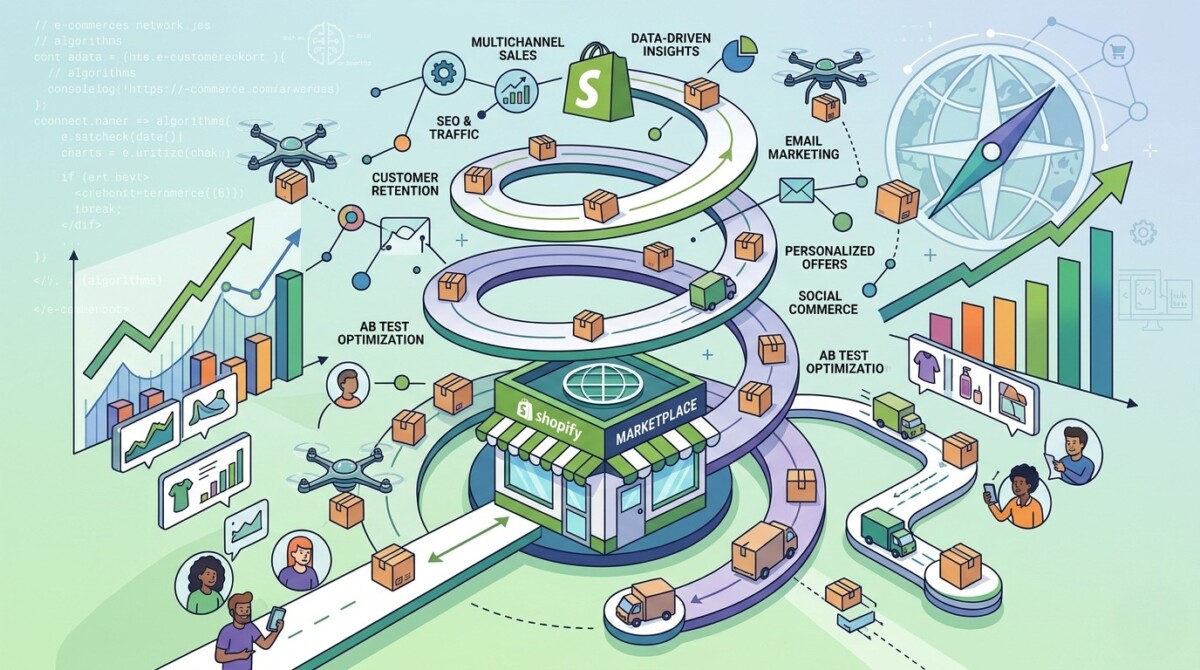
Shopify DTC brands grow profitably in 2026 by fixing conversion friction first, building retention systems that compound, treating paid as an accelerant rather than an engine, and positioning for the agentic commerce shift where AI agents discover and purchase products on behalf of shoppers.
Most DTC brands stalled at $500K to $2M do not have a traffic problem. They have a system problem. The traffic they are already paying for is enough to scale them past $5M if the store, the retention engine, and the operating cadence are built to compound it.
The most common growth conversation I hear from DTC founders goes something like this. Traffic is up. Ad spend is up. Revenue is not moving the way it should. The instinct is to spend more on acquisition. The actual problem is almost always somewhere else.
After six years inside Shopify’s merchant success team working with brands like Dr. Squatch, Bulletproof Coffee, and Tentree, and 460+ podcast conversations with founders and operators since, the pattern is consistent. Most Shopify DTC brands under $5M hit a plateau not because they cannot get traffic, but because their store is not built to convert it, retain it, or compound it. Customer acquisition costs have risen 222% over the past eight years, with the average DTC CAC now sitting between $45 and $70. Meanwhile, the platform wide average Shopify conversion rate is still 1.4 to 1.8%. Moving from 1.5% to 3% doubles revenue from the traffic you are already paying for, without adding a single new ad dollar.
This guide is a practitioner’s playbook, not a trend roundup. It covers the six growth levers that actually move the needle for Shopify DTC brands: the growth ceiling diagnostic, conversion optimization, retention systems, acquisition discipline, the agentic commerce shift, and the operational layer that holds everything together. Each section includes specific benchmarks, Shopify native tactics, and the stage aware framing that most generic growth content skips. If you are pre launch or still validating demand, start with building your Shopify foundation first before optimizing for growth.
Before spending another dollar on ads or adding another app to your tech stack, you need an honest read on where your growth is actually blocked. Most founders skip this step and end up treating symptoms instead of causes. The diagnostic is three numbers, all of which sit in Shopify Analytics under Analytics > Overview, and all of which take five minutes to pull.
Where you fall short tells you which section of this guide to prioritize. A CVR below 2% means the conversion section is your highest leverage starting point. A repeat purchase rate under 25% means retention is your ceiling, and consumable categories at that number have a serious problem. A flat email list means you are building your business on rented land.
The brands that compound growth consistently do not spray tactics and hope. They run a structured cycle quarterly: audit traffic quality, on site friction, post purchase experience, and channel dependency. If more than 60% of revenue comes from paid ads, you are one algorithm change away from a cash flow crisis. The highest leverage lever at $500K per year is rarely the same one at $2M. Re run the diagnostic every quarter and let the numbers reset your priorities, not the next trending tactic.
Conversion rate optimization is the highest ROI growth lever available to most Shopify DTC brands, and it is the one most founders underinvest in. The math is unambiguous. If your store converts at 1.5% and you move it to 3%, you have doubled revenue without adding a single visitor. No other growth channel offers that kind of leverage, and yet the typical Shopify operator spends three times more on acquisition than on the store itself.
Product detail pages are where purchase decisions actually happen, and most Shopify PDPs underperform because they are built around what the brand wants to say, not what the shopper needs to know before buying. The highest impact fixes are consistent across thousands of stores. Star ratings and review counts visible above the fold do more for conversion than another paragraph of brand copy. Benefit led copy outperforms feature lists every time: your supplement customer does not care that you have 500mg of magnesium glycinate, they care that they will sleep better. A sticky add to cart that follows the shopper as they scroll through images and reviews removes friction at the moment of highest intent. Risk removers placed adjacent to the CTA, free returns, satisfaction guarantees, shipping clarity, reduce hesitation right when hesitation is most likely to kill the sale.
Cart abandonment averages around 70% across ecommerce, and Baymard’s long running research puts mobile higher still. Shopify’s native checkout is strong, but it rewards configuration. Enabling Shop Pay, Apple Pay, and Google Pay early in the flow reduces the number of fields a shopper has to complete, which is the single highest leverage checkout optimization available. Surprise shipping fees revealed at checkout remain the leading cause of abandonment industry wide. Either build shipping into your price or surface costs on the product page itself.
Mobile is where the majority of your traffic lives. According to Shopify’s own data on mobile commerce, more than half of ecommerce traffic now arrives on mobile, yet mobile conversion rates consistently lag desktop by 30 to 50%. That gap is almost entirely a UX problem, not a buyer intent problem. Target Largest Contentful Paint under 2.5 seconds, keep tap targets at 44px minimum, lead with one hero image or short video under 2MB, and put primary actions in the lower third of the screen where thumbs naturally rest. The brands that close the mobile conversion gap do not just shrink their desktop site. They redesign the experience from the thumb up.
Retention is the most profitable revenue available to a DTC brand, and the discipline that separates brands growing profitably from brands growing at a loss. Acquiring a new customer costs five to seven times more than retaining an existing one. For DTC brands paying $45 to $70 per acquisition, that math has become existential. The brands growing profitably in 2026 are not necessarily the ones with the best ad targeting. They are the ones with the best post purchase systems.
The benchmark that matters here: the average Shopify store sits at roughly 27% returning customer rate, and the average DTC brand retains just under 30%. Top performers in consumable categories, supplements, coffee, skincare, hit 40 to 55%. If your repeat purchase rate is below 25% and you are in a consumable category, you are leaving the most profitable revenue on the table. Most of the gap closes through email and SMS done well.
Klaviyo’s 2026 benchmark data is striking on this point. Automated flows generate roughly 30 times more revenue per recipient than broadcast campaigns, and they account for 41% of email revenue from just 5.3% of sends. The brands compounding revenue have a post purchase sequence triggered at days 1, 3, 7, and 14 that confirms the order, sets expectations, delivers value before the product arrives, then asks for a review and introduces a complementary product. They have replenishment reminders firing at 80% of the typical consumption window for consumables, because customers who reorder on a reminder have meaningfully higher LTV than customers who discover they have run out. They have win back sequences at 90 days before customers go cold, and VIP tier triggers that treat the top 10% of customers by LTV materially differently from everyone else. Welcome series flows convert 8 to 12% of new subscribers to first time buyers, and three email cart recovery sequences at one hour, 24 hours, and 72 hours recover roughly 40% more revenue than single email sequences. For a deeper breakdown of the specific flow mechanics, the retention marketing tactics that drive repeat purchases guide covers each one in detail.
SMS works best as a complement to email, not a replacement. Use it for time sensitive triggers: flash sales, back in stock alerts, shipping updates. Reserve email for relationship building and longer form content. Subscription commerce is the most reliable path to LTV stability for the right product categories. Not every DTC product is subscription appropriate, but for consumables and curated discovery categories, subscriptions change the unit economics entirely. Track churn rate, MRR growth, and average subscription age rather than top line subscriber count; the guide to subscription metrics for DTC brands covers the full set. Rely less on rented land and more on email, SMS, and community. Every dollar invested in list growth compounds. Every dollar invested in paid acquisition evaporates the moment you stop spending.
Paid acquisition works as an accelerant on a profitable growth system, not as a foundation under a leaky one. The problem isn’t the channel; it’s the dependency. DTC brands that build their entire growth model on paid are one algorithm change, one iOS update, or one CAC spike away from a cash flow crisis. The brands that scale sustainably treat paid as fuel for a system that already converts and retains, not as the engine itself.
The unit economics matter more than the channel mix. Target a Marketing Efficiency Ratio of at least 3:1, with 4 to 5:1 being the healthier band for a DTC brand. Below 3:1 you are likely growing at a loss. Aim to recoup customer acquisition cost within six months unless your LTV is high enough to defensibly support a 12 to 18 month payback, and even then only if your retention systems are genuinely doing the work to deliver that LTV. Track blended CAC, total acquisition spend divided by total new customers, because your Meta reported CAC and your true blended CAC are almost never the same number. The gap between blended and platform reported CAC has widened materially since 2023 with measurement signal loss, and brands operating on Meta reported numbers alone are routinely 30 to 50% off their actual efficiency.
The conventional wisdom used to be that targeting was the primary driver of paid social performance. That is no longer true. With signal loss from privacy changes and platform algorithm improvements, creative is now the dominant variable. The brands winning on Meta and TikTok in 2026 are testing five to ten new creative concepts per week, not five to ten per month. They treat creative production as a core growth function, not a quarterly agency deliverable. UGC style video that mirrors how real customers talk about the product outperforms polished brand advertising. The first two to three seconds of any ad have to earn the scroll stop. Specific claims with social proof, “4.8 stars from 3,200 reviews,” outperform generic “loved by customers.” Problem led framing, lead with the pain state and introduce the product as the resolution, consistently outperforms feature led structures.
Paid is your now. Content and owned channels are your moat in 12 to 24 months. The brands that understand this invest in both simultaneously rather than treating them as competing priorities, and rarely allow paid to exceed 60% of revenue contribution at steady state.
AI is no longer an aspirational growth lever for Shopify DTC brands; it is the discovery channel that is restructuring how products get found in the first place. Shopify’s data on DTC adoption shows 42% of merchants actively using AI features in 2026, and the brands using them well are seeing measurable returns. Companies deploying AI personalization are generating approximately 40% more revenue than those delivering generic experiences, according to ringly.io’s 2026 DTC ecommerce research. But the bigger story is what is happening above the storefront entirely.
The structural shift to pay attention to is agentic commerce. Shopify reports that AI attributed orders on its platform grew 11 times between January 2025 and January 2026, and Adobe Digital Insights tracked a 4,700% year over year increase in AI driven traffic to retail sites by mid 2025. In December 2025 and January 2026, Shopify launched Agentic Storefronts: a set of capabilities that lets the Shopify Catalog syndicate merchant products into ChatGPT, Perplexity, Gemini, and Copilot. Shoppers asking “what is the best protein supplement for women over 40” inside an AI chat are increasingly getting curated answers with direct purchase paths, not lists of links. McKinsey estimates the global agentic commerce opportunity at $3 to $5 trillion by 2030. Shopify’s own breakdown of agentic commerce walks through how Catalog handles the syndication and how attribution flows back into the admin. For DTC operators, the practical implication is that being absent from these answers in 12 to 24 months will be the equivalent of being absent from Google in 2012.
On site AI personalization is the more immediate lever. Generic product recommendations are table stakes and perform accordingly. The personalization that moves AOV and conversion is behavioral and predictive. Dynamic product recommendations driven by real time browsing behavior, not just purchase history, surface the right cross sell at the right moment. For consumable products, predictive replenishment fires before a customer goes looking elsewhere. AI driven email content blocks, tailored to each subscriber’s purchase and browse history, materially improve open and click rates over batch sends. The best Shopify AI tools for store growth covers the specific apps matched to revenue stage, because what makes sense at $200K per month is not what makes sense at $2M.
Getting cited in AI answers requires content that AI engines can extract and trust. AI systems prefer well structured, in depth, and credible content. Lead every major section with a direct, self contained answer to the question it addresses. Cite specific data rather than vague quantifiers. Build topical depth across 20 deeply interconnected pieces rather than 200 loosely related ones. Demonstrate experience, expertise, authority, and trust through real author credentials, first person practitioner perspective, and citations from primary sources. The brands investing in this kind of content now are building a discovery moat that will compound for the next 24 to 36 months, while competitors are still optimizing only for traditional search.
Every tactic in this guide works. The reason most DTC brands do not see sustained growth is not that they do not know what to do. It is that they do it in bursts, stop when results do not appear immediately, then try something else. Growth systems compound. Growth sprints do not.
The failure mode I see most consistently at $500K to $2M is premature complexity. Founders invest in advanced attribution platforms, multi channel automation, and custom headless builds before the fundamentals are solid. They are solving for problems they do not yet have, while ignoring the catalog work, review velocity, and conversion friction that no platform can fix for them. The right tech stack at $200K per year is not the right stack at $2M per year. Buying tools your current revenue does not justify creates operational overhead without creating growth.
The column that changes most as you scale is retention. Brands at $500K can get away with basic email flows. Brands at $2M still running basic flows are leaving significant revenue on the table. Sustainable growth requires a cadence, not just a strategy. The brands that compound results consistently run a simple weekly rhythm: three to five new tests started per week with one variable each and a 14 day decision window, a Friday debrief that takes the data at face value rather than the version the team hoped to see, a Monday rollout of winning changes, and one core metric per initiative tracked weekly rather than monthly. This rhythm keeps the team focused on the highest leverage work and prevents the “we tried that and it did not work” trap, which usually means “we tried that once, did not see results in a week, and moved on.” A 1% conversion lift, a 5% repeat purchase rate gain, and a 10% CAC reduction do not add to 16% growth. They multiply.
The growth ceiling for most Shopify DTC brands is not set by the market, the competition, or the platform. It is set by the gap between current conversion rate and what existing traffic could produce with a better store. Fix that gap first, then move down the stack.
Run the diagnostic from the first section. Pull your CVR, your repeat purchase rate, and your email list growth rate. The number that is furthest from the benchmark tells you where to focus. One lever, pulled consistently, over one quarter, will do more for your growth than six tactics run in parallel for two weeks each. The order I would work in: first, audit your store against the CVR benchmarks and fix the highest friction point in the checkout and PDP experience. Second, build or upgrade your post purchase email sequence to the four touch standard. Third, set a blended CAC target and a MER floor before scaling paid spend. Fourth, add one AI personalization layer, recommendations, replenishment, or segmentation, that fits your stage. Fifth, get your product catalog ready for agentic surfaces so you are present in AI search answers as that channel grows. Sixth, establish the weekly test, debrief, ship rhythm and hold to it for at least one quarter before you judge whether it is working.
Growth on Shopify in 2026 is not about finding the next platform or the next channel. It is about building a store that converts better, retains customers longer, and compounds the results of every dollar you spend, while positioning for the agentic discovery shift that is restructuring how products get found. The platform can handle hundreds of millions in GMV. The question is whether your systems are built to grow with it. If you want a weekly read on what is working for Shopify DTC brands right now, including tactics, tools, and the honest take on what is overhyped, the Fastlane Insider newsletter goes out every week to 45,000+ founders and operators. It is free, and it is the fastest way to stay current without having to read everything yourself.
A good Shopify conversion rate in 2026 is 2.5 to 3%, with the top 20% of stores converting at 3.2% or higher and the top 10% reaching 4.7%+. The platform wide average sits at 1.4 to 1.8%, but that number includes inactive stores and broken checkouts and is misleading as a target. The benchmark that matters more is your industry. Beauty and gifts convert at 4.5 to 5%, food and beverage near 4.2%, while electronics and furniture sit closer to 1 to 2% due to higher consideration cycles. Compare your conversion rate within your industry and against your own month over month trend before chasing a generic target.
Most DTC brands should keep their customer acquisition cost recoverable within six months and aim for a Marketing Efficiency Ratio of at least 3:1, with 4 to 5:1 being the healthier band. The average DTC CAC in 2026 sits between $45 and $70, with luxury categories running considerably higher. The figure that matters more than channel reported CAC is blended CAC: total acquisition spend divided by total new customers. Meta reported and platform reported CAC figures routinely understate true cost by 30 to 50%. If paid acquisition contributes more than 60% of revenue, treat that as a structural risk and invest in retention and owned channels to rebalance.
Agentic commerce is the emerging model where AI agents browse, compare, recommend, and in some cases complete purchases on behalf of consumers inside platforms like ChatGPT, Perplexity, Gemini, and Copilot. Shopify launched Agentic Storefronts in late 2025 and reports an 11 fold increase in AI attributed orders between January 2025 and January 2026. For Shopify DTC brands, this means optimizing product catalog data, structured metadata, brand reviews, and content for AI extractability is now a discovery channel decision, not a future state debate. McKinsey estimates the global agentic commerce opportunity at $3 to $5 trillion by 2030, which makes early positioning a compounding advantage rather than a hedge.
A Shopify DTC brand should invest in retention as soon as repeat purchase rate falls below industry benchmark, regardless of stage. For consumables, supplements, coffee, skincare, that benchmark is 40% or higher; if you are below 25 to 30%, retention is your ceiling. For considered purchase categories like apparel or home goods, 25 to 30% is reasonable. The economic logic is consistent across categories: a 5% increase in retention can lift profits 25 to 95%, and repeat customers spend roughly 67% more than new customers on average. If paid acquisition is over 60% of your revenue mix, retention investment is the structural fix, not another acquisition channel.
The most common growth mistake at $500K to $2M is premature complexity: investing in sophisticated infrastructure before the fundamentals are solid. Founders adopt advanced attribution platforms, headless builds, and multi channel automation while still running basic email flows, untested product pages, and a checkout that has not been audited in 18 months. The second most common mistake is over reliance on paid acquisition, with paid contributing 70%+ of revenue and no compounding owned channel investment. The third is treating growth as a series of tactical sprints rather than as a quarterly system with diagnostic, plan, and execute phases. Brands that compound past $5M run weekly cadences and resist the next shiny tool until the current stack is producing.




