

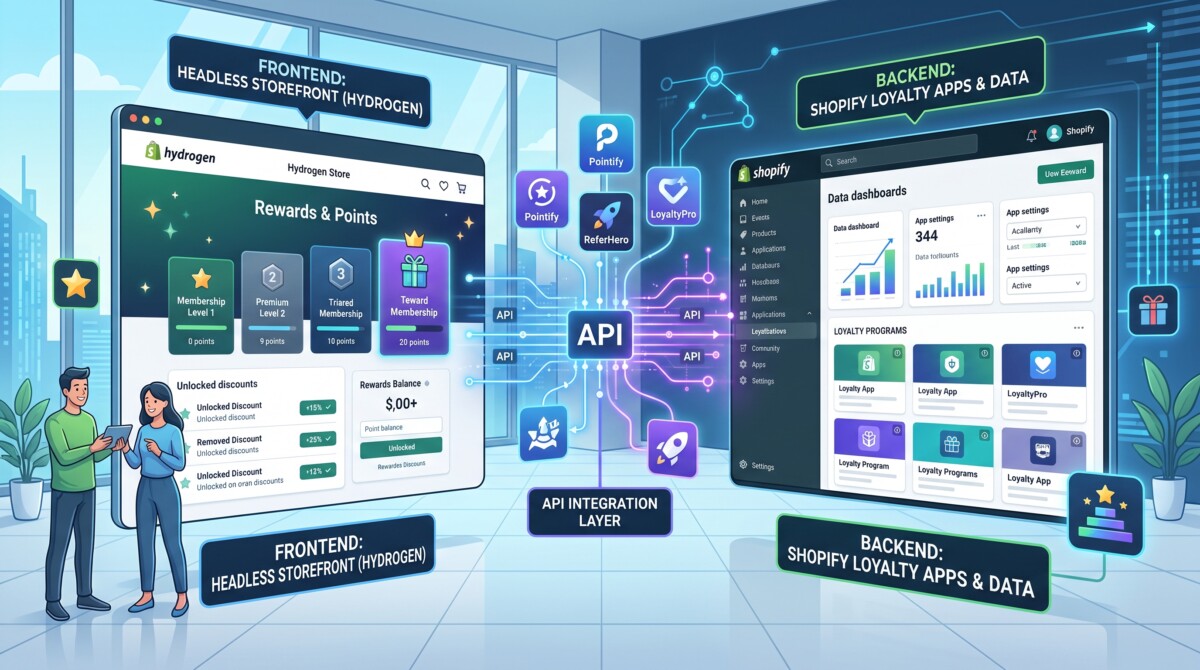
Most Shopify loyalty apps break on headless storefronts because their widget depends on the Online Store channel. Only a handful expose loyalty data through an API or SDK that Hydrogen and Next.js can read, and among those the capability is usually gated behind a higher pricing tier.
The loyalty app is almost never the thing that fails during a headless migration. The widget is. And the widget is the only part your customers ever see.
A brand doing roughly $6M went headless on Hydrogen last year and discovered on launch day that their loyalty widget had simply vanished. Not broken, not degraded. Absent. Eleven thousand members with point balances they could no longer see, a referral flow that no longer rendered, and a support inbox that filled up inside forty-eight hours. The app was still installed. The points were still accruing in the backend. There was just no way for a customer to look at them.
This is the most common self-inflicted wound in headless commerce, and it is almost never in the migration plan. Teams audit their theme, their checkout, their analytics and their reviews. Loyalty gets treated as a backend system because the points live in a database somewhere. But loyalty is a frontend product. The ledger is worth nothing if the member cannot see their balance, and every loyalty app that renders through Shopify’s Online Store channel loses its rendering surface the moment that channel stops serving your storefront.
The five platforms below all offer some route to running loyalty on a headless Shopify build. They are listed alphabetically rather than ranked, because the right choice depends almost entirely on how much frontend engineering time you have and how much you are already paying. Pricing in this category is tied to monthly order volume and changes regularly, so verify current plans before budgeting.
Every platform here was assessed against four criteria applied uniformly. One, is there a documented route for a custom frontend to read loyalty data, meaning an API, an SDK or an equivalent. Two, is that route documented publicly rather than available on request. Three, is Hydrogen specifically supported or referenced, rather than headless being claimed generically. Four, is the pricing tier that unlocks the capability identifiable before you contact sales.
The research base is the published documentation and pricing pages of each platform as checked in August 2026, plus the Shopify App Store listings, plus merchant conversations on the eCommerce Fastlane podcast where a headless migration surfaced app compatibility problems after the fact. Rivo was considered and excluded: it is deliberately Shopify native and architected around checkout extensions and theme integration, which is a coherent strategy and the opposite of what this list is looking for. BON Loyalty was considered and excluded because its Hydrogen support is referenced in third party roundups rather than in its own published developer documentation, and this list requires the second. eCommerce Fastlane has a commercial relationship with one platform on this list; the criteria above were applied to it exactly as they were applied to the other four, and the honest limitations section for that platform is the longest on the page.
Anchor Loyalty and Rewards is a Shopify loyalty app with points, VIP tiers and two sided referrals, built so the same widget renders on both native themes and headless storefronts.
Anchor covers the standard loyalty mechanics: merchants set point earning rates, build VIP tier ladders with milestone rewards, and run referrals that reward both the inviter and the friend. What separates it in this category is the delivery model for headless. Rather than exposing an API and leaving the interface to your team, Anchor’s Headless SDK serves the same prebuilt widget used on Liquid themes into any JavaScript frontend, including Hydrogen, Next.js, Gatsby and Vue. The SDK loads the widget, fetches customer points and tier data, and handles redemption, returning a discount code. Redemption can be authenticated with a signed customer token. The widget ships with automatic browser language detection across 32 languages and lazy loads on interaction rather than on page load. The app is built by No7 Software Limited, a Shopify Plus and BigCommerce development studio registered in England and Wales, company number 15251801.
As of August 2026, Anchor offers a free plan covering 200 orders per month with three active rewards, a Growth tier at $14.99 per month or $143.90 annually covering up to 1,000 orders with 10 active rewards, 3 VIP tiers and the referral program, and a Pro tier at $39.99 per month or $383.90 annually. The Headless SDK sits on Pro, alongside unlimited orders, rewards and tiers, spending milestones, removal of the “Powered by” branding, priority support, and a Checkout UI Extension available to Shopify Plus stores only. Pro carries a 14 day free trial.
The standout strength is that the SDK returns a finished interface rather than a data feed. For a lean team, the difference between “here is your points balance as JSON” and “here is the widget your customers already recognise” is the difference between a sprint of frontend work and an afternoon. The second strength is that headless capability sits at $39.99 per month rather than behind an enterprise gate, which is genuinely unusual in this category and is the reason the platform belongs on this list at all.
Three honest limitations, and they matter. First, Anchor launched in 2026, so there is no long public track record, no large install base, and no years of migration case studies to reference; a merchant choosing it is choosing a young product on the strength of its architecture rather than its history. Second, the company itself has been open that it is entering a mature category against established incumbents and did not invent a new loyalty primitive; the mechanics here are the same points, tiers and referrals everyone offers, and the differentiation is delivery, not concept. Third, several capabilities on the roadmap at launch, including Shopify Flow triggers and deeper segmentation, were stated as forthcoming rather than shipped, so verify current status against your requirements rather than the roadmap.
Best fit for Shopify merchants between roughly $500K and $5M running or planning a Hydrogen or Next.js storefront, with limited frontend developer capacity and no appetite for building a loyalty interface from scratch.
Skip if your procurement process requires a multi year vendor track record, if you need loyalty data flowing into a complex enterprise CRM and BI stack, or if your program design depends on mechanics outside points, tiers and referrals.
Growave is an all in one Shopify marketing app bundling loyalty, reviews, wishlists and user generated content, with headless compatibility stated across the full feature set rather than loyalty alone.
Growave’s proposition is consolidation. Instead of running four vendors for loyalty, reviews, wishlist and UGC, a lean team runs one app with one bill and one login. For headless builds, Growave states that all features are compatible with custom storefronts including Hydrogen, and provides events that let developers build their own widgets alongside customisable prebuilt ones. That middle position, somewhere between a raw API and a finished drop in widget, means your developer does real work but not all of it. Growave also publishes onboarding support for headless integration, which is worth using rather than treating the docs as sufficient.
As of August 2026, published Growave pricing starts at an Entry tier in the $39 to $49 per month range covering roughly 500 monthly orders, with a Growth tier around $159 per month at 1,500 orders and a Plus tier around $399 per month at 3,000 orders. Figures vary between sources, and Growave prices on order volume, so confirm against the live pricing page before budgeting.
The standout strength is bundle economics. For a brand under $2M running four separate tools, consolidating to one vendor frequently cuts the combined monthly spend and removes three integration surfaces from the headless build at the same time. The second strength is that headless support is not gated behind the top tier, which puts it in the minority here.
Two limitations. The trade off in any bundle is depth, and Growave’s loyalty module is good rather than best in category; a brand whose entire retention strategy runs through loyalty mechanics will hit its ceiling sooner than they would with a specialist. Second, the free plan is a trial rather than a permanent tier, which changes the evaluation path if you were planning to prove the concept before paying.
Best fit for headless Shopify brands under roughly $2M with a small team, where consolidating loyalty, reviews and wishlist into one integration is worth more than depth in any one of them.
Skip if loyalty is your primary retention channel rather than one of four, or if you already run best in class tools for reviews and UGC that you have no intention of replacing.
LoyaltyLion offers a purpose built Headless Loyalty API that exposes program configuration, customer balances, activity history and redemption flows to any custom frontend.
LoyaltyLion is the most complete headless implementation in this list, and it is built the way an engineering team would want. Program rules, rewards and tiers are still configured in the LoyaltyLion dashboard, so merchandisers keep a UI. The Headless API then exposes that configuration so developers can build fully custom loyalty experiences across web, native apps and POS from a single source of truth. Authentication runs through API keys or OAuth, with legacy token and secret authentication no longer supported. The API is framework agnostic, works with React, Vue and Next.js, and LoyaltyLion publishes a Shopify Hydrogen reference guide plus a documented client library to shorten the build. The platform reports use by over 12,000 brands.
As of August 2026, LoyaltyLion does not publish a public rate card; pricing is quoted per engagement and the platform is generally positioned for Shopify Plus and mid market brands. Independent category comparisons place it as the standard pick above roughly $3M in annual GMV, which is a directional indicator rather than a quote.
The standout strength is architectural cleanliness. Treating loyalty as a headless service with the dashboard as its control plane is the correct design for a brand running a storefront, an app and a physical POS from one program, and very few competitors do it this deliberately. The second strength is the reference implementation: shipping a documented Hydrogen guide rather than a generic API spec removes a genuine week of discovery from a build.
Two limitations. You are buying an API, which means you are also buying the frontend build; every screen a member sees is yours to design, build, test and maintain, and that cost keeps recurring every time the program changes. Second, the absence of published pricing means no self qualification, and for brands under $2M the practical outcome is usually a call that ends in a number above budget.
Best fit for Shopify Plus brands above $3M with in house frontend engineering, running loyalty across more than one customer touchpoint.
Skip if you have no dedicated frontend developer, if your only surface is a single Hydrogen storefront, or if your budget cannot absorb both a mid market platform fee and the build hours on top.
Smile.io is the largest installed loyalty platform in ecommerce, and it supports headless builds through API access that sits on its highest tier.
Smile.io covers points, referrals and VIP tiers with a dedicated loyalty page, product page embedding and a member hub, and holds both Built for Shopify and Shopify Technology Partner status. Its install base is the deepest in the category, with the platform reporting more than 70,000 Shopify stores having used it and over 4,000 Shopify App Store reviews at a 4.9 rating. For headless, the relevant fact is structural rather than technical: Smile.io does offer API access, and that access is gated at the top of the pricing ladder. Everything below that tier assumes the Online Store channel is rendering your storefront.
As of August 2026, published Smile.io pricing runs from a free plan capped at 200 monthly orders through mid tiers in the $39 to $199 per month range depending on order volume and whether VIP tiers are required, up to a Plus plan at $999 billed annually where API access unlocks, plus a custom enterprise tier. Published figures differ between sources and the plans key off monthly order volume, so verify against the live pricing page.
The standout strength is maturity. A decade of production use across tens of thousands of stores means the edge cases in points accrual, refunds, cancellations and fraud have been found by someone else already, and for a brand migrating an existing program with real balances that history has value. The second strength is the ecosystem: integrations with Klaviyo, Judge.me and the rest of the standard stack are established rather than promised.
Two limitations, both financial. API access at $999 billed annually means headless capability costs roughly twenty five times what the same capability costs on Anchor’s Pro tier, and unless you need the rest of the Plus feature set that is a very expensive way to buy a data connection. Second, the upgrade curve within Smile.io is steep in the middle: VIP tiers alone push most brands from the entry tier to a plan several times the price, which catches merchants off guard well before headless enters the conversation.
Best fit for established brands above $5M already running Smile.io with a mature program and real point balances, where migrating away costs more than the Plus plan does.
Skip if headless access is your only reason to consider the Plus plan, or if you are starting a new program from scratch on a headless build, in which case you are paying enterprise pricing for a capability available far cheaper elsewhere.
Yotpo Loyalty provides APIs and React components for headless storefronts with official Hydrogen documentation, delivered as part of a broader retention suite rather than a standalone loyalty app.
Yotpo’s loyalty product sits alongside reviews, SMS and subscriptions, and the commercial logic assumes you want more than one of them. For headless builds, Yotpo publishes APIs and React components specifically for custom storefronts with Hydrogen documentation available, which puts it among the better documented options here. The cross product value is real: loyalty tier data feeding SMS segmentation and review request timing is a genuine advantage over stitching three vendors together, and it is the main reason brands choose the suite. Yotpo is also one of the vendors most frequently named as headless compatible in independent Shopify app compatibility guidance.
As of August 2026, Yotpo does not publish standalone loyalty pricing; engagements are quoted and typically structured across the suite. Independent category comparisons position it as a fit for brands already invested in other Yotpo products rather than as a standalone loyalty purchase.
The standout strength is the suite effect. If you are already running Yotpo reviews or SMS, adding loyalty means one vendor, one data model and one integration to maintain in your Hydrogen build instead of three. The second strength is that React components rather than raw endpoints reduce the frontend build meaningfully compared with an API only approach.
Two limitations. Widget weight has been a persistent criticism of Yotpo across the category, and on a headless build where performance is frequently the entire reason for going headless, that matters; Anchor’s published comparison puts the Yotpo widget bundle at roughly 650 KB against its own 14 KB, which is a competitor’s figure and should be measured yourself rather than taken on trust. Second, buying loyalty alone from Yotpo rarely makes commercial sense, so the real decision is about the suite, not the loyalty module.
Best fit for Shopify Plus brands above $3M already running at least one other Yotpo product, moving to a headless storefront and wanting to keep their retention data in one system.
Skip if loyalty is the only Yotpo product you want, or if page weight budgets on your Hydrogen build are tight enough that a heavy third party bundle would undo the performance gains you migrated for.
The deciding variable is not features, it is how many frontend developer hours you can spend on loyalty and keep spending every time the program changes.
If you are between $500K and $2M on Hydrogen with no dedicated frontend developer, buy the finished widget. Anchor’s SDK at $39.99 per month or Growave’s prebuilt components on the entry tier both give you something rendering this week. The alternative, building a member interface against an API, sounds like a two week job and reliably becomes a two month one, because the balance display is the easy part and the redemption flow, error states, tier progression and referral sharing are not. This is the premature complexity pattern I see repeatedly in the $500K to $2M band: teams take on a custom build to preserve flexibility they never end up using.
If you are between $2M and $10M with at least one frontend developer and a program design that is genuinely specific to your brand, LoyaltyLion’s Headless API is the better architecture. You are trading build hours for control, and above $2M that trade usually pays, particularly if loyalty needs to appear in a native app or at POS as well as on the storefront. Budget the ongoing maintenance honestly rather than just the initial build.
If you are already running a mature program on Smile.io or Yotpo with tens of thousands of members and real balances, the honest answer is usually to stay and pay. Migration risk on a live points ledger is the most underrated cost in this whole category, and a botched migration that zeroes member balances does more brand damage than an extra several hundred dollars a month ever will. Price the migration properly before you treat a cheaper monthly fee as a saving.
One trade off worth naming. A prebuilt widget is fast to ship and constrains how loyalty looks and behaves on your site. An API gives you complete control and hands you a permanent maintenance obligation. Neither is the right answer in general, and any vendor telling you otherwise is describing their own architecture rather than your situation.
There is no single best loyalty app for headless Shopify stores, which is why this list is unranked and alphabetical. What the category actually shows in 2026 is a split between platforms that hand you data and platforms that hand you an interface, with pricing that correlates poorly with which you get.
The practical lesson from the brand that lost eleven thousand visible point balances on launch day is simpler than any comparison table. Audit every customer facing app against your headless plan before the migration, not after. Loyalty, reviews, wishlists and upsell widgets all render through the Online Store channel by default, and every one of them needs an explicit answer to the question of what renders it once that channel is gone.
If you are early in a headless migration, list every app your customers can see, then ask each vendor two questions in writing: does a documented headless route exist, and which plan is it on. The answers will reshape your app stack more than any feature comparison will.
Most Shopify loyalty apps do not work on headless Hydrogen stores without additional work, because their widgets render through the Online Store channel that a headless build replaces. The app keeps running in the backend and points keep accruing, but customers lose the interface entirely. Only platforms that publish an API or SDK, including Anchor Loyalty, Growave, LoyaltyLion, Smile.io on its top tier, and Yotpo Loyalty, offer a documented route to a custom frontend. Before any headless migration, audit every customer facing app and confirm in writing whether a headless route exists and which pricing plan it sits on.
Anchor Loyalty is the cheapest documented headless option in 2026, with its Headless SDK included on the $39.99 per month Pro plan as of August 2026. Growave’s headless support sits on its entry tier from around $39 per month, which is comparable, though Growave bundles loyalty with reviews and wishlists rather than specialising. At the other end, Smile.io gates API access behind its $999 annually billed Plus plan, and both LoyaltyLion and Yotpo price by quote. Cost should be weighed against build hours, since an API only option that saves monthly fees can cost far more in developer time.
An API returns loyalty data and leaves you to build every screen, while an SDK returns a working interface you drop into your frontend. LoyaltyLion’s Headless API exposes program configuration, customer balances, activity history and redemption endpoints, which your developer then renders however you choose. Anchor’s Headless SDK loads the same prebuilt widget used on Liquid themes into a Hydrogen or Next.js storefront with the API key handling the rest. The API route buys control and costs build and maintenance hours; the SDK route buys speed and constrains how loyalty looks on your site.
You will not lose customer points if the migration is planned properly, but this is the highest risk task in the category and it is routinely underestimated. A clean migration means exporting current point balances, mapping VIP tier membership across differing tier logic, reconciling pending and expiring points, and sequencing the cutover so members never see a zero balance. Most vendors publish migration guides and several will run the export with you. Budget for a parallel period where both systems hold the data, and communicate the change to members before it happens rather than after.
Loyalty alone is rarely a strong enough reason to abandon a headless migration, but it is a legitimate reason to delay one. If your loyalty program is a primary retention driver, your current platform has no documented headless route, and you have no frontend developer capacity, the sequence should be to solve loyalty first and migrate second. Going headless mainly buys frontend performance and design control, and those gains are undermined if a heavy third party widget or a half built member interface goes back on top. Audit the app stack before committing to the migration date.





