

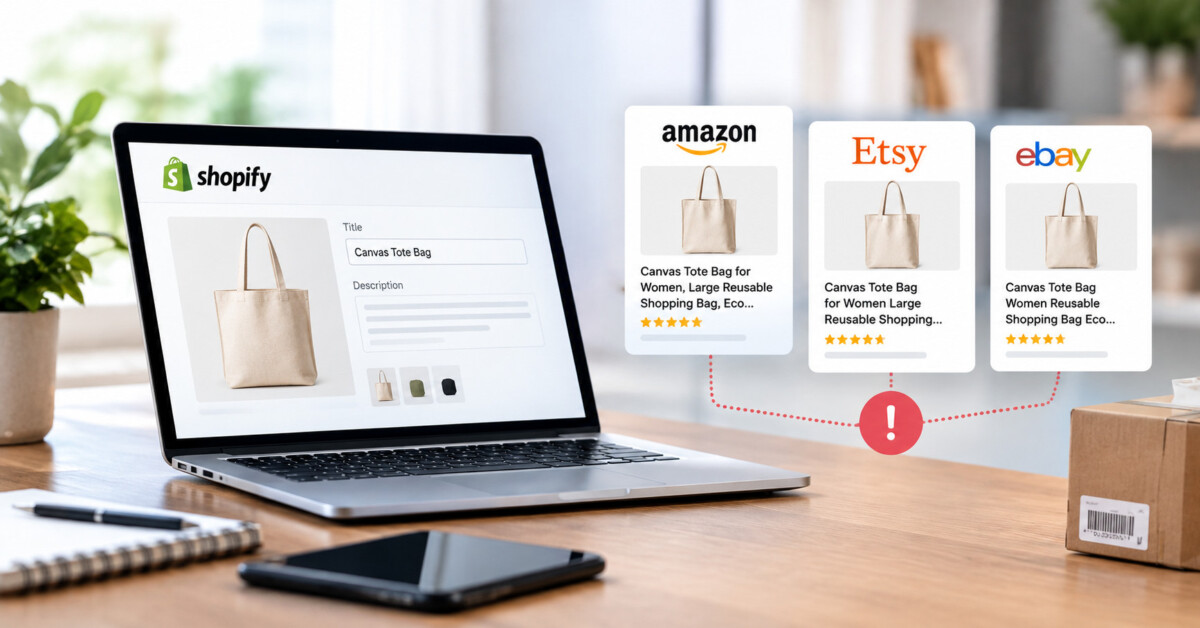
Do not copy a Shopify product title into a marketplace unchanged. Build a channel-specific listing from the same product facts: lead with the object buyers search for, fit the platform’s current title rules, and fill every structured discovery field the marketplace provides.
A product title is not portable copy. It is a small piece of channel-specific merchandising infrastructure, and the channel decides what that infrastructure needs to do.
If you run a Shopify store and you are opening a second sales channel, the product title is the first thing you will be tempted to copy. You already wrote it. It already converts. The import tool will accept it without complaint. Paste, publish, move on.
That is usually the moment the listing quietly stops working. Not because the title is bad, but because it was written for a surface that behaves nothing like the one it just landed on. Nothing errors. Nothing gets rejected. The listing goes live, sits there, and six weeks later the channel gets written off as a dud.
Here is what actually changes when a title crosses from your own store into a marketplace, and what to do instead of pasting.
Start with the least interesting difference, because it is the one that bites first and the one almost nobody re-checks.
Amazon cut its product title limit to 75 characters on 27 July 2026, down from the 200 that most categories allowed before, and introduced a separate Item Highlights field at the same time. A title written to fill 200 characters does not get flagged when you import it. It gets truncated, and the words you believed were doing the ranking are simply not there any more.
Etsy, at the time of writing, allows 140 characters. eBay allows 80. Depop does not publish a title length at all, which is a different and more irritating problem: you are budgeting blind, and every number you have read in a “2026 marketplace limits” roundup is somebody’s internal guess being handed to you as a platform rule.
Meanwhile, on your own Shopify store, the number that matters is not a platform cap at all. It is Google, which shows roughly the first 60 characters of your SEO title before it cuts the rest.
That is five surfaces, five different amounts of room, and not one of them is the surface your title was written for. Before pasting anything it is worth checking the current caps and — more importantly — which field on each marketplace actually carries your keywords, because that is where most of the damage happens. This breakdown of cross-listing SEO covers both.
On your own site, a product page competes on the open web. Google has your entire domain to judge it by: your other pages, your links, your reviews, your structured data, how long the domain has existed. The title is one signal among many.
Inside a marketplace, none of that exists. Your listing competes in a closed catalogue, frequently against listings that are near-identical in every respect that matters, and the engine ranking them has far less to go on. Title text therefore carries a much larger share of the decision than it does on Google.
The vocabulary is different too. Someone who opens Google is often part-way through a research process — comparing, checking a brand, reading a review. Someone who types into a marketplace search box has already decided to buy something and is describing the thing itself: the object, who it is for, the occasion, the material, the personalisation. A title that opens with your brand name is spending its most valuable characters on a word that buyer did not type.
This is the part that catches experienced merchants, because it is invisible until you go looking.
Etsy gives you thirteen tags of up to twenty characters each, sitting alongside the title and doing a large share of the matching work. eBay leans on structured item specifics — brand, size, colour, style — which are fields, not prose. Amazon has a backend search-terms field that buyers never see, measured in bytes rather than characters, plus the Item Highlights field it added in July 2026.
Shopify has none of these. You have collections, metafields, body copy and your own internal search. The keyword work that a marketplace expects you to distribute across several purpose-built fields is work that, on your own store, you did entirely inside the title and the description.
So when you copy a Shopify title into a marketplace, you are not just copying a string that is the wrong length. You are copying a string that is trying to do a job the marketplace has already assigned to three other fields — while the fields built for that job sit empty.
The useful mental model is not “one title, published in several places”. It is one product, one set of facts, and a separate listing built for each surface out of those facts.
In practice that means four habits.
Write the object first. Whatever the buyer would actually call the thing — “ceramic mug”, “leather journal”, “linen apron” — belongs at the front, before the brand and before the adjectives. Truncation eats the end of a title, so the end is the worst place to keep anything load-bearing.
Budget to the surface, not to the most generous one. Writing a single title that fits your roomiest channel and letting the others cut it is the most common version of this mistake. Write short where it is short.
Fill the fields the marketplace built. If a channel gives you tags, item specifics or backend search terms, those are not optional metadata. They are where a meaningful part of your matching happens, and leaving them empty while stuffing the title is the opposite of what the platform is asking for.
Re-check the rules on a schedule. The Amazon change above is the clearest argument for this: a limit that had been stable for years moved by more than half, and a great many published guides still have not caught up. If your listings were written against a number from a blog post rather than from the platform’s own documentation, some of them are already wrong.
Doing this properly costs more than pasting. That is the real reason most stores do not do it, and it is worth saying out loud rather than pretending adaptation is free.
But the alternative is not “a slightly weaker listing”. It is a listing that is invisible for the queries you were targeting, on a channel you will then conclude does not work for your product — which is a far more expensive conclusion than the hour it takes to rewrite a title properly.
If you are about to open a marketplace channel, the cheapest thing you can do this week is take your ten best-selling products, look up what each target marketplace actually permits today, and write ten titles for that marketplace rather than exporting the ones you already have.
You should not use the same product title on Shopify and Amazon unchanged because Shopify and Amazon give the title different jobs and different space. Amazon now limits most non-media product titles to 75 characters and provides a separate searchable Item Highlights field for material, use-case, and comparison information. Keep the factual product record consistent across both channels, but write Amazon’s title around the object and primary differentiator, then place supporting facts in Item Highlights and category attributes.
The product object should go first in a marketplace title, followed by the attribute most likely to determine buyer fit. Start with the words a shopper would type when they do not know your brand, such as “ceramic coffee mug,” “leather journal,” or “linen apron.” Add one defining feature, such as capacity, material, compatibility, or intended use, before brand language or promotional adjectives. This protects your essential terms when the title is truncated or displayed on a narrow mobile result.
Etsy tags still matter even when your title contains strong keywords because Etsy search evaluates listings using multiple signals, including titles, tags, attributes, categories, descriptions, photos, and reviews. Etsy gives sellers 13 tag slots and advises using all of them with varied, natural multi-word buyer phrases. Use the title to make the item immediately clear, then use tags to cover alternate ways shoppers describe the product, occasions, recipients, and relevant long-tail phrases without making the title unreadable.
eBay item specifics affect product discovery because they provide structured facts that buyers frequently use to search and filter listings. Complete brand, size, colour, style, model, type, condition, and category-relevant attributes instead of assuming your 80-character title can do that work alone. Accurate item specifics also reduce ambiguity for buyers and make it easier for eBay to place the listing in relevant filters. A complete title plus complete specifics is stronger than a keyword-packed title with missing structured fields.
You should audit marketplace titles and product fields before a channel launch, before a bulk import, after major marketplace policy changes, and at least quarterly for your best-selling listings. Start with the products that produce most of your marketplace revenue, then review title length, front-loaded product terms, attributes, tags or search fields, images, and any new platform fields. A recurring audit is more valuable than a one-time rewrite because marketplace rules, category requirements, buyer language, and your own assortment all change over time.




