A mattress is sold once a decade on how it feels in a showroom. A temperature system is sold on a result the buyer notices on night one, and that one difference rewrites the price ceiling, the offer, and the retention model.
Two sleep brands now ask buyers to spend close to $3,000 on a cover that sits on top of a mattress they already own, and neither one sells it as bedding. Active systems that heat and cool the bed itself have turned sleep temperature from a fabric feature into a category with its own pricing, software, and offer design.
That shift matters well beyond sleep. Any brand trying to sell a new kind of product at a premium price runs into the same three questions these companies had to answer: should the core experience sit behind a subscription, how long should a buyer get to decide, and how do you make a large number feel manageable? The way each sleep brand answered them is a usable case study, because the answers are public, priced, and different from each other.
If you are under $500K, read this for the offer design and skip the subscription debate until your product has proven it delivers value every month. If you are scaling past $2M, the five year cost math and the return exposure section are where the decisions get expensive.
Sleep temperature became a category when brands stopped selling bedding that feels cool and started selling systems that change the temperature of the bed. That shift sounds small. Commercially, it changes the price ceiling, the offer, and the retention model.
For decades, “cooling” meant materials: percale sheets, gel foam, phase change fabrics. Those products are passive. They move heat a little better, but the room, the humidity, and the sleeper still decide how the night goes.
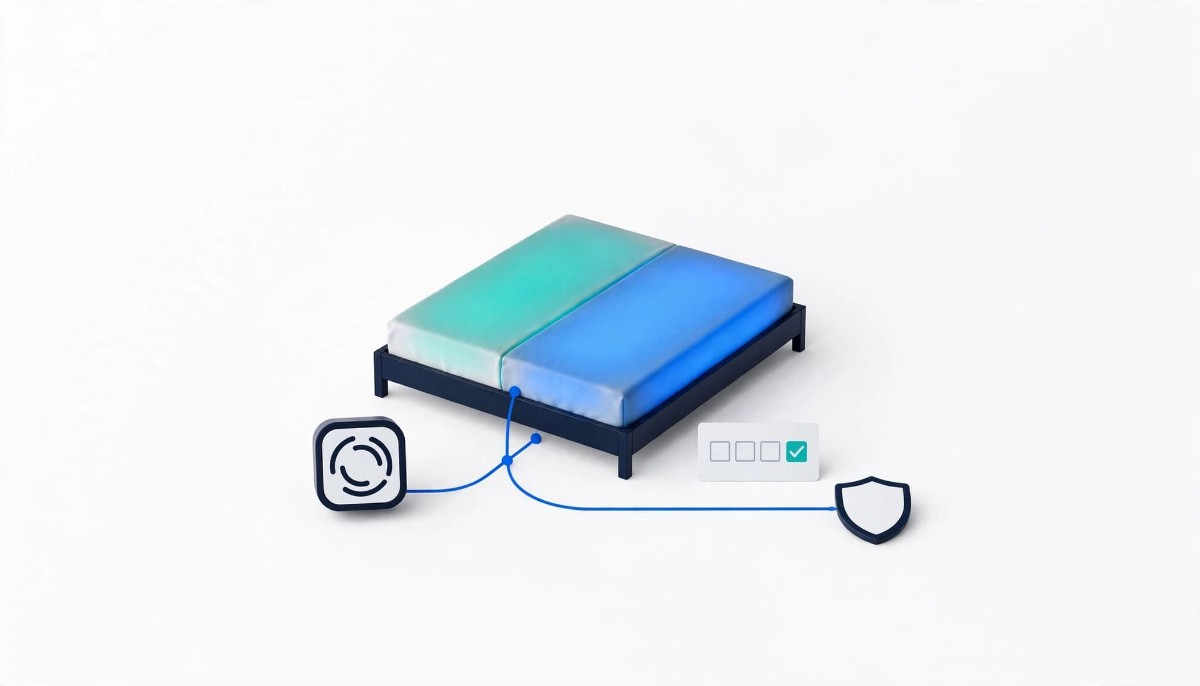
Active systems work differently. A bedside hub heats or cools water and circulates it through a thin layer on top of the mattress, and an app or an algorithm sets the target temperature. Both of the brands discussed below sell that layer as a cover for the mattress the buyer already owns, which removes the biggest barrier in mattress retail: asking someone to throw out a bed they paid for.
The demand side is real. McKinsey’s Future of Wellness research on the $1.8 trillion wellness market, based on a survey of more than 5,000 consumers in China, the UK and the US, ranks sleep as consumers’ second highest wellness priority and the area where they report the most unmet needs. Fastlane’s look at how better sleep products are shaping the wellness market covers the wider spread of products chasing that demand, from supplements to smart mattresses.
The science gives brands a physical problem to point at. A 2012 review of thermal environment and sleep in the Journal of Physiological Anthropology found that in real life conditions, where people sleep with bedding and clothing, heat exposure increases wakefulness and reduces slow wave and REM sleep.
Here’s why that matters for operators. A mattress is a once a decade purchase sold on feel. A temperature system is sold on a result the buyer notices on night one, and it carries software, data, and an upgrade path. The reframing only holds if the product performs, though. Passive products marketed with the same “cooling” language blur the category and teach buyers to distrust the word, which is a risk every brand in an emerging category shares with its weakest competitor.
The category’s biggest strategic split isn’t hardware; it’s whether the core experience sits behind a subscription.
Eight Sleep built the category’s best known brand on hardware plus software. Its Pod product page lists the Pod at $2,899 and shows a $3,198 checkout total that includes an Autopilot plan. Independent reviews, including Sleep Junkie’s Pod 5 review, report that Autopilot is required for the first 12 months and unlocks automatic adjustment and full tracking. That model funds ongoing software development and raises lifetime value per customer. The cost is a recurring fee that buyers weigh on top of an already high sticker price, and reviewers regularly call it out.
OVAL Adapt takes the opposite position. According to OVAL’s membership terms, the free Core tier includes app and manual controls, adaptive temperature control during sleep, basic sleep insights, and software and firmware updates. A paid Plus tier at $199 a year adds proactive pre-sleep temperature adjustment, HRV, sleep stages, and daytime recovery insights.
Source: brand product and policy pages, as of November 2026. All figures are vendor listed and unverified by independent testing.
Neither model is universally right. A subscription works when the software delivers value the customer sees every month, such as new features, coaching, or measurable insights. A free core works when purchase friction is the bottleneck, which is usually the case for a challenger brand asking strangers for a premium purchase. If you’re considering a subscription for your own product, start with Fastlane’s guide to subscription ecommerce growth, which includes a readiness checklist for product fit and margins.
Over five years, the subscription decision moves the buyer’s real cost by several hundred dollars, which is why it shapes the purchase more than any hardware spec.
Illustrative example, assuming a buyer keeps a $199 a year software plan for all five years and pays no other fees. On a $2,899 system, that adds $995, taking the five year total to about $3,894. A buyer who stays on a free core tier pays only the hardware price, while one who upgrades to a $199 paid tier gets to the same added $995 by choice rather than by requirement. On paper the totals can end up close. In the buyer’s head they are not, because one fee is a condition of getting the product to work as sold and the other is an upgrade they opted into.
That psychological difference is the real lesson. A required fee is counted at checkout, before the buyer has felt any benefit, so it lands on top of sticker shock. An optional fee is counted later, after the product has earned some trust. Brands with strong word of mouth and a loyal base can carry the first structure. Challengers usually cannot.
The flip side is that recurring software revenue pays for the features that keep a hardware product from feeling dated. A brand that gives away its core experience needs a different way to fund ongoing development, whether that is a higher hardware margin, a paid tier enough customers actually want, or accessories. Fastlane’s breakdown of how subscription brands build predictable profit walks through the curation, replenishment, and access models, using Birchbox and HelloFresh as examples, and is a useful check on which one your product could support.
If you are earlier stage, the practical rule is simple: decide what the free experience includes before launch, and make it good enough that a buyer who never upgrades still tells a friend. If you are scaling, model the five year cost from the buyer’s side, not just your LTV, and put that number in your own comparison content before a reviewer does it for you.
They take the financial risk out of the first night, because few buyers commit to a premium price for a feeling they haven’t felt yet.
Trial length is the first lever. Mattress brands normalized the 100 night trial years ago, and temperature systems inherit that expectation. A thermal product also needs time to prove itself: a buyer who orders in October hasn’t tested it in July, and couples need a few weeks to settle on settings. OVAL offers 100 nights with a refund of installments paid within 100 days, while Eight Sleep offers 30.
The tradeoff is return exposure, so budget for refurbishment and reverse logistics before you extend a trial. Illustrative example, assuming 1,000 units sold, a 10% return rate, and $300 per return for freight, inspection, and refurbishment: that is $30,000 a year in return cost, before any loss on units that cannot be resold as new. A longer trial can raise that rate, so test the change on a slice of traffic first and watch whether conversion lifts more than returns do.
Financing is the second lever. OVAL’s product page frames Adapt as “from $153/month” through three installment partners, and Eight Sleep lists financing as a payment option at checkout. Either way, a sticker shock number becomes a monthly line item. Fastlane’s breakdown of adding buy now, pay later to your store covers how splitting a total into payments makes a larger purchase feel manageable.
Price protection is the third, and it’s underused. OVAL offers one year of price protection, which neutralizes the “I’ll wait for Black Friday” objection in a category where hardware prices tend to fall as products mature.
Finally, OVAL is running a time limited founding member offer that, according to its product page, bundles extended warranty coverage and a wearable health tracker. Early offers like this seed reviews and reward early adopters. A firm end date is what makes it work: it gives buyers a concrete reason to act now instead of waiting for reviews to pile up, as long as the deadline is real.
Once two brands can both cool a bed, the competition moves to how precisely each one fits the person lying in it.
The first layer is the couple. Dual zone control, where each side of the bed runs its own temperature, solves the most common bedroom argument and gives buyers an easy story to tell. OVAL goes a step further by splitting each side into upper body and lower body zones, based on the idea that a cooler core and warmer feet help people fall asleep. That’s OVAL’s framing, and it shows how brands turn a sleep physiology concept into a product feature. The same Journal of Physiological Anthropology review notes that warming the feet has been shown to shorten the time it takes to fall asleep, which is the kind of published finding a brand can point to without overclaiming.
The second layer is automation. OVAL pairs built in sensors with an adaptive mode that adjusts temperature as the sleeper moves through the night. Eight Sleep’s Autopilot plays the same role on its side of the market.
The lesson for operators: personalization only counts if the customer feels it without effort. If a buyer has to tune a schedule every night, the feature is a cost, not a benefit. Sell the outcome (“your side stays cool, your partner’s stays warm”) rather than the sensor count, and be explicit about what data you collect and why. Premium brands hold their price through exactly this kind of category education, a point Fastlane makes in how premium DTC brands justify higher prices.
Cost per use math helps too. Illustrative example: a $3,000 system used nightly for five years works out to about $1.64 a night. That number does more selling than a spec sheet, because it compares the purchase to something the buyer already spends money on every day.
The playbook transfers to any brand selling a new kind of product at a premium price.
First, sell the controllable outcome, not the material. Buyers pay more for “you decide the temperature” than for “breathable fabric.” Second, decide the subscription question before launch, and whichever way you go, make the free experience genuinely useful on its own.
Third, match risk reversal to time to value. If your product’s benefit takes weeks to show up, a 14 day return window works against you. Fourth, write claims you can prove today and let reviews carry the rest. The comparison table above is labelled vendor listed for a reason: every figure a brand publishes becomes something a reviewer will test.
Stage matters here. If you are under $500K, the cheapest lever is usually the claim and the trial message on your product page, not a new financing app or a software tier. Between $500K and $2M, resist adding every lever at once; one change you can measure beats four you cannot untangle. Past $2M, the subscription and trial decisions start to show up in your cash flow and your return line, so model them before you announce them.
Here’s where it stops working: low ticket, low involvement products. A 100 day trial and installment financing on a $40 item add operating cost without moving conversion, because the buyer’s risk was never the barrier.
Pull your top 20 pre purchase objections from support tickets, chat logs, and post purchase surveys this week. Tag each one as price, risk, or proof, then fix the largest bucket first with a single offer change: a longer trial, a financing message on the product page, or a claim you can back with data.
Price objections point to financing or cost per use framing. Risk objections point to trial length, returns, or price protection. Proof objections point to reviews, published data, and claims you can show rather than state. Run one change for a few weeks, compare conversion and returns against the period before, and only then move to the next bucket.
Smart mattress covers have become a real category, though they started with early adopters. Multiple brands now sell temperature controlled covers at roughly $2,900 to $3,200, with financing and long trials aimed at mainstream buyers rather than enthusiasts. Demand supports the move: McKinsey’s Future of Wellness research ranks sleep as consumers’ second highest wellness priority and the area with the most unmet needs. The category’s growth still depends on products delivering a result buyers can feel, because passive cooling products using the same language make buyers skeptical.
A hardware DTC brand should charge a subscription only when its software delivers new value every month that customers can see, such as new features, coaching, or insights. If the core value is delivered by the hardware itself, a free core tier with optional paid upgrades lowers purchase friction, which matters most for challenger brands asking strangers for a premium purchase. A required fee is counted at checkout before the buyer has felt any benefit, while an optional fee is weighed after the product has earned trust.
A trial for a high ticket product should be long enough for the benefit to show up. Sleep products typically run 30 to 100 nights because buyers adjust over weeks and seasons, and couples need time to agree on settings. A longer trial lowers the risk of buying but raises return exposure, so budget for freight, inspection, and refurbishment on returned units before extending it. Test a longer trial on part of your traffic and confirm that conversion rises faster than returns.
A temperature controlled cover actively heats or cools the bed, while a cooling mattress protector only helps heat move away a little faster. The protector relies on fabric, so the room still decides how warm the bed gets. The controlled cover uses a powered hub to heat or cool the sleep surface to a set temperature and adjusts it through the night. That difference is why active systems can charge thousands of dollars while protectors compete on price.
Temperature controlled mattress covers work by circulating heated or cooled water through a thin layer that sits on top of an existing mattress. A bedside hub sets the water temperature, and sensors and an app control the target for each side of the bed. Some systems adjust automatically through the night based on sleep data, and some split each side into separate zones for the upper and lower body. Buyers keep their current mattress, which lowers the cost and effort of switching.