

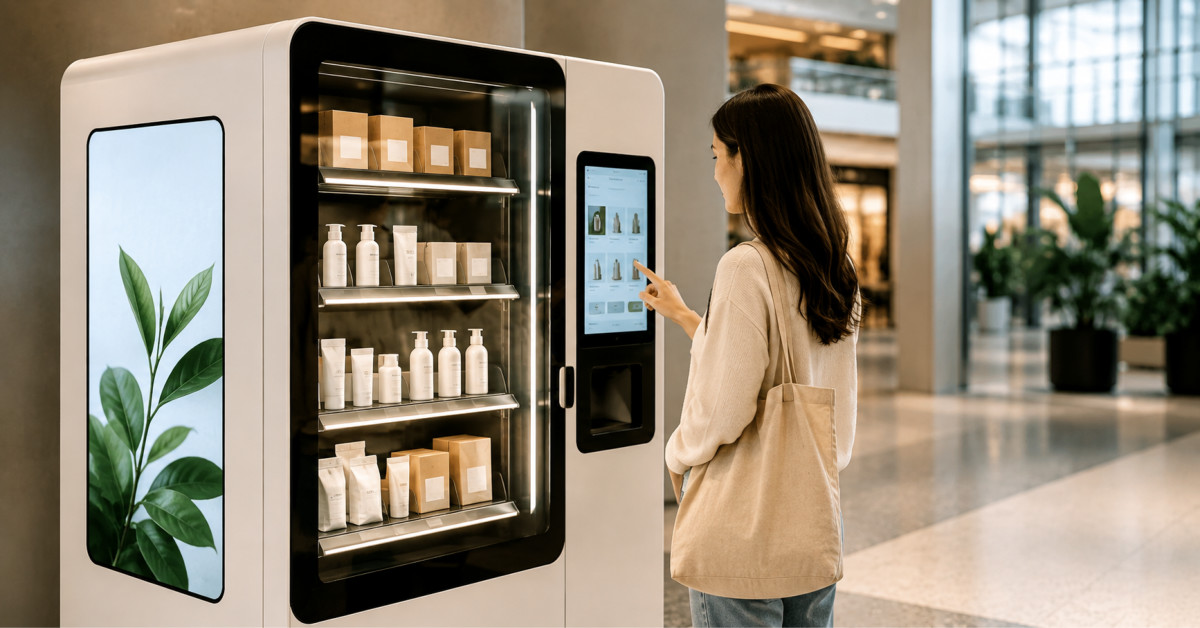
Smart vending machines give DTC brands a physical retail channel for $2,500 to $7,200 per unit instead of a six figure store buildout. They work best as placement tests in high traffic venues, with experiential machines doubling as brand activations that capture emails and social content.
Allbirds spent $166.7 million on SG&A in 2022, largely driven by a store expansion it later reversed. The offline channel most brands actually need might weigh 300 pounds and fit in a mall corridor.
Eighty five percent of US retail sales still happen in physical spaces. Every DTC founder knows this number, and most have quietly priced out what it would cost to participate: the lease, the buildout, the staffing, the twelve month commitment on a channel they have never tested. So they stay online, watch acquisition costs climb, and file “retail” under someday.
There is a middle path that most Shopify operators have never seriously evaluated. Smart vending machines have quietly become legitimate retail infrastructure: cashless payments, remote inventory telemetry, and per unit costs that run 5 to 10% of a store buildout. The category has moved far beyond snacks. Brands now vend skincare, collectibles, electronics, and fresh made products from machines placed in malls, airports, gyms, and event venues.
This piece looks at unattended retail the way an operator should: as a channel test with specific economics, not a novelty. Whether you are doing $10K months or $1M months, the question is the same one you would ask of any channel. What does it cost, what does it teach you, and when does it earn a place in the stack?
Traditional retail is out of reach for most DTC brands because store economics demand six figure commitments before a single insight about offline demand comes back. The cautionary tales are recent and well documented. Allbirds grew from 22 stores in 2020 to 58 by the end of 2022, and its SG&A expenses climbed to $166.7 million, or 56% of net revenue, up from 44% the year before. The company then closed stores to free up cash. Purple’s CEO called stores the toughest part of the brand model and paused expansion at 60 locations. Modern Retail’s reporting on how DTC brands recalibrated their physical store strategies captures the pattern: overexpansion first, painful retreat second.
Here is the thing though: the retreat from stores is not a retreat from offline. The demand signal is unchanged. Customers still discover, touch, and buy in physical spaces, and rising digital acquisition costs make offline discovery more valuable every year, not less. I have covered how Shopify brands are cutting customer acquisition costs without increasing ad spend, and the through line is always the same: the brands that win are the ones that add owned and lower cost channels around their paid engine.
The mistake is treating “offline” as a binary between no presence and a full store. Between those poles sit pop-ups, wholesale, retail partnerships, and the least examined option of all: an unattended machine that sells for you 24 hours a day in someone else’s high traffic space, for less than most brands spend on a single month of Meta ads.
Modern AI-powered vending machines differ from legacy vending in three ways that matter to an ecommerce operator: real time inventory telemetry, full cashless payment stacks, and transaction level sales data comparable to what you get from your online store. The machine stops being a metal box you visit on a schedule and becomes a remote sales node you manage from a dashboard.
Walk through what that means operationally. Inventory is monitored remotely with automatic restock alerts, so you service the machine when it needs product, not on a guessed cadence. Payments run through contactless cards, mobile wallets, and QR codes, which matches how your online customers already pay. Every transaction is logged with a timestamp and SKU, which means you can answer real merchandising questions: what sells at an airport versus a gym, what moves at 7am versus 10pm, which two SKUs to stock when the machine only holds eight.
For a Shopify brand, the data posture is the point. Your online store taught you to make decisions from dashboards, cohorts, and conversion rates. Legacy retail never offered that; you got a monthly wholesale report if you were lucky. A connected machine gives you store level granularity on a channel you can actually afford to test. Industry projections put the smart vending market past $21 billion by 2029, and the growth is coming precisely from operators who treat machines as data producing retail infrastructure rather than passive dispensers. That reframe, from box to node, is what makes the rest of this article’s economics work.
A vending machine placement costs $2,500 to $7,200 in hardware plus a venue revenue share, which makes it the cheapest durable offline test available to a DTC brand. A pop-up costs more per week but tests brand experience. A store tests everything and costs the most by an order of magnitude. The three are different instruments, not competing versions of the same idea.
Cost figures above are illustrative ranges drawn from current machine pricing and typical short term retail rates; your venue and city will move them. The strategic read is what matters. A machine runs continuously for months on one hardware spend, so it excels at the slow, boring questions: does this location produce sales, which products move, what price clears. A pop-up burns hotter and shorter, so it excels at the loud questions. I keep a running list of pop-up shop ideas and examples for brands testing that lane, and the honest guidance is that the two formats stack well: machines for persistent presence, pop-ups for moments.
The venue side works like marketplace economics. Malls, airports, hotels, and entertainment centers want machines because they monetize dead corridor space, which means placement negotiations are typically revenue share rather than fixed rent. Your downside on a failed placement is relocation, not a lease you are stuck holding.
Experiential vending machines work as brand activations because the machine itself draws the crowd, produces the social content, and captures the customer data, all without staff. This is the lane where the format stops competing with stores and starts competing with your event marketing budget. Snapchat launched Spectacles through bright yellow Snapbot machines dropped in surprise locations with 24 hours notice, turning a hardware release into a national scavenger hunt. Moet placed champagne vending machines in high traffic luxury venues and let Instagram do the amplification. Beauty brands run sampling machines in premium malls that trade a perfume or skincare sample for an email signup, converting foot traffic directly into a retargetable list.
The current generation of robotic machines pushes this further because the production process is the show. A machine that spins cotton candy into a hundred shapes in 90 seconds, prints custom chocolate designs, or generates AI photo portraits stops foot traffic in a way a shelf of product never will. Manufacturers like Futureino build AI-powered cotton candy vending machines that hold 250 servings and produce each one live in front of the customer, at hardware prices in the $5,500 to $6,000 range. For a brand activation, that unit cost is competitive with a single day of staffed event sampling, and the machine works every day after.
The playbook for a Shopify brand is straightforward. Wrap the machine in your brand, gate the dispense behind an email or SMS capture on the touchscreen, and place it where your customer already spends time. A candy or dessert brand vending fresh made product at a family entertainment center is direct revenue. An apparel brand running a branded photo booth at a festival is acquisition with a cost per email you can measure against Meta. Either way, the machine is doing a job you are currently paying ad platforms or event staff to do.
The right entry point into unattended retail depends on your stage: rent for a single event under $500K in annual revenue, buy one machine for a placement test between $500K and $2M, and build a small multi venue program only above $2M with proven unit economics. Skipping steps here is the classic premature complexity trap. I have watched hundreds of merchants stall at the $500K to $2M stage by adding channels before the fundamentals were solid, and a fleet of machines you cannot service is exactly that mistake wearing a new costume.
If you are at $10K to $40K months, rent a machine for one launch event or holiday market. You are testing whether physical presence moves your numbers at all, and a rental answers that for a few hundred dollars. At $50K to $150K months, buy one machine and negotiate one venue placement with a revenue share. Give it 90 days, track weekly sales against your online baseline, and measure captured emails against your paid CAC. This is also the stage to think about connection: a machine placement only compounds when it feeds your omnichannel retail loop, meaning the offline buyer gets identified, tagged, and flowed into your email and SMS programs rather than remaining anonymous.
Above $2M, machines become one lane in a deliberate online-to-offline commerce strategy: three to five placements in venues where your customer data says demand concentrates, serviced on a route, reviewed quarterly like any other channel. The discipline that matters at every stage is the kill criteria. Decide before placement what weekly revenue or email capture number justifies the corridor space, and relocate the machine without sentiment when a location misses it. The whole advantage of this channel is that walking away costs a van rental, not a lease buyout.
Smart vending machines cost roughly $1,400 to $7,200 per unit at factory direct pricing, depending on format and complexity. Compact units like perfume sampling stations sit at the low end around $1,400 to $1,600, mid range robotic machines like popcorn or cotton candy units run $2,500 to $6,000, and larger refrigerated or AI photo formats reach $5,300 to $7,200. Add shipping, any custom branding wrap, and payment processing setup to the hardware price. Venue placement is usually a revenue share rather than fixed rent, so the machine itself is the bulk of your upfront commitment. For most Shopify brands, a realistic first placement test lands between $3,500 and $8,000 all in.
Yes, modern connected vending machines produce transaction level data that can sit alongside your Shopify analytics, though the integration depth varies by machine platform. Most smart machines log every sale with timestamp, SKU, and payment method to a cloud dashboard, and support cashless payments through the same processors your customers already use. Some operators export machine data into their reporting stack manually each week, while others use middleware or the machine vendor’s API where one exists. The practical goal is simpler than full integration: capture the customer identity at the machine through an email or SMS gate so offline buyers enter your Klaviyo or Postscript flows instead of staying anonymous.
A vending machine is better for testing location demand over time, while a pop-up is better for testing staffed brand experience, so the right choice depends on the question you need answered. A machine runs continuously for months on one hardware spend and tells you which venues, products, and price points produce sales. A pop-up costs more per week but generates press moments, face to face feedback, and higher touch conversion. Many brands sequence them: run a machine to identify which location performs, then invest in a pop-up or deeper presence where the data justifies it. If your budget only allows one test, choose based on whether your bottleneck is demand data or brand experience.
Products that sell best in branded vending machines are compact, giftable, impulse priced items under $40, plus fresh made novelty products where the machine production is the attraction. Beauty samples, skincare minis, collectibles, blind boxes, phone accessories, and packaged snacks all perform because the purchase decision is instant and the item fits standard dispensing. Fresh made formats like cotton candy, popcorn, and custom printed chocolate flip the logic: the live robotic production draws the crowd, so they suit entertainment venues and activations. Products that struggle include anything requiring sizing, consultation, or a price point that demands deliberation. Match the SKU to a decision a customer can make in fifteen seconds.
Brands capture emails from vending machines by gating the dispense or a discount behind a touchscreen signup, a QR code flow, or a receipt delivered by email or SMS. The most common pattern is a sampling gate: the customer enters an email or scans a QR code tied to their phone number to receive a free sample or unlock a first purchase discount, which luxury beauty brands already run in premium malls. A second pattern is digital receipts, where the machine offers an emailed receipt with a post purchase offer attached. Either way, route the capture into your email platform with a source tag so you can measure cost per subscriber against your paid channels and trigger a dedicated welcome flow for machine acquired customers.




