A social commerce strategy works when every platform gets one job and one scorecard. Treat TikTok Shop as checkout only if a first order clears your margin target after returns; most $50 to $100 AOV brands should cap it as discovery spend and measure the lift on their own store.
The most expensive social commerce mistake is not picking the wrong platform. It is grading the right platform on the wrong number, then cutting the channel that was quietly filling your branded search.
A brand puts a hero product into TikTok Shop, sees a few thousand orders in the first month, and then watches the dashboard settle into a number that looks small next to the effort. Another brand ignores TikTok Shop entirely and wonders why its branded search has gone flat while a competitor’s keeps climbing. Both are running a social commerce strategy. Neither decided, before starting, what the channel was supposed to do.
That is the gap this guide closes. Most social commerce advice is a list of best practices: post engaging content, use creators, make checkout easy, answer comments. All of it is true, and none of it tells you whether a given platform should be judged on the orders it books, the customers it sends to your site, or the trust it builds before someone ever clicks. Whether you are doing $20K months or $800K months, that one decision changes what you spend, what you measure, and what you cut.
eMarketer’s August 2026 TikTok Shop forecast puts its US ecommerce sales at $23.41 billion in 2026 and its share of US social commerce at 22.8%, up from 18.2% in 2025.
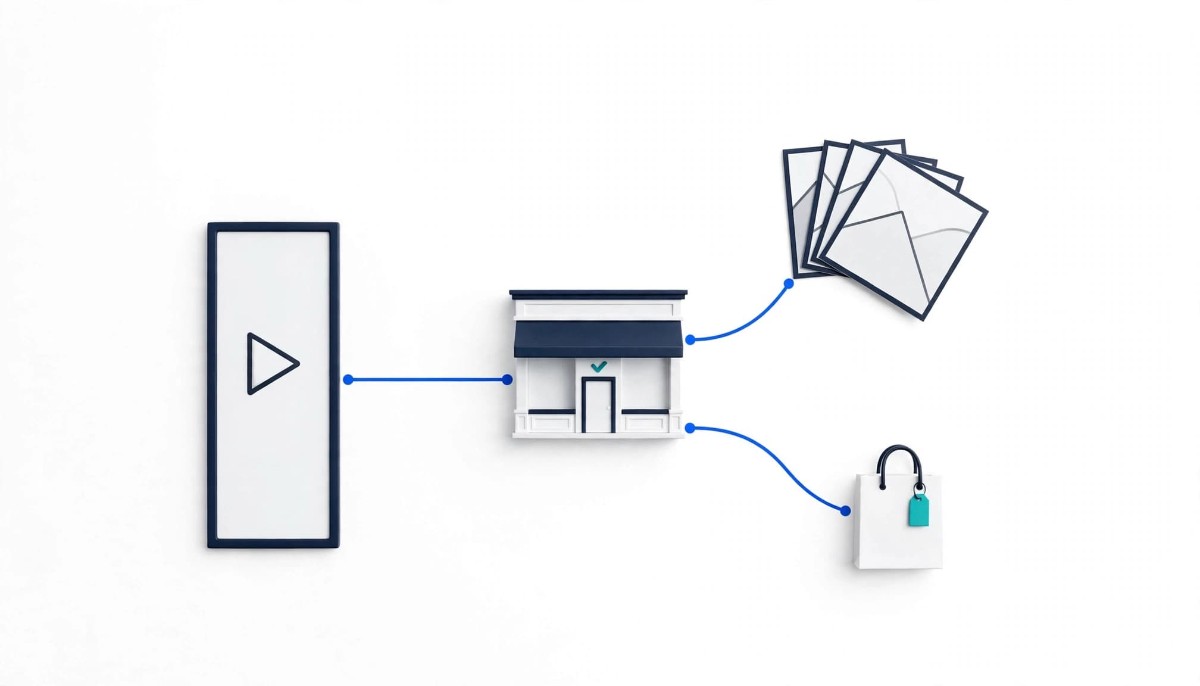
Every social platform you sell on should be assigned exactly one primary job: a checkout channel that must make money on the order it books, a discovery channel that must create demand you capture somewhere else, or a proof channel that must convince a shopper who is already looking. The job decides the scorecard, and the scorecard decides whether you keep funding it.
A checkout channel is judged like any other sales channel. Revenue after platform fees, affiliate commissions, samples, fulfillment, and returns has to leave contribution margin on the first order, because that is often the only order you will see. TikTok Shop is the clearest example in the US today, and it is a marketplace in everything but name.
A discovery channel is judged on what happens off the platform. Did branded search rise in the weeks after a creator push? Did direct traffic and new customer orders on your Shopify store move? Did your Amazon listing pick up? Grade discovery on in-app revenue and you will cut it right before it pays off.
A proof channel is judged on whether it helps a shopper who already knows your name say yes. Your Instagram profile, tagged customer photos, creator reviews, and the comments under your ads do this work. The measure is softer: conversion rate from social referral traffic, the share of first orders that touched your profile, and the objections that stop showing up in support tickets. Our guide to choosing Instagram posts by the job each post does goes deeper on that layer.
The same platform can do different jobs for different brands. TikTok can be a checkout channel for a $25 impulse accessory and a pure discovery channel for a $90 skincare regimen. The mistake is letting the platform’s default dashboard pick the job for you, because every platform’s dashboard is built to show the revenue that happened inside it.
In the US, in-app social checkout now lives mainly on TikTok Shop, while Facebook and Instagram Shops send buyers to your own website checkout. That shift matters more than any tactic, because it changes what “selling on Instagram” means for a Shopify store.
Meta began moving Facebook and Instagram Shops to website checkout in June 2025 and said most shops would switch by the end of August 2025, with shops on third party order management systems moving later, according to PPC Land’s report on the Meta Shops checkout change. For a Shopify merchant, that turns Instagram and Facebook back into discovery and proof surfaces that feed your store. The product catalog still matters, because tagged products and shop tabs shorten the path, but the order lands in your own checkout, with your own email capture and post purchase flows. That is good news for retention and bad news for anyone who built a plan around in-app Instagram sales.
The plumbing for both lives inside Shopify. The Facebook and Instagram sales channel app syncs your catalog to Meta, and the TikTok sales channel app syncs products, inventory, and orders with TikTok Shop. Installing either takes an afternoon; deciding what each is for is the part most brands skip.
TikTok Shop is a different animal. Orders happen inside the app, TikTok handles checkout, and the economics include a platform referral fee, creator affiliate commissions, free samples, and the returns that come with impulse buying. eMarketer’s summary puts TikTok’s take rate at 6%, with affiliate commissions that averaged 13.1% in 2025 stacked on top. Check your exact rate in TikTok Shop Seller Center before you model anything, because category rates and fee notices change.
Judged as a checkout channel, TikTok Shop’s first order economics look thin; judged as a discovery channel, it can lift sales on Amazon and your own store. Two guests on the eCommerce Fastlane podcast made those two cases, and each was right about a different job.
Gary Garofalo, CEO and founder of LoudCrowd, judged TikTok Shop as a checkout channel on episode 373, recorded in late 2024, and found it unproven. LoudCrowd sells creator storefronts, a competing social commerce product, and his comments came when I asked him to compare the two, so weigh them with that in mind. He told me the brands he talks to often see a TikTok Shop average order of $20 to $30 against $75 to $100 on their own site, and that the customer frequently remembers the product rather than the brand. His sharpest point was about what you do not get back: “TikTok also is not gonna give you, you know, a person’s email address or really any ability to retarget this person.” He called a profitable first TikTok Shop purchase “not an obvious yes,” and his conclusion was that “brands really, really need to think about TikTok Shop as a unique channel that’s got its own set of economics.”
Myriah Castillo, president of Joybyte, a TikTok Shop certified agency that runs creator programs for consumer brands, made the discovery case on episode 472 in 2026. I put a question to her that I drew from my days at Shopify: “a lot of brands, they really do judge, like the TikTok shop, really by sales that are happening right from within the app only.” Her answer was that the platform’s own focus has shifted to “how much of an impact TikTok has on other channels.” She said Joybyte usually sees about a 20 to 40% lift in Amazon sales when TikTok is generating awareness for a brand, and spikes on Shopify too: “We can really attribute spikes in sales when an affiliate video goes viral or when the shop is really starting to take off.” Those are her agency’s figures from its own clients, not an industry benchmark.
Put the two side by side and the disagreement resolves into a decision rule. If a $20 to $30 order clears the same margin target you hold every other sales channel to, after returns and with no second order counted, TikTok Shop can be a checkout channel and Garofalo’s scorecard applies. If it cannot, TikTok Shop is a discovery budget, Castillo’s scorecard applies, and the question is whether the lift on your store and marketplaces justifies the spend. What does not work is running it as discovery and grading it as checkout, or the reverse.
For a $68 AOV skincare store, the one job rule makes TikTok Shop a capped discovery budget, gives Instagram the proof job, and limits Facebook to the catalog sync behind its ads. This is a labelled composite built from patterns I have seen in merchant conversations, not a real brand, and every figure below is illustrative with its assumptions stated.
The store sells skincare on Shopify at about $1.5M a year. Its average order on site is $68, gross margin is around 72%, and the founder is under pressure to “get on TikTok Shop” because a competitor did. It already posts on Instagram, runs Meta ads, and has a small Amazon listing.
Start with TikTok Shop as a checkout channel, because that is the job the founder is imagining. A single cleanser sells for $28 on the platform. Illustrative math, assuming a 6% referral fee (eMarketer’s take rate figure), a 13% affiliate commission, $6.50 fulfillment, and $2 of sample cost spread across each order:
That is a positive number, so the channel can carry itself on paper. Now hold it to the store’s own rule: the founder expects about 35% contribution from site orders, the $2 sample assumption is probably low (Garofalo warned that seeding is “gonna cost you a lot of money”), and impulse returns have not been subtracted. There is no email to earn a second order, and the customer may not remember the brand name. My call for this store: TikTok Shop does not clear the bar as a checkout channel. It is a discovery budget, capped at a figure the founder would be comfortable spending on awareness with nothing to show in-app, and scored on what happens off the platform.
The scorecard for that discovery job uses data the store already owns. Branded search impressions in Google Search Console, new customer orders and direct traffic in Shopify analytics, and Amazon sessions on the listing, each compared with the same weeks before the creator push. Search Console can now report on your social profiles too, and our walkthrough on adding Instagram, TikTok and YouTube to Search Console shows how to see which queries your social posts win that your store does not. The rule I would set in advance: if branded search and new customer orders do not move within 90 days of steady creator volume, the budget shrinks, whatever the in-app dashboard says.
The strongest objection to that call is that on TikTok, in-app sales are what attract affiliates. Castillo described the flywheel directly: “the more sales you generate on the platform, the more affiliates will want to work with you.” A cap set too low can starve the engine that creates the lift. So I would size the cap to reach steady creator volume on one hero bundle rather than to a round number, and I would strengthen the read with a holdout, such as pausing creator pushes on one product line, because a simple before and after comparison is easy to confuse with seasonality, promotions, or Meta spend.
Instagram gets the proof job. With checkout back on the store’s own site, the work is a profile that answers “is this for my skin type” in three scrolls, tagged customer photos, and creator reviews reused in Meta ads. The measure is conversion rate from Instagram referral traffic and first orders that touched the profile. Facebook’s only job for this store is catalog and ad delivery in support of that proof work, so it gets no content plan of its own.
The fastest improvement to most social commerce plans is removing work, not adding channels. Each item below is a cut I would make before spending another dollar, and each one frees time for the single job a channel actually has.
Stop treating Instagram and Facebook Shops as a separate storefront project. With checkout going back to your site, the hours spent styling an in-app shop are better spent on your mobile product page, which is where those orders now finish. Keep the catalog synced and accurate, and leave it there.
Stop scheduling livestreams before you have creators. Livestreaming is growing on TikTok Shop, and eMarketer reports it reached 14% of sales there in 2025. A brand with no affiliate base streaming to its own small following is mostly paying staff to talk to an empty room. Earn the creator volume first; livestreams work better once there is an audience that already buys.
Stop counting views as a social commerce result. A video with a million views and no lift in branded search, site sales, or marketplace sales did not do a commerce job, however good it looked in a deck. Castillo’s own description of what works on TikTok is creators the audience already trusts, and she said a healthy Joybyte client usually earns about 80% of its TikTok Shop revenue through affiliates. Our breakdown of how much of a creator-led growth system to build at your stage covers how to size that before you commit.
And stop running a channel with no stated job. If you cannot write one sentence that says what TikTok, Instagram, or Pinterest is supposed to do for your store and which number proves it, pause it until you can.
The right social commerce strategy narrows as a store grows: early brands should run one channel in one job, growth stage brands can split jobs across two or three channels, and established brands can afford to fund discovery that pays off in other channels. Premature complexity is the failure I would watch for at every stage.
If you are under about $250K a year, pick one platform where your buyers already spend time and give it the proof job. Post content that answers the questions stopping people from buying, send the traffic to your own store, and capture email on the first order. TikTok Shop can wait unless your product is a low price impulse buy that clears the per order math above on day one.
Between roughly $250K and $2M, this is where the worked example lives. You can afford a capped discovery test on TikTok Shop and a proper proof job on Instagram, but not both run as checkout channels. Set the scorecard and the cut rule before the first sample ships. Most brands at this stage that struggle with social are running four channels with no job each, which is the premature complexity pattern in a new costume.
Above $2M, the question becomes coordination. TikTok’s own data, cited by eMarketer, says sales from brands with at least $30 million in annual revenue rose 97% in 2025, so larger brands are clearly finding a reason to be there. At this size you can run TikTok Shop as both a discovery engine and a sales channel for selected SKUs, measure the halo on retail and Amazon, and feed creator content into paid social. Every SKU on the platform still needs a job, and the ones that lose money with no halo to show for it come off.
A social commerce strategy for a Shopify store is a plan that gives each social platform one job, either checkout, discovery, or proof, and measures it on the number that job should move. Checkout channels like TikTok Shop must make money on the order they book. Discovery channels must lift branded search, site traffic, and marketplace sales. Proof channels like your Instagram profile must help shoppers who already know you decide to buy. Without assigning jobs, most brands end up judging every platform on in-app revenue, which undervalues discovery and hides money lost on low price checkout orders. Write one sentence per platform naming its job and its scorecard before you spend on it.
TikTok Shop is worth it for a small Shopify brand when a low price first order clears its margin target after returns, or when it has budget to treat the platform as capped paid discovery. Guests on the eCommerce Fastlane podcast have described TikTok Shop orders averaging $20 to $30, a platform referral fee on top of creator commissions, and no customer email to earn a second sale. Run the per order math with your own costs before listing. If the number is thin, cap a discovery budget and judge it on branded search and new customer orders on your store over about 90 days, not on in-app sales alone.
In most cases you can no longer complete a sale inside Instagram, because Meta moved Facebook and Instagram Shops to website checkout during 2025. Shoppers can still discover tagged products and browse your shop tab, but the purchase finishes on your own site. For Shopify merchants that means syncing your catalog through the Facebook and Instagram sales channel app and putting your effort into a fast mobile product page and email capture. Treat Instagram as a discovery and proof channel that feeds your store, and measure it on conversion rate from Instagram referral traffic rather than in-app orders.
Measure social commerce on your website by comparing branded search, direct traffic, and new customer orders before and after a social push, alongside the referral traffic each platform sends. Google Search Console shows branded search impressions and can now report on your social profiles. Shopify analytics shows new customer orders and sessions by referrer. If you sell on Amazon, track sessions on your listing over the same weeks. Set the comparison window and the cut rule in advance, for example 90 days of steady creator volume, so you judge the channel on the job you gave it rather than on whatever its own dashboard highlights.
Most Shopify brands should start with Instagram in the proof job and add TikTok Shop first only when a low price impulse product clears the per order math. Either way, start where your buyers already spend time. For most Shopify brands under about $250K a year that means content that answers buying objections and sends traffic to your own store, where you capture email on the first order. TikTok Shop makes sense earlier for products that clear the per order math at a $20 to $30 price point. Adding a second platform before the first one has a clear job and scorecard is the most common way social commerce turns into busy work without results.