

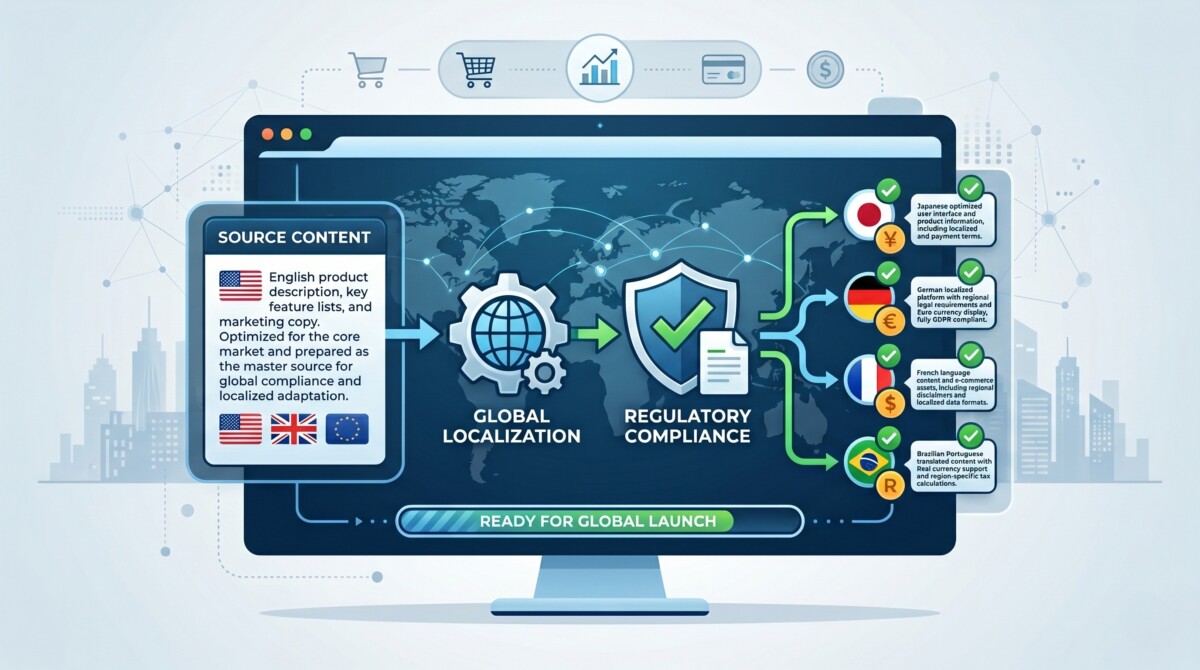
For any brand selling across borders, localization is now a compliance requirement, not a final market-entry step. Regulators in the EU, UK, GCC, and Southeast Asia increasingly treat unclear or unlocalized disclosures, consent flows, and checkout language as a consumer-protection failure, not a translation gap.
The old expansion sequence was build the product, secure the license, then translate. In a growing number of jurisdictions that order was never legally sound, and regulators are now treating the language gap as a compliance gap.
Picture a brand doing $3M a year that decides to open its first European market. The product is ready, the Shopify Markets configuration is live, and the storefront has been machine-translated into German and French in an afternoon. Six weeks later a data-protection complaint lands, because the cookie consent flow and the privacy disclosure read as if they were run through a translation engine. They were. The expansion did not fail on product. It failed on language that a regulator decided was not clear enough to count as informed consent.
For years the standard expansion sequence was build the product, secure the licensing, then localize. That sequence is no longer safe, and in a growing number of jurisdictions it was never legally sound to begin with. What regulators across the EU, UK, GCC, and Southeast Asia are now making explicit is that the language a customer transacts in is part of compliance, not a cosmetic layer applied after the fact.
This matters most at the $500K to $10M stage, where the pull toward international revenue is strong and the legal infrastructure to support it usually is not. If you are selling only domestically with no near-term plan to cross a border, you can stop here. If a foreign market is on your roadmap for the next year, the language decisions you make now are compliance decisions, whether you treat them that way or not.
Localization became a compliance requirement because regulators shifted from checking what your policy documents say to checking how your systems actually behave in real time, including the language those systems use to talk to users. Supervisors now look at how a platform verifies identity, controls data access, and surfaces warnings, and that scrutiny extends to whether a real user can understand any of it.
The shift built over several years and accelerated through 2024 into 2025. Across the United States, the European Union, and the Gulf Cooperation Council, supervisory bodies rolled out stricter licensing standards, tougher consumer-protection requirements, and enhanced oversight of financial products. The signal was unambiguous: the era of light-touch supervision is over, and customer-facing journeys are now part of what gets examined.
For a merchant, the practical translation is direct. A storefront, a checkout, or a consent banner that a regulator finds unclear is no longer just a conversion problem you can A/B test your way out of. It can become a finding. Information that is technically accurate but not meaningfully comprehensible, whether because of a language barrier or a clumsy machine translation, can fall short of the standard a regulator now applies to the whole customer journey.
Regulators rarely name localization directly. The obligation arrives through overlapping frameworks, consumer protection, disclosure, data rights, and platform conduct, each of which assumes the user can actually understand what the platform is telling them. Examined closely, the language gap becomes a compliance gap in four specific places.
The first is plain-language disclosure. The UK’s FCA Consumer Duty standard for retail customer outcomes, in force since 2023, requires firms to deliver good outcomes and to make sure customers actually understand what they are being told, not just that the disclosure was technically made. A disclosure that is accurate but incomprehensible to its intended audience can still miss the mark.
The second is the consent interface. Under PSD2, payment providers must give clear consumer disclosures and apply Strong Customer Authentication across the EU. When those flows are presented in unlocalized or machine-translated form, the validity of the consent itself comes into question, because a user cannot meaningfully agree to something they could not read clearly. The third is identity verification: KYC flows that ignore local ID formats, naming conventions, or address structures create onboarding friction and weaken verification accuracy, which becomes a due-diligence concern, not just a UX one. The fourth is data-rights communication, where a user who cannot understand how to exercise their rights faces a procedural barrier that regulators increasingly treat as a platform failure rather than a customer mistake. Jurisdiction-specific terms add a fifth layer, since rules like the e-money disclosure requirements depend entirely on the customer understanding what they are agreeing to.
There is no single localization standard to satisfy, because each major market built its own compliance logic, which is exactly why a one-size translation approach fails an audit. The language obligations differ in scope, in how aggressively they are enforced, and in what happens when you miss them.
In the EU, GDPR governs any platform processing EU user data and demands transparency and a valid legal basis for processing. The Digital Operational Resilience Act (DORA) added stronger ICT risk and third-party oversight requirements from 2025, MiCA requires crypto-asset disclosures to be fair, clear, and not misleading, and the EU AI Act, adopted in 2024, classifies creditworthiness assessment as high-risk and attaches strict documentation duties. In the GCC, regulators in the UAE, Saudi Arabia, and Bahrain have tightened licensing and disclosure rules, Arabic interfaces are increasingly expected alongside English, and Sharia-compliance introduces terminology obligations where precision matters. Across Southeast Asia, Singapore operates a mature framework under the Monetary Authority of Singapore, while Indonesia, Vietnam, and Thailand embed national-language requirements inside consumer-protection law, which makes them easy to overlook and hard to contest once cited. For brands weighing how far to adapt their business for each international market, Latin America is the sharpest reminder that regional shortcuts fail: in Brazil, communications must be in Portuguese, and Spanish content from neighboring markets does not satisfy the requirement.
Ecommerce brands selling cross-border live under lighter versions of the same rules: GDPR governs your EU customer data, consumer-disclosure law governs your checkout, and national-language requirements can govern your storefront the moment you take orders from that market. The fintech examples above are the sharp end of the spectrum, but the underlying logic reaches any Shopify store that collects data and takes payment from customers in a regulated market.
The Shopify ecosystem already gives you most of the mechanical pieces. Shopify Markets handles multi-market configuration, Shopify Payments and local payment methods cover the checkout, Shopify Translate & Adapt produces native storefront translation rather than a browser-level overlay, and the Customer Privacy and consent tooling manages the cookie and tracking banners that GDPR cares about. The mistake is assuming those tools finish the job. They localize the interface; they do not localize the legal meaning of your privacy policy, your terms, or your refund disclosure.
Stage changes the answer here more than anything else. A $50K store testing one additional market can reasonably lean on Translate & Adapt and a solid consent app, because the surface area of risk is small and the priority is learning whether the market converts at all. A brand doing $2M to $10M across five markets cannot, because the disclosures, terms, and consent flows now need human-reviewed localization that machine translation will not deliver. This is the same pattern that sinks merchants at the $500K to $2M stage in general: premature complexity. Bolting on five markets before the fundamentals of one are solid multiplies your compliance surface faster than it multiplies revenue. If you are weighing how to combine AI translation with human localization expertise, the dividing line is whether the content carries legal weight.
A localization gap becomes a crisis when the cost stops being a fixed line item and starts distributing across licensing, penalties, distribution, retention, and reputation, each arriving at a different time and at a scale the original budget never anticipated. The cost of localizing correctly is predictable. The cost of localizing badly is not, and it rarely arrives all at once.
On licensing, regulators assess whether customer-facing journeys, including KYC and consent, meet the standard for clarity and fairness, and poor localization can contribute to a non-compliance finding when users cannot understand required disclosures. On penalties, GDPR enforcement has produced substantial fines tied to transparency and consent failures, and inadequately localized consent mechanisms sit squarely inside that exposure. Distribution risk is real but secondary: severe breaches can lead to removal from app stores or platforms, though that usually follows enforcement escalation rather than a translation problem alone. The quieter costs are often the larger ones. User trust in early interactions, onboarding, consent, the first transaction, is highly sensitive to clarity, and confusion at that stage drives churn before it ever shows up as a complaint. Reputation compounds the damage, because financial and commercial trust is built slowly in a new market and lost quickly, and it shapes the environment a brand re-enters after fixing the problem, if it re-enters at all. For the broader picture of what merchants face here, the compliance hurdles specific to Shopify merchants are worth reviewing alongside the cross-border view.
Treating localization as risk architecture means building it into the compliance layer from the start, not bolting it on after the product ships, because the build-globally-translate-last sequence is precisely what produces the enforcement findings. The framing that has governed most expansion strategies is now generating failures expensive enough to reframe the conversation entirely.
The capability that matters is not text conversion at volume. It is understanding the regulatory register of financial and commercial communication, the legal precision that consent language requires, and the cultural and structural adaptation that makes a KYC flow, a fee disclosure, or an error message function correctly for the person receiving it. That is the difference between a generalist translation vendor and a professional software localization partner with genuine regulatory-content expertise. For merchants comparing providers, the practical evaluation criteria for a localization partner that handles compliance-grade content matter more than headline per-word pricing.
The brands that build international expansion around this understanding treat localization as the risk-management function it has become. The ones that do not are discovering, through enforcement actions, licensing delays, and market exits, what it costs to treat it as anything less. If a border is on your roadmap, decide now which side of that line you want to be on, because the regulator will decide for you otherwise.
Often yes, because in many markets clear local-language disclosure is a consumer-protection requirement, not a courtesy. The exact obligation depends on the country and what you sell. Brazil requires Portuguese for consumer communications, several Southeast Asian markets embed national-language requirements inside consumer-protection law, and the EU requires that disclosures and consent be genuinely understandable to the customer. A fully translated marketing site is not the same as compliant localization. The pieces that carry legal weight, your privacy policy, terms, consent flow, and refund disclosure, are the ones regulators actually scrutinize, so translation of the storefront alone does not guarantee you have met the requirement.
Machine translation is enough for the storefront surface but not for content that carries legal weight. Product descriptions, navigation, and marketing copy can run through tools like Shopify Translate & Adapt with good results. Privacy policies, terms and conditions, consent language, and KYC flows cannot, because a regulator can decide that a machine-translated disclosure is not clear enough to count as informed consent, which puts the validity of the agreement itself in question. The practical rule is simple: if the text creates a legal obligation or captures a user’s consent, it needs human review by someone fluent in both the language and the regulatory register. Everything else can be automated.
The EU, the GCC, Brazil, and parts of Southeast Asia currently apply the strictest expectations. The EU enforces clear local-language disclosure through GDPR, MiCA, and the Consumer Duty equivalent standards, and adds DORA and the EU AI Act for regulated financial products. The GCC increasingly expects Arabic alongside English, with added Sharia-compliance terminology obligations. Brazil mandates Portuguese for consumer communications and does not accept Spanish from neighboring markets. Indonesia, Vietnam, and Thailand embed national-language requirements inside consumer-protection legislation, which makes them easy to miss and difficult to contest once a regulator cites them. The enforcement posture and the consequences differ by market, which is why a single translation approach rarely satisfies all of them.
Translation converts words between languages; localization adapts the entire experience to a market’s legal, cultural, and structural expectations. For compliance purposes the distinction is decisive. Translation gives you a German version of your privacy policy. Localization makes sure that German version reflects how GDPR consent must actually be presented, that your KYC flow accommodates local ID formats and naming conventions, and that your fee disclosure uses the terminology a local regulator expects. A translated document can still fail an audit if it does not account for these structural requirements. Localization is the work of making the platform behave correctly for the user who receives it, which is the standard regulators now apply.
Invest in professional localization before you take meaningful order volume from a regulated market, not after a complaint arrives. At the testing stage, one new market with low volume, automated translation plus a reliable consent app is a reasonable starting point. The line to watch is legal weight and scale: once a market is generating real revenue, or once you are operating across several markets at the $2M to $10M range, your disclosures, terms, and consent flows need human-reviewed localization. The common mistake is adding markets faster than you can support them properly, which multiplies compliance exposure ahead of revenue. Localize the legal layer of a market before you scale spend into it.





