
A step and repeat banner turns a Shopify brand’s NYC pop-up, trade show booth, or press event into a reusable content asset, because every photo taken in front of it becomes branded, shareable coverage, provided the material, print resolution, and production partner are chosen correctly for the venue and lighting involved.
The cheapest marketing asset at your pop-up is also the one most brands forget to budget for until the week before the event.
A DTC skincare brand books its first trade show booth at the Javits Center. The product samples ship on time, the staff training is dialed in, and the booth looks sharp on setup day. Then the photos start coming in from attendees, and every single one is a phone shot of a table against a plain white pipe-and-drape wall. No logo, no branding, nothing a social team can repost. The booth worked. The content did not.
That gap shows up constantly with growing Shopify brands the moment they start staging physical activations, whether that is a Brooklyn pop-up, a Fashion Week adjacent event, or a booth at a trade show. Brands doing $2M or more in revenue have usually learned this lesson once already and now budget for the backdrop as seriously as they budget for the product table. Brands still under $500K in revenue are the ones most likely to skip it, then wonder why their first pop-up generated foot traffic but almost no usable social content afterward.
This guide walks through what a step and repeat banner actually does for an ecommerce brand, how to choose the right material and print partner for a New York City event, and how to think about the cost so one banner earns its keep across several activations instead of one.
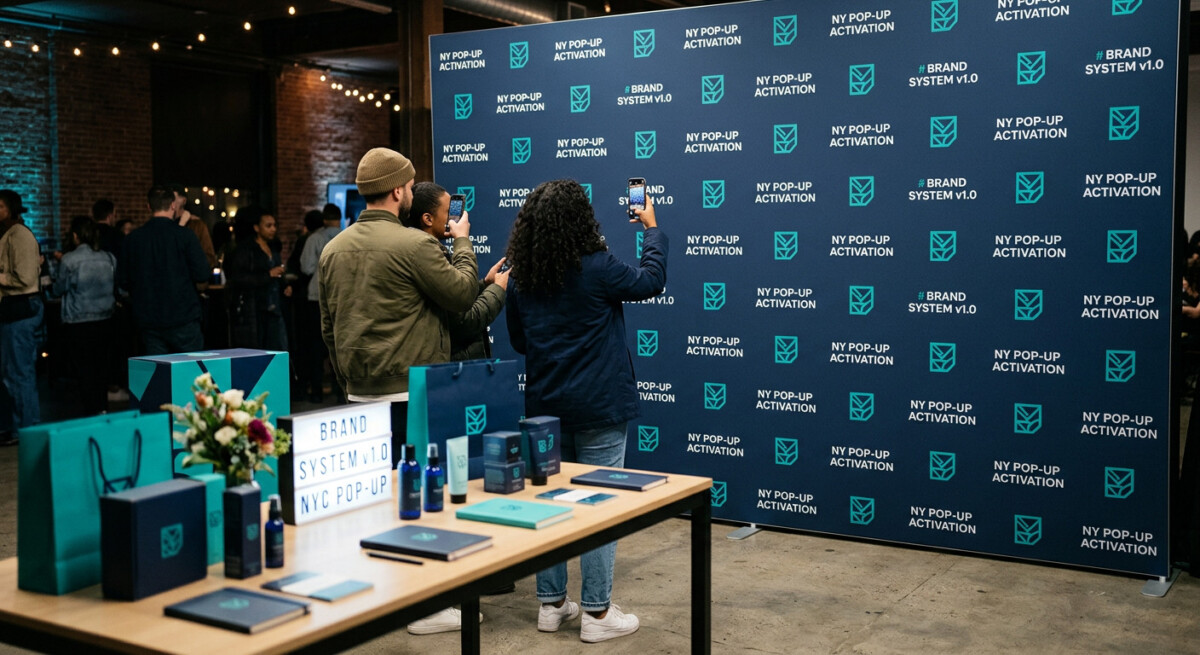
A step and repeat banner works by turning every photo taken at your event into a piece of branded media, because the backdrop repeats your logo in a grid pattern that stays legible no matter how the shot is cropped. The name comes from the production process itself: a logo is stepped across a layout and repeated to fill the full surface, so a tight crop and a wide crop both still show your brand.
For a Shopify brand, the return on that setup is closer to a media placement than a decoration line item. Attendees photograph themselves against it, staff photograph product demos in front of it, and any press or influencer coverage from the event inherits the same branded frame. Recent research on branded activations found that 98% of consumers create digital or social content at experiences and events, which means the backdrop is effectively deciding what a large share of your event’s organic content looks like before a single guest arrives.
New York specific production matters here because turnaround windows are tight and venues vary widely in lighting and ceiling height. Businesses sourcing step and repeat banner NYC locally get same-week proofing and pickup that a national print broker usually cannot match, which matters when a booth confirmation comes through two weeks before a show.
The right backdrop material depends on where your event happens and how it will be photographed, because vinyl and fabric solve different problems and neither one is universally correct. Vinyl is durable, holds color well over repeated use, and costs less per unit, which makes it the practical default for outdoor pop-ups, farmers markets, and trade show booths where the banner gets packed, unpacked, and reused often.
Fabric earns its higher price at press facing events because it has no glare under flash photography, which matters the moment a photographer or influencer is shooting your booth. Tension fabric systems also pack flat, so a brand running the same activation across multiple cities can travel with the backdrop instead of shipping it. Resolution matters just as much as material. A backdrop should print at 150 dpi or higher at full size, and color matching to your existing brand palette, whether that is defined in Pantone or CMYK, is not optional once sponsor or partner logos share the same surface.
A step and repeat banner earns the strongest return when it is planned alongside the event itself rather than added at the last minute, because backdrop placement and booth layout affect each other directly. Brands planning their first physical pop-up should treat the backdrop as part of the same budget line as signage and fixtures, not an afterthought purchased once the space is already booked.
The placement decision changes by format. At a pop-up, the backdrop usually anchors a dedicated photo moment near the entrance or checkout, since that is where dwell time and foot traffic naturally cluster. At a trade show booth, the same banner typically sits behind the demo table so it appears in every product photo a buyer or attendee takes, which is why guides covering trade show booth ideas consistently flag signage as one of the first things attendees notice before they ever reach the products.
Brands running a coordinated content push around the event should build the backdrop into their broader pop-up marketing plan rather than treating it as a standalone purchase. A guide to Instagrammable moments and pop-up promotion is worth reading alongside this one, since the backdrop is the physical infrastructure that makes those planned photo moments actually work.
The right print partner for a step and repeat banner is one who can turn a proof around inside 48 to 72 hours without cutting corners on color accuracy, because NYC event timelines rarely leave room for a second attempt. Ask directly about in-house production. Printers running large format equipment in house maintain tighter quality control and faster turnaround than shops that outsource the actual printing to a third party, which adds a day or more to any rush order.
Ask about pre-press support as well. Many brands arrive with a logo file that is not print ready, whether that is a low resolution export or a file in the wrong color space, and a quality print shop should catch that during proofing rather than after the banner is already printed. New York based large format specialists like Industri Designs, located at 175 Varick Street, New York, NY 10014, bring years of event production experience to orders ranging from a single banner for a small pop-up to multi-piece backdrop systems for larger activations across the five boroughs.
Also confirm the hardware. The stand system, whether retractable, pop-up frame, or tension fabric, determines how the backdrop actually looks once it is set up in your specific venue, and an experienced NYC printer can advise on the right configuration based on ceiling height and setup time before you order.
A well produced step and repeat banner pays for itself the moment it gets used at a second event, because the cost is fixed while the impressions compound with every additional activation. A brand that spends $600 on a fabric backdrop and uses it across four pop-ups over a year is paying $150 per event for a piece of branded media that shows up in every photo taken at each one, plus any lanyards or floor signage layered in for the same activations.
Brands running lanyards or supplemental signage alongside the backdrop should coordinate the two, since custom lanyards and event signage extend brand visibility beyond the photo moment and into every conversation staff have on the floor. Conversely, a backdrop that photographs poorly, fades after one use, or fails structurally mid-event is both a wasted spend and a missed content opportunity at every event it should have supported.
For brands weighing whether the investment fits their current stage, the honest answer is that it scales down as easily as it scales up. A $300 vinyl banner for a single farmers market pop-up and a $1,500 fabric system for a recurring trade show presence are solving the same problem at different budget levels, and both beat showing up with a bare table.
A basic vinyl step and repeat banner for a first pop-up typically runs $300 to $800 depending on size and stand hardware. That range covers a standard retractable or pop-up frame system sized for a booth or entryway. Fabric systems with a premium, glare-free finish start closer to $800 and can run past $1,500 for larger multi-panel setups. Most first-time pop-up brands are well served by the lower end of the vinyl range, since the goal at that stage is validating whether the backdrop generates usable content at all before investing further.
Vinyl is good enough for most one-day events, especially outdoor pop-ups, farmers markets, or trade show booths where durability and cost matter more than eliminating flash glare. Fabric becomes the better choice specifically when press coverage or professional photography is expected, since its glare-free finish photographs more cleanly under flash. If your one-day event has no confirmed media or influencer attendance, vinyl covers the need without the added cost.
Order a step and repeat banner at least one to two weeks ahead of an NYC trade show, even though many in-house NYC printers can turn a production-ready file around in 48 to 72 hours. That buffer accounts for file preparation, a proofing round if your logo file needs color correction, and any last-minute booth confirmation changes. Booking closer to the show date is workable if your logo file is already print ready, but it removes any room for a second proof if the first one needs adjustment.
Yes, a well produced step and repeat banner is designed to be reused across multiple pop-ups, trade shows, and press events, which is where most of its value comes from. Fabric systems in particular pack flat and travel well between venues, holding up better than vinyl across repeated setup and teardown cycles. The only exception is a banner built around a time-limited promotion or seasonal campaign, which naturally has a shorter useful life than a banner built around your core brand identity.
Send your logo as a vector file (AI, EPS, or PDF) whenever possible, since vector files scale to any banner size without losing sharpness. If only a raster file (PNG or JPG) is available, it needs to be sized for at least 150 dpi at the banner’s full print dimensions, not just at typical web resolution. A quality NYC print shop will flag resolution or color space problems during pre-press review, but starting with a vector file or a properly sized high-resolution export avoids that back and forth entirely.





