

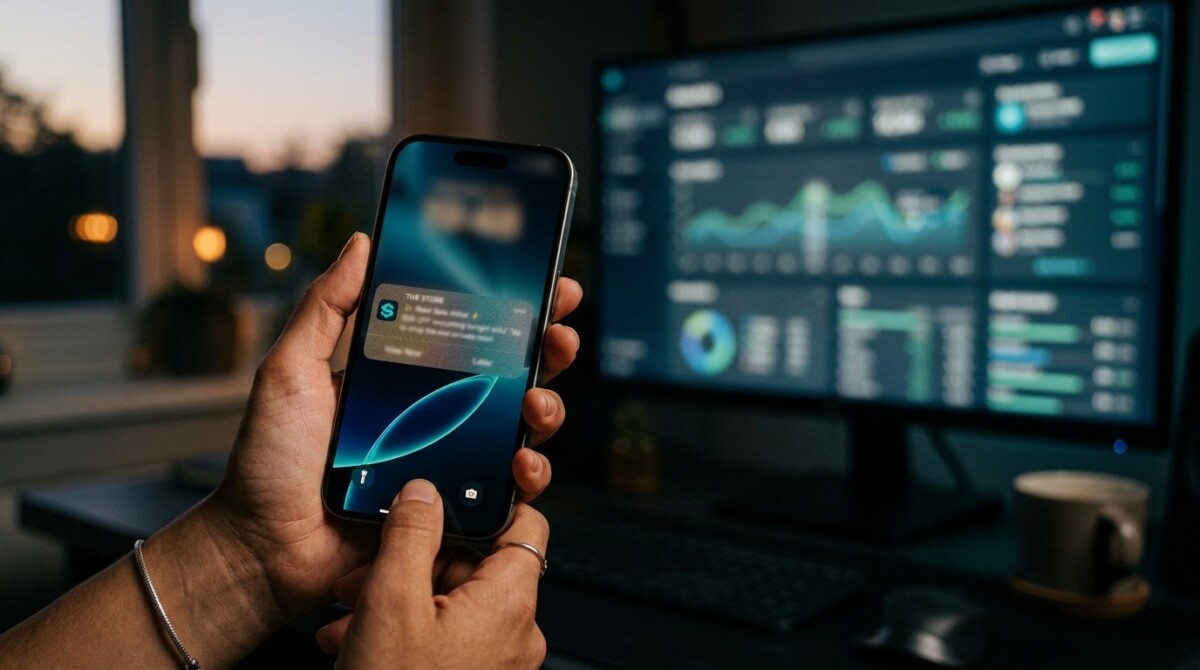
StoreClip, marketed as StorePush, is a same-session cart recovery layer for Shopify brands running iPhone-heavy paid social. Apple’s eight-hour App Clip notification window makes it additive to Klaviyo and Postscript rather than a replacement.
Apple gives an App Clip eight hours of notification permission per launch. Every recovery this product can run for you happens inside that window, or it does not happen at all.
The single largest untouched cohort in most Shopify stores is the shopper who tapped a paid social ad, browsed for 40 seconds inside an in-app browser, and left without ever adding to cart. Cart abandonment gets all the attention, and the Baymard Institute figure of roughly 70% is quoted in every retention deck ever built. But cart abandonment is a problem you can at least attack, because a shopper who reaches your cart has often given you something to work with. The browse-and-bounce cohort gives you nothing. No email, no phone number, no account. They are gone the moment they swipe away, and no amount of Klaviyo sophistication changes that.
What makes 2026 different is that Apple quietly built a mechanism that reaches them. App Clips can send notifications for up to eight hours after each launch, granted automatically, with the shopper able to switch it off directly on the App Clip card. No download. No signup. No contact details. For a channel that has been structurally unreachable since the first iPhone shipped, that is a genuine opening.
It is also the reason I keep pushing merchants toward conversion work before acquisition work, which is exactly the ground Krisztian Kiraly and I covered when we talked about the cheapest growth lever most founders skip. You have already paid for these taps. Meta has already been compensated. Recovering even a small share of that cohort is cheaper than buying the same traffic twice. That is the case for paying attention to this category in the first place, independent of any single vendor in it.
StoreClip is an abandoned cart recovery app for Shopify that renders your storefront as a native iOS App Clip when a shopper taps your social ad, then sends push notifications to bring them back. It is listed in the Shopify App Store under the Abandoned cart category, published by a developer named ShopClip, operating out of Miami, and it went live on May 14, 2026.
Before anything else, the naming. The marketing site is StorePush at storepush.io and carries a BETA label. The App Store listing is StoreClip. The developer of record is ShopClip. The support site is storeclip.app. Four surfaces, three names. I am not raising this as a red flag about the people building it, because early stage teams rebrand mid flight all the time and this is a normal artifact of moving fast. I am raising it because you are the one who has to find the thing, install the right app, and explain the line item to your bookkeeper. Search the App Store for StorePush and you will not find it. Search for StoreClip and you will.
Mechanically, the flow is three steps. You append query parameters to a Meta or TikTok campaign. A shopper taps, and instead of dropping into the platform’s in-app browser, an App Clip card presents and your storefront loads as a native experience with Apple Pay available. If they leave without buying, a push notification lands on their lock screen and returns them to where they stopped. The merchant side gives you configurable triggers, timing, and messaging without code, plus discount codes that auto create and sync to the campaign, and a funnel view from product view through to purchase.
The capability that matters most is not the push notification, it is what happens before it: replacing the Meta in-app browser with a native rendering of your store. Anyone who has watched session recordings of in-app browser traffic knows the pattern. Sluggish loads, broken sticky headers, payment sheets that misbehave, and a back button that dumps the shopper back into their feed. Serving that same traffic a native App Clip with Apple Pay attached removes a category of friction that most merchants have simply accepted as the cost of paid social. Even if not a single push notification ever fired, that swap alone is worth measuring.
The second is the recovery push itself, and its value is entirely a function of timing. The product’s own default triggers sit around 45 minutes after abandonment, which lines up with what most 2026 benchmarks show as the strongest first touch window for fashion, beauty, and home. Inside eight hours, the mechanism works. This is genuinely complementary to your broader abandoned cart automation playbook rather than competitive with it, because your Klaviyo flow only ever fires for shoppers who handed over an email at checkout.
The third is attribution, and here they have made an unusually honest design choice. A conversion counts only when a shopper taps a StoreClip notification and completes checkout within 24 hours, with no claim made on organic sales. Compare that to Meta’s default seven day click window or a typical five day email attribution window and you will notice this vendor has given itself the narrowest credit window of anything in your stack. That is a deliberate decision and it deserves acknowledgment. It also matters commercially, because on the Pro plan the attributed revenue figure is what you get billed a percentage of. What StoreClip charges once you outgrow the free tier is worth reading before you install rather than after.
Before you install anything, open Shopify analytics and calculate what share of your paid social sessions arrive on iOS and never reach your cart, because that number tells you whether this is a real problem for you or a solution looking for one. If iOS paid social is under 20% of your sessions, close this tab and go work on something else.
If you are under $50K a month, the honest answer is that this is not your bottleneck. Your bottleneck is almost certainly the landing page those ads point at, and I have watched enough merchants at this stage add tools instead of fixing fundamentals to be direct about it. Run the premature complexity test first. The free tier exists, so the cost of curiosity is low, but the cost of your attention is not.
If you are between $500K and $5M with real Meta or TikTok spend, this is worth a structured test rather than a rollout. Pick one campaign, leave a comparable campaign untouched as a control, and run both for at least three weeks. Judge it on incremental revenue per session against your control, not on the recovered revenue number in the vendor dashboard. Stay on the free tier until you have that comparison in hand.
If you are above $10M, the 5% revenue share is the variable to negotiate before you start, not after, and the $5,000 cap is the number that makes this interesting at your volume. Ask about a flat rate. Early stage vendors have more flexibility than mature ones, and a brand your size is a reference customer they do not yet have.
Yes, they are the same product under different names. The marketing site is StorePush at storepush.io, the Shopify App Store listing is StoreClip, and the developer of record is ShopClip based in Miami. If you search the Shopify App Store for StorePush you will not find a result, because the listing is published under StoreClip in the Abandoned cart category. The vendor’s support and privacy documentation lives at storeclip.app. This is most likely a rebrand that has not finished propagating across every surface. For merchants, the practical takeaway is to install by searching StoreClip, and to expect the StorePush name on the marketing materials and dashboard.
StoreClip uses Apple’s App Clip framework, which grants automatic notification permission for up to eight hours each time a shopper launches the App Clip. When a shopper taps your social ad, your storefront loads as a native App Clip instead of inside the platform’s in-app browser, and Apple’s ephemeral permission lets the app send lock screen notifications during that window without collecting any contact information. The shopper can disable it directly on the App Clip card. Beyond eight hours the permission expires, and extended notification access requires an explicit opt in from the shopper. This is why the product functions as a same day recovery channel rather than a multi day winback tool.
StoreClip offers a free tier and a Pro plan at $50 per month plus 5% of attributed recovered revenue, with the usage commission capped at $5,000 per billing cycle. The free tier covers up to 200 push notifications per month with full App Clip and Apple Pay checkout, cart abandonment detection, and revenue attribution. Note that the Shopify App Store listing currently displays a Free plan only, which suggests Pro is billed outside Shopify’s billing system and will not appear on your Shopify invoice. Attribution for the revenue share counts only conversions where a shopper taps a StoreClip notification and purchases within 24 hours.
No, StoreClip’s core functionality is iOS only, because Apple’s App Clip framework does not exist on Android. Android shoppers who tap your ad route to your existing mobile site with fallback handling, which means they receive no App Clip experience and no push notification recovery. The product also requires iOS 16 or later. For US focused Shopify brands where iPhone accounts for well over half of mobile traffic, this covers the majority of paid social sessions. For brands selling primarily into Android dominant markets, the addressable share of your traffic is considerably smaller and the economics change accordingly.
No, StoreClip is additive to Klaviyo rather than a replacement for it. The two tools address different shoppers. Klaviyo and Postscript recover shoppers who reached checkout and provided an email address or phone number, and they can run sequences over days or weeks. StoreClip reaches shoppers who browsed and left without providing anything, and Apple’s eight hour notification limit means it cannot follow up beyond the same day. If you are choosing between them, keep your email and SMS flows running and evaluate StoreClip as an additional layer covering a cohort your retention stack currently cannot see at all.





