


Ecommerce migration and replatforming is a reality many businesses at some point will have to face. Today, competition is fiercer than it’s ever been, and ecommerce sales are continuing to grow globally at a rapid pace—from $5.5 trillion in 2022 to a projected $7.3 trillion by 2025. Ecommerce businesses need to keep up with the demand and, in many cases, that means moving to a more scalable and robust platform.
The platform you choose for your ecommerce business will have a direct
Ecommerce migration has historically been viewed as a time-consuming and costly burden. And without the proper plan and execution strategy, it can be. This guide will walk you through how to effectively navigate ecommerce migration and replatforming so you can set your business up for future success.
Table of contents:
Ecommerce migration is the process of moving the front end and/or back end of your ecommerce store from one platform to another. It includes moving everything that lives on your current platform, including products, collections, pages, blog posts, meta data, and customer and order information.
Some of the most common reasons to initiate an ecommerce migration include:
Replatforming does not always mean moving your ecommerce store from one service partner to another. Many store owners transition from a SaaS platform to their own in-house infrastructure, or vice versa.
In general, there are three types of ecommerce migration and replatforming:
There are endless variations of the three types of migration mentioned above. Each project template is different and will require a unique plan to ensure you check off all of your replatforming requirements and business goals.
In Deloitte’s 2022 Retail Industry Outlook survey, 67% of respondents said ecommerce and online shopping platforms were a top investment priority for their company, citing ongoing issues with old and outdated platforms. This sentiment is backed up in the Digital Commerce 360 report, where 18% of the 93 retailers—and 61% of B2B ecommerce sellers—surveyed said that they are actively looking to switch commerce platforms within the next year.
This growing sense of urgency to migrate to modern ecommerce platforms—a market that’s expected to reach $7.4 billion by 2023—correlates directly with the increasing percentage of internet users who purchase online regularly. As of 2022, 58.4% of working-age internet users globally now buy something online every week.
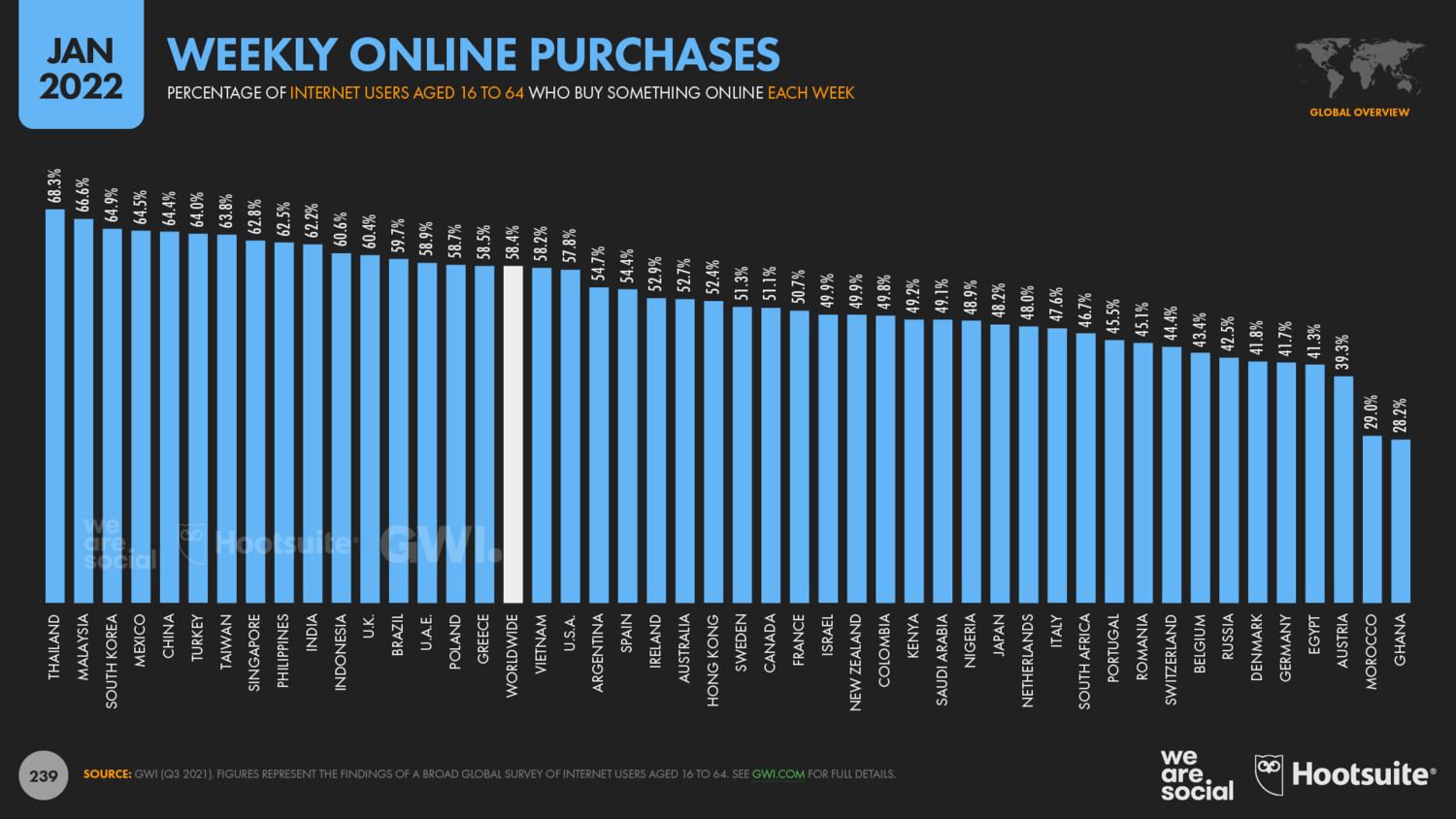
To keep up with this demand, businesses are looking to cloud and SaaS ecommerce solutions that can help them improve scalability, user experience, payment options, checkout and conversion rates, site speed, and general ease of maintenance. And it’s little wonder. All of these factors have a significant
Mobile devices account for 61% of ecommerce traffic, but most sales still take place on desktop. This means that ecommerce businesses need to use a platform that lets them provide an optimal user experience on mobile or desktop, and makes it easy for users to buy on any device.
In 2020, digital and mobile wallets accounted for 45% of global ecommerce payment transactions, a figure that’s expected to grow to 50% by 2024. The digital wallet is by far the most popular online payment method worldwide. If your current ecommerce platform cannot currently accept digital wallet payments, it’s likely you’re missing out on potential sales.
Cart abandonment remains a major issue for ecommerce businesses in 2022. This year, the average reported cart abandonment rate is 69.99%. A “too long or complicated checkout process” was cited by 17% of surveyed users as their reason for dropping off, and 16% listed “website errors or crashes.” Slow-loading websites also increase cart abandonment rates by as much as 75%.
All three of those issues—poor checkout experience, website uptime, and site speed—can be directly addressed by migrating to a modern ecommerce platform. In fact, ecommerce sites can gain a 35% increase in conversion rates by optimizing their checkout design alone.
Despite the clear evidence in support of migrating to a modern ecommerce platform, only 25% of respondents in the Deloitte survey said they were prioritizing a migration in 2022. While everyone will have their own reasons for delaying a migration, there’s one common variable on everyone’s mind: cost.
Twenty-nine percent of respondents to the Digital Commerce 360 report said they expect to pay between $100,000 and $500,000 to transition to a new platform. That’s on top of the internal resources and time commitments needed to carry out the ecommerce website migration.
Ecommerce platform migration can be an expensive and time-consuming activity. There’s no question about that. But both cost and time can be managed properly with a carefully thought-out migration plan. This, combined with the future benefits of migrating to a new platform, should outweigh the upfront costs.
[SECTOIN]3
Ecommerce migration and replatforming are two interchangeable terms that mean the same thing: moving your store from one platform to another. The scope of this project—including costs, resources, timeline, and steps—will vary depending on the size and complexity of your online business.
A successful migration, however, will follow a fairly formulaic process that includes:
Let’s dig into each in more detail.
Ecommerce migration is a collaborative business process that involves both doers and decision-makers. The first step is to bring these people together and present your case for why a replatforming project is necessary.
When doing so, be sure to explain the following:
Every case will be unique. Compile as complete a list as possible that demonstrates to key decision makers why your current platform isn’t cutting it today, and why that’s a problem for the future.
If your stakeholders agree that a new platform is the right solution, the next step is to agree on what you’re looking for in a new solution.
To do this, you should identify:
An external agency partner is a helpful resource throughout this process and can help guide your conversations and decision-making from an early stage.
Next up is the discovery phase, where you shop around for potential new platforms. Sites like G2 Crowd, Capterra, and Gartner are helpful resources when compiling your initial list of vendors. You might also want to consider sending out a request for proposal (RFP) with your list of requirements to help extend your reach and reduce the workload.
Make a shortlist of five or six ecommerce platforms that you’re considering and set up exploratory calls with each.
During those calls, ask questions like:
Add any questions to this list that relate to your specific requirements. Track the answers to these questions in a shared document so that your team members can effectively weigh potential vendors collaboratively.
Once you’ve selected an ecommerce partner, the next step is to establish a realistic scope of work and timeline for your migration. When doing so, you should map out all key milestones, and resources required for each.
Most migrations will require you to plan sub-projects to tackle the following:
Data migration is also a critical element in the planning phase. This is when you’ll determine what data needs to be transferred, and how it will be safely moved from one platform to the other. Data migration can be completed using a third-party service, API plug-in, app, or manual CSV transfer. Talk to your agency partner or solution provider about the best option for your replatforming project.
The design and development phase will likely take up the bulk of your time and resources. This is where your designers and development team will go to work and create the front and back ends of your new ecommerce website. It’s also where all of the data that you migrated over will be loaded into your new website redesign.
If there are significant changes you’d like to make to your website’s navigation, content, user experience, design, or back-end functionality, now is the time to do it.
Depending on your selected ecommerce platform, you may also have the opportunity to customize and optimize your checkout experience. Connect any third party checkout apps you may be using in your existing system to your new platform, and optimize the user flow as much as possible.
This is a good time to ensure that the new checkout experience matches the best practices you laid out early in the planning phase. The goal is to ensure that the new experience is fast, secure, and efficient for your customers.
Ecommerce replatforming is not without its risks from an SEO perspective. Any time you move a website from one platform to another, you’re likely to run into a wide variety of variables that may negatively (or positively)
To mitigate that risk, make sure that you:
Once your site is launched, continue to monitor your organic traffic, search rankings, and technical SEO profile through tools like SEMrush or Ahrefs. Keep an eye out for things like 404 errors, site speed issues, and any other red flag that pops up that might indicate compromised performance.
Before you launch, run multiple tests of the site navigation, checkout experience, front- and back-end website functionality, and product selection process. The more scenarios you can test, the more bugs and hidden issues you’re likely to uncover. This will ensure that your new store is in the best possible state come launch day.
When doing so, run your site through a performance auditing tool like Google PageSpeed Insights to ensure all of your pages are loading and behaving as expected. This will help ensure that there are no speed or usability issues when you launch.
Depending on the size of your store, you will likely want to have numerous people analyze your site from a business and customer perspective. Ask internal stakeholders in your organization to work in the back end of your site and complete specific tasks. Do the same on the customer side. You may even want to consider giving beta or early access to some of your most loyal customers. Gather all of this feedback and work it into your final tweaks before launch.
The actual launch of your website should be fairly straight forward. Plan your launch window to minimize disruption to your customers. If possible, work with your agency or solutions partner to create a launch checklist in advance so that you can work through tasks in sequential order.
Ecommerce businesses replatform for a wide variety of different reasons, most of which are determined by factors unique to that company. Generally, the motivating factors are either a desire to avoid specific issues or gain specific functionalities (or a combination of the two).
Ecommerce businesses may be looking to avoid or find a solution to:
Additionally, those same online businesses may be looking to gain the following:
“Ecommerce companies may shift their online presence to a new platform to scale their business and create a better user experience,” says Alexandra Fennel, co-founder and CEO of Attn: Grace. “They choose to replatform when their current provider experiences regular technical issues that harm conversion rates, or when it cannot develop fast enough to keep up with the competition.”
By doing so, says Monte Deere, CEO of Kizik, the business also expands their credibility in the eyes of their customers.
“Who’s not impressed with a company—and trusts it more—if an ecommerce platform is just as stylish and intuitive as Apple’s?” asks Deere.
Compromised site speed leading to lost sales was precisely the motivation that Bombas needed to kick start its own migration to Shopify Plus.
Having grown its revenue from $300,000 in 2013 to $4.7 million in 2015, Bombas founders David and Andrew Hath landed a deal with Daymond John on Shark Tank. That was the good news. The bad news was that, because of that success, their website received way more traffic and demand that it could handle—4,000 transactions per day, up from just 500.
Product images broke, customers couldn’t check out, and losses climbed to $15,000 in just a few minutes. That was all the convincing David needed to migrate the Bombas site over to Shopify Plus. The process was time-intensive, and cost about $150,000, but the effort has paid off.
The business and customer experience is better for Bombas and its customers, and the migration saved an estimated $108,000 in platform costs in the first year alone. For the team at Bombas, the catalyst for replatforming was unreliable infrastructure leading to lost revenue, and the payoff was scalability, innovation, and near immediate positive return on investment.
Ecommerce platforms can be broken into three key types, each of which has its own benefits and challenges. The type of platform you choose will have a significant
SaaS ecommerce platforms are subscription-based solutions built and maintained by a third-party provider. Businesses essentially rent the software from the service provider, without the need to build or develop any of their own infrastructure.
Growing ecommerce businesses, or those that prioritize ease-of-use and reliability, should strongly consider a SaaS solution. The long-term cost of SaaS ecommerce is much lower than the other two options, and all of the burden of dealing with technical issues, downtime, and security are placed on a third party.
The benefits of SaaS ecommerce platforms include:
Shopify Plus is an example of a SaaS ecommerce solution.
On-premise ecommerce platforms are built with the company’s own resources and hosted in an internal storage facility. Internal or third-party development and engineering teams conduct all of the development and ongoing maintenance, and are responsible for a technical and security infrastructure.
The benefits of on-premise ecommerce solutions include:
While on-premise legacy systems are a great option for teams with deep technical bench strength, they are also quite costly, averaging $200,000 per year or more for mid-market retailers. Plus there are ongoing infrastructure costs, employee salaries, and third-party assistance, when needed.
The performance, backups, uptime, security, and scalability of the site also rests on the internal team’s shoulders, meaning it can be hard to quickly pivot to account for peak seasons and new market opportunities.
Cloud ecommerce platforms are a hybrid between the SaaS and on-premise solution, and use an infrastructure as a service (IaaS) model. That is, the business hosts its ecommerce website in the cloud through a provider like Amazon Web Services or Microsoft Azure.
While cloud ecommerce companies rent the storage and hardware infrastructure from a third-party provider, they are in charge of developing and maintaining the core ecommerce platform.
The benefits of cloud ecommerce solutions include:
While cloud ecommerce platforms are less resource intensive than on-premise, they still carry a hefty price tag at $170,000 per year, on average. Companies will need to pay licensing fees for IaaS infrastructure, and will still need a highly technical team to develop and maintain their ecommerce website.
[SECTON]6
Planning your ecommerce migration is the most important part of the entire project. Without proper planning you run the risk of missing important steps, running beyond your time and budget constraints, and making costly mistakes that can harm your business.
“The biggest risk with ecommerce migration is not planning properly,” says Nathan Lomax, co-founder of Quickfire Digital. “Trying to replatform in too short a period of time causes problems further down the track, valuable data is in danger of being lost, search visibility can be hit hard, and you end up in an extended period, post-launch, of trying to fix what should have been dealt with easily in advance,” he says.
To avoid costly mistakes, make sure to focus your planning around these five key considerations.
It’s critical that you have a thorough understanding of your business’s needs and requirements for the new platform. And that understanding needs to be inclusive of all key stakeholders and future requirements for your company.
“Typically, successful ecommerce programs involve numerous departments,” explains Kevin Patel, CEO of Convrrt. “Ensure that every requirement has been captured by reaching out to all stakeholders in your organization. You should compose a list of today’s essentials and wants, and a list of features that may be required in the future.”
To do so, take stock of all of the issues and constraints that you’re facing with your current ecommerce platform. What can you not do? How much does it cost you to maintain your current solution? What is the estimated loss of sales and wastage caused by the issues with your current platform? How much will that cost in the future if there’s no intervention?
As you work through these questions, jot down a list of goals you want to achieve, and when you want to achieve them. This will give you a good roadmap for what you need to upgrade on your current platform, and by when. As you think about migration to a new platform, focus on areas where you business can win, and make sure your chosen platform can keep up as you innovate.
If ecommerce replatforming is the right decision for your company, it’s also important to go into the process with eyes wide open.
“It’s often a costly process, since you’re giving up your investment with the original platform,” explains Fennell. “It requires new training for your employees, and it impacts customer data, which could lead to a confusing and frustrating user experience. If you have to switch platforms, map out what areas of your business will be adversely impacted to optimize operations and avoid going offline.”
RFPs are a great way to solidify your company’s intentions and requirements for the right ecommerce platform internally, before starting conversations with external vendors. By doing so, you can objectively examine and evaluate prospective solutions on your own terms. RFPs also help to focus the conversations you have with prospective vendors around the platform capabilities and issues that are most impactful for your business.
Your ecommerce RFP can be as detailed or as general as you like. The more specific you get with your requirements, the more tailored the pitches are likely to be from prospective vendors. Keep in mind, however, that RFPs can also cause some vendors to drop out of consideration, even if they may be a partially suitable contender.
When creating your RFP, think about and record your answers to questions like:
Evaluating the total cost of ownership for all ecommerce platforms you’re evaluating is critical to ensuring that you make the right business decision for your company.
In addition to upfront purchase prices, platforms may also require the following investments to get up and running:
Additionally, you likely will also have to account for replatforming and ongoing maintenance costs such as:
This is where understanding the nuances of each type of ecommerce platform is important. On-premise and cloud platforms will have many additional expenses that increase your total cost of ownership, beyond the initial licensing fees.
SaaS, on the other hand, bundles a lot of these fees into the core licensing agreement. Shopify Plus, for example, removes entire cost structures from the equation by ensuring that most of the mission-critical features you need are built into the platform.
Make sure that you clearly map out all additional and ongoing costs associated with each platform provider you’re considering. The cost of migration, plus licensing and ongoing maintenance fees, equals your total cost of ownership.
Before selecting your new ecommerce platform, it’s also helpful to take stock of all of the technologies you currently use, and which ones need to integrate with your new solution.
For example, you may need to integrate your existing enterprise resource planning (ERP) software, a customer relationship management software (CRM), or marketing automation software into your new ecommerce store. Each prospective ecommerce partner should be able to tell you what is possible out of the box, and what might require additional work and investment. In some cases, there may be an alternate ecommerce app that could be a cost-effective alternative to your current solution.
This is also an excellent time to evaluate your entire tech stack to identify what must be transferred over and what could be removed.
Transferring data is one of the most important and sensitive parts of the ecommerce replatforming process. You want to ensure that all mission-critical customer and product data is transferred safely, accurately, and in the correct format.
There are four ways that data can be transferred from one ecommerce platform to another.
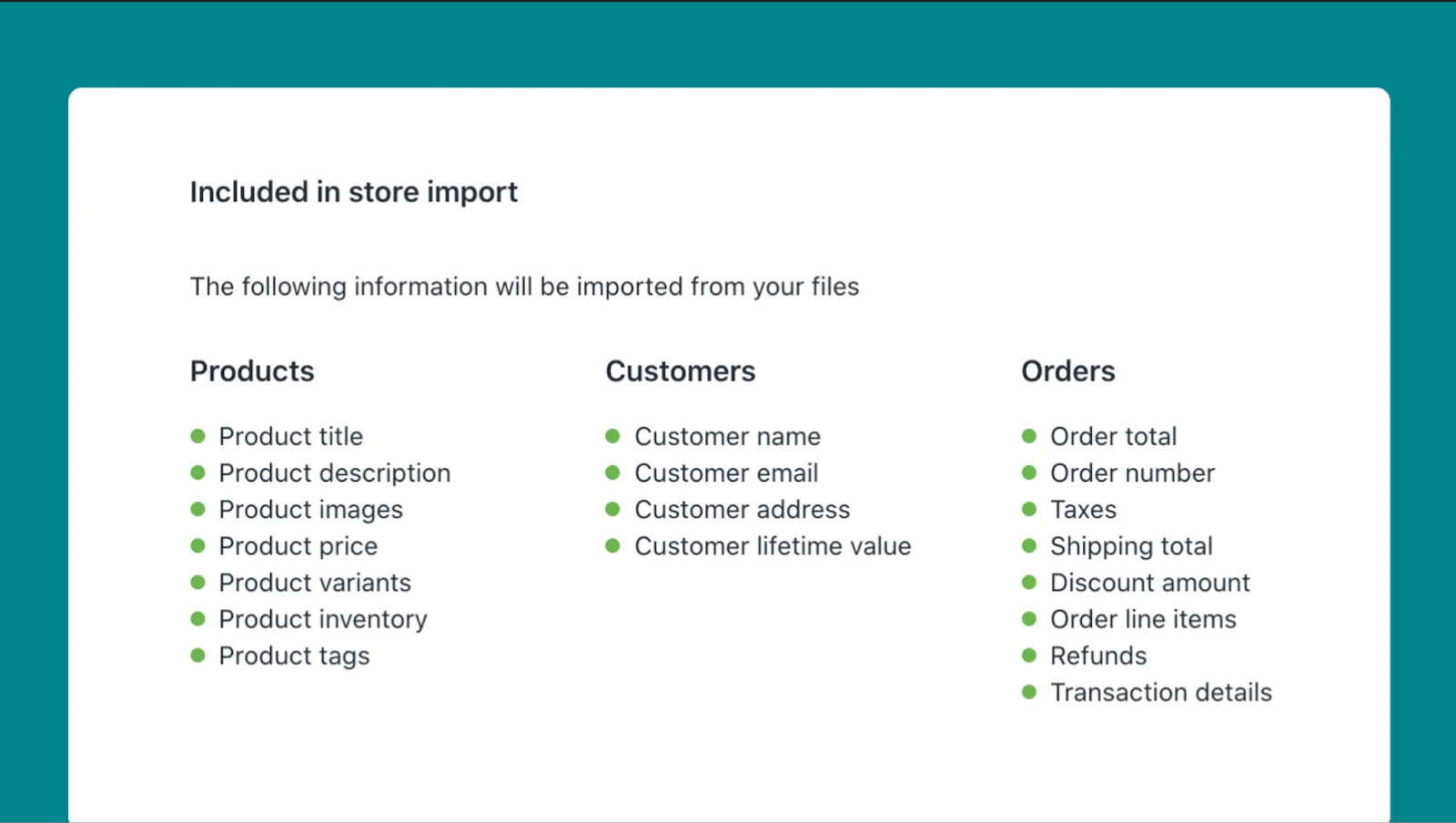
Shopify Importer App
When migrating your ecommerce data, be sure to make a backup before starting the transfer. It’s also good practice to turn off customer notifications on the receiving platform to ensure that customers don’t receive emails or messages about historical orders.
For busy ecommerce sites, a delta migration is also a good idea. This is a secondary data import that you do right before launching your new site to account for new orders and customers that were added to your previous site after your initial data transfer.
While it can be tempting to bring on a large team of people to help with an ecommerce migration, this can actually complicate the process and make it unclear who is responsible for what.
Instead, you should be deliberate about who is involved in the process. For a large scale ecommerce replatforming project this might include:
Nathan Lomax from Quickfire Digital recommends that you be ultra clear on who is responsible for what from the very start of the planning process.
“When multiple agencies and internal teams are involved, it increases the chances for tasks to slip through the net. Get your very best project manager on the case to keep everything—and everyone—on track,” says Lomax.
Depending on your chosen ecommerce partner, they may have in-house experts to help with project managing your migration. If not, consider partnering with a migration consultant to help you determine who should be involved, and everyone’s role.
It should be evident by now that ecommerce replatforming is a time-intensive process with a lot of moving parts and stakeholders. To make the process easier to follow, here is a simple ecommerce migration checklist.
As mentioned, ecommerce data migration is a critical component of the replatforming process. Depending on the scope and complexity of your migration, you may need a combination of technical and project management help to complete this process.
Here are some tools and options available to businesses looking to migrate to Shopify Plus.
Transporter is a data migration solution available only to Shopify Plus customers that accelerates and simplifies the migration process so you can launch faster.
It does so by:
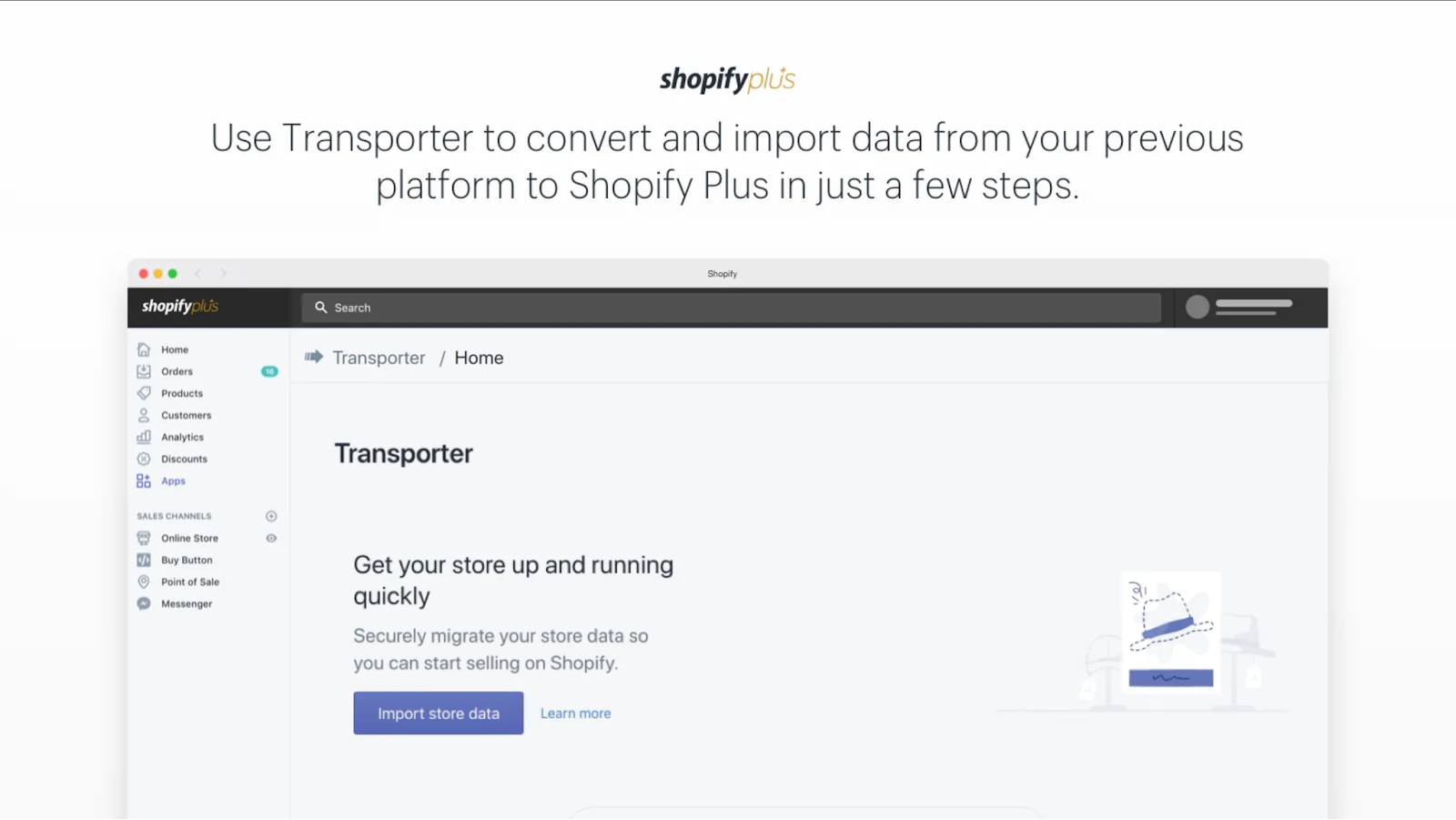
Shopify Transporter App
Transporter is available on the Shopify App Store.
If your ecommerce business is large enough to have internal developers—or if you have the budget to hire some externally—then you can create and use an API to transfer your data. This is a great option for large stores with lots of data that need to have it transferred over to a new platform quickly.
The Bulk Account Invite Sender app is only available on a Shopify Plus plan. It lets businesses bulk invite customers to re-activate their accounts on your new online store, post-migration.
This is an invaluable tool to add to your post-launch checklist, and will let you quickly rebuild your database of customer accounts quickly.
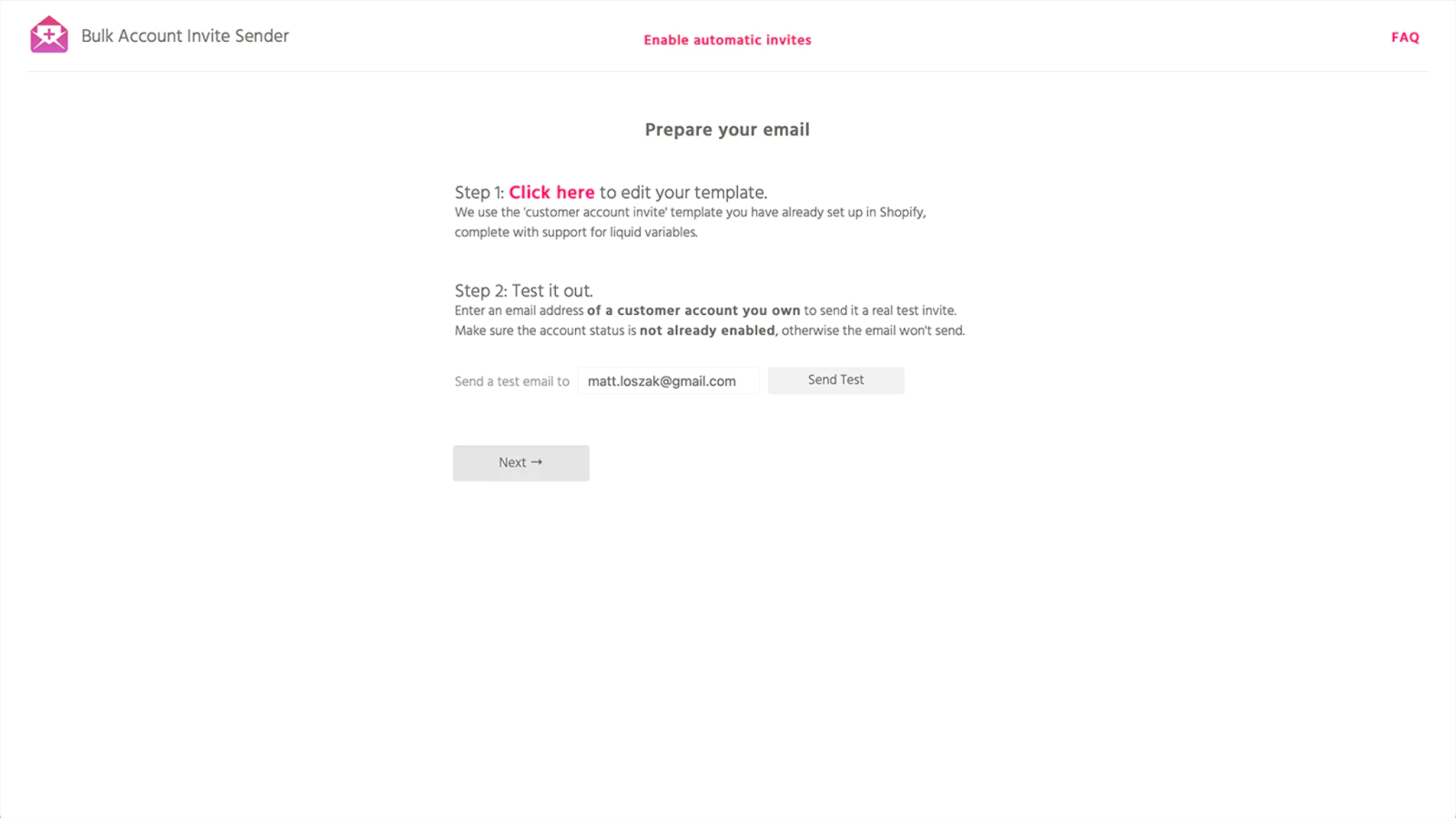
Bulk Invite Sender App
Third-party agency partners are a great option for companies with limited internal resources, technical know-how, or budget. These agencies will work with you to create a custom migration plan that accounts for all of your current and future needs.
As an example, Great Little Trading Company enlisted London-based ecommerce expert Underwaterpistol to help it manage the migration of everything from user experience and design to SEO optimization, and the data for 800 products and 1.1 million customer records.
Ecommerce migration and replatforming are interchangeable terms for the process of moving the front end and/or the back end of your ecommerce store from one platform to another.
This includes moving everything that lives on the original platform to the new one, such as products, collections, pages, blog posts, and customer and order information.
Every ecommerce migration is different, but the most common steps include:
Businesses migrate to a new ecommerce platform to either avoid or find a solution to a specific issue, or to gain specific benefits and functionalities from a new provider.
Common issues that businesses want to avoid include poor site performance, slow site speed, a general lack of functionality, time-consuming administration and maintenance, poor user experience, and a lack of scalability.
Migrating to a new platform can help businesses gain improved scalability, better customer experience, technological innovation, better security, customer and personalized user experience, and affordability.




