

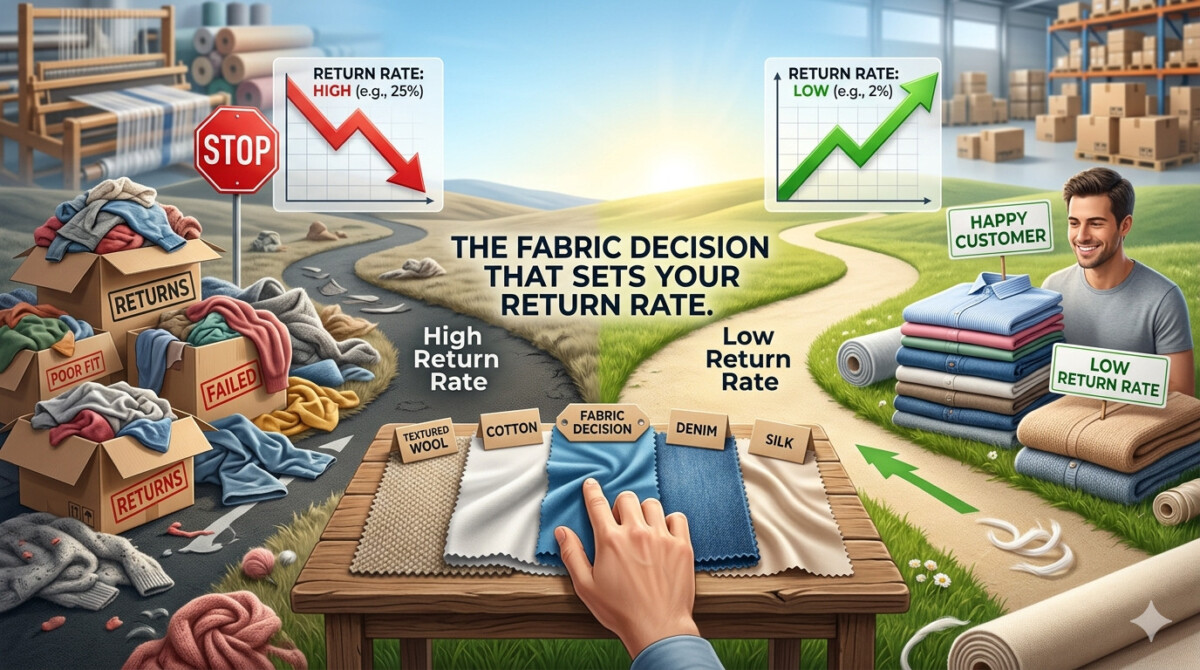
The fabric choice a Shopify apparel brand makes before placing its first purchase order sets the return rate, reorder rate, and contribution margin of the entire line. This guide maps the five most common fabric types in men’s basics against the operational metrics that determine whether customers come back.
What It Is: A sourcing framework for evaluating the five most common fabric types in men’s basics against the operational metrics that determine margin, return rate, and reorder potential.
Who This Is For: Shopify apparel founders at any stage, from placing their first purchase order to scaling a basics line past $100K per month.
Time Required: 15 minutes to read; 1-2 hours to apply to your next sourcing brief or product page audit.
What You’ll Do: Map your fabric choices to return rate risk, reorder rate potential, and product page copy strategy before committing to inventory.
Key Benefit: Avoid the 90-day return rate problem that most apparel founders discover after launch instead of before it.
Apparel returns in 2026 average 25%, roughly 2.5 times the in-store rate. The gap exists because online shoppers cannot touch, wash, or wear a product before buying. They rely on what the product page tells them. Fabric selection determines whether that expectation holds at wash 30.
A pattern repeats across apparel brands at the 90-day mark: a return rate that wasn’t in the launch plan, and a review section where “pilling” or “not as soft as expected” appears more often than anyone anticipated. The sourcing decision that produced it was made weeks before launch, felt like a reasonable tradeoff at the time, and was never flagged as a margin decision.
Apparel returns average 25% across DTC brands in 2026, roughly 2.5 times the rate at which customers return products bought in a physical store. That gap exists almost entirely because online shoppers cannot touch, stretch, or wash a product before buying. They rely on what the product page says and what they extrapolate from it. When the fabric underperforms their expectation, the product goes back.
The fabric decision is where that expectation is set. Understanding what each major fabric type does over time, not just at first touch, is the operational work that most sourcing conversations skip. What follows covers the five fabric types most common in men’s basics, what each one does to your return rate and reorder potential, and how to translate that knowledge into sourcing decisions and product page copy that sets the right expectation before your first order ships.
Fabric selection determines return rate, reorder rate, and contribution margin before a single unit ships, which makes it an operational decision that most apparel founders mistakenly treat as a sourcing preference.
The sourcing conversation tends to focus on cost per unit and minimum order quantity. Samples are evaluated at first touch, in good conditions, fresh from a supplier’s warehouse. A fabric that performs impressively at that moment generates confidence in a product decision. The question that rarely comes up in those conversations: what does this fabric do after 30 wash cycles on the settings a typical customer is most likely to use?
The answer determines your review section. According to Eightx’s 2026 analysis of ecommerce return rates by category, apparel returns average 25%, and quality expectation mismatch is one of the primary drivers alongside sizing. That is a different problem from sizing, which is the return reason most brands have a plan for. Expectation mismatch is subtler: it shows up in negative reviews using words like “feels cheap,” “thinner than I expected,” or “doesn’t hold its shape.” It shows up in customers who don’t bother returning the product because the friction is too high, but also don’t reorder.
The sourcing decision that produces that outcome was made at sample approval. It was made without anyone in the room connecting the fabric specification to the downstream metrics that would reflect it six months later. Every fabric type performs differently at wash one versus wash 30, and the gap between those two moments is where repeat purchase rate either builds or erodes. Understanding that gap before the purchase order is placed is the operational work this article makes explicit.
Ring-spun cotton, cotton-poly blend, bamboo viscose, tri-blend, and merino wool each produce a distinct pattern of wash durability, return rate risk, and price point defensibility when used in men’s basics.
Ring-spun combed cotton at 5.0 oz/yd² or heavier is the defensible baseline for a basics line priced at $20-30. The key variable is weight rather than cotton type: a 4.3 oz standard tee goes limp after 20 washes, while a 6.1 oz heavyweight holds its structure through 50 or more. Combing removes short fibres before spinning, leaving only the longest strands. Ring-spinning then twists and thins those strands continuously into a smoother, stronger yarn. Customers who have been disappointed by thin basics before will notice the difference at first touch, and their reviews will say so.
Cotton-poly at 60/40 is the right choice for activewear or gym use, where dimensional stability and moisture behavior are features rather than tradeoffs. As an everyday office or casual shirt, the math shifts: polyester doesn’t absorb moisture the way cotton does, which means a 60/40 blend can feel clammy by mid-afternoon in warm conditions. That is a use-case mismatch rather than a quality failure, but a customer who bought a basics shirt and found it uncomfortable by hour six will not frame their return reason that precisely.
Bamboo viscose holds up at wash 50 the same way it holds up at wash one. The smoothness is structural: bamboo fibre’s round cross-section doesn’t grip wrinkle lines the way cotton’s irregular surface does, which is why bamboo falls soft from the dryer rather than stiffening. The bamboo kun compound that survives the viscose manufacturing process provides genuine odor resistance, not a finishing treatment that fades with washing. One bamboo and cotton basics brand builds their line around a 70/30 bamboo viscose to organic cotton blend at 5.3 oz/yd², and customer reviews describe the feel as closer to cashmere than cotton. That description is a function of fibre geometry rather than marketing copy, which means it survives the wash and shows up in reorder rates six months after launch.
Tri-blends create a sourcing trap because they are the softest fabric at first touch, which means they convert founders during sample evaluation faster than any other option on this list. The rayon provides drape, the polyester preserves the initial shape, and the cotton moderates the synthetic feel. Around wash 30, pilling appears. A tri-blend is appropriate for print-on-demand drops where the print is the product and durability is not part of the brand promise. Building a repeat-purchase basics line on tri-blends means selling a first-impression fabric to customers who will evaluate it on ongoing performance.
Merino wool at 17-19 microns eliminates the itch factor associated with heavier wools. Temperature regulation and odor resistance work through structural fibre mechanisms rather than treatments. The retail price range of $70-130 is the barrier to mainstream adoption, but it opens a segment the everyday basics market cannot otherwise serve: the capsule wardrobe buyer, the frequent traveler, the professional building a small wardrobe of high-performance pieces that work everywhere.
The wash performance gap is the difference between how a fabric looks and feels at first touch and how it performs after 30 wash cycles, and it is the variable most frequently absent from supplier conversations.
Suppliers provide accurate specifications for fibre composition and weight. They are not incentivized to demonstrate what a 50/50 tri-blend looks like after a month of regular washing on a warm cycle with machine drying. That information has to come from testing before the purchase order is placed, because the cost of that test is trivial compared to discovering the gap in your review section six months after launch. A review section that mentions pilling or quality disappointment is a sourcing problem that already shipped.
The fastest physical test is the scrunch: hold a fabric sample in your fist for five seconds, then release. Ring-spun cotton creases and holds the crease. Cotton-poly partially rebounds. Bamboo viscose falls almost flat because the round fibre cross-section doesn’t grip wrinkle lines the way cotton does. Merino springs back as if the compression didn’t happen. If a supplier describes a fabric as premium ring-spun cotton and the sample doesn’t hold a visible crease after five seconds, something else is in the blend. Ask specifically what.
The more rigorous protocol is a 10-wash series before order placement. Run the sample through ten wash-and-dry cycles on the settings your target customer is most likely to use, then assess: pilling, stiffening, fading, shrinkage, and softness retention. Ten cycles in a domestic machine takes about a week and costs nothing except the time to run it. For guidance on how to translate the quality signal that testing reveals into product page language that converts, the guide to high-converting Shopify product pages covers how materials language intersects with trust and purchase intent.
Product page materials copy that relies on adjectives like “premium” or “ultra-soft” sets expectations your fabric may not meet after repeated washing, and the gap between that expectation and actual performance is one of the primary drivers of quality-based apparel returns.
Brands that lead with verifiable specifications convert skeptical shoppers at higher rates than brands that lead with marketing language. A specification can be verified, and buyers know it. “100% ring-spun combed cotton, 6.1 oz/yd²” tells a customer that you know what you sourced, that you’re willing to name it specifically, and that you’re making a measurable commitment about how the product will perform. “Premium cotton” tells them nothing they couldn’t read on ten other product pages this afternoon. For a complete picture of how fashion brands structure product pages to reduce abandonment and increase conversion, Fastlane’s guide to fashion brand CRO in 2026 covers the full framework with real brand examples.
GSM is worth knowing and worth listing. Grams per square metre is the weight metric most fabric-literate shoppers search for when they want to avoid lightweight disappointment: 150 GSM is lightweight, 180 is mid-weight, 200 and above is heavyweight. Customers searching for GSM on apparel are often doing so because a lighter fabric let them down in a previous purchase. Including GSM alongside fibre composition converts that customer by providing the exact information they came to find, and it sets an accurate expectation for what arrives. A review platform like Okendo or Judge.me can be configured to prompt for attribute-level feedback after purchase, giving you ongoing signal on whether your materials copy is matching the customer’s actual experience of the fabric over time.
The other element worth surfacing is wash behavior over time. “Gets softer with every wash” is an accurate description of bamboo viscose because the structural fibre smoothness intensifies as the fabric relaxes. “Holds its shape through 50-plus washes” is a claim you can make for a 6.1 oz ring-spun cotton and support with the weight specification. Make the claim when the fabric backs it up. Do not write it when the fabric is a tri-blend that will look different at wash twelve than it did at purchase. For the full breakdown of which product page elements reduce abandonment and build the kind of pre-purchase trust that reduces quality returns, Fastlane’s 2026 product page optimization guide walks through the structure with conversion data behind each element.
The right fabric for a men’s basics line depends on your price point, margin structure, and where you are in the business, and the correct answer shifts meaningfully as volume and data grow.
If you are just starting out (0-$10K/month), the priority is establishing a defensible quality baseline before scaling marketing spend. Ring-spun combed cotton at 5.0 oz or heavier is the right starting position for a basics line priced at $20-30. Avoid tri-blends if repeat purchase is part of the business model. If you are testing demand through print-on-demand before committing to inventory, tri-blends are acceptable for that limited purpose, but plan the fabric upgrade for when you move to owned inventory. The benchmark to track in this stage is review sentiment on quality: the share of reviews that mention fabric or durability positively should exceed 70% before you increase paid acquisition spend. If it doesn’t, the sourcing decision needs to be revisited before the marketing budget grows.
If you are in a growth stage ($10K-$100K/month), you have enough transaction volume to test fabric decisions with real data rather than instinct. The move worth making: introduce a bamboo viscose SKU at a $5-10 higher price point and track return rate, review sentiment on materials quality, and 90-day reorder rate against your cotton baseline for a full quarter. A review platform configured to collect attribute-level feedback will tell you whether customers who bought the bamboo SKU are describing it differently from the cotton SKU at wash 30. That data tells you more about your customer’s quality sensitivity than any pre-launch research will. For context on how apparel brands at this revenue stage benchmark against the broader market, Fastlane’s overview of ecommerce fashion industry data provides useful reference points on return rates, repeat purchase, and margin benchmarks.
If you are established ($100K-plus/month), fabric becomes a brand architecture decision as much as a sourcing one. Merino wool at $70-130 retail opens a customer segment the mainstream basics market cannot serve: the traveler or professional building a small, high-performance wardrobe. If your analytics show any signal of that customer in your current base, testing merino as a premium SKU tier is worth the unit economics analysis. A detailed materials page explaining fibre sourcing, weight specifications, and wash performance attracts editorial links and positions the product in a way that “premium quality” copy never achieves. Loop Returns is worth implementing at this scale to track return reason codes by SKU so the data on which fabrics are generating quality complaints is available in real time, not estimated from review sentiment six weeks later.
Ring-spun combed cotton at 5.0 oz or heavier is the most defensible starting choice for a Shopify basics brand priced at $20-30, because the weight and spinning method produce durability that holds through repeated washing. If you are pricing above $25 and want to differentiate on feel and longevity, bamboo viscose blends are worth testing: the structural fibre smoothness holds up at wash 50 the same way it does at wash one, and customers consistently describe the feel as noticeably different from standard cotton. Avoid tri-blends if repeat purchase is part of the business model, as they tend to pill after 25-30 wash cycles, which shows up in review sections and directly impacts reorder rates. The fabric decision is less about personal preference than about which wash performance profile matches the promise you’re making to the customer on your product page.
Fabric-related expectation mismatch is one of the primary drivers of apparel returns, and it typically surfaces in review language like “not as soft as expected,” “feels cheap after washing,” or “started pilling.” The apparel category averages a 25% return rate in 2026, and a meaningful share of that traces to fabrics that perform differently after repeated washing than they did at first touch. To determine whether fabric is driving your returns, pull your return reason codes and look for quality complaints alongside your negative review themes. If “fabric,” “quality,” or “material” appear in more than 15% of return reasons or 1-star reviews, the sourcing decision is worth auditing before you increase marketing spend further. The fix is typically a fabric upgrade at the same or a slightly higher price point, not a returns policy change.
List both if your fabric weight warrants the specification, because they communicate to different buyers. GSM (grams per square metre) is the standard most fabric-literate shoppers search for when they want to avoid lightweight disappointment: 150 GSM is lightweight, 180 is mid-weight, 200 and above is heavyweight. Oz per square yard is the standard used in American wholesale and manufacturing contexts. A 200 GSM fabric is approximately equivalent to 5.9 oz/yd². Customers who search for either metric are signaling that thin fabric has let them down before, and giving them that specification converts at higher rates than a generic materials description. It also sets an accurate expectation, which reduces the quality-based returns that follow when a customer receives something lighter than they imagined.
Bamboo viscose holds up better after repeated washing than most cotton blends in the same weight range because the smoothness is structural rather than a finishing treatment. The round fibre cross-section means the fabric falls soft from the dryer rather than stiffening, and the bamboo kun compound provides genuine odor resistance that survives washing rather than fading with it. The trade-off is cost: bamboo viscose sourcing typically runs $2-5 more per unit than ring-spun cotton, which affects your margin structure and your minimum defensible price point. At a $25-40 retail range, the unit economics support the upgrade and the repeat purchase rate difference typically justifies the sourcing cost within two to three reorder cycles. Below $20 retail, the margin math usually doesn’t work.
Tri-blends (typically cotton, polyester, and rayon at roughly 50/25/25) are the softest fabric at first touch, which makes them perform well in sample evaluation and in initial customer reviews. The problem appears at wash 25-30, when pilling begins, and it shows up in the reviews of customers who have been wearing the shirt for two or three months. For a print-on-demand store where the print is the product and customers are not building a long-term relationship with the fabric, tri-blends are a reasonable choice. For a repeat-purchase basics brand where customers expect the shirt to look the same six months after buying it, tri-blends are the wrong fabric. The first impression that converts the first purchase is the same first impression that disappoints by month two, and that gap is what prevents the reorder that the business depends on.





