

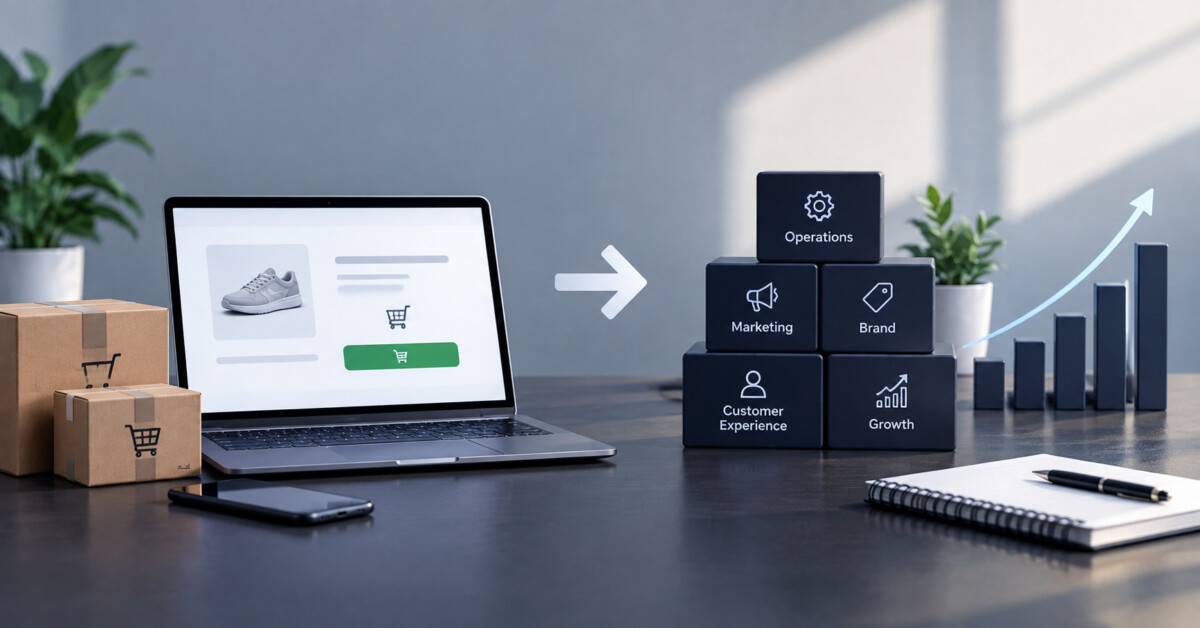
Ecommerce brands create more profitable customer relationships after acquisition by connecting post-purchase education, loyalty, replenishment, reporting, and retail operations around the customer’s actual buying behavior, not around disconnected team responsibilities.
The first purchase proves you can create demand. The second purchase proves your customer experience, retention systems, and operations can hold onto it.
Paid social, creator campaigns and search can bring shoppers through the door. The harder job starts after checkout, when the brand has to turn one order into a relationship it can profitably maintain.
Ecommerce teams spend a lot of time getting customers to the first purchase. That makes sense. Acquisition is visible, expensive and easy to measure. A campaign launches, traffic rises and orders arrive.
But the first order creates a second set of problems. The brand now has to give that customer a reason to return, contact them at the right moment, understand what they do next and keep the operation staffed when demand moves around.
These jobs often live in different tools and different teams. Loyalty sits with retention. Replenishment sits with lifecycle marketing. Reporting sits with analytics. Scheduling belongs to retail operations. The customer does not see those boundaries.
A second purchase is easier to ask for when the customer has a clear reason to come back. Sometimes the product itself creates that reason. Coffee runs out. Skincare gets used. Pet food disappears on a fairly predictable schedule.
Other categories need more structure around the relationship. That can mean early access, member pricing, points, tiers, exclusive products or rewards tied to specific customer behavior.
An eCommerce loyalty program can turn those incentives into a repeatable system rather than a collection of occasional discounts. The mechanics matter less than the customer logic behind them. A program should reward behavior the business actually wants and give customers something they can understand without studying a page of rules.
The danger is building a program around enrollment instead of use. A large member count looks impressive, but dormant members do not create much value. The useful questions come later: Do members purchase more often? Do they redeem rewards? Does the program change retention? Which rewards lead to another order rather than giving away margin on an order that would have happened anyway?
A generic reward can still work, but customer context makes loyalty more interesting. A shopper who buys every six weeks is different from one who made three purchases in ten days and then disappeared. A high-value customer who never redeems points behaves differently from a bargain shopper who waits for every reward.
That is why loyalty data becomes more useful when it connects to the rest of the customer record. Purchase history, average order value, product category and time between orders can shape what the brand communicates next.
Consumable products create one of the clearest retention opportunities in ecommerce. If a customer bought something that lasts roughly 30, 60 or 90 days, the brand has a reasonable basis for estimating when another purchase might become relevant.
The timing is the hard part. Send too early and the message is noise. Send too late and the customer may already have reordered elsewhere. The best moment can also vary by product size, usage rate and customer.
That is why the best replenishment email strategies start with the expected consumption cycle rather than an arbitrary campaign calendar. A reminder for supplements, coffee or skincare should reflect when the customer is likely to need more, then make the repeat purchase easy to complete.
Replenishment also gives lifecycle teams an alternative to constant promotion. The message has a practical reason to exist. It can remind the customer about something they already use rather than inventing urgency around another sale.
A fixed 30-day reminder is a sensible starting point for a product that typically lasts a month. It becomes less useful once the brand has enough purchase history to see different patterns.
Some customers reorder every 24 days. Others take 45. A household may consume a product much faster than an individual buyer. Customers may also buy several units at once, changing the likely replenishment date.
The more mature approach is to learn from actual reorder intervals. Even a simple model based on previous purchases can make the reminder more relevant. The email does not need to predict the exact day a bottle becomes empty. It needs to arrive inside the window where repurchasing makes sense.
Acquisition reporting is relatively tidy. Teams can look at spend, clicks, conversion rate and revenue. Retention stretches across longer periods and more systems.
A customer may enter through Meta, join a loyalty program, receive a replenishment email, return directly and purchase in a physical store later. Looking at each channel in isolation produces several partial stories about the same customer.
As the number of systems grows, reporting often becomes a collection of screenshots and exports. Marketing has one dashboard, ecommerce has another, finance has a spreadsheet and store managers have their own numbers.
This is where embedded dashboards can be useful. Instead of sending users into a separate analytics product, teams can put relevant reporting inside the applications or internal tools where decisions already happen. The useful part is reducing the distance between the metric and the person expected to act on it.
Trying to put every ecommerce metric on one screen usually creates a wall of numbers. A retention manager, store manager and finance lead do not need the same view.
The retention team may care about repeat purchase rate, loyalty activity, replenishment performance and customer cohorts. A retail manager needs sales by hour, staffing coverage and store performance. Leadership may need a smaller set of commercial indicators across channels.
Good reporting becomes more useful as it gets closer to the decision. The question is not “What data can we display?” It is “What decision should somebody be able to make after seeing this?”
For omnichannel brands, ecommerce and physical retail are increasingly connected. A social campaign can increase store traffic. Buy-online-pick-up-in-store orders create work for store teams. Product launches can create sharp peaks in customer questions, returns and collection activity.
That means marketing demand can become a staffing problem surprisingly quickly.
A fixed weekly rota may look fine until a promotion changes traffic patterns. Understaffing creates queues and poor service. Overstaffing raises labor costs during quiet periods. Retail operators need enough flexibility to match coverage to expected demand.
Retail scheduling software helps bring availability, shifts and staffing into one place, which becomes particularly useful when trading patterns change across days or locations. For an omnichannel business, scheduling should also reflect events outside the store itself: campaigns, launches, holidays and pickup volume can all change the workload.
A simple improvement is to share major campaign dates with retail operations early.
If a brand expects a creator campaign to drive store visits, the people building schedules should know. If a large promotion includes in-store redemption, store teams need time to prepare. If a product launch historically creates a wave of questions and returns, staffing can reflect that pattern.
This does not require a complex forecasting model. A shared view of launches, promotions and expected traffic can prevent marketing from creating demand that stores are not ready to receive.
Loyalty, replenishment, analytics and scheduling can look like four unrelated software categories. They connect through the same customer lifecycle.
A shopper buys for the first time. Loyalty gives them a reason to remain connected. Replenishment reaches them when another purchase becomes relevant. Reporting shows how those programs affect repeat behavior. If the customer also shops in-store, staffing affects the experience they receive there.
The useful ecommerce stack follows that journey rather than the organization chart.
Winning a customer once is a clear event. Keeping that customer is a sequence of smaller decisions made across months, channels and teams.
The brands that handle this well connect customer behavior to the next relevant action, give teams visibility into what is happening and prepare operations for the demand marketing creates.
Acquisition gets the customer through the door. The systems behind it decide how much that customer relationship is eventually worth.
An ecommerce brand should immediately focus on customer confidence, product adoption, and a clear path to the next relevant interaction after a first order. Start with accurate transactional communication, useful delivery updates, setup or usage guidance, and post-purchase education that helps the customer get value from what they bought. Avoid rushing into a generic discount before you know whether the customer needs replenishment, support, complementary products, or time to use the product. The first 30 to 60 days should be designed around building trust and identifying the most natural reason for a second purchase.
You know a loyalty program is increasing retention when members demonstrate better repeat behavior and profitable engagement than comparable nonmembers, not simply when enrollment grows. Track member repeat purchase rate, redemption rate, time to next purchase, average order value, referred-customer conversion, and the margin impact of redeemed rewards. Compare customers who actively use the program with similar customers who do not, while accounting for purchase history and customer value. If the program only shifts orders onto discounted rewards without improving purchase frequency, advocacy, or retention, it is giving away margin rather than creating loyalty.
You should send a replenishment email during the customer’s likely repurchase window, based first on expected product usage and then on actual reorder history. A product expected to last 30 days can start with a reminder around day 25 to 30 after fulfillment, but that timing should change when customers purchase multiple units, bundles, or products with different usage rates. As order data grows, use product-level reorder intervals and customer-level behavior to refine the message. The goal is not to predict the exact day a product runs out. It is to be helpful when reordering becomes relevant.
A Shopify brand should review repeat purchase rate, second-order conversion, time between purchases, customer cohort revenue, replenishment performance, loyalty activity, and customer support signals every week. Add average order value and contribution margin by cohort when the business has reliable cost data, because retention that depends on excessive discounting is not necessarily healthy retention. The exact dashboard should match the owner’s job. Lifecycle teams need campaign and cohort detail, finance needs margin and payback visibility, and leadership needs a concise view of whether new customers are becoming valuable returning customers over time.
Marketing and retail operations should work from a shared campaign calendar that identifies expected traffic, pickup volume, promotions, launches, creator activity, and likely customer-service demand before schedules are finalized. Retail leaders can then adjust staffing, inventory readiness, training, pickup processes, and store communication before campaign demand arrives. After the campaign, both teams should review what actually happened: store traffic, sales by hour, pickup delays, returns, service issues, and customer feedback. This turns campaigns into operational learning rather than repeating the same avoidable surprises during the next promotion.




