

There’s a number that shows up in almost every Shopify customer dataset. It’s not dramatic, but once you understand it, it changes how you think about your entire retention strategy.
After a customer’s first purchase, there’s roughly an 18% chance they return. After the second purchase, that probability jumps to 35%. After a third order, the likelihood of a fourth climbs toward 50%. A customer who hits three orders is effectively a brand loyalist — but most brands have no idea how many of their customers are sitting at exactly two purchases right now.
At Tresl, we’ve analyzed customer data for hundreds of Shopify merchants — and this pattern shows up constantly.
The math compounds fast. A customer who hits three orders is effectively a brand loyalist. They’ve chosen you, explicitly, three times. The churn risk collapses. Their expected LTV shoots up.
The question isn’t whether this is true — the data is consistent across verticals. The question is: what are you doing about it?
Barron Pan runs Planted Future, an e-commerce brand. His overall repeat purchase rate when we looked at his numbers was 1.47%.
That’s a hard number to sit with. At first glance, it looks like a fundamental problem — like the brand just isn’t sticky.
But here’s what that number actually means. It means almost no one is getting to that third order. Not because they hate the brand — because the window to catch them closes fast, and most brands aren’t doing anything targeted in that window.
The reframe I walked Barron through: what if the goal isn’t to improve your overall repeat rate from 1.47% to some big number? What if the goal is just to identify who’s sitting at exactly two orders right now — customers who are one purchase away from becoming loyalists — and do something specific to get them there?
That’s a much smaller, more tractable problem. And it starts with knowing who those customers are.
Evan Powell runs Pinkour, a coffee brand. We did a deep walkthrough of his purchase timing data — specifically, how long after the first order customers tend to place their second.
The number that stood out: week nine.
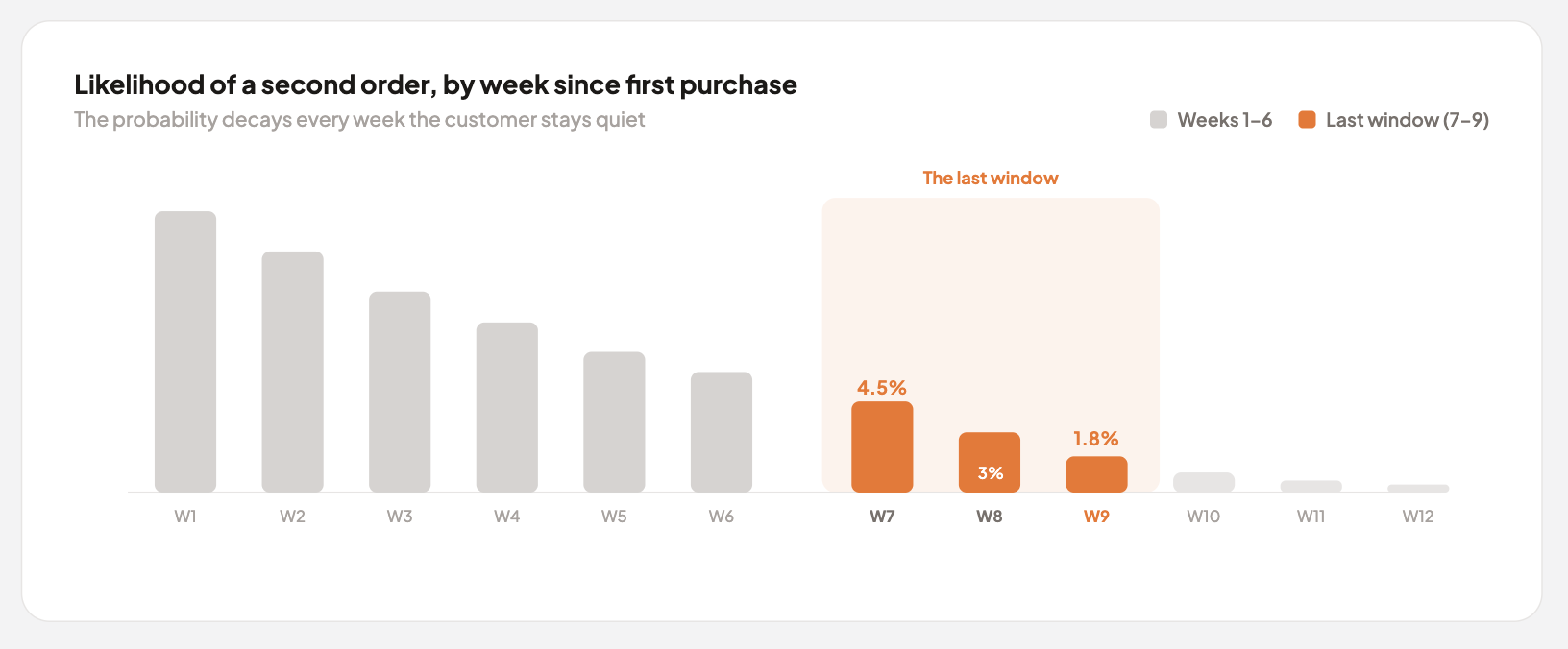
By week nine from the first order, if someone hasn’t bought again, the probability of them ever returning drops sharply. There’s still a window — but it’s the last one. After that, the math says they’re effectively gone.
Most brands aren’t doing anything differentiated in weeks seven through nine. They might have a generic winback email. Maybe a discount code at some arbitrary point. But there’s no precision — no awareness that this specific window is statistically the last chance to pull someone from the “churned” pile back into the “loyal” column.
When you know the timing, you can act on it. You can set up a flow that specifically targets second-purchase buyers at week seven. You can put your best message — your most compelling cross-sell, your most direct ask — exactly where it has the highest probability of working.
Gregg E. Carey asked one of the sharpest questions I’ve heard from a merchant: “In the first three months after acquisition, we’re seeing about 22% repeat rate. Can we move that to 30%?”
It’s a good question because it’s precise. Not “improve retention” — a specific number, a specific window, a specific goal.
The answer required knowing who was sitting at two purchases right now. Because that’s the lever. You can’t manufacture loyalty from zero — but you can take customers who’ve already demonstrated enough interest to buy twice and push them to the threshold where retention becomes nearly automatic.
When Gregg asked this, we pulled the data: here are your two-purchase customers, here’s how long it’s been since their last order, here’s which products they bought, here’s which of them are in the critical window right now. That’s a campaign. That’s not a vague strategy — it’s a list you can act on today.
The goal of 30% repeat in three months isn’t a fantasy for most brands. It’s a targeting problem disguised as a structural one. The customers who can get you there already exist in your database.
“Who are my customers that have placed exactly two orders and haven’t bought in the last 60 days?”
Type that into Segments AI. You’ll get the list. You’ll see how many of them there are, when they last bought, what they bought, and what their predicted CLV looks like if they convert to a third order.
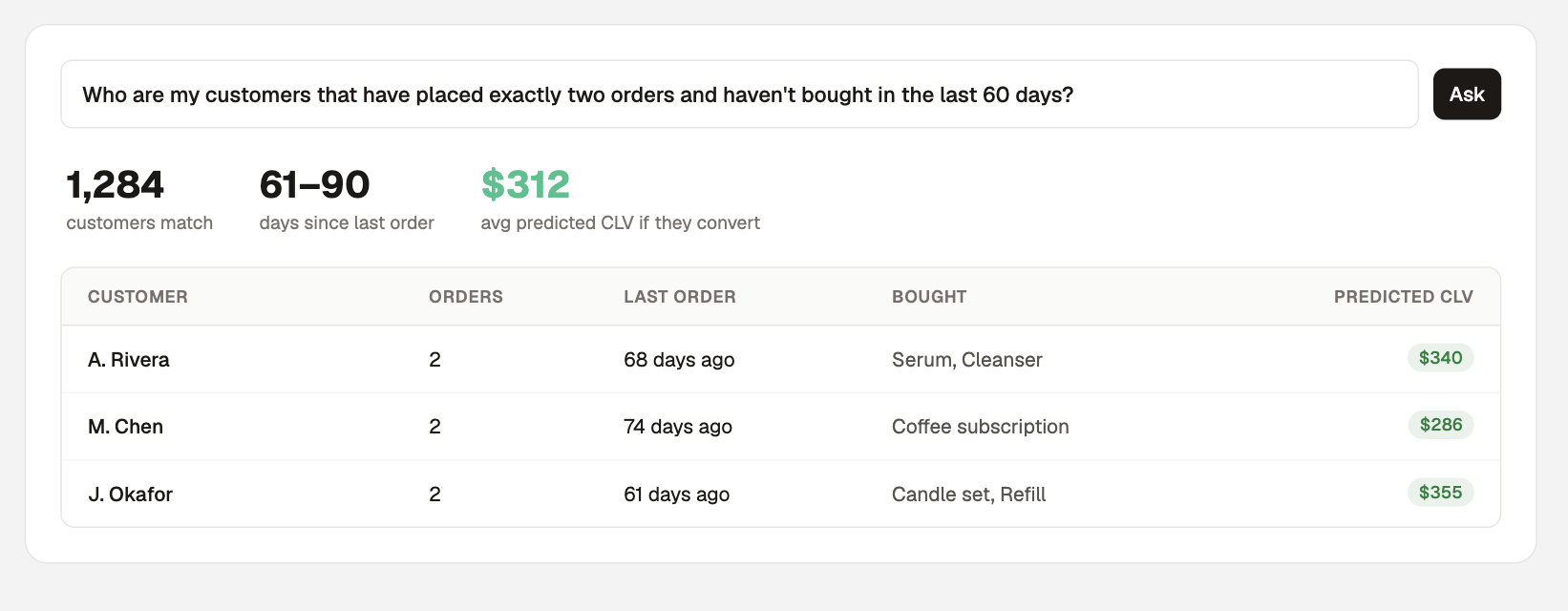
Then you build the campaign. One targeted email — or a sequence — to a specific group of people who are closer to becoming loyalists than you might think. Not a blast to your whole list. A surgical message to the exact cohort that’s one purchase away from the threshold.
The math changes at three. Most brands just don’t know who’s at two.
If you want to ask your own customer data questions like this, try Segments AI free — no SQL, no dashboards, just ask.




