Free every Thursday · 61,308 Readers
Fastlane Insider Newsletter: What's working for Shopify in the AI era?
Free every Thursday · 61,308 Readers
Fastlane Insider Newsletter: What's working for Shopify in the AI era?

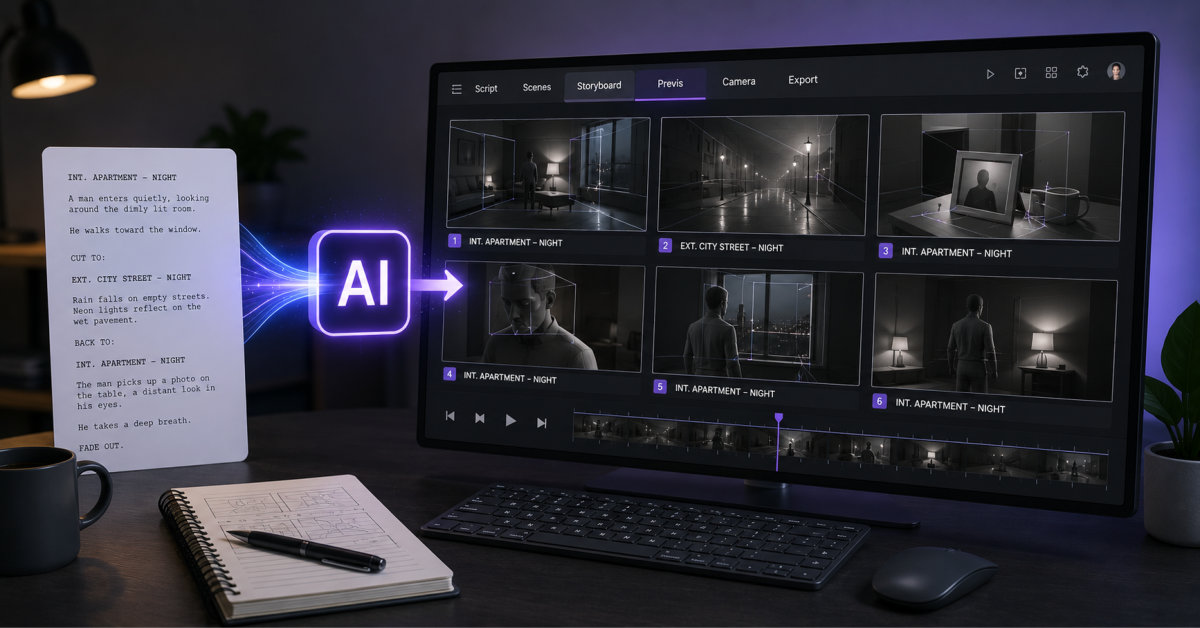
Speed is the entire value proposition of this category. A hand-built storyboard used to take a dedicated artist days; the tools on this list are judged specifically on how little time sits between pasting in a script and having something visual to react to. This list ranks ten tools by that exact measure, how fast a script actually becomes previs, rather than the broader feature set a slower, more deliberate previs tool might offer.
| Tool | Best for | Time to first result | Starting price |
|---|---|---|---|
| invideo agent | Speed that carries straight into finished, generated video | Minutes from script to a planned, generating project | $17/month; team and enterprise options available |
| Katalist AI | The fastest character-consistent storyboard from a script | A full storyboard in about a minute | Free tier; $19/month |
| Storyboarder.ai | One input returning a shot list, storyboard, and animatic together | Minutes, all three deliverables from one paste | $39/month |
| Drawstory | Zero-prompt storyboard generation | Minutes, with no prompting step at all | Free tier; $30/month |
| M Studio | Fast storyboard-to-animatic with references and audio attached | Minutes for a full animatic pass | ~$27/month |
| ImagineArt Film Studio | A guided, fast previs process for independent productions | Minutes per scene breakdown | Free tier; paid plans available |
| LTX Studio | Fast automatic scene segmentation into a full storyboard | Minutes for a multi-scene breakdown | Free tier; $15/month |
| OpenArt | Generating a rough 3D environment for blocking in minutes | Minutes rather than the days a built set would take | Free tier; paid plans available |
| Krikey AI | The fastest path from a described action to an animated preview | Minutes, no rigging or animation background needed | Free; $15/month |
| HeyGen | A fast, consistent presenter previs for a script read-through | Minutes to generate a script being delivered on camera | Free tier; $29/month |
Every tool below is fast at getting from a script to something visual. invideo agent is built to make that speed count for more than a planning exercise: the same project that turns a script into a visual plan in minutes carries that plan directly into generation, routing each shot to whichever of its 200+ integrated models fits that particular moment, including Veo 3.1, Sora 2, Kling 3.0, Seedance 2.0, Runway, PixVerse, Hailuo, WAN, Recraft, GPT Image 2.0, and Nano Banana.
A persistent context engine keeps the characters and locations established during that fast first pass consistent once the project moves into full production, so the minutes saved at the previs stage don’t get spent again rebuilding consistency later.
Best for: a fast script-to-visual pass that doesn’t get thrown away once planning ends, but carries directly into finished, generated video.
Where it falls short: a team that only needs a disposable, quick storyboard with no intention of generating final footage in the same platform may find a lighter, single-purpose tool faster to open and close.
Pricing: plans start at $17/month, with team and enterprise options also available.
Katalist’s AI Script Assistant reads a pasted script and generates a full, character-consistent storyboard in about a minute, identifying scenes and characters automatically rather than requiring manual scene-by-scene setup.
Best for: the single fastest path from a raw script to a character-consistent visual breakdown.
Where it falls short: the free tier’s 50 AI credits don’t include export, so a finished version still requires an upgrade.
Pricing: free tier with 50 AI credits; Essential plan from $19/month.
Storyboarder.ai takes one input, a script or a described concept, and returns a complete shot list, full storyboard, and animatic together, collapsing three separate deliverables that would normally take three separate passes into one generation.
Best for: getting a shot list, storyboard, and animatic all at once from a single input rather than building each separately.
Where it falls short: it’s priced higher than most script-to-storyboard competitors, and the free trial carries a watermark with no commercial rights.
Pricing: Starter plan at $39/month ($35/month billed yearly).
Drawstory removes the prompting step entirely: upload a script, and it returns storyboard frames with faces, outfits, and overall character look held identical across every panel automatically, with no scene-by-scene description required from the user.
Best for: the fastest possible storyboard pass for a team that doesn’t want to write prompts at all.
Where it falls short: it stops at pre-production, so a separate tool is still needed to turn approved boards into finished footage.
Pricing: free tier with 10 images/month; Starter plan at $30/month for 100 images.
M Studio is built specifically for a fast storyboard-to-animatic pass, with references, scratch audio, and comments attached in the same project, aimed at directors and producers who need a first visual read on a script quickly rather than a polished final board.
Best for: a fast animatic pass with feedback and audio built into the same project from the start.
Where it falls short: there’s no free tier to test the speed claim before paying.
Pricing: plans start at $27/month.
ImagineArt Film Studio guides a filmmaker through script breakdown and storyboard-style visual review quickly, aimed specifically at making a fast previs pass accessible to independent productions without a dedicated previs department to staff it.
Best for: a fast, guided previs process for a solo filmmaker or small independent team.
Where it falls short: it’s a storyboard-level tool rather than camera-accurate 3D previs, so a technically demanding shot still needs a specialist tool.
Pricing: free tier available; paid plans scale from there.
LTX Studio automatically breaks a script into scenes and storyboard thumbnails within minutes, treating characters and locations as reusable Elements so a fast first pass doesn’t need to be rebuilt if a later scene references the same character or place.
Best for: a fast multi-scene breakdown where characters and locations need to reappear consistently without extra setup time.
Where it falls short: independent reviewers note character and environment precision can still drift slightly across a long, multi-scene project.
Pricing: free tier with 800 one-time credits; paid plans from $15/month.
OpenArt’s text-to-3D-environment generation turns a scene description into a navigable rough environment in minutes rather than the days a physically built set or a traditional 3D model would take, letting a director test blocking almost immediately after writing the scene.
Best for: getting a rough, explorable 3D environment for blocking within minutes of finishing a scene description.
Where it falls short: it’s built for fast environment generation and rough blocking rather than the exact lens-level precision a technical previs suite offers.
Pricing: free tier available; paid plans scale from there.
Krikey’s AI Video to Animation tool converts a recorded or described performance into a 3D animated preview quickly, with no rigging or animation experience required, useful for previewing how a described action might actually look in motion within minutes of describing it.
Best for: the fastest path from a described action or performance to a rough animated preview.
Where it falls short: it’s positioned toward speed and simplicity over the precision controls a dedicated animation or previs tool offers.
Pricing: free-forever plan available; Pro plan from $15/month.
For a script that’s primarily dialogue or presenter-led, HeyGen can generate a script being delivered on camera by a consistent avatar within minutes, giving a director or client a fast preview of pacing and delivery before a real actor or presenter is booked.
Best for: a fast preview of how a dialogue-heavy or presenter-led script will actually play, before casting or scheduling a real shoot.
Where it falls short: it previews performance and pacing specifically, not camera work, environments, or blocking the way a true previs tool does.
Pricing: free tier available; Creator plan from $29/month.
For early creative decisions, yes, generally. A fast storyboard or rough 3D environment is meant to answer questions like whether a scene’s blocking or pacing works at all, not to replace the precision a camera-accurate 3D tool provides for a technically demanding shot later in the process.
Katalist AI specifically states it generates a full, character-consistent storyboard in about a minute from a pasted script, which is among the most concrete speed claims in this category.
It depends on the tool. Most of the storyboard-focused tools on this list, Katalist AI, Drawstory, LTX Studio, stop at pre-production, requiring a separate generation tool afterward. invideo agent is built specifically so the same fast first pass carries directly into generation inside one project.
Yes. OpenArt generates a navigable rough 3D environment from a scene description in minutes, letting a director test blocking and camera positions before any physical or fully rendered set exists.
Several offer usable free tiers, including Drawstory, Katalist AI, LTX Studio, ImagineArt Film Studio, OpenArt, Krikey AI, and HeyGen, though full export, commercial rights, and higher resolution typically require a paid plan.