

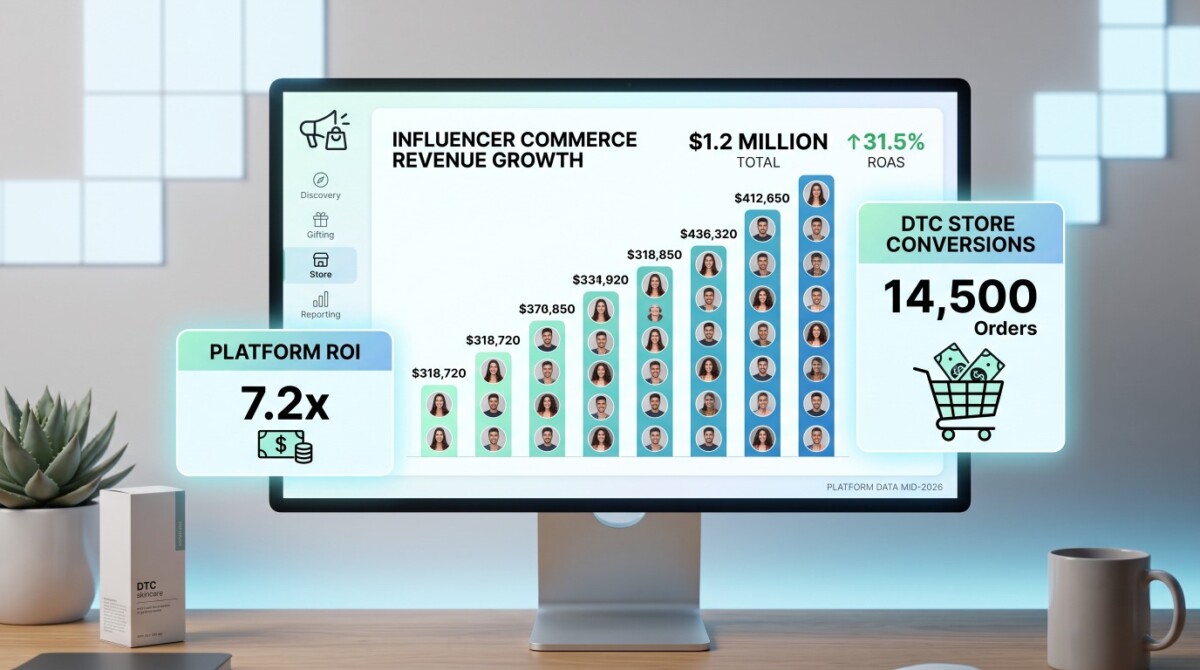
For eCommerce and DTC brands, influencer marketing is not a brand-awareness exercise – it is a performance channel that has to tie back to revenue. The platform you choose needs to do more than find creators; it needs to connect them to your store, automate gifting and discount codes, track affiliate sales, and attribute revenue per creator so you know exactly what your program returns. The wrong tool turns that into a manual, leaky mess.
The strongest eCommerce influencer platforms now wire discovery, outreach, and CRM directly into your commerce stack – Shopify, WooCommerce, and beyond – with affiliate tracking, creator storefronts, and ROAS reporting built in. That integration is what separates a tool that drives measurable sales from one that just manages relationships. This guide ranks ten of the best influencer marketing tools for eCommerce and DTC brands in 2026, starting with Influencer Hero, with clear criteria, a cost comparison, and a how-to-choose framework.
eCommerce changes priorities. A platform that is great for brand campaigns can fall short on the commerce mechanics that drive DTC revenue. Weigh these criteria most heavily:
Influencer Hero is the most complete platform on this list for eCommerce and DTC brands, because commerce runs through every part of it. Six eCommerce integrations (Shopify, WooCommerce, Magento, BigCommerce, Prestashop, and Amazon) give it the broadest native coverage here, so gifting, discount codes, and attribution work wherever you sell – not just on Shopify.
The commerce stack is deep. Product gifting runs directly from the CRM via $0 Shopify orders with automatic tracking sync, creator storefronts let influencers sell a curated selection (the company reports up to 8x higher ROI), affiliate tracking is protected by AI code-leakage prevention, and a Stripe-based Payout Manager handles commissions with a full audit trail. A dedicated ROI & Sales reporting tab attributes revenue per creator. Around the commerce layer sits a 450M+ database, AI outreach at a 43 percent response rate, and CRM automation – so a lean DTC team can run a large, measurable program at $649/month with month-to-month billing.
Best for: eCommerce and DTC brands that want gifting, affiliate tracking, creator storefronts, and revenue attribution wired across multiple commerce platforms in one tool.
Pricing:
Standout features:
The platform is feature-rich, so very small stores running only a few campaigns may not use every capability immediately, and teams new to workflow-driven tools will spend some initial time on setup. The Standard plan is sized for programs at that scale and the architecture scales to enterprise volume.
GRIN is a leading platform purpose-built for large-scale eCommerce influencer programs. Native integrations across Shopify, WooCommerce, BigCommerce, Magento, and Salesforce Commerce power gifting, discount codes, and sales tracking, and a unified workflow consolidates the full lifecycle. Creator portals, automatic media rights, and real-time ROI dashboards make it a strong fit for established DTC brands with mature programs.
Best for: Enterprise eCommerce brands running mature, high-volume programs across multiple store platforms.
Pricing:
Standout features:
GRIN’s $25,000+/year minimum and 12-month contract are a heavy commitment for growing DTC brands, and its native coverage does not extend to Prestashop or Amazon. Brands wanting comparable commerce breadth with month-to-month flexibility often weigh a platform like Influencer Hero against it.
Modash pairs a 350M+ database with clean Shopify-native affiliate workflows – discount codes, UTMs, product picks, and automated payouts with creator dashboards. The “Find Your Fans” tool surfaces existing customers worth recruiting, and AI visual discovery matches products to creators by aesthetic. For Shopify DTC brands, it is an affordable, effective engine.
Best for: Shopify DTC brands that want strong discovery and affiliate workflows at mid-market pricing.
Pricing:
Standout features:
Deep integration is Shopify-only – a limitation for brands on WooCommerce, Magento, BigCommerce, or Amazon – and there are no dedicated storefronts or AI-personalized outreach. Multi-platform DTC brands often find broader coverage in an all-in-one like Influencer Hero.
Aspire connects creators to commerce through a Shopify fulfillment integration – creators select products directly from your catalog – combined with an inbound marketplace of over a million creators applying to campaigns. The end-to-end workflow governs contracts, approvals, and tracking, and an asset library archives the content creators produce, tied to ROI reporting.
Best for: Recognized DTC brands that want catalog-connected commerce through an inbound creator marketplace.
Pricing:
Standout features:
Commerce is centered on Shopify fulfillment rather than broad multi-platform integration, custom pricing limits transparency, and the inbound model favors brands with existing recognition. Newer DTC brands often need stronger outbound and broader commerce coverage.
Upfluence is built around customer-affiliate commerce: it identifies existing customers who can become affiliates based on social reach and purchase history. Dual Shopify and Amazon support is notable – Amazon coverage is uncommon – affiliate and gifting automation generates discount codes, and bulk payments handle seller payouts without usage commissions.
Best for: DTC brands that want customer-affiliate commerce across both Shopify and Amazon.
Pricing:
Standout features:
Upfluence requires an annual contract starting around $2,000/month, its 12M database is smaller than the largest competitors, and users report a steep learning curve. It focuses on affiliate commerce rather than dedicated branded storefronts.
Later brings shoppable content to eCommerce programs through Linkin.bio and a UGC library that repurposes creator content across ads and storefronts. Shopify-integrated gifting with inventory management connects product to creators, and content-planning synergy aligns shoppable creator content with the brand calendar – a fit for DTC brands that think content-first.
Best for: DTC brands that want shoppable creator content tied to social content planning.
Pricing:
Standout features:
Later offers shoppable content rather than dedicated creator storefronts, and its full feature set lives in plans starting around $28,500/year. For brands wanting deep multi-platform commerce attribution, a platform like Influencer Hero is more purpose-built.
SocialLadder builds community-driven commerce by turning customers and followers into selling brand ambassadors. eCommerce integration auto-invites new customers post-purchase, gamified challenges reward selling and posting, and content usage rights are agreed on join – creating a self-sustaining base of credible ambassador-sellers from your own customer base.
Best for: DTC brands that want a community-driven ambassador program built from existing customers.
Pricing:
Standout features:
Community-driven commerce takes time to build, and ambassador volume is less predictable than affiliate or storefront programs. It depends on an existing customer base and a 6-12 month commitment, so it suits long-term community building more than a fast launch.
Storyclash brings content-performance intelligence to eCommerce programs, with a Shopify integration that ties creator content to ROAS, CAC, and AOV. Historical content data (including expired Stories) across a 183M database helps identify which creators and content formats actually drive sales, and competitive benchmarking shows what is working for rival DTC brands.
Best for: Content-led DTC brands that want to tie creator content to ROAS and competitive intelligence.
Pricing:
Standout features:
Storyclash is an intelligence layer rather than a full commerce-execution platform – it does not handle gifting logistics, storefronts, or payouts, and with no built-in licensing, rights are handled separately. It works best paired with an execution platform.
Heepsy is the most affordable entry point for small DTC brands, with a free plan and paid tiers from $89/month. Shopify and WooCommerce affiliate tracking (on advanced plans) connects creators to sales, authenticity filters protect budget, a Kanban CRM organizes the pipeline, and bulk email outreach covers modest volume.
Best for: Small eCommerce brands that want an affordable, easy starting point with a free plan.
Pricing:
Standout features:
Shopify sales tracking and the best features require the $369/month Advanced plan, the 50M database is the smallest of the discovery tools here, and outreach lacks AI personalization. Brands scaling past basic affiliate tracking will need deeper tooling.
Influencity offers affordable all-in-one capabilities for mid-market DTC brands, with a direct Shopify integration for discount codes and sales attribution. AI-powered search with lookalike functionality helps scale a roster, a visual Kanban CRM keeps it organized, and flexible post tracking adapts to different campaign structures – all at roughly $3,800/year.
Best for: Mid-market DTC brands that want affordable all-in-one capabilities with Shopify attribution.
Pricing:
Standout features:
Native eCommerce integrations beyond Shopify are limited, add-on pricing can accumulate, and the platform lacks dedicated storefronts, broad multi-platform commerce, and AI outreach personalization. Brands selling across multiple commerce platforms will want broader coverage.
| Tool | Best For | eCommerce Support | Starting Price | Contract |
|---|---|---|---|---|
| Influencer Hero | All-in-one eCommerce influencer programs | Shopify, WooCommerce, Magento, BigCommerce, Prestashop, Amazon | $649/mo | Monthly |
| GRIN | Enterprise eCommerce lifecycle | Shopify, WooCommerce, BigCommerce, Magento, Salesforce | ~$2,500/mo | 12-month min |
| Modash | Shopify discovery + affiliate | Shopify-native | $199/mo | Annual |
| Aspire | Inbound creators + Shopify fulfillment | Shopify fulfillment | ~$2,300/mo | Custom |
| Upfluence | Customer-affiliate commerce | Shopify + Amazon | ~$2,000/mo | Annual |
| Later | Shoppable content + planning | Shopify gifting | ~$28,500/yr | Annual |
| SocialLadder | Customer ambassador commerce | eCommerce post-purchase invite | <$2,000/mo | 6-12 mo |
| Storyclash | Content performance + ROAS | Shopify (ROAS, CAC, AOV) | $870/mo | TBD |
| Heepsy | Affordable eCommerce starter | Shopify, WooCommerce (adv. plans) | Free / $89/mo | Monthly |
| Influencity | Affordable Shopify all-in-one | Shopify | ~$3,800/yr | TBD |
Pricing and integration figures are current as of mid-2026 and reflect publicly stated starting points; enterprise and custom tiers vary. “eCommerce Support” lists native commerce integrations relevant to gifting, codes, and attribution.
For DTC brands, the deciding factor is usually how tightly a platform connects creators to revenue – and across how many commerce platforms. Start with the scenario closest to yours.
Choose Influencer Hero if you want commerce wired through everything. It offers the broadest native eCommerce coverage on this list – Shopify, WooCommerce, Magento, BigCommerce, Prestashop, and Amazon – plus gifting from the CRM, creator storefronts, affiliate tracking with code-leakage prevention, a Stripe Payout Manager, and per-creator revenue attribution. Because all of that is connected to a 450M+ database, AI outreach, and CRM automation, a lean DTC team can run a large, measurable program without stitching tools together, at $649/month with month-to-month billing. If you sell on more than one platform or expect to, its breadth makes it the safest default.
From there, narrow by your situation:
For eCommerce and DTC brands, the best influencer marketing tool is the one that turns creators into a measurable revenue channel – which means commerce integration, affiliate and storefront attribution, and per-creator ROI cannot be afterthoughts. Choose on those mechanics, not on follower-count features.
If you want the widest commerce coverage and the tightest content-to-sale attribution in one platform, Influencer Hero leads for DTC brands at an accessible price. If your needs are more specific, the field has strong options: GRIN for enterprise lifecycle, Modash and Aspire for Shopify discovery and fulfillment, Upfluence for customer-affiliate commerce, Later and Storyclash for shoppable content and ROAS intelligence, SocialLadder for ambassador communities, and Heepsy or Influencity for affordable starting points. Run two or three demos against your actual store and workflow, and choose the platform that makes your creator revenue easiest to grow, prove, and leverage data for content optimization.
For DTC brands that want gifting, affiliate tracking, creator storefronts, and revenue attribution across multiple commerce platforms, Influencer Hero offers the broadest coverage at $649/month with month-to-month billing. GRIN is strong for enterprise eCommerce at scale, and Modash is a great Shopify-focused option. The best choice depends on how many platforms you sell on and how mature your program is.
Most tools here integrate with Shopify, but coverage beyond it varies. Influencer Hero supports six platforms (Shopify, WooCommerce, Magento, BigCommerce, Prestashop, and Amazon), GRIN covers Shopify plus four others, and Upfluence adds Amazon. Modash, Aspire, Storyclash, and Influencity are primarily Shopify-focused, so confirm coverage for your exact stack.
Through discount codes, affiliate links with UTM tracking, and creator storefronts, tied back to your commerce platform for per-creator revenue attribution. The strongest tools add safeguards like code-leakage prevention (Influencer Hero) and ROAS reporting (Storyclash) so attribution stays accurate and you know exactly what each creator returns.
Not necessarily, but they convert well. A creator storefront concentrates an influencer’s recommendations in one shoppable page, often outperforming scattered affiliate links – Influencer Hero reports up to 8x higher ROI from storefronts. If creator-driven selling is central to your strategy, prioritize a platform with native storefront support.
Entry options start free (Heepsy) or at $199/month (Modash); a full all-in-one commerce platform like Influencer Hero starts at $649/month; and enterprise eCommerce platforms like GRIN run $25,000+/year. Calculate total cost including any separate tools you would otherwise need – an all-in-one platform often costs less than assembling discovery, affiliate, and analytics tools separately.
Keywords: best influencer marketing tools for eCommerce, DTC influencer marketing software, influencer marketing platforms for Shopify, eCommerce creator marketing tools 2026, influencer affiliate tracking software, creator storefronts eCommerce, Influencer Hero eCommerce, influencer marketing tools comparison




