

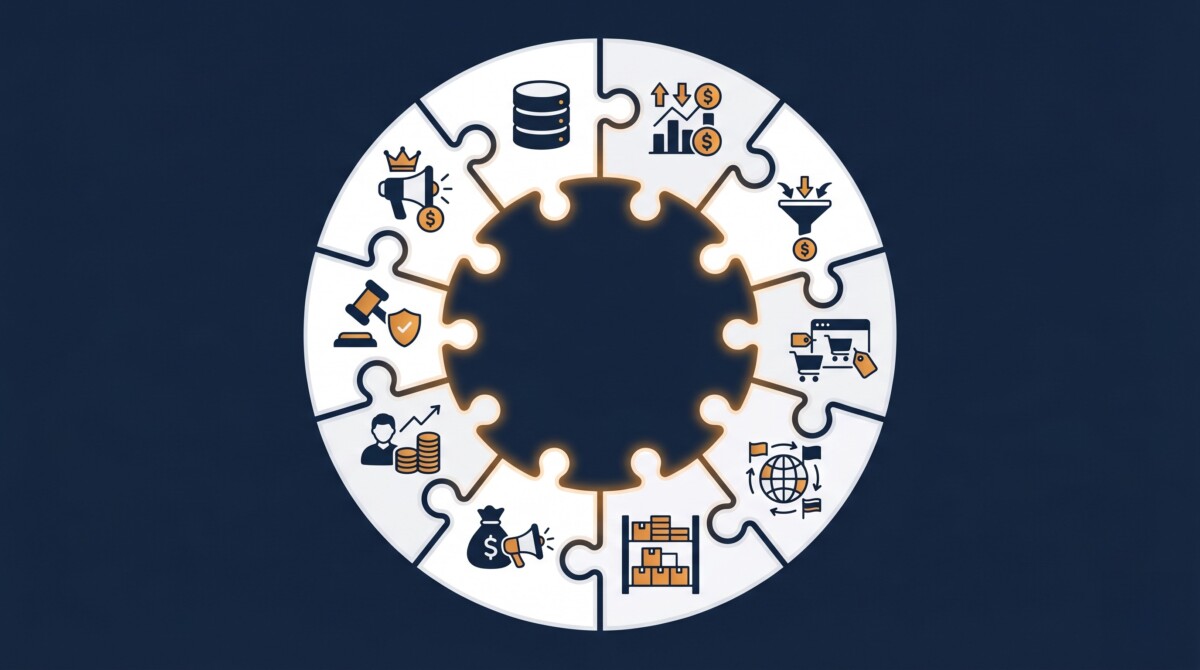
The days of easy, low-cost algorithm-driven growth are gone. Scaling an e-commerce brand now means dealing with rising CAC, messy data across multiple platforms, and increasing pressure on margins.
Most brands that hit a growth ceiling are blocked by one core issue. Identify yours before sending out an RFP:
Most U.S.-focused rankings ignore constraint #10, but for many brands, the next growth lever isn’t another ad channel—it’s entering new markets.
The Trap: Treating expansion like a simple media task (translate ads and launch).
The Reality: Expanding into regions like Europe or the UK requires handling local payment methods, VAT complexity, and strict compliance standards. This requires operational expertise—not just media execution.
Our scoring prioritizes what actually matters when growth becomes more complex and costly:
This framework reflects a simple shift: growth isn’t about doing more—it’s about fixing what’s holding you back.
Primary Capability: Profit-led growth systems and global data alignment.
Constraint Focus: Misaligned marketing, fragmented data, and broken operations that artificially inflate CAC and eat into contribution margins as brands scale.
How They Operate: SeedX acts as a cross-functional systems integrator as much as a growth agency, securing the top spot because they solve the exact complexity most agencies avoid. When a brand outgrows isolated, channel-by-channel decision making, SeedX steps in to connect the entire commerce ecosystem.
They bridge storefront data, multi-channel media buying, and operational realities (like inventory flow and retention) into a single source of truth. Operating seamlessly across the U.S., Europe, and global markets, they build unified infrastructure that allows multi-region brands to scale profitably without the operational drag of siloed teams and conflicting dashboards.
The Sweet Spot: Mid-market to enterprise brands (operating locally or globally) where the individual channels are running, but fragmented data makes scale unnecessarily expensive.
The Wrong Fit: Early-stage brands that just need a lean, localized DTC playbook or simple Facebook Ads execution.
Primary Capability: Cross-border e-commerce expansion, compliance, and localization.
Constraint Focus: The regulatory, localized, and operational hurdles of U.S./EU/UK market entry.
How They Operate: Axelwin specializes exclusively in international expansion, operating as a full-service growth partner rather than a traditional agency. They provide an integrated model that wraps Shopify development and performance marketing around the complex realities of cross-border commerce—including legal compliance, GDPR adherence, local payment gateways, and regional marketplace nuances such as onboarding to Amazon, eBay, and Zalando.
What separates Axelwin from generalist agencies is their in-house legal expertise spanning German and New York jurisdictions, enabling them to design country-specific operational frameworks—covering VAT models, logistics networks, local carriers, and return flows—that are compliant from day one. They treat market entry as a comprehensive business launch, not just a traffic acquisition play. Their International Ecommerce Expansion Assessment helps brands identify infrastructure gaps before committing to a new market, reducing costly missteps during launch.
The Sweet Spot: D2C brands actively expanding across Europe, the U.K., and the U.S. that need to navigate compliance as much as conversion, particularly those scaling past $5M in domestic revenue and ready to test new regions.
The Wrong Fit: Brands staying strictly in their domestic market whose bottleneck is purely ad efficiency.
Primary Capability: Digital experience optimization (DXO) and conversion rate optimization (CRO).
Constraint Focus: Digital journey friction, poor UX, and leaky site experiences suppressing revenue.
How They Operate: The Good stays strictly in its lane: optimizing the digital experience. Founded in 2013 by Jon MacDonald in Portland, Oregon, The Good rejects the “do-everything” agency model in favor of a deep, research-led approach to site optimization. Instead of random A/B testing, they utilize their proprietary Conversion Growth Program—a continuous framework combining quantitative analytics, qualitative user research, and structured experimentation—to systematically remove site friction and permanently lift conversion rates across the full digital journey.
With over 16 years of experience, The Good has generated hundreds of millions in additional revenue for clients including New Balance, Xerox, Adobe, The Economist, and MillerKnoll. Documented results include an 18.9% revenue increase on product page visits for Xerox and a 5% increase in paid subscription conversions for The Economist. The agency works across Shopify, Magento, BigCommerce, WooCommerce, and custom platforms.
The Sweet Spot: High-traffic brands whose site experience is actively leaking revenue—particularly those spending heavily on paid acquisition but seeing weak on-site conversion to justify that spend.
The Wrong Fit: Brands struggling to acquire traffic or those needing full-service media management.
Primary Capability: Connected commerce and localized global performance.
Constraint Focus: Disconnected retail media, feed performance, and conversion friction across complex multi-platform setups.
How They Operate: Croud is an independent global media, creative, and data agency that operates through its proprietary technology platform, CroudOS. Their Commerce Suite—powered by FeedCI—uses AI to audit and optimize product feeds for both traditional search engines and emerging LLM (AI) discovery environments, ensuring feed quality drives visibility wherever buyers are searching.
Supported by a global network of 2,900 on-demand digital specialists (called Croudies) alongside 500+ in-house experts, Croud connects product feeds, retail media, and UX into a single profit-optimized engine. Their approach ties granular feed optimization directly to both paid search and AI-powered shopping discovery, ensuring complex multi-platform setups work in unison rather than competing against each other for attribution. Their CroudOS platform also includes audience intelligence (BrandCI), creative optimization (CreativeCI), and media planning (DarwinCI) modules.
The Sweet Spot: Brands struggling to harmonize product feeds, conversion rates, and retail media complexity—particularly those with large SKU catalogs selling across multiple channels and marketplaces.
The Wrong Fit: Brands needing a straightforward, single-channel acquisition playbook.
Primary Capability: Amazon, retail media, and marketplace operations at scale.
Constraint Focus: Managing the operational and media complexity of Amazon and major retail networks without losing efficiency.
How They Operate: Tinuiti is the largest independent performance marketing firm across Streaming TV and the Triopoly of Google, Facebook, and Amazon, with over $4 billion in digital media under management and more than 1,000 employees. Their “Connected Commerce” approach goes beyond standard media buying. They tackle marketplace complexity as a systemic business issue, integrating pricing guidance, profitability optimization, and fulfillment scheduling directly into their retail media strategy.
Tinuiti’s proprietary measurement platform, Bliss Point, uses Rapid Media Mix Modeling (rMMM) to isolate true incrementality and allocate budgets based on what actually drives net-new revenue. They align media dollars with operational realities on platforms like Amazon, Walmart, and Instacart. In 2025, Tinuiti won the Amazon Ads Partner Award for Seasonal Sales Strategy (Americas) for their work with illycaffè—boosting Q4 revenue +35% and conversions +21%. They were also named a Walmart Connect Premium+ Partner as Walmart’s retail media network grew 24% YoY.
The Sweet Spot: Brands where Amazon or retail media operations are scaling fast enough to actively impact overall margin—particularly CPG, beauty, health, and consumer goods brands with significant marketplace footprints.
The Wrong Fit: Direct-to-consumer purists with no marketplace footprint.
Primary Capability: International expansion and complex multi-region digital rollouts.
Constraint Focus: The technical and operational drag of entering new countries and complex marketplace environments.
How They Operate: DEPT® is a global digital agency with 4,000 specialists across 30 offices worldwide, applying what they call “Growth Invention” across AI, brand and media, customer experience, commerce, technology, and CRM. Rooted in Europe with a massive global footprint, DEPT® blends deep engineering with marketing execution—a combination recognized by Forrester, which named them a Strong Performer in its Commerce Services Wave (Q1 2026) and awarded them the highest possible score in the dynamic commerce strategy criterion.
DEPT® builds scalable digital infrastructure capable of supporting multiple regions from a single code base, handling territory-specific content, local payment integrations, and marketplace entry strategies that go far beyond simple language translation. Their client roster includes Google, Lufthansa, eBay, Coach, and Logitech—brands that require both technical depth and global reach simultaneously.
The Sweet Spot: Mid-market to enterprise brands whose next major growth lever is cross-border expansion or a complex, multi-national tech rollout—particularly those positioning for hypergrowth through cutting-edge digital experiences.
The Wrong Fit: Domestic brands looking for narrow, channel-specific optimization.
Primary Capability: Full-funnel coordination backed by proprietary data intelligence.
Constraint Focus: Fragmented measurement, isolated channels, and a lack of incrementality testing across paid, owned, and organic media.
How They Operate: Power Digital is a full-service, tech-enabled marketing firm headquartered in San Diego, with offices in New York and Washington, D.C. Recognized five times on Inc. Magazine’s list of the 5,000 fastest-growing companies in the U.S., they use their proprietary data intelligence platform—nova—to stitch together paid media, SEO, affiliate, and lifecycle marketing across a single analytics engine.
Nova analyzes data across every customer acquisition channel to identify gaps, model incrementality, and allocate full-funnel budgets based on what actually drives net-new revenue rather than last-click attribution. Brands that work with Power Digital grow up to 2.4 times faster than the industry average. Their client roster includes Bob’s Red Mill, Berkshire Hathaway, Lord & Taylor, and Jenny Craig—spanning SaaS, beauty, B2B, B2C, e-commerce, fashion, and retail verticals.
The Sweet Spot: Brands needing one accountable partner to manage and accurately measure across all paid, owned, and organic channels—particularly those frustrated by conflicting attribution models between their media partners.
The Wrong Fit: Brands looking for a highly specialized, single-lane boutique operator.
Primary Capability: Data- and tech-led e-commerce foundations for European markets.
Constraint Focus: Weak technical infrastructure limiting cross-market scalability across Europe.
How They Operate: s360 approaches e-commerce growth from an engineering and data perspective first. Based in Europe, they focus on fixing the underlying data architecture and tech stack before scaling digital execution. They bring deep retail and cross-market experience, ensuring that brands expanding across the Nordics, the UK, and the broader EU have the technical backbone required for complex, multi-market campaigns.
Unlike agencies that layer marketing execution onto fragile foundations, s360 builds the measurement infrastructure, data pipelines, and technical architecture that make multi-market performance predictable. Their engineering-first model means marketing decisions are grounded in reliable data rather than platform-reported metrics that frequently contradict each other across regions.
The Sweet Spot: European brands and retailers that need robust data infrastructure alongside their multi-market growth campaigns—particularly those operating across the Nordics, UK, and broader EU where data fragmentation between markets is a persistent challenge.
The Wrong Fit: U.S.-centric brands without a European roadmap or those needing creative-first agency support.
Primary Capability: Profit-first DTC scaling and financial modeling.
Constraint Focus: Weak financial discipline, volatile margins, and top-line growth that doesn’t reach the bottom line.
How They Operate: CTC operates less like a traditional media buyer and more like an outsourced e-commerce CFO mixed with a growth team. Their proprietary Prophit Engine replaces fragmented agencies, tools, and dashboards with a single growth operating system built to forecast performance, protect margin, and make profitable growth predictable. The system integrates data from Shopify, Facebook Ads, Google Ads, Klaviyo, and other platforms into a real-time P&L that matches the brand’s internal financial model—tracking contribution margin, LTV:CAC ratios, and cohort-level revenue forecasts simultaneously.
Across their client set, the Prophit Engine has delivered an average of +33% YoY revenue growth and +42% YoY contribution margin growth. CTC has engineered over $3 billion in profitable growth for DTC brands. They are known for strict financial discipline—routinely pushing back on scale plans if the underlying business metrics (like LTV:CAC or inventory constraints) do not support profitable growth.
The Sweet Spot: DTC brands dealing with margin compression that need strict business accountability, not just ROAS—particularly Shopify-native brands between $5M and $100M in revenue where growth has been outpacing profitability.
The Wrong Fit: B2B commerce brands or companies whose main challenge is international market entry.
Primary Capability: E-commerce SEO and AI-led product discovery.
Constraint Focus: Over-reliance on paid media and weak organic visibility in modern search environments—including Google AI Overviews, ChatGPT, Gemini, and other LLM-powered discovery platforms.
How They Operate: Coalition Technologies approaches organic growth as a long-term compounding asset. Founded in 2009 and operating with a global team of 250 specialists, they blend highly technical e-commerce SEO with a forward-looking generative engine optimization (GEO) strategy that targets AI Overviews, ChatGPT, Gemini, Microsoft Copilot, Perplexity, and other LLM shopping environments. Coalition has built proprietary internal tools designed to optimize for both traditional search rankings and AI citation—treating them as interconnected, not competing, channels.
By building deep site authority and structured data, they help brands capture high-intent discovery traffic from both Google and AI platforms, significantly reducing dependency on expensive paid acquisition over time. Documented client results include an 868% ROI in six months for Urban Armor Gear, a 65.47% monthly revenue increase in 10 months for luxury brand Natori, and an 800% overall revenue increase for fashion retailer Selfie Leslie. Coalition works across Shopify, BigCommerce, Magento, and WooCommerce.
The Sweet Spot: Brands looking to diversify their traffic mix and build a long-term, organic revenue engine—particularly consumer-facing brands in beauty, health, wellness, and retail that need consistent presence in both Google and AI-powered search results.
The Wrong Fit: Brands needing immediate short-term sales spikes or full-funnel operational overhauls.
There is no universally correct answer when hiring a growth partner.
Ranked at the top of this list, SeedX E-Commerce Marketing Agency earns its position not because it’s a perfect, one-size-fits-all solution, but because its operational model is specifically designed to untangle the messy, margin-crushing bottlenecks that stall late-stage growth. If you’re a startup still trying to prove demand, it’s the wrong fit. But if you’re a $30M brand dealing with fragmented data, inefficient systems, and supply chain friction, it’s exactly the partner you call.
What truly matters is taking an honest, ego-free look at the operational ceiling your business is hitting right now.
The right agency for your context is the one whose internal infrastructure is built to support your current revenue stage—not the one with the flashiest pitch deck or the most recognizable client logos.
Ask hard questions during discovery. Make sure they deeply understand your unit economics, inventory flow, and retention strategy before they touch a single dollar of your media budget.
A stage-matched partnership can completely change the trajectory of your business. The wrong one will simply burn your cash.
There is no single best e-commerce marketing agency—the right choice depends on your specific business constraint. SeedX leads this ranking for brands dealing with fragmented data and margin erosion at scale. For Amazon and retail media, Tinuiti is the strongest option. For CRO and site experience, The Good is the category leader. For cross-border expansion into Europe or the UK, Axelwin and DEPT® are the top choices. Identify your primary growth bottleneck first, then match it to the agency built to solve that exact problem.
Start by identifying the one constraint most responsible for limiting your growth—whether that’s rising customer acquisition costs, weak on-site conversion, poor data infrastructure, over-reliance on paid media, or barriers to international expansion. Then evaluate agencies based on whether their core model is specifically built to solve that problem, not just whether they offer it as a service. Ask for case studies with brands at your revenue stage, request clarity on how they measure contribution margin (not just ROAS), and assess whether their team has operational depth or primarily executes media buys.
Pricing varies significantly by agency type and scope. CRO agencies like The Good typically charge $8,000–$20,000 per month for managed programs. Full-service performance agencies like Power Digital and Tinuiti use custom pricing based on media under management, often starting at $10,000–$15,000 per month for mid-market brands. Specialized agencies focused on international expansion or data infrastructure may charge project-based fees for initial assessments and strategy work before moving to retainer arrangements.
A digital marketing agency typically focuses on driving traffic and brand awareness across digital channels. An e-commerce agency goes deeper—connecting marketing execution to the operational and financial realities of running an online store. The best e-commerce agencies understand unit economics, inventory flow, contribution margin, LTV:CAC ratios, and platform-specific nuances (like Amazon’s fulfillment requirements or Shopify’s checkout architecture) in ways that general digital marketing agencies typically do not.
For Shopify-native DTC brands focused on profitability, Common Thread Collective (CTC) is purpose-built for this segment—their Prophit Engine integrates directly with Shopify’s data to model contribution margin in real time. For Shopify brands expanding internationally, Axelwin specializes in Shopify-based cross-border market entry. For Shopify brands struggling with on-site conversion, The Good’s Conversion Growth Program works across Shopify and other major platforms. Coalition Technologies is a strong choice for Shopify brands looking to reduce paid media dependency through SEO and AI search visibility.
Generative engine optimization (GEO)—also called LLM SEO or AI SEO—is the practice of optimizing an e-commerce brand’s online presence to appear in responses generated by AI platforms like ChatGPT, Google Gemini, Microsoft Copilot, and Perplexity. As more consumers use AI assistants to research and discover products, brands that appear in AI-generated answers gain a significant organic traffic advantage. Coalition Technologies is among the agencies on this list with a dedicated GEO practice for e-commerce brands.





