
Email marketing, by no mistake, is still one of the most effective ways to build relationships with customers, nurture leads, and drive consistent revenue.
But to make the most of it, you need the right platform — one that fits your business goals and scales with your growth. A while back, we looked at the best customer service tools for strengthening support and communication; this time, we’re turning our attention to email marketing tools, which are just as essential for keeping your audience engaged and converting.
When choosing an email marketing platform for your business, it can be challenging to identify one that fully meets your needs. Many of them offer a drag-and-drop builder, personalization, segmentation, and other essential features. In this comparison, we‘ll provide you with the best tools we found on Capterra and G2 in terms of pricing, usability, and features. Here are our top 10 email marketing services to help you communicate with your customers properly.
SendPulse is an all-in-one marketing automation platform launched in 2015, and it currently powers campaigns for over 3 million users worldwide. What makes it unique is its versatility: alongside a feature-rich email marketing suite, SendPulse provides tools for SMS and chatbots. It also includes a CRM, landing page, and website builder, and even online store creation—all connected under one platform. This makes it especially attractive for businesses that want to manage everything in one place rather than piecing together multiple tools.
When it comes to email, SendPulse shines with its visual drag-and-drop builder and a wide selection of professional templates. The built-in AI assistant helps refine subject lines and body text, ensuring polished, error-free copy. Beyond email, the AI content generator can craft and optimize website or landing page text, letting you translate, rewrite, summarize, or simplify content to match your target audience.
Its free plan allows you to send 15,000 emails to 500 subscribers, and make 100 verifications with the email verifier. The platform’s paid plans start at around $5.30 per month for 500 subscribers, offering unlimited emails, full A/B testing, and other perks.
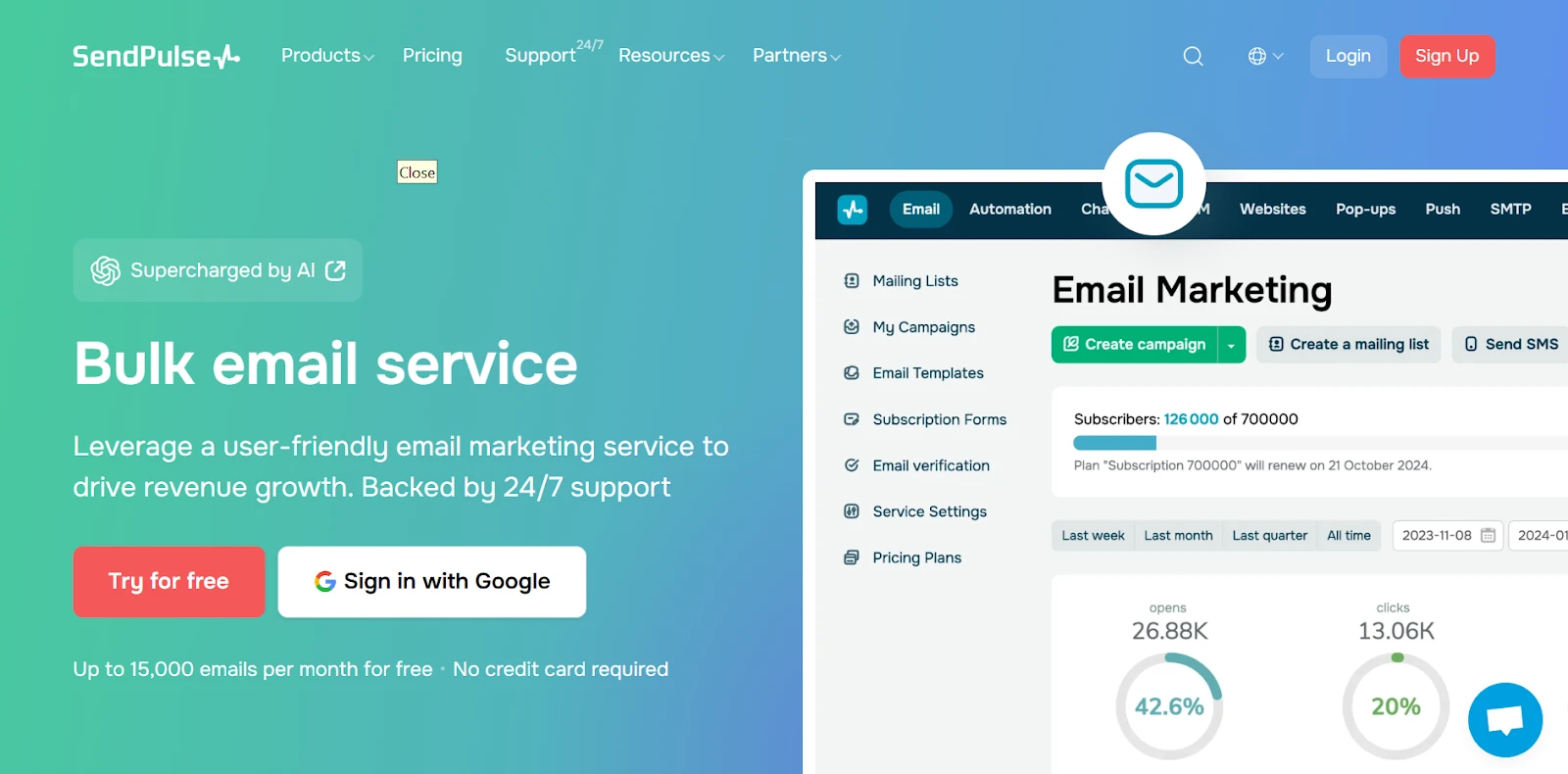
Best for: Agile small businesses and agencies needing an affordable multichannel marketing suite under one roof. SendPulse’s standout USP is that it allows you to manage email, SMS, push notifications, and chatbots all in one place – even on the free tier.
Mailmodo is an AI-powered email marketing software that helps you create, automate, and optimize campaigns effortlessly. From planning strategy to writing copy and building journeys, Mailmodo’s AI Agents handle it all, with no technical expertise needed. It’s the fastest way to send smart, interactive, and high-performing emails.
The AI-Powered Email Builder allows users to create on-brand, polished email designs in seconds, easily remixing layouts, colors, and content through AI commands. For hands-on customization, the drag-and-drop editor ensures complete design control with live previews for quality assurance.
Key Features:
Pricing
It has a forever free plan with limited features, The Lite plan costs $39 per month (billed annually) and provides 20,000 credits. The Pro plan is $79 per month with 25,000 credits, and the Max plan costs $159 per month and offers 37,500 credits.
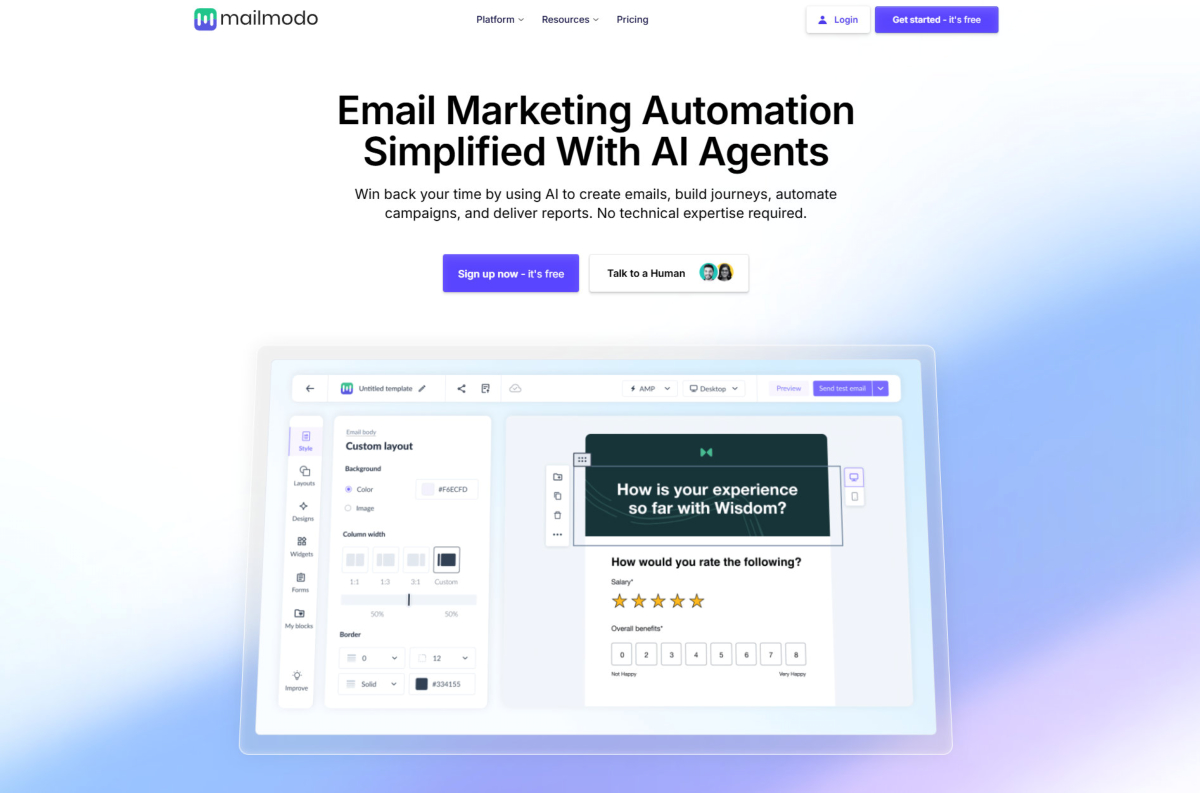
Best for: A complete AI-powered email platform with AMP technology that helps SaaS businesses, marketers, and startups build and automate smarter campaigns.
Sequenzy is an email marketing platform built specifically for SaaS businesses. While most email tools are designed for newsletters or ecommerce, Sequenzy was purpose-built for subscription products – connecting directly to Stripe, understanding your MRR and churn data, and triggering the right emails at the right moments in the subscription lifecycle. Setup takes minutes thanks to native AI and MCP (Model Context Protocol) support for tools like Claude, Cursor, and Windsurf.
What makes Sequenzy stand out is its deep Stripe integration and AI-first approach. You can describe a campaign in plain English – “re-engagement sequence for churned users” or “dunning emails for failed payments” – and the AI generates a full sequence with copy, send delays, and trigger conditions. No templates to configure, no complex automation rules to write.
Sequenzy offers a generous free plan that includes 2,500 emails per month, unlimited contacts, and all features – with no credit card required and no “Sent with Sequenzy” branding. Paid plans are usage-based, scaling with the number of emails you send rather than the size of your contact list.
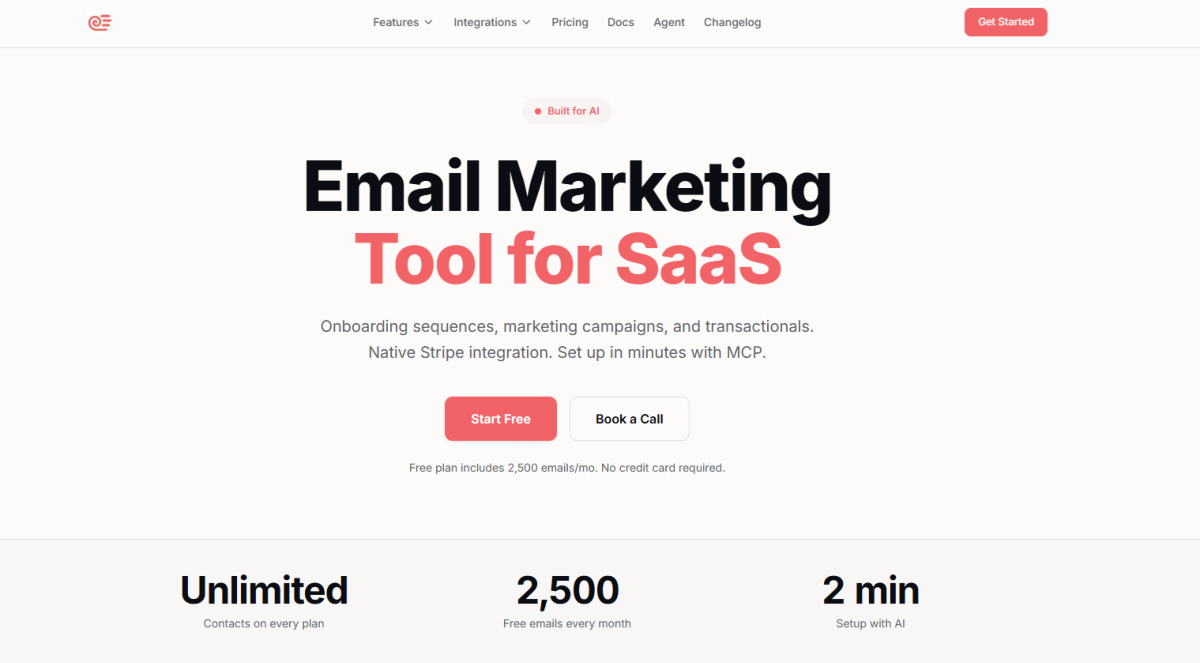
Best for: SaaS founders and product teams who need email that understands the subscription lifecycle. Sequenzy’s standout USP is its native Stripe integration and AI-driven setup – automating onboarding sequences, trial emails, dunning flows, and transactional messages from a single platform without hours of configuration.
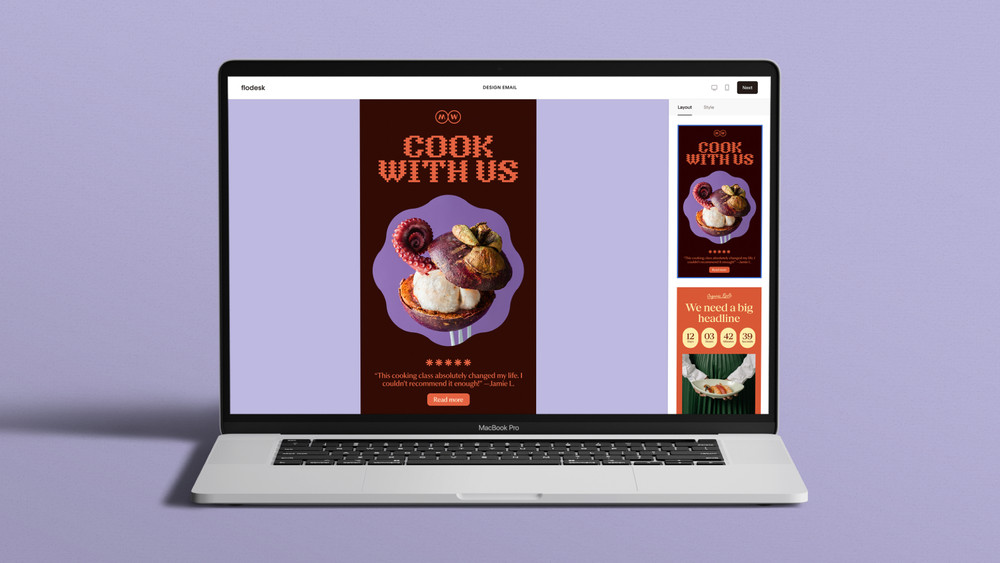
Flodesk is a design-first email marketing platform built for small businesses, solopreneurs, and creators. Founded in 2019, it serves over 100,000 businesses globally with tools for email marketing, automations, forms, landing pages, and ecommerce checkout — all built around the user’s brand identity. Its patented layout technology renders custom fonts consistently across Gmail, Apple Mail, Outlook, and mobile, so your emails always look on-brand without needing a designer.
The drag-and-drop email builder — with Canva integration, countdown timers, polls, and deep personalization built in — makes it easy to create polished, high-converting emails in minutes. Flodesk also maintains approximately 99% platform-wide deliverability, nearly 10 points above the industry average.
Key Features:
Pricing Flodesk offers a free plan for list building (forms and landing pages, no email sending). The Lite plan starts at $25/month, the Pro plan at $35/month, and the Everything plan at $54/month — all with unlimited email sends. A 30-day free trial is available on all paid plans, no credit card required.
Best for: Small businesses, solopreneurs, and creators who want beautiful, on-brand emails and powerful automations without needing a design team or technical expertise.
Salesforce’s Email Marketing Platform uses AI automation to help businesses create more personalized and relevant email campaigns. Since it connects directly to Salesforce CRM, the platform can pull in your existing customer data and use it to tailor each message automatically. This makes it easy to adjust email content based on things like demographics, past interactions, and behavior.
The platform also has a strong A/B testing feature that lets you track how your emails are performing in real time. From these tests, you’ll get clear reports that show what’s working and how you can improve.
Although the platform doesn’t offer a free tier, Salesforce provides a 30-day trial to test its features. Pricing starts at US $2,000/month, which is higher than most options, but you’re paying for stronger automation, CRM integration, and AI-powered personalization.
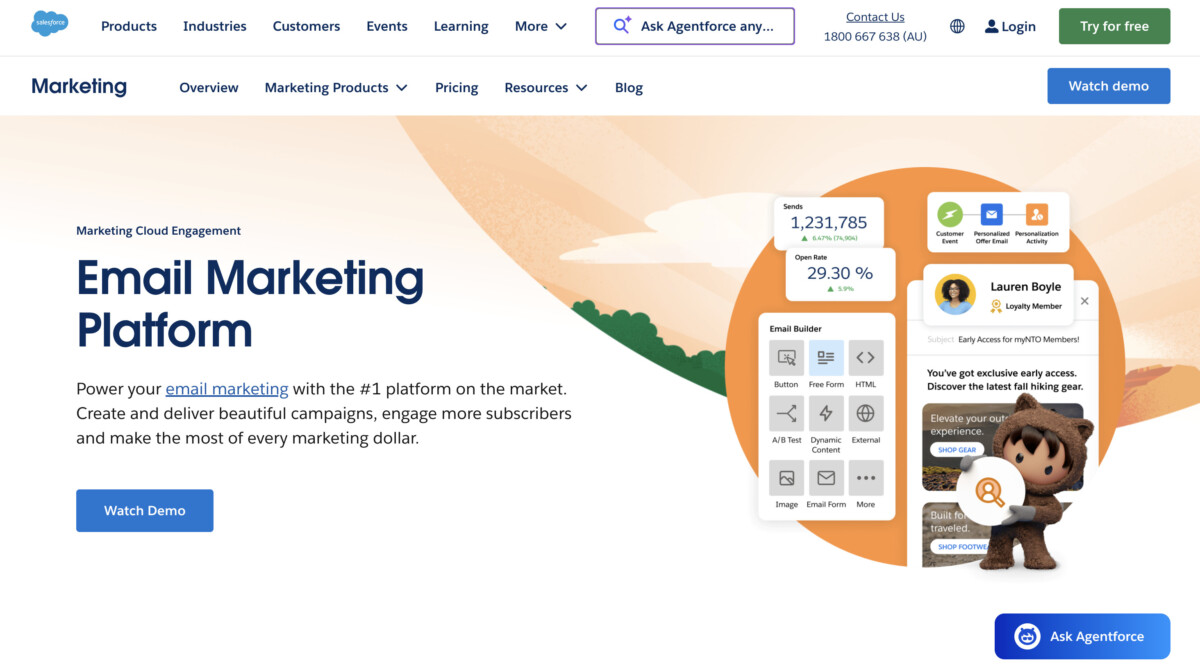
Best for: Mid-to-large businesses or marketing teams who already use Salesforce CRM and need an email marketing platform that offers AI-powered personalization and deep customer-data integration.
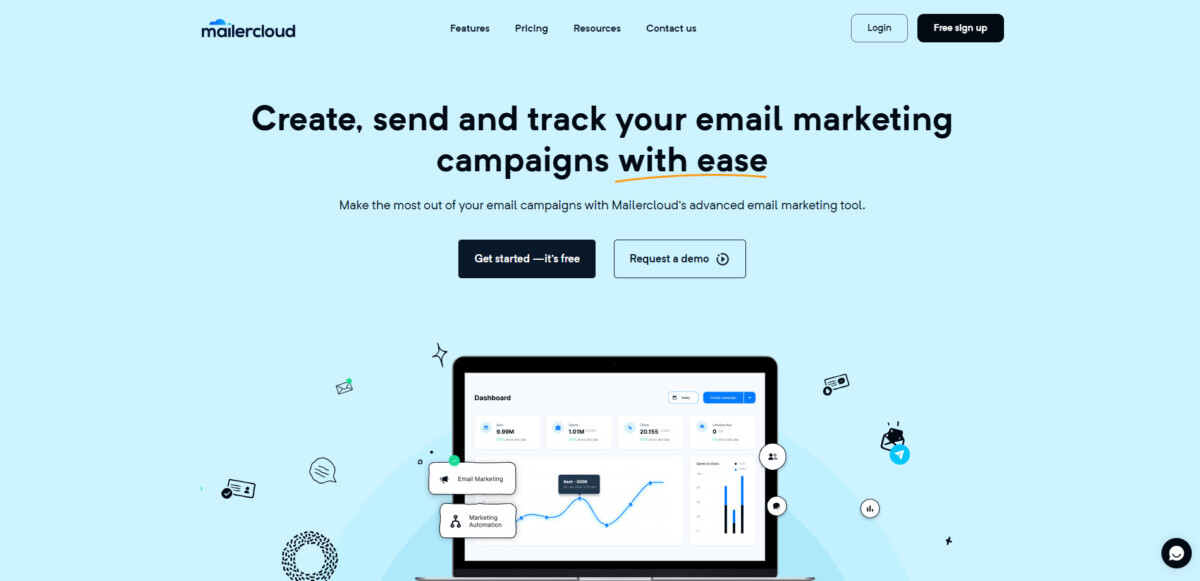
Mailercloud is an all-in-one email marketing platform built for e-commerce businesses and growing teams that want powerful campaign tools without the high cost. Its built-in Inbox Tracker shows exactly where your emails land across Gmail, Yahoo, and Outlook in real time — a deliverability feature most platforms charge extra for. The AI Subject Line Generator and AI Email Writer help you craft high-performing campaigns faster, while AMP email support lets subscribers interact with forms and carousels directly inside their inbox.
The free plan covers up to 1,000 contacts and 12,000 emails per month. Paid plans start at $10/month with unlimited sends.
Best for: E-commerce brands and growing businesses that want strong deliverability and interactive email capabilities at an affordable price.
Mailchimp is arguably the most famous email marketing platform. Founded in 2001 and now owned by Intuit, Mailchimp serves millions of customers’s marketed as a one-stop marketing automation platform for growing businesses, offering email, landing pages, social ads, and CRM tools. Mailchimp’s strength lies in its ease of use, featuring a polished drag-and-drop editor, a vast template library, and helpful AI recommendations. It has evolved well beyond email into full marketing suites.
On the flip side, its free plan is limited (500 contacts, 1,000 sends), and it can be pricier as lists grow. The price for paid plans starts at $13 monthly for 500 contacts, 10X contacts email sends, and 3 audiences.
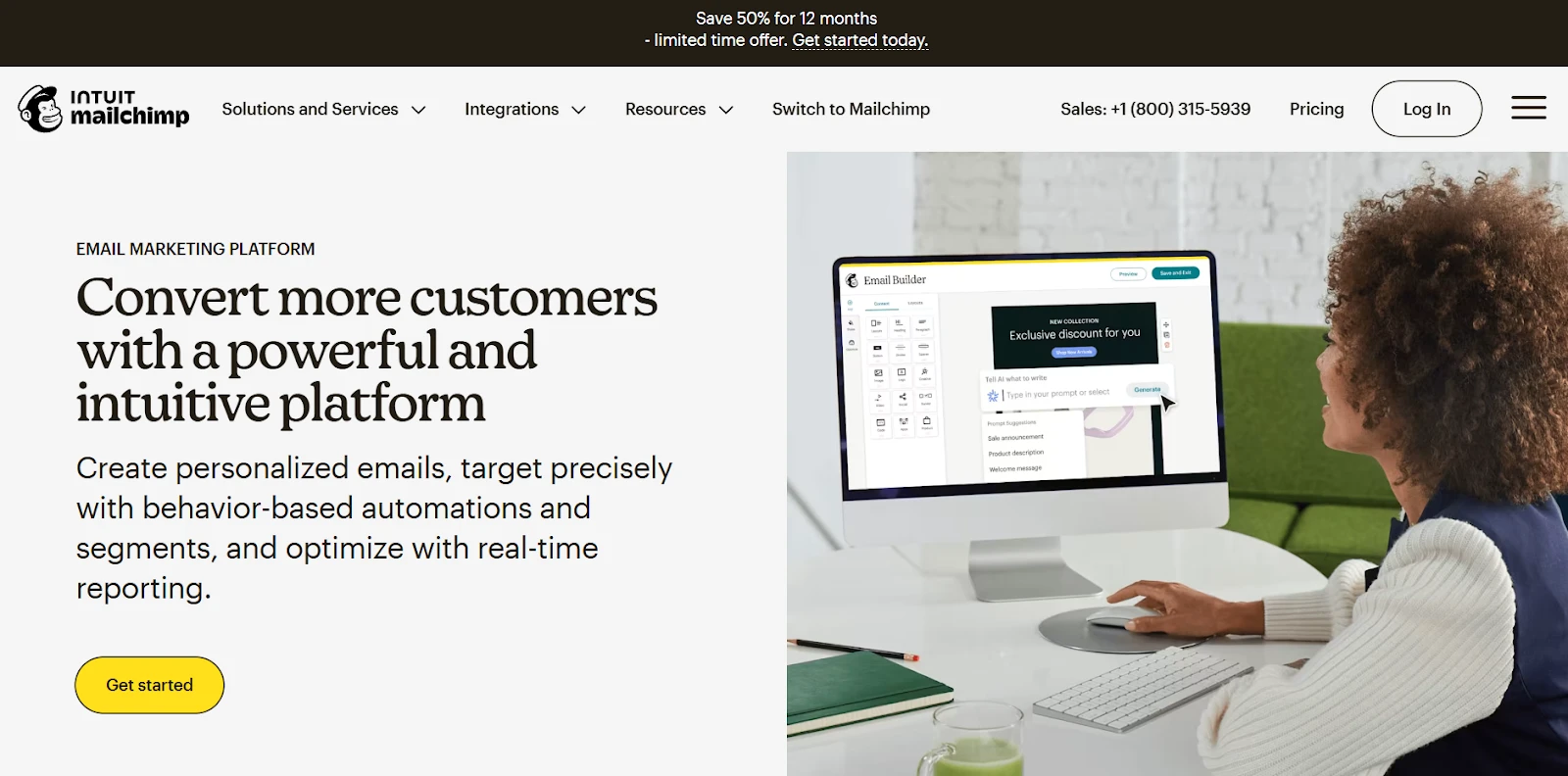
Best for: Entrepreneurs and marketers who want a familiar, user-friendly all-in-one marketing platform. Mailchimp’s USP is its polished interface and comprehensive feature set, which caters to both beginners and intermediate users, covering email, basic CRM, and more in one place.
Constant Contact is an email and digital marketing tool aimed at small businesses, nonprofits, and event organizers. Its tagline is “Email marketing, made easy,” and it has millions of users who appreciate its straightforward approach. Notably, Constant Contact offers built-in event marketing, donation collection, and social media tools, reflecting its roots serving community organizations and franchises.
While it doesn’t offer a free tier (only a 60-day trial), it stands out for its supportive customer service and marketing guides. Critics say it’s more basic than some newer tools, but it excels at simple email campaigns, list-building, and helping non-technical users get started.
Although the platform does not offer a free plan, it still allows marketers to enjoy a free trial. The price for paid plans starts at $12 monthly for 10x your number of contacts email sends.
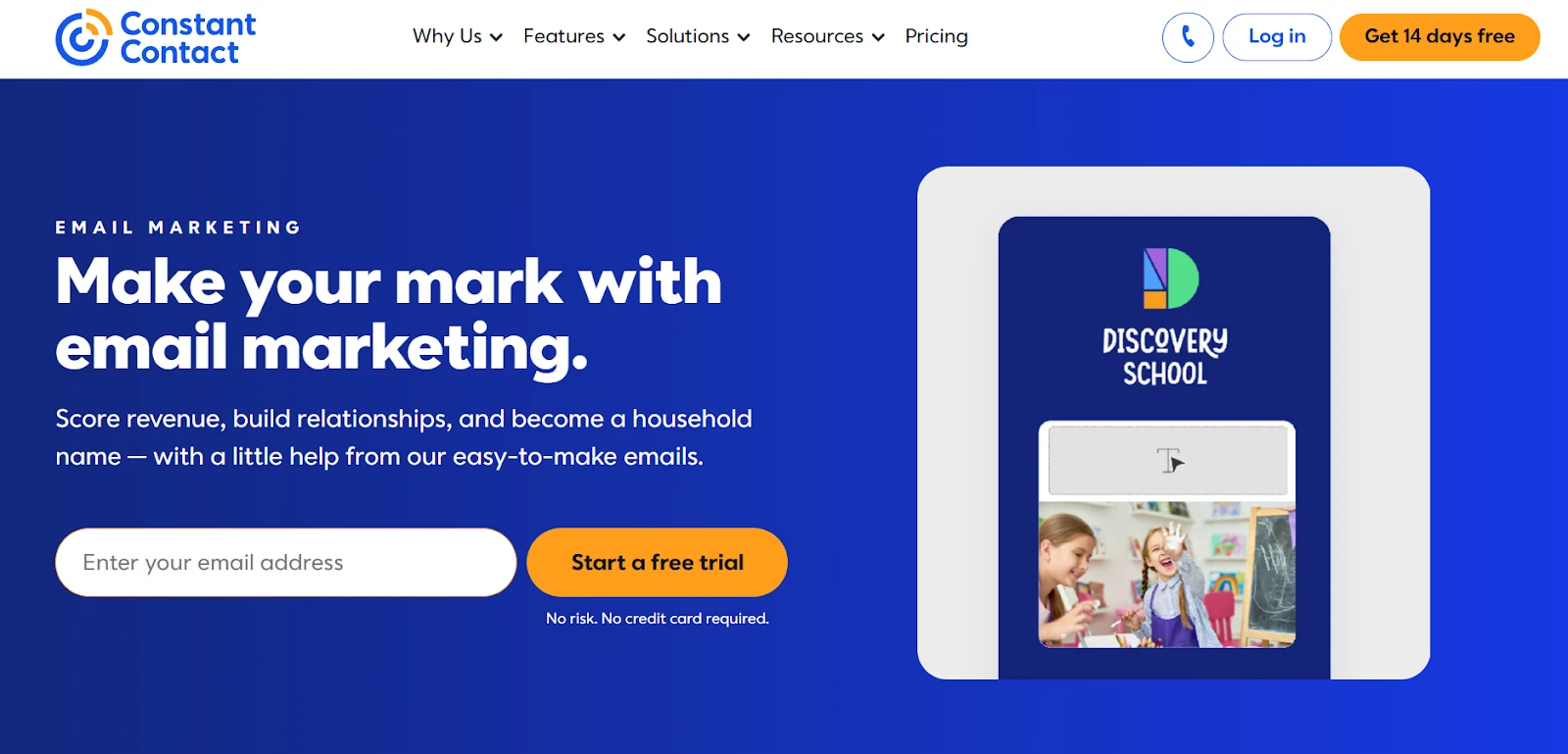
Best for: Small businesses and organizations seeking a no-fuss email/event marketing solution. Constant Contact’s USP is its ease of use and specialized tools for event invites and communities, making email campaigns straightforward even for beginners.
Brevo (the rebranded Sendinblue) is an all-in-one marketing platform with a strong emphasis on automation and AI. It combines email, SMS, WhatsApp, and live chat in one interface. The company highlights an “AI-enabled platform” and claims 500,000+ customers worldwide.
Key strengths include its AI content generators (Aura AI) and sophisticated automation workflows. Its visual workflow builder allows complex multi-step campaigns, and it even incorporates AI agents for content creation and send-time optimization. In short, Brevo tries to be a budget-friendly alternative to big names like HubSpot, and many users say it “saved us $30K annually compared to HubSpot”.
Brevo’s free plan is generous with contacts (unlimited), although it caps at 300 emails/day, which is unusual yet beneficial for businesses that send frequent, low-volume emails. For businesses that require sending more emails, a paid plan is necessary. The cheapest option will cost $9 per month for 5,000 emails, with no daily sending limit, basic reporting, and analytics.
Best for: Growing businesses that want AI-enhanced multichannel marketing on a budget. Brevo’s USP is its integrated multi-channel toolkit (email + SMS/WhatsApp + live chat) and AI-powered features, enabling advanced automation without the HubSpot price tag.
ActiveCampaign is a robust platform renowned for its advanced automation and CRM capabilities. It combines email marketing with a built-in sales CRM and messaging (including new channels like WhatsApp and SMS). Over 180,000 businesses use it as a central marketing hub. Unlike simpler tools, ActiveCampaign caters to businesses ready for sophisticated segmentation and analytics. It touts AI-powered “agents” that can create and adapt campaigns, and excels at orchestrating multichannel funnels.
ActiveCampaign’s email designer is solid (though not the best), but its greatest strength lies in logic-driven workflows, including conditional splits, predictive sending, lead scoring, and CRM-driven automations. The trade-off is a steeper learning curve and higher cost. However, if you need enterprise-style automation without migrating to a large platform, ActiveCampaign shines.
The service does not offer a free plan, but marketers are provided with a free trial to test the features. The price for paid plans starts at $15 monthly for 1,000 contacts and 10x contact limit email sends.
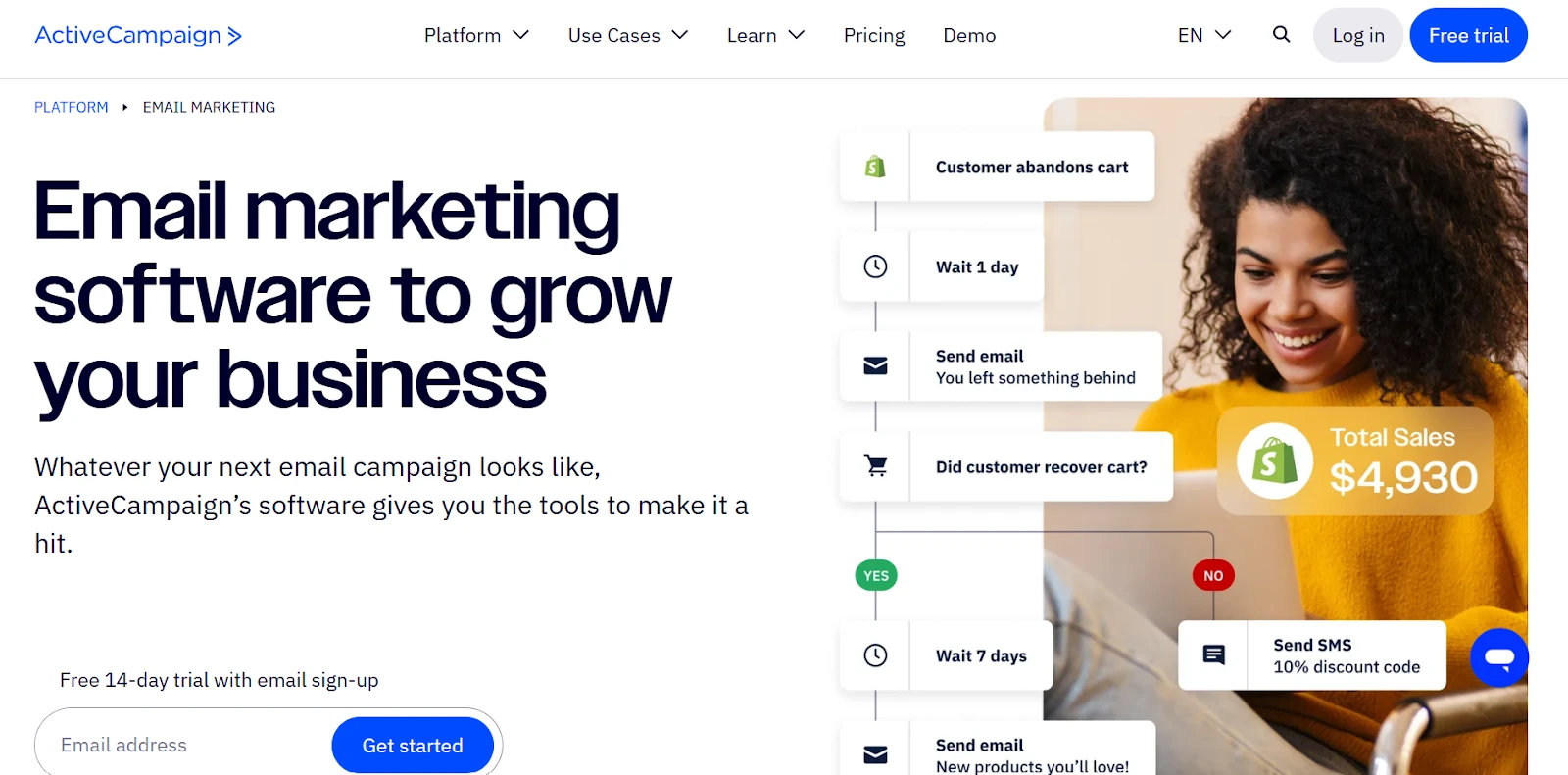
Best for: Businesses seeking enterprise-level automation on a small-business budget. ActiveCampaign’s USP is its powerful workflows and CRM integration that let you “punch above your weight” – automating cross-channel campaigns (email, SMS, WhatsApp) and lead nurturing with very granular logic.
GetResponse is a comprehensive marketing platform that originally focused on email but now offers a range of additional features, including webinars, funnels, and an AI-powered webinar builder. Marketed as “email marketing & automation features for marketers and content creators”, GetResponse shines with a broad feature set. Unique to GetResponse is its integrated webinar tool (host unlimited webinars, up to 1,000 attendees) – one of the first email providers to bundle webinar software. It also offers e-commerce integrations, CRM, and content monetization (course and newsletter builders).
With modern AI writing assistants and “Perfect Timing” send optimization, the platform continually adds new tools. However, the interface can feel cluttered due to the numerous options. Still, for businesses or creators who need email, webinar, and sales funnel features in one account, GetResponse remains a solid choice.
Although the platform does not offer a free tier, it does allow marketers to enjoy a 30-day trial instead. The cheapest paid plan starts at $18,60 monthly for 1,000 contacts, an AI email generator, and unlimited autoresponders.
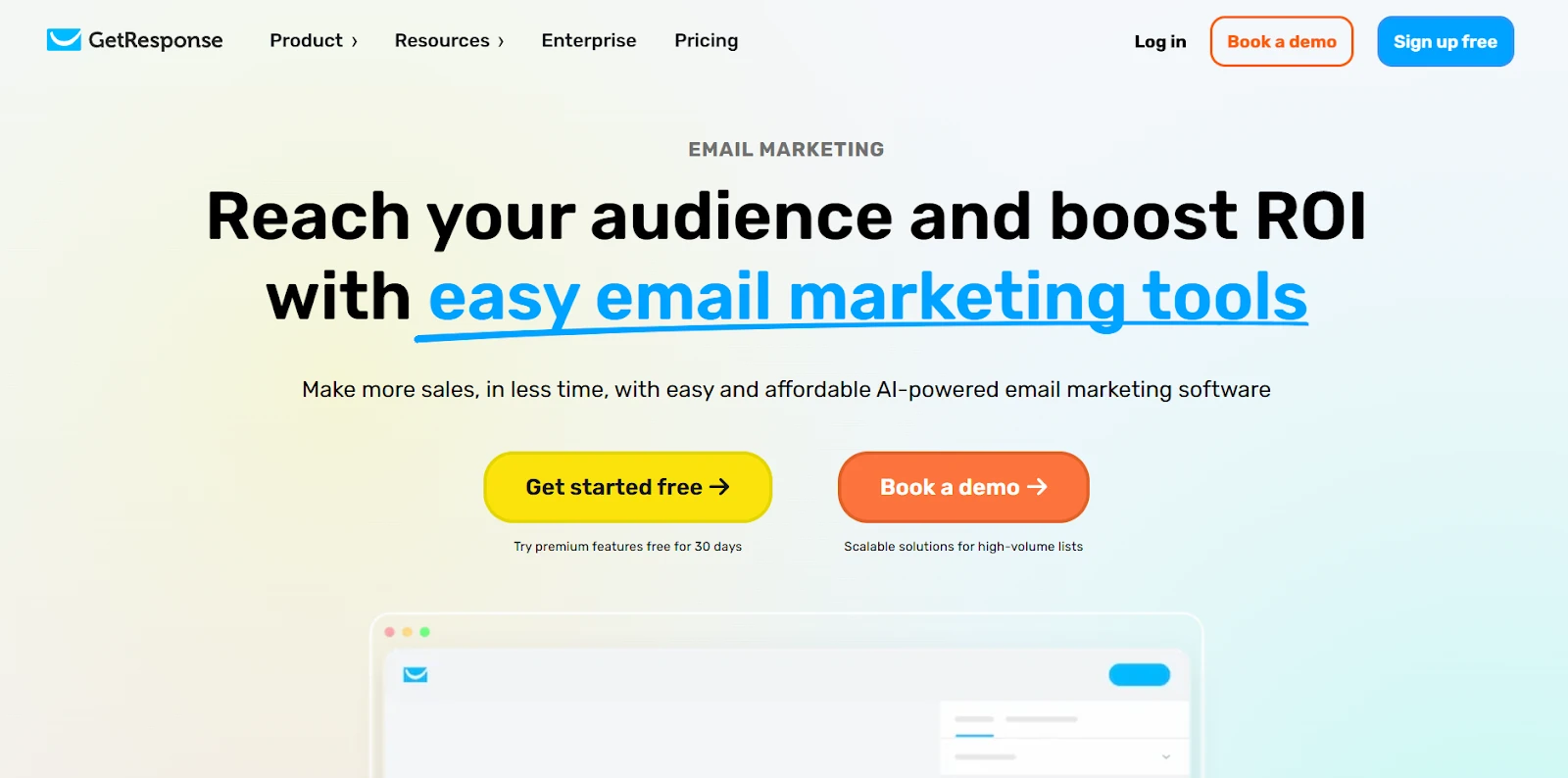
Best for: Marketers and creators who want all-in-one email + webinar marketing. GetResponse’s USP is its built-in webinar suite and AI tools, which enable you to run webinars and automate tasks from one platform. It’s especially useful if you need webinars or complex funnels in addition to email.
AWeber is one of the oldest email marketing companies (founded in 1998) and remains a popular choice for small businesses and entrepreneurs. Its tagline is “Connect, automate, and sell your vision to the world”. AWeber excels at simplicity and reliable deliverability. Unlike more complex rivals, AWeber’s approach is straightforward: easy list building, a drag-and-drop email editor, and basic automations. It was among the first to provide email templates and autoresponders, and it maintains a high sender reputation.
Notably, AWeber also includes web push notifications (one of the few legacy platforms to do so). The platform offers 24/7 support and free migrations, which new users appreciate. If anything, AWeber is missing some modern fluff (e.g., native SMS, advanced AI). But for plain email newsletters and autoresponders, it’s rock-solid and cost-effective.
The tool offers a 14-day free trial for businesses to test its features. After that, they’ll have to purchase a paid plan, which starts at $15 per month for 500 subscribers, 5,000 emails, and one email list.
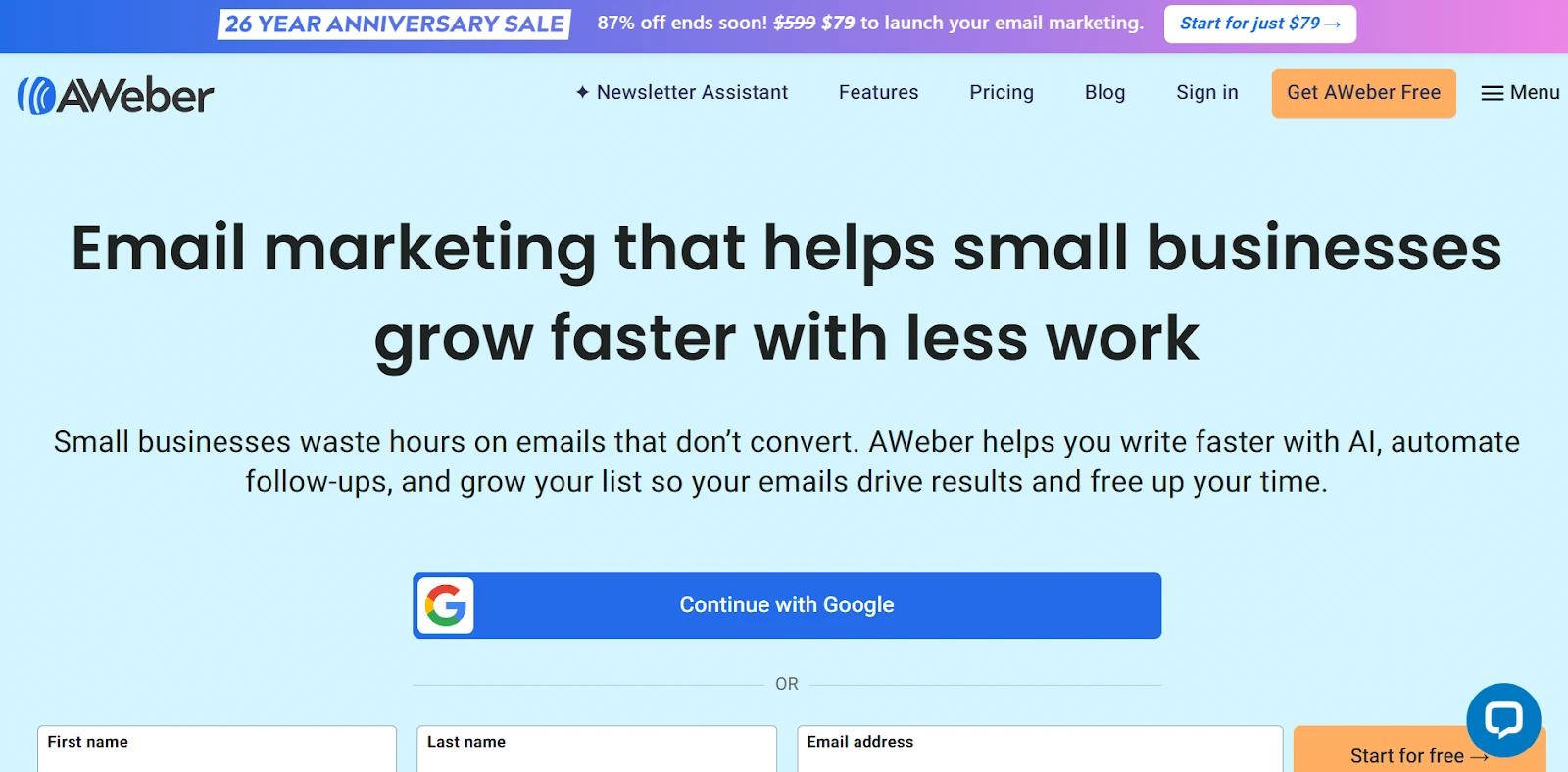
Best for: New entrepreneurs and small businesses wanting a proven, user-friendly email solution. AWeber’s USP is its emphasis on simplicity and support; it’s particularly trusted for being easy to set up with reliable deliverability.
After reviewing the top email marketing tools of 2025, one thing becomes clear: while each platform has its strengths, SendPulse delivers the most balanced and future-proof solution for businesses and marketers worldwide.
Here’s why SendPulse stands out as the best choice:
In short, SendPulse isn’t just another email marketing platform—it’s an integrated marketing hub designed to grow with your business. If you’re looking for a cost-effective, AI-powered, and multi-channel solution in 2025, SendPulse is the smartest choice among all the options available today.
Choosing the right email marketing platform is a big step toward building stronger customer relationships and driving growth. But email is only one part of the bigger picture — managing leads, tracking interactions, and closing deals often requires a more comprehensive system. If you’re ready to take the next step, check out our guide to the best CRM platforms, where we explore platforms that can help you organize contacts, streamline sales, and connect your marketing with long-term customer management.