


Influencity earned its following by making creator data feel manageable. Agencies and DTC teams reach for it because the discovery is genuinely strong – AI-assisted keyword, hashtag, and lookalike search across a 200M+ database, audience-authenticity checks, and a clean visual CRM that turns a shortlist into an organized pipeline. For teams whose core need is data-forward discovery and analytics, it does that job well. The friction shows up after the shortlist: outreach replies land back in your regular email inbox rather than a shared workspace, eCommerce tracking is limited to Shopify, and content licensing lives outside the platform entirely. Once a program has to reach creators, negotiate at volume, collect and license content, and prove revenue across more than one store, execution starts leaking out of the tool and into a patchwork of spreadsheets and separate apps.
The platforms below keep the data-first strengths that draw teams to Influencity and add the execution layer it leaves out. Leading the list is Influencer Hero, which pairs a 450M+ creator database – with fraud detection built directly into discovery – with a full three-layer CRM, AI-powered outreach at a 43% average response rate through a centralized in-platform inbox, six eCommerce integrations, and a UGC content library with rights handling. It is a step up in scope rather than a like-for-like swap, and for a program that has outgrown analytics-first discovery, that is usually the trade worth making.
Influencity is genuinely good at data-forward discovery and analytics. The reasons teams look elsewhere are almost always about what happens after you find creators:
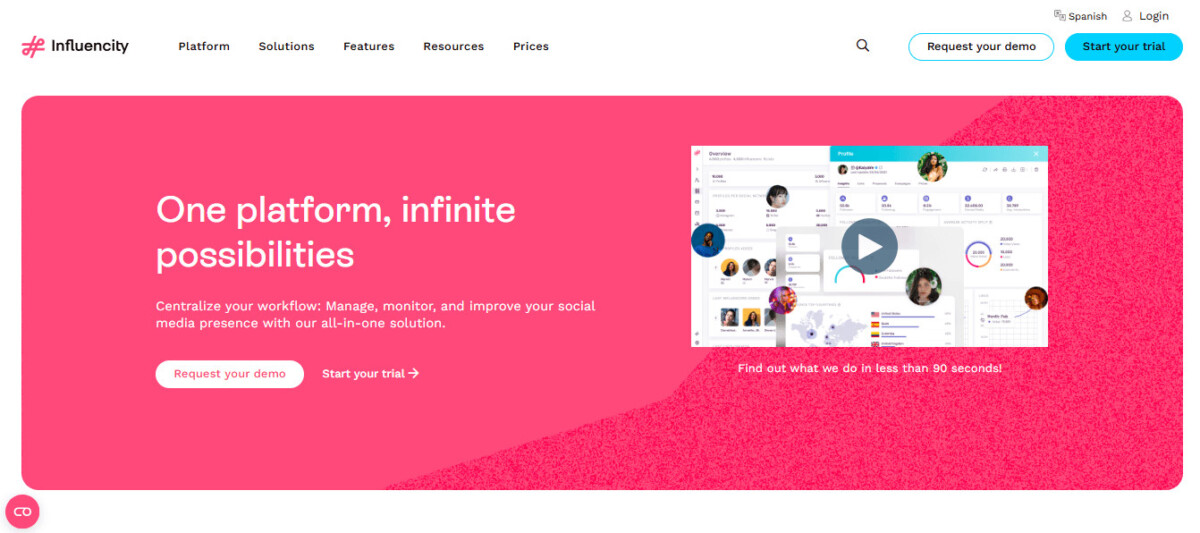
Influencity is a modular, data-driven influencer marketing platform built around discovery, analytics, and campaign management, aimed at agencies and eCommerce teams that value data and flexibility. It indexes a reported 200M+ creators across Instagram, TikTok, YouTube, and Twitch, with AI-assisted keyword, hashtag, and lookalike search, audience-authenticity analysis, a visual Kanban-style CRM, social listening, and a Shopify integration for discount codes and sales attribution. For teams whose priority is finding and analyzing the right creators, it is a capable, well-regarded tool.
Pricing runs from Basic at $168/month to Professional at $348/month and Business at $698/month, with Enterprise custom, and month-to-month billing is available. Where Influencity is strong at surfacing and vetting creators, the platform stops short of running the rest of the program: there is no centralized outreach inbox, eCommerce attribution is Shopify-only, and content licensing sits outside the tool. That is exactly the ground the alternatives below cover.
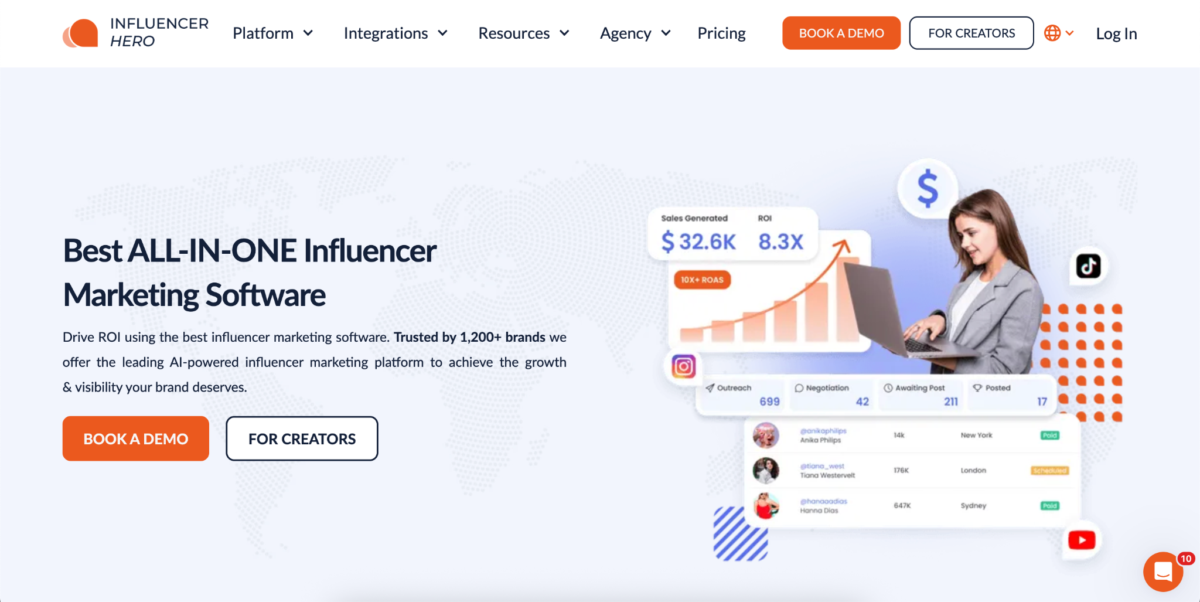
Influencer Hero keeps the data-first strengths teams like about Influencity – AI discovery and built-in authenticity checks – and adds the execution layer Influencity leaves out. Its 450M+ creator database spans 8 platforms, more than double Influencity’s pool, with fraud detection built directly into discovery and a free Chrome Extension for real-time vetting on Instagram, TikTok, and YouTube. Where it truly separates is everything after the shortlist: a three-layer CRM with rules-based automation, AI-powered outreach at a 43% average response rate through a centralized in-platform inbox, gifting, a UGC content library with rights handling, affiliate tracking, and six eCommerce integrations with real-time attribution.
Best for: Agencies and DTC brands that want Influencity-level discovery plus a complete, automated program – native outreach, CRM, gifting, UGC, and multi-store attribution – in one system.
Pricing:
Standout features:
Influencer Hero starts at $649/month, above Influencity’s Basic and Professional tiers, and its full feature set can be more than a team running only a handful of one-off campaigns needs. The value shows once a program runs consistently across multiple creators, channels, and stores.
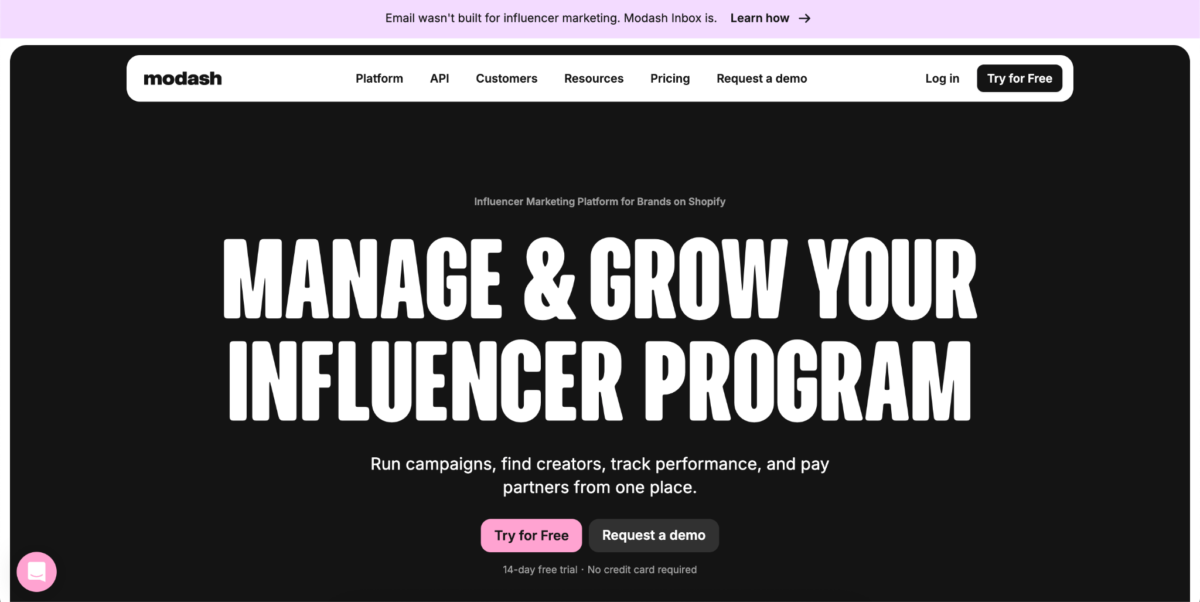
Modash is the closest thing to a bigger, more transparent discovery engine, with a pool of 350M+ public creator profiles across Instagram, TikTok, and YouTube and no filters hidden behind higher tiers. Against Influencity’s manual-search-then-external-email workflow, it adds a rebuilt CRM with automated email sequences that send from your own domain and stop when a creator replies, plus AI search by vibe or reference image and strong credibility scoring. Shopify-synced codes, gifting, and affiliate links connect discovery to revenue.
Best for: Teams that want the largest transparent discovery pool with light native outreach automation built in.
Pricing:
Standout features:
Modash charges a 5% payment transaction fee and remains primarily discovery-led, so lifecycle features such as UGC licensing and multi-store attribution are lighter than a full all-in-one platform. Like Influencity, its eCommerce tracking centers on Shopify.
HypeAuditor answers the data-accuracy question directly: it is the category’s gold standard for fake-follower detection and audience-quality analysis, backed by a 200M+ database and covering Snapchat, which most competitors omit. For teams that leaned on Influencity’s authenticity checks but wanted deeper vetting, AI Scout turns a campaign brief into a ranked shortlist in seconds, AI Coach acts as an always-on strategy advisor, and JavaScript-based sales tracking works across any store, not only Shopify.
Best for: Teams that prioritize rigorous fraud detection and audience authenticity above all else.
Pricing:
Standout features:
HypeAuditor is an analytics and vetting tool, not a campaign-execution platform, so running a full program still means pairing it with outreach, CRM, and gifting – the kind of workflow an all-in-one like Influencer Hero keeps in one place.
Heepsy sits at the affordable, lightweight end of the discovery spectrum. It indexes a reported 11M+ creators across Instagram, TikTok, YouTube, and Twitch, with a free search tier, intuitive filtering, and fake-follower checks that let a small team vet a shortlist quickly. For brands that find even Influencity’s entry tier more than they need, Heepsy is a simpler, cheaper way to test the channel.
Best for: Budget-conscious SMBs and agencies that want fast, low-cost discovery and authenticity checks.
Pricing:
Standout features:
Heepsy has an even smaller database than Influencity and no real outreach, CRM, or full-funnel attribution, with core filters and sales tracking reserved for higher tiers. It is a discovery starting point rather than a platform to run a program on.
GRIN answers Influencity’s Shopify-only limit head on. It is an eCommerce-first creator platform that consolidates the full lifecycle – discovery, CRM, messaging, gifting, contracts, and analytics – in one dashboard, with native integrations spanning Shopify, WooCommerce, BigCommerce, and Magento. Its Gia AI assistant helps find creators and draft outreach, and a free-forever affiliate hub plus co-branded storefronts round out a mature program trusted by 1,500+ brands.
Best for: DTC and eCommerce brands running product-seeding and affiliate programs across multiple stores.
Pricing:
Standout features:
GRIN does not publish its creator database size, and its discovery curation is reported to be weaker than dedicated sourcing tools like Influencity. Its lower tiers bill monthly, but the enterprise Core tier moves to annual, quote-based contracts.
Upfluence blends influencer marketing with eCommerce, and its signature strength is customer-affiliate identification – finding creators inside your existing customer base based on social reach and purchase history. Dual Shopify and Amazon integrations tie creator activity to actual sales, its Jace AI assistant supports outreach, and a full influencer relationship manager with bulk payments gives it the end-to-end execution workflow Influencity handles outside the tool.
Best for: eCommerce brands that want to turn existing customers into affiliates and tie creators to revenue.
Pricing:
Standout features:
Upfluence requires an annual contract and carries a steeper learning curve, and its 12M database is far smaller than the discovery-led tools higher on this list, including Influencity. Setup can be time-consuming for teams without an established system.
Sprout Social folds influencer marketing (via its Tagger acquisition) into an established social-media and analytics suite, which makes it a strong fit for teams that need to prove ROI and enforce governance – the reporting rigor Influencity users often want as programs scale. A Brand Fit Score ranks creators against your audience, approval workflows and contract management keep large teams compliant, and Modular Reports tie influencer activity back to revenue alongside your organic social data.
Best for: Teams that want influencer marketing inside a broader social suite with strong reporting and approval workflows.
Pricing:
Standout features:
Sprout’s per-user pricing scales quickly, the influencer module is quoted on top of the core suite, and it lacks bulk outreach automation, vibe-based visual search, and native UGC rights management. It suits teams already invested in the wider Sprout ecosystem.
Traackr is a data-driven platform built for long-term strategy and budget optimization – the enterprise-analytics peer to Influencity’s mid-market flexibility. Its Brand Vitality Score measures brand health, a budget calculator and cost-per-metric analysis (CPC, CPM, CPV, CPE) guide spend, and cross-market benchmarking standardizes reporting across regions and languages for multinational programs. A CRM with shared notes keeps large, distributed teams aligned.
Best for: Multinational brands that need comparative ROI analysis and market-by-market insight.
Pricing:
Standout features:
Traackr’s 6M+ database is far smaller than Influencity’s, with reported thinner coverage of micro and niche creators and a steeper learning curve. At enterprise pricing from roughly $25,000/year, it is built for governance rather than fast, tactical execution.
Meltwater approaches influencer marketing from media intelligence, pairing creator discovery with PR monitoring and social listening. For teams that want reputation context around creator activity – not just campaign metrics – it draws on a 30M+ creator database, AI Discovery, and proprietary influence and ad-value-equivalent scoring, all tied into the wider Meltwater listening ecosystem. It is the option for PR-heavy organizations that treat influencers as one channel within brand reputation.
Best for: PR-led teams that want influencer discovery inside a broader media-monitoring and social-listening suite.
Pricing:
Standout features:
Meltwater is expensive and its pricing is opaque, with a steep learning curve and no native gifting, affiliate, or outreach automation. It is strongest only if you also use its listening suite; as a standalone influencer platform it is heavier and pricier than Influencity.
CreatorIQ is an enterprise command center built for global brands at scale, from Disney to Unilever – the opposite end of the spectrum from Influencity’s mid-market flexibility, included here to show the full budget range. Its discovery runs on direct API integrations for verified, real-time data rather than public-source metrics, and SafeIQ fraud and brand-safety tooling, a full talent CRM, structured approvals, and real-time analytics with EMV make it a fit for large, multi-stakeholder teams.
Best for: Global enterprises needing API-verified data, governance, and complex approval workflows.
Pricing:
Standout features:
CreatorIQ is built for enterprise budgets and annual commitments, with a floor around $35,000/year, no transparent pricing, limited native affiliate automation, and long onboarding. It is overkill for the mid-market teams that adopt a tool like Influencity.
Starting prices, contract terms, and review scores for the alternatives covered above (for context, Influencity runs from Basic $168/month to Business $698/month, with month-to-month billing available):
| Platform | Starting Price | Contract | Review Score |
| Influencer Hero | $649/mo (annual from ~$454/mo) | Monthly (3-mo min) or annual | 5.0 Capterra |
| Heepsy | Free / $89/mo | Monthly | 3.9 Trustpilot |
| Modash | $299/mo ($199/mo annual) | Annual or monthly | 4.9 Capterra |
| HypeAuditor | ~$299/mo (annual) | Annual | 4.8 Capterra |
| GRIN | $399-$1,799/mo; Core from ~$25,000/yr | Monthly / annual | 4.5 G2 |
| Sprout Social | $199-$399/user/mo; module quoted | 12-month min | 4.5 Capterra |
| Upfluence | From $1,276/mo (annual term) | Annual | 4.3 Capterra |
| Traackr | From ~$25,000/yr | Annual | 4.3 G2 |
| Meltwater | Custom ~$33,100-$73,000/yr | Annual | G2 leader |
| CreatorIQ | Quote-only; floor ~$35,000/yr | Annual | 4.6 G2 |
Influencity is a strong, data-forward discovery and analytics platform, and for teams whose core need is finding and vetting the right creators it remains a capable choice. The reason to look at alternatives is scope: once you move past discovery into reaching creators at volume, managing live deals in one place, collecting and licensing content, and attributing revenue across more than one store, an analytics-first tool starts to hold a program back.
Match the alternative to your priority. Influencer Hero pairs the largest database here with a complete, automated program and a native outreach inbox. Modash offers the biggest transparent discovery pool with light automation, HypeAuditor leads on fraud detection, Heepsy covers low-cost entry discovery, GRIN and Upfluence serve multi-store eCommerce programs, Sprout Social and Meltwater bring reporting and reputation context, and Traackr and CreatorIQ deliver enterprise analytics and governance. Agencies that run influencer programs at scale, such as NC Media Group, often layer platforms like these to manage discovery, outreach, and reporting across many campaigns at once. The best fit is the one whose scope matches where your program is headed, not just where it is today.
Yes, for what it does – Influencity is a capable, data-forward discovery and analytics platform with a 200M+ database, AI-assisted search, audience-authenticity checks, and a visual CRM, well suited to agencies and eCommerce teams focused on finding and vetting creators. Teams look for alternatives mainly when they need a native outreach inbox, multi-store eCommerce attribution, UGC licensing, or a fuller campaign workflow that Influencity handles outside the tool.
For most brands scaling beyond discovery, Influencer Hero is the closest all-in-one match: a 450M+ database with fraud detection built into discovery, plus a three-layer CRM, AI outreach through a centralized inbox, gifting, a UGC library, affiliate tracking, and six eCommerce integrations. It costs more than Influencity ($649/month versus $168/month at entry), so it is a step up in scope rather than a like-for-like swap.
Influencity’s sales attribution is Shopify-only, so this is a common reason to switch. Influencer Hero supports six integrations including WooCommerce, Magento, BigCommerce, Prestashop, and Amazon. GRIN adds WooCommerce, BigCommerce, and Magento, and Upfluence covers both Shopify and Amazon. HypeAuditor’s JavaScript-based tracking also works across any store.
Influencity can send emails through a connected external account, but replies return to your normal inbox with no in-platform negotiation. Influencer Hero leads on native execution, with AI-personalized outreach at a 43% average response rate managed in a centralized inbox and a three-layer CRM with rules-based triggers. Modash, GRIN, and Upfluence also offer built-in CRM and outreach, while HypeAuditor and Traackr are analytics-led and need pairing with a separate outreach system.
Yes. Influencity indexes a reported 200M+ creators. Influencer Hero indexes 450M+ across 8 platforms with fraud detection built into discovery, and Modash covers 350M+ public profiles across Instagram, TikTok, and YouTube. Enterprise tools such as CreatorIQ and Traackr run smaller but API-verified or analytics-focused databases, so the right choice depends on whether you value raw reach or verified depth.
No – Influencity offers month-to-month billing with no mandatory annual commitment, alongside discounted annual options. Several alternatives are similarly flexible: Influencer Hero bills monthly with a short 3-month minimum, GRIN’s tiered plans are month-to-month, and Modash offers a monthly option. Enterprise platforms like Traackr, Meltwater, and CreatorIQ are the ones that typically require annual contracts.




