
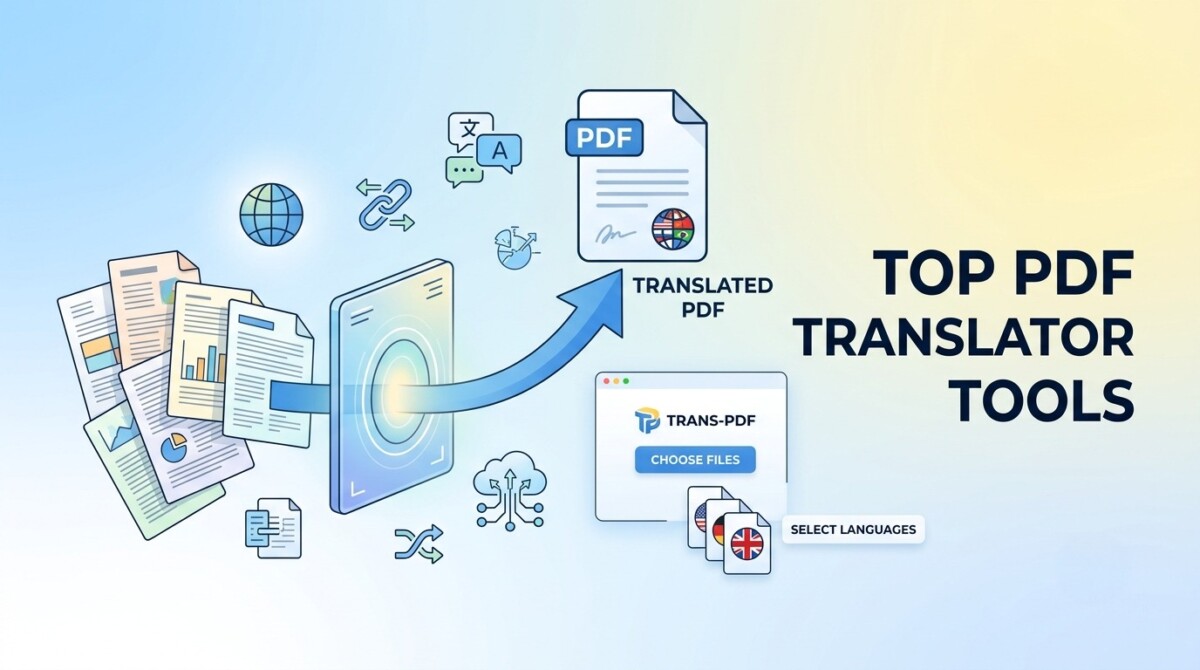
No single AI PDF translator wins for everyone in 2026. DeepL leads on output quality for common languages, Tomedes and iFoto handle the widest language range and scanned files, and Monica or Smallpdf suit quick casual translations. The right tool depends on your languages, file size, and accuracy needs.
A decade ago, a research paper in German meant hours of manual translation or the cost of a professional. In 2026, the bottleneck is no longer the translation itself. It is choosing the tool that actually fits the document in front of you.
Picture a procurement manager who opens a 40 page supplier contract written in Japanese, with a deadline that afternoon. Ten years ago that meant a rushed call to an agency and a four figure invoice. Today it means uploading a file and reading a formatted draft in minutes. The shift is real, and it has changed who relies on translation: not just linguists and global enterprises, but students, solo founders, and anyone who lands on a document in a language they do not read.
The catch is that these tools are not interchangeable. One handles 330 languages but caps files at 30 MB. Another preserves layout beautifully but covers only twenty languages. A third reads scanned images but skips Office formats entirely. Picking on brand name alone is how people end up paying for a subscription they cannot use on the file they actually have.
The seven tools below are listed alphabetically by product name, not ranked. There is no number one here, because the best choice genuinely depends on your languages, your file sizes, and how much accuracy matters for the document at hand. The comparison grid and the Best For section are built to help you find your match.
This list covers dedicated AI PDF translation tools that take a full PDF and return a translated version, judged on language coverage, file handling, format support, OCR, security posture, and pricing transparency as of May 2026. The qualifying bar was simple: the tool had to translate complete PDF documents, not just pasted text, and had to be available to individual users without an enterprise contract. The comparison is built from each vendor’s published specifications and documentation, plus general knowledge of the translation category. It is not an independent accuracy benchmark, and where a claim is illustrative rather than verified, the text says so. Two options were considered and excluded: Google Translate’s document upload, which struggles with complex multi-column layouts and offers no human review path, and Adobe Acrobat’s built-in translation, which is a feature of a broader PDF suite rather than a dedicated translator.
Each tool below trades language breadth, file limits, format support, and price differently, so scan the row that matches your priority first. Feature and pricing details are current as of May 2026.
AI PDF Translator by Monica is an AI translation tool for students, professionals, and casual users who mainly need clean, formatting-preserving PDF translation in widely used languages.
Monica’s AI PDF Translator takes a PDF, translates it into the target language, and returns a version that holds the original layout, including headings, columns, and spacing. It supports more than twenty languages, including English, Spanish, French, German, Arabic, and Chinese, and it reaches users through a browser extension as well as desktop and mobile apps, so the same tool follows you across devices. Each document can run up to 50 MB and roughly 100,000 tokens, which works out to around 70,000 words, enough for most reports and ebooks in a single pass. The vendor reports a 4.9 out of 5 rating on the Chrome Web Store and a user base in the millions, which signals a mature, widely adopted tool rather than a weekend project.
As of May 2026, Monica offers a limited free tier, a Pro plan at 8.30 US dollars per month, and an Unlimited plan at 12.40 US dollars per month for heavier use and advanced features.
Its real strengths are reliable format preservation, a generous 50 MB and 70,000 word ceiling per document, and the cross-device workflow that lets you start on desktop and finish on mobile. The standout limitations are coverage and scope: roughly twenty languages is the narrowest range in this lineup, well behind tools that reach 130 or more, and the tool focuses on PDF rather than handling Word, PowerPoint, or Excel files the way DeepL and PDFSimpli do. The free tier is also limited enough that any sustained use pushes you to a paid plan.
Best fit for students and professionals who translate PDFs in common languages and care most about keeping the document looking like the original across their devices. Skip if you need a less common language outside its roughly twenty supported, if you work mainly in Office file formats, or if your files run larger than 50 MB.
AI PDF Translator by Tomedes is built for formatted, high-stakes documents, using multi-model consensus and optional human review to cut the single-engine errors that break technical and contract translations.
Built by Tomedes, a professional translation company, the AI PDF Translator translates full PDFs across more than 330 languages while keeping the original layout intact, including headings, tables, lists, columns, and footnotes. Its defining feature is SMART, which compares output from several leading AI models segment by segment and returns the version with the strongest agreement, which reduces the kind of single-engine errors that surface in documents with technical terms or nuanced phrasing. Built-in OCR handles scanned and image-only PDFs, and for sensitive files there is an optional path to human review and desktop publishing. Because it sits inside a wider professional translation business, you can escalate the same document from AI draft to certified human translation without starting over, which matters for contracts, manuals, and official records.
As of May 2026, Tomedes offers a free, no-signup preview of a limited portion of the output, so you can judge translation quality, formatting, and OCR before paying. Full translations of longer PDFs may require a one-time payment with no subscription, though the tool page does not publish a specific price.
Its strengths are the multi-model SMART approach for reliability on difficult text, the widest language coverage in this list at 330 plus, strong layout and table preservation, and the OCR plus human QA options for formal documents. The honest limitations are real: the 30 MB file ceiling is the smallest here, so large manuals or bulky scanned bundles will not fit where Sider and iFoto accept up to 500 MB, and pricing for full documents is not shown up front, so you cannot estimate cost until you have run the preview.
Best fit for businesses, language professionals, and global teams translating formatted or high-stakes PDFs where accuracy and structure matter more than raw file size. Skip if you need to translate very large files, or if you want a fully free full-document translation that some alternatives in this list offer.
DeepL Translator is a professional-grade translation tool known for output quality, supporting documents across more than thirty languages and trusted by large organizations.
DeepL translates PDF, Word, PowerPoint, and Excel files, which makes it the most flexible option here for mixed Office workflows. It is widely regarded for the naturalness of its output in its supported languages, and it adds professional controls that casual tools lack: a glossary feature for enforcing preferred terminology, a clarify feature for resolving ambiguous phrasing, and tone options. On the security side, DeepL states ISO 27001 and GDPR compliance, with its strongest data protection reserved for paid tiers. The company reports use across more than 100,000 businesses and government bodies, which reflects a tool chosen where translation quality and data handling are scrutinized.
As of May 2026, DeepL has a free tier, a Starter plan at 8.74 US dollars per month, an Advanced plan at 28.74 US dollars per month, and an Ultimate plan at 57.49 US dollars per month, with higher tiers unlocking more document volume and the maximum security terms.
The strengths are output quality on common languages, genuine multi-format support including Office files, glossary control for consistent terminology, and a compliance posture that holds up in regulated settings. The limitations to weigh: at 30 plus languages, DeepL covers far fewer than Tomedes, iFoto, or PDFSimpli, because it prioritizes depth on a smaller, mostly European and major Asian set, and the strongest data security plus the higher document limits sit behind paid plans that climb to 57.49 US dollars per month.
Best fit for professionals and businesses translating into widely used languages where output quality, terminology control, and data compliance matter, especially across mixed Office formats. Skip if you need a rare or regional language outside DeepL’s set, or if you want maximum data protection without paying for a higher tier.
iFoto PDF Translator is a broad-coverage tool for professionals, students, and travelers, built around 200 plus languages and OCR for scanned documents.
iFoto translates PDFs and image files, and its OCR engine reads scanned and image-only documents so you can translate a photographed page or a non-selectable scan, not just a clean digital PDF. It supports more than 200 languages, second only to Tomedes in this list, which makes it a strong pick when the document is in a less common language that narrower tools simply do not offer. File handling is generous at up to 500 MB, tied for the largest ceiling here, and the supported inputs include PDF along with common image formats such as JPG, PNG, and WebP. The vendor states GDPR compliance and data protection measures, and the tool is positioned for people who frequently encounter documents and signage in languages they do not read.
As of May 2026, iFoto is free to use with limitations; the available information does not publish specific paid tier pricing, so confirm current rates on the site before relying on it for ongoing work.
The strengths are very broad language coverage, OCR that handles scanned and image-based files, the 500 MB ceiling for large documents, and direct support for image inputs. The limitations: format support is restricted to PDF and images, so it will not process Word, PowerPoint, or Excel files the way DeepL and PDFSimpli do, and the lack of published paid pricing makes it harder to budget than tools with clear tiers. The available data also offers no user-base or rating figures, so its public track record is less established here than DeepL, Monica, or Sider.
Best fit for users translating scanned documents, photographed pages, or images, or anyone who needs a less common language that narrower tools do not support. Skip if your source files are Word, PowerPoint, or Excel, or if you need transparent pricing before you commit.
PDFSimpli PDF Translator is a high-volume tool for professionals, supporting 130 plus languages, batch translation of multiple files, and the widest set of file formats in this list.
PDFSimpli translates documents while preserving the original layout and accepts an unusually broad range of inputs, including PDF, DOCX, PPT, XLSX, HTML, and TXT, which makes it a fit when your source material is mixed rather than PDF only. Its standout capability is batch translation: you can process multiple files in one pass rather than uploading them one at a time, which is the difference between a five minute task and an afternoon when you are working through a stack of documents. With more than 130 languages, its coverage sits comfortably above DeepL, Monica, and Smallpdf, landing it in the upper tier for breadth alongside iFoto and Tomedes.
Pricing is not stated in the information reviewed here. PDFSimpli has historically used a low-cost introductory trial that converts into a recurring subscription, a model that has drawn billing complaints, so confirm the current terms and the renewal price directly before subscribing as of May 2026.
The strengths are 130 plus language coverage, the broadest format support in this lineup across PDF and the main Office types, and batch processing for translating many files at once. The limitations: the trial-to-subscription billing pattern reported for PDFSimpli means the up-front price you see may not reflect what you are charged on renewal, and the available data includes no per-language quality benchmarks or independent user metrics, so output quality is harder to judge in advance than with DeepL.
Best fit for professionals and teams translating many files across mixed Office and PDF formats who need batch processing in one workflow. Skip if you want transparent, predictable pricing before committing, or if you only need the occasional single-file translation, where the subscription model is more than you need.
Sider PDF Translator is a browser-based tool for professionals who need to translate large PDFs quickly, with file support up to 500 MB and more than fifty languages.
Sider runs primarily as a browser extension and translates PDFs while preserving the original formatting. Its headline capability is scale: it accepts files up to 500 MB, tied for the largest ceiling here, which makes it suitable for long manuals and dense reports that smaller-ceiling tools reject. It covers more than fifty languages, including English, Spanish, French, German, Arabic, and Hindi, and on privacy it states that files are deleted after processing, which matters when the document is confidential. Premium plans unlock more capable AI models such as GPT-4o, higher page limits, and priority processing, and the vendor reports a 4.9 out of 5 Chrome Web Store rating across a user base in the millions.
As of May 2026, Sider is free to use with limitations, with premium plans available for advanced models, higher page limits, and priority processing; the available information does not list a specific premium price.
The strengths are the 500 MB ceiling for very large documents, the delete-after-processing privacy practice, the browser-extension workflow that fits into existing reading, and the option to upgrade to stronger models when quality matters. The limitations: at 50 plus languages it sits in the middle of this list, behind the 130 to 330 of the broadest tools, and the best capabilities, including the advanced models and higher page limits, are gated behind premium, so the free tier is meaningfully constrained.
Best fit for users translating large PDFs who want a browser-based workflow and value files being deleted after processing. Skip if you need a rare language outside its 50 plus set, or if you want top model quality without moving to a paid plan.
Smallpdf Online PDF Translator is an easy-to-use tool for casual users and students, pairing quick translation with a built-in AI chat for asking questions about the document.
Smallpdf translates PDFs and a wide set of other formats, including DOCX, PPT, and image types such as JPG, PNG, GIF, and TIFF, and it lets you choose between translating a summary or the entire document. Its distinguishing feature is the built-in AI chat: after translating, you can ask the tool questions about the content rather than rereading the whole file, which is useful when you only need the gist of a long document. It supports more than twenty languages, including English, Spanish, French, German, Arabic, and Chinese, states GDPR compliance, and operates as part of a long-established platform that the vendor says has served well over a billion people since 2013.
As of May 2026, Smallpdf is free to use with limitations, with fuller features available on its paid plans; specific translation pricing is not detailed in the information here.
The strengths are the built-in AI chat for document questions, broad format and image support including TIFF and GIF, the summary-or-full-document choice, and the credibility of a platform operating since 2013. The limitations: at around twenty languages, its coverage ties Monica for the narrowest in this list, well short of the broader tools, and the free tier is limited enough that consistent use pushes you toward a paid plan. It is also positioned for casual use, so it is a weaker choice for dense technical or legal material that demands precision.
Best fit for casual users and students who want fast translations plus the ability to ask an AI chat questions about the document. Skip if you need a less common language, or if you are translating high-stakes technical or legal material where casual-grade output is not enough.
The right tool depends less on which has the most features and more on the document in front of you. If you are a student or casual reader translating an article or a report in a common language and you mainly want it to stay readable and properly laid out, Monica covers that well across desktop and mobile, and Smallpdf is the better pick if you also want to ask questions about the content through its AI chat rather than read the whole thing.
If you are translating business documents where output quality and data handling are scrutinized, DeepL is the stronger choice for widely used languages and mixed Office files, with glossary control that keeps terminology consistent across a set of documents. The trade off is language breadth: if your document is in a regional or less common language, DeepL may not support it, and that is exactly where iFoto’s 200 plus languages or Tomedes at 330 plus earn their place instead.
If the file is a scanned contract, a photographed page, or an image-only PDF, you need OCR, which narrows the field to iFoto, Tomedes, and Sider among the options here. For very large files, Sider and iFoto accept up to 500 MB, while Tomedes caps at 30 MB, so a 100 page scanned manual goes to Sider or iFoto, not Tomedes, even though Tomedes is the stronger pick for a shorter high-stakes document. If you are processing many files at once, PDFSimpli’s batch translation is the time saver, provided you confirm its renewal pricing first.
And when the document genuinely matters, a contract, a regulatory filing, an official record, the honest answer is that AI alone is not the finish line. Tomedes is the only option here with a built-in path from AI draft to human review, which is why it leans toward formal and high-stakes work even with its smaller file ceiling.
There is no single best AI PDF translator, which is why this list is unranked. All seven tools earn their place, and the right choice comes down to four questions: what language you are translating into, how large the file is, whether the source is a scan or an image, and how much accuracy is at stake. A casual reader and a procurement manager translating a contract are not shopping for the same tool, even though both are translating a PDF.
Use the comparison grid to filter on your top constraint, whether that is language coverage, file size, OCR, or format support, then use the section above to match a tool to your specific situation. For everyday reading in common languages, the lighter tools are more than enough. For business documents, weigh quality and compliance against language breadth. And for anything where a mistranslation carries real cost, treat AI output as a fast first draft and keep a human review step in the loop. The technology has closed most of the gap, but on the documents that matter most, that last step is still yours to own.
There is no single best AI PDF translator in 2026, because the right tool depends on your languages, file size, and accuracy needs. For common languages with strong output quality, DeepL leads. For the widest language coverage, Tomedes at 330 plus and iFoto at 200 plus are ahead. For scanned files, you need OCR, which points to iFoto, Tomedes, or Sider. For quick casual reading, Monica and Smallpdf are simpler and lighter. Rather than asking which is best overall, identify your hardest constraint, such as a rare language, a large file, or a scanned source, then pick the tool that clears it. The comparison grid above is built to make that filtering fast.
Yes, some AI PDF translators handle scanned and image-only PDFs through built-in OCR, but not all of them do. In this list, iFoto, Tomedes, and Sider include OCR or image handling that can read a scanned page or a non-selectable document and translate the recognized text. Tools without OCR can only translate PDFs that already contain selectable text, so a photographed or scanned page would come back untranslated. If your source is a scan, an image, or a photo of a document, confirm the tool advertises OCR before you rely on it. Accuracy on scans also depends on image quality, so a clean, high-resolution scan will always translate more reliably than a blurry photo.
As of May 2026, AI PDF translators range from free tiers with limits up to roughly 57 US dollars per month for top business plans. Monica runs a free tier, a Pro plan at 8.30 US dollars per month, and an Unlimited plan at 12.40 US dollars per month. DeepL offers a free tier and paid plans from 8.74 up to 57.49 US dollars per month. Tomedes provides a free preview, then a one-time payment for longer documents without publishing a set price. iFoto, PDFSimpli, Sider, and Smallpdf list free tiers with limitations but do not publish full paid pricing in the information reviewed here, so confirm current rates and renewal terms on each site before committing.
The main difference is that DeepL prioritizes output quality across about thirty languages, while the Tomedes AI PDF Translator prioritizes language breadth and reliability across 330 plus languages with a human review option. DeepL is the stronger pick for widely used languages and mixed Office files, with glossary controls and a compliance posture suited to regulated business use. Tomedes covers far more languages, uses its SMART feature to compare multiple AI models for accuracy on difficult text, includes OCR for scanned files, and offers a path to certified human translation, which suits high-stakes documents. The trade off is file size: Tomedes caps files at 30 MB, while DeepL handles larger documents and broader file formats.
The Tomedes AI PDF Translator supports the most languages in this list, at more than 330, followed by iFoto at 200 plus and PDFSimpli at 130 plus. Sider covers more than fifty, while DeepL sits at 30 plus and Monica and Smallpdf each cover around twenty. Broad coverage matters most when your document is in a regional or less common language that narrower tools simply do not offer. It matters less if you only ever translate between major languages such as English, Spanish, French, German, or Chinese, where even the narrower tools perform well and other factors like output quality, file size, and OCR become the deciding ones.
AI PDF translators are accurate enough for understanding the gist of legal or technical documents, but not reliable enough to be the final word on high-stakes files without human review. Accuracy has improved sharply, and features like the multi-model consensus in Tomedes or the glossary controls in DeepL reduce errors on specialized terminology. Even so, a single mistranslated clause in a contract or a misread figure in a technical spec can carry real cost. For documents where the wording is legally or financially binding, treat the AI output as a fast first draft and route it through a qualified human translator. Tomedes is the only tool here with a built-in path from AI draft to certified human review.





