

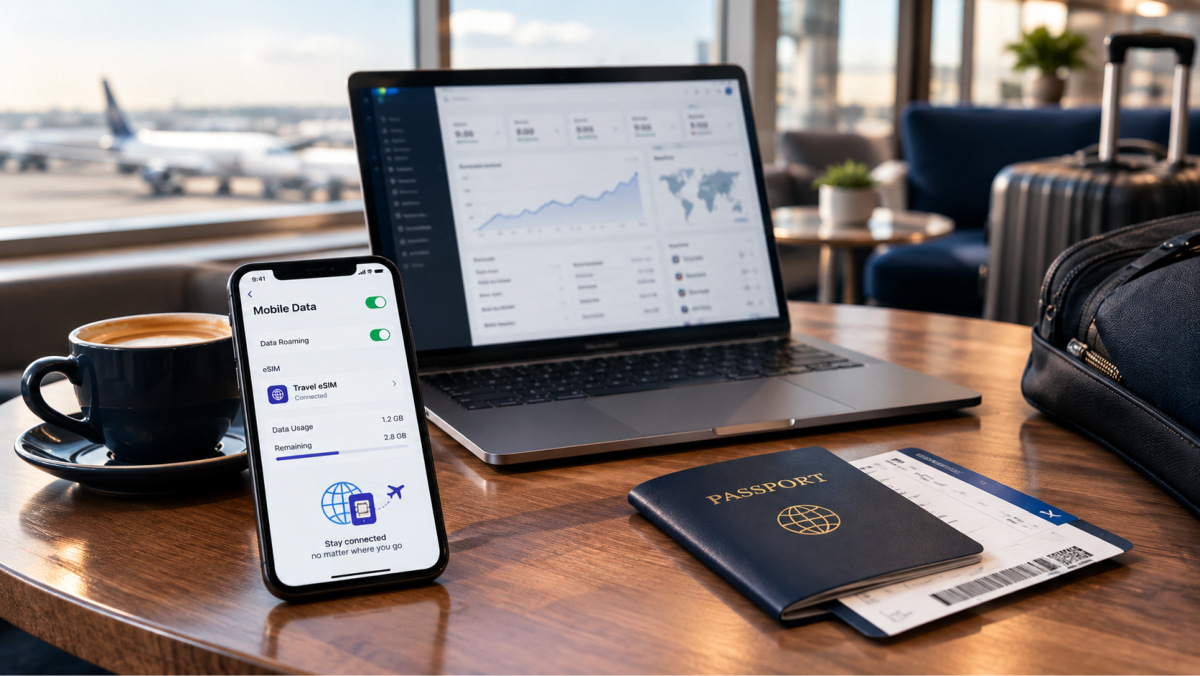
Ecommerce founders can avoid unexpected roaming charges by auditing their existing carrier plan, using a destination-appropriate eSIM for data when it offers better value, and locking down phone settings before departure so background activity does not consume business travel data.
International connectivity is not a minor travel detail when you run an online store. It is part of the operating infrastructure that lets you respond to customers, protect ad spend, and keep orders moving when you are not at your desk.
Running an ecommerce business doesn’t stop when you leave the country. For Shopify merchants, ecommerce founders, and digital marketers, travelling often means staying connected to the business wherever you are. You may need to check an order from an airport, respond to a customer message from a hotel, monitor a marketing campaign while sightseeing, or deal with an unexpected issue with your store while crossing a border.
The challenge is that using your phone abroad can introduce another expense that is easy to overlook: mobile roaming.
A few map searches, customer calls, Slack messages, emails, social media uploads, and store-management tasks may not seem like much individually. But when you’re relying on mobile data throughout a trip, the costs can quickly become difficult to predict.
Fortunately, business travellers have more options than simply relying on their usual mobile provider. eSIM technology makes it possible to arrange a separate mobile data connection before travelling, potentially giving ecommerce professionals more control over how they stay connected.
For a traditional holidaymaker, losing mobile data for a few hours might be inconvenient.
For an ecommerce founder, it can be much more disruptive. Your phone may be connected to your Shopify store, email account, payment notifications, customer support platforms, advertising dashboards, analytics tools, and team communication apps. Even if you aren’t actively working all day, important notifications can arrive at any time.
Imagine travelling between countries while managing an online store. A customer could report a payment problem while you’re at the airport. A supplier might need an urgent response. An advertising campaign could suddenly start spending more than expected. Or your team may need you to approve an important change.
Being able to get online reliably can therefore be more than a convenience. It can help you keep the business moving while you’re away from your normal workspace.
Roaming is convenient because you don’t need to change anything on your phone. You can land, turn on your device and continue using your existing connection. The problem is that the cost depends heavily on your mobile provider, destination and plan.
Some providers include international data allowances, while others offer travel packages or charge separately for overseas usage. There may also be data limits, fair-use policies or additional charges once an allowance has been exhausted.
For someone running an ecommerce business, predicting usage can be particularly difficult. You might expect to use your phone occasionally, but then spend an afternoon answering customer enquiries, joining video calls, checking advertising performance and uploading content. Your actual data consumption can end up being very different from what you expected.
Before travelling, it’s worth checking exactly what your existing mobile plan includes in every country on your itinerary.
An eSIM is a digital SIM that can be installed on compatible smartphones without removing the physical SIM already in the device.
For ecommerce professionals, one advantage is flexibility. Instead of relying entirely on your existing provider’s international roaming terms, you can arrange a separate data connection specifically for your trip.
Your regular SIM can remain available for calls or messages where appropriate, while the eSIM handles mobile data. This can be useful when you’re travelling for business, attending conferences, visiting suppliers or simply taking a holiday while continuing to oversee your online store.
Services such as eSIM io provide different connectivity options for travellers, allowing users to choose a setup based on their destination and expected usage.
Not every ecommerce founder needs the same amount of mobile data. Someone taking a short break and checking Shopify orders once or twice a day may use relatively little. Another founder could spend several hours online every day managing campaigns, communicating with staff and handling customer support.
This is where choosing a plan based on actual usage can make sense.
For lighter usage, a pay-as-you-go option can avoid paying for a large amount of data that you may never consume.
For people who know roughly how much connectivity they need, fixed-term plans can provide a predetermined allowance for a specific destination or region. And for travellers who need to remain connected throughout the day, unlimited daily options can remove some of the uncertainty around trying to estimate data consumption.
The important point isn’t simply choosing the cheapest option. It’s choosing a connection that matches the way you actually use your phone while travelling.
Ecommerce professionals often underestimate how much data their normal work activities can consume.
Checking an order dashboard may require very little data. But other activities can quickly increase usage.
For example, while travelling you might:
If your trip involves several of these activities every day, your mobile data requirements can be considerably higher than those of a typical tourist. Planning around your actual workflow can help you avoid both unexpected charges and running out of data at an inconvenient time.
International ecommerce businesses often operate across multiple markets, which can make travel more complicated.
A founder might start a trip in the UK, travel to France for a conference and then continue to Germany to meet a supplier. Each country can have different roaming conditions depending on the mobile provider.
Rather than checking your roaming coverage every time you cross a border, a regional or multi-country eSIM may provide a simpler alternative.
eSIM io’s OneSIM technology is designed to let users install the service once and stay connected as they move between supported countries. For someone managing an online business across several destinations, reducing the amount of connectivity management required during a trip can be valuable.
One of the easiest ways to avoid expensive surprises is to deal with mobile connectivity before your flight.
Check:
Planning these details before departure means you are less likely to make a rushed decision after landing.
Some eSIM services also allow users to purchase a plan in advance and choose when it should activate. With eSIM io’s Custom Plan Activation Date, for example, travellers can arrange their connectivity before departure without necessarily starting the plan immediately.
That can be particularly useful when a business trip has been booked weeks or months in advance.
Avoiding roaming charges isn’t only about buying a different data plan. Your phone’s settings can also affect how much data you consume.
Before travelling, consider disabling automatic app updates over mobile data, limiting background data for apps you don’t need and downloading maps or other essential content over Wi-Fi.
Cloud photo backups can also consume significant amounts of data, particularly if you’re taking lots of product or travel photographs.
For ecommerce teams, it’s also worth reviewing which apps actually need mobile access while you’re away. There is little reason for every application on your phone to constantly use data if only a handful are required for your business.
Small changes can make a noticeable difference when you’re relying on mobile connectivity for several days.
New users can also get an additional benefit when starting with eSIM io. Apply the special promo code 50BONUS to receive a 50% bonus on your top-up.
For example, if a new user applies 50BONUS and tops up £20, eSIM io will provide an additional £10 bonus in credit to use within the app.
So the £20 top-up receives an extra £10, giving the new user additional balance while trying the service.
For ecommerce founders, travelling doesn’t necessarily mean stepping away from the business completely. The ability to manage orders, communicate with customers, monitor campaigns and stay in touch with a team means many online businesses can continue operating from almost anywhere.
But that flexibility depends on reliable connectivity and the wrong mobile setup can turn it into an unexpected expense. Roaming may still be the simplest option if your existing plan offers affordable international data. If it doesn’t, an eSIM can provide another way to separate your travel connectivity from your normal mobile plan.
The best option ultimately depends on where you’re travelling, how much data your business requires and how long you’ll be away.
For Shopify merchants and ecommerce professionals, the goal isn’t simply to stay connected while abroad. It’s to make sure connectivity supports the business without creating another unnecessary cost.
You should use the option that gives your Shopify business reliable access at the most predictable total cost for every country on your itinerary. Roaming is often easiest when your existing carrier includes sufficient international data at a fixed daily or monthly price. An eSIM can be a better fit when roaming is expensive, coverage differs between countries, or you want a separate travel data line while keeping your normal number available for calls and two-factor authentication. Compare the complete plan terms before departure, including data caps, high-speed limits, activation rules, and overage charges.
An ecommerce founder’s travel data needs depend on whether they are only checking orders and messages or actively handling calls, content, advertising, and team operations. Light check-ins for Shopify, email, customer support, maps, and Slack may require relatively little data. Video meetings, cloud backups, social uploads, laptop tethering, and campaign monitoring can increase usage quickly. Check the per-app mobile-data report on your phone for the previous month, then choose a plan with enough capacity for your highest-use days and a clear top-up path if an urgent issue arises.
You can often keep your normal phone number while using a travel eSIM for mobile data if your device supports dual SIM or eSIM functionality. Configure your usual SIM to remain active for calls, SMS, and two-factor authentication, then set the travel eSIM as the cellular data line. Exact options vary by device, carrier, and operating system, so test the configuration before you leave. Confirm that data switching is disabled or controlled if you want to prevent your main line from unexpectedly using expensive roaming data.
You should disable automatic app updates over cellular data, restrict cloud photo and video backups to Wi-Fi, download offline maps and essential documents, and limit mobile-data access for nonessential apps. Set a data warning below your travel plan’s allowance and verify that your travel eSIM, not your main SIM, is selected for mobile data. Keep device security enabled with a strong passcode, current software, and two-step authentication for business accounts. These changes reduce surprise data use while preserving access to Shopify, email, customer support, maps, messaging, and authentication tools.
Managing Shopify and business accounts on public Wi-Fi carries risk, so use mobile data or trusted networks whenever possible and protect every login with unique credentials and two-step authentication. Confirm the exact network name with hotel, airport, or conference staff before connecting, and do not bypass browser security warnings. Avoid entering sensitive credentials on unfamiliar or suspicious networks. Shopify recommends that store owners keep credentials confidential, use individual staff accounts with specific permissions, and protect accounts with security features such as passkeys and two-step authentication.




