

Returns are the moment every ecommerce brand dreads. But they don’t have to be the end of the relationship. When Smile’s loyalty infrastructure meets Loop’s best-in-class returns experience, brands can flip a traditionally costly interaction into a genuine customer retention engine.
The scale of the returns problem is hard to overstate. According to the National Retail Federation, U.S. retailers absorbed $890 billion in returned merchandise in 2024, a 16.9% average return rate across all retail. For ecommerce specifically, the number is worse: online return rates hit an estimated 19.3% in 2025, meaning nearly one in five orders shipped is sent back.
The costs compound quickly. Reverse logistics, restocking labour, repackaging, and inventory write-downs on unsellable stock all erode margin. Add the re-acquisition cost to win back a customer who churns after a return, and the true cost of a poorly handled return becomes significant.
But there’s a different way to read those numbers. A 19% return rate is also a 19% opportunity to have a second, high-stakes conversation with a customer before they decide whether to come back.
When a customer initiates a return, they are working within your process. They haven’t filed a chargeback. They haven’t gone to social media. They’re still engaging with your brand. The relationship is intact and the outcome is still in your hands.
What you do in the post-purchase window, including the returns flow, is one of the highest-leverage moments in the entire customer journey. A frictionless return handled well can produce a loyal customer. A slow, frustrating one ends the relationship permanently. Customer retention research consistently shows that the post-purchase experience is one of the highest weighted factors in whether a customer comes back.
Most brands treat the returns portal as pure cost containment: get the product back, issue the refund, move on. The brands building durable customer lifetime value treat it as a retention touchpoint.
Loop is the returns management platform that powers the post-purchase experience for thousands of Shopify brands. Its core capability is steering customers away from refunds and toward outcomes that retain revenue: instant exchanges, Shop Now (where the return credit can be applied to any new product), and store credit with optional bonus incentives.
Smile is the loyalty infrastructure that sits beneath a brand’s entire customer relationship: points, tiers, rewards, and the behavioural nudges that drive continuous customer retention.
The Loop and Smile integration connects these two systems through an OAuth connection that syncs your Smile loyalty audience into Loop as custom lists, segmented by VIP tier or membership status. Those lists become live conditions inside Loop’s Workflow engine, so Loop knows exactly who your VIPs and members are at the moment they land in the returns portal.
Each list carries per-customer loyalty metadata (VIP tier name, points balance, loyalty status) and stays current automatically. No manual exports. No static CSVs that go stale between returns. When a customer’s tier changes in Smile, it’s reflected in Loop. The result is a live connection between who your best customers are and how your returns portal treats them.
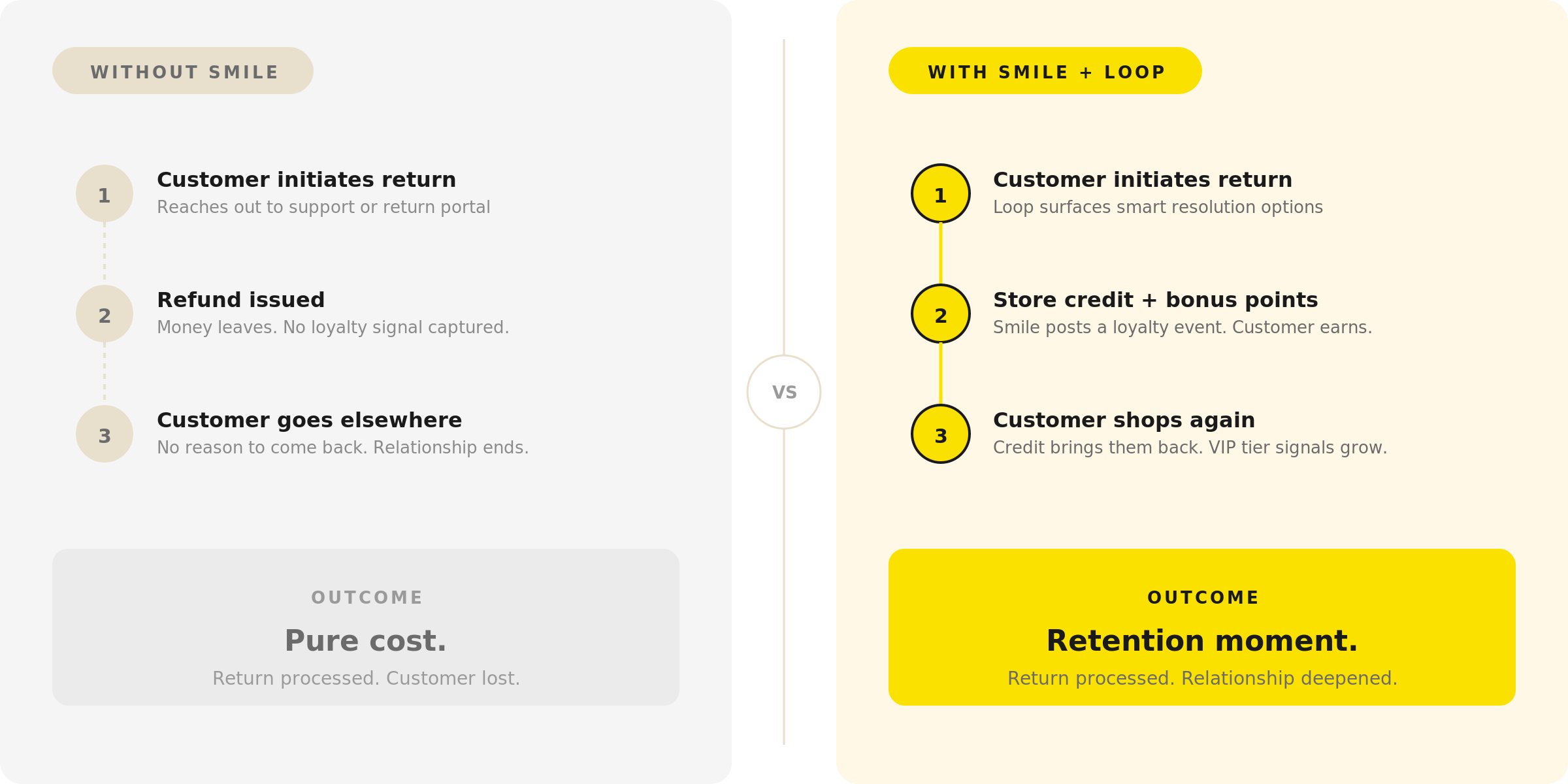
With the integration in place, loyalty status becomes a live variable in how every return is handled, and that changes the economics of the return itself.
A Gold tier member initiating a return might see a more generous bonus credit offer than a first-time buyer. A loyalty member might get a longer return window, free return shipping, or access to Instant Exchange where a non-member sees only standard options. The differentiation happens behind the scenes: the shopper just experiences a better return, not a loyalty program overlay.
That’s where the value compounds. Bonus store credit is one of the most effective tools for shifting customers from refund to exchange – and when that offer is calibrated to loyalty status rather than applied identically to everyone, the impact goes beyond conversion. For a top VIP customer, a differentiated return experience is proof that membership means something at a moment that actually matters. Not just points accumulation on purchases, but tangible recognition when a purchase goes wrong.
Brands wanting to get the most from the Smile and Loop integration should structure the returns flow around three principles.
Make the loyalty offer visible at the point of decision. The bonus store credit offer – whether it’s a flat incentive or a VIP-tiered one – needs to appear inside the Loop portal at the moment the customer is choosing between refund, store credit, and exchange. Not in a follow-up email. Timing matters.
Calibrate the incentive to your AOV. Loop’s benchmarking data suggests that bonus credits set at roughly 10% of average order value perform best at shifting behaviour. For a brand with a $120 AOV, that’s a $12 bonus, a meaningful incentive that doesn’t require heavy discounting.
Reward loyalty members differently. Smile’s tier data flows into the Loop experience, which means top VIP tier members can see enhanced offers not available to other members. This reinforces the value of tier status in a concrete, transactional moment: exactly the kind of VIP recognition that high-LTV customers respond positively to.
The alternative to a loyalty-powered returns experience is treating every return as a refund transaction to be processed as quickly as possible. But this is clearly no way to protect your margin and retain customers. This approach may keep operations simple, however it also means that the 19% of ecommerce orders that come back represent nothing but cost – no retention signal, no relationship signal, no second conversation.
The secondary benefits of a loyalty program – including retention during high-friction moments like returns – are exactly where the ROI compounds. Brands investing in customer lifetime value understand that the post-purchase window is too valuable to leave as pure logistics. Loop handles the operational complexity of returns elegantly. Smile adds the retention layer that turns an operational interaction into a relationship moment.
Together, we make the case that a return doesn’t have to be the end of anything.
Ready to turn your returns portal into a retention engine? Talk to our team about how Smile and Loop work together for mid-market and enterprise brands.
Already using Loop? Set up the Smile integration in minutes.




