
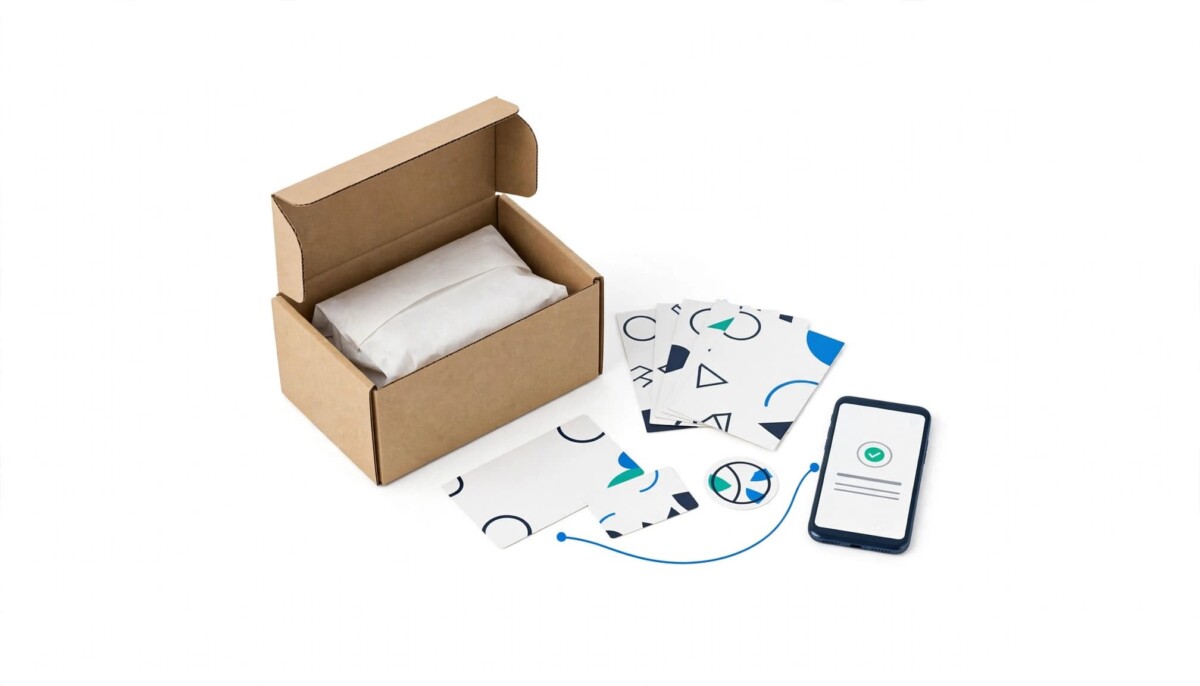
Printed inserts earn their place in an ecommerce package when each one has a job: a thank-you card for goodwill, a care or setup insert to prevent avoidable returns, and a trackable bounceback offer for the second order. Two or three purposeful pieces beat a pile of flyers.
The box is the only part of your store a customer can hold in their hands, and most merchants fill it with a packing slip and nothing else.
A customer clicks buy on a Tuesday, gets a confirmation email, and then hears nothing until a box lands on the porch on Friday. That box is the first physical contact they have ever had with an online-only brand. For a lot of stores it holds the product, a crumpled packing slip, and nothing else, so the one moment the customer is fully paying attention gets spent on relief that the order arrived rather than on the brand that sent it.
The fix is not a bigger packaging budget. It is a small set of printed pieces, each with one job, produced consistently enough that every order feels like it came from the same company. Working with a reliable commercial printing partner matters more than it sounds, because a thank-you card that prints muddy on the second run undoes what the first run built. This guide covers which pieces to use, what each one should do, how to tell whether a discount card is earning its keep, and what to leave out of the box.
Whether you pack 50 orders a week at the kitchen table or hand inserts to a 3PL at 5,000 a month, the logic is the same. Only the number of pieces and how you measure them changes with stage.
Unboxing deserves its own line in the marketing plan because it is the one touchpoint where the customer’s attention is close to guaranteed. When someone buys in a physical store, they touch the product, see the display, and talk to a person. Online shopping skips all of that. The delivery box is the only physical object that connects the digital cart to the customer’s home, and it arrives at the exact moment they are most curious about what they bought.
Compare that with the inbox. Mailchimp’s email marketing benchmarks put the average ecommerce open rate at 29.81%, based on data as of December 2023, and Mailchimp itself notes that Apple’s Mail Privacy Protection affects how accurate open rates are. A package has no such problem. The customer has to open it to get what they paid for, so whatever sits on top of the product gets at least a glance. That does not mean every insert gets read, but it does mean the first few seconds are yours, without competing against twenty other promotional emails.
The timing helps too. A delivery that feels considered reassures the customer that they made a good decision, which is the opposite of buyer’s remorse. If you place a clear, low-friction reason to come back inside that box, you reach the customer while they are happiest with you, not three weeks later when your win-back email lands.
The box is one stage of a longer sequence that also includes confirmation, tracking, and returns, all covered in this guide to driving repeat purchases through post-purchase experiences. Treat the package as the physical step in that sequence, not a separate project.
Customers judge an online purchase by everything around the product, and the box is the first part of that judgment they can physically touch. The moment a parcel hits the doorstep, the buyer notices how sturdy the mailer is, how the tape peels, and how easy it is to open. If the presentation looks cheap, the product inside can feel less valuable, whatever it costs.
Category leaders set the expectation. Apple turned opening a phone box into a deliberate ritual, and subscription boxes lay out their contents so each item reveals itself in sequence, which is what makes unboxing videos worth filming. Shoppers carry those expectations into every other delivery they open.
The sharing behavior is real, and so is the shift in what customers value. Dotcom Distribution’s 2018 ecommerce study of more than 1,400 online shoppers found that 43.33% of Gen Z and 38.56% of Millennial respondents said they share a picture or video of a product after opening it. The same study found that fancy ribbons and scented boxes now take a back seat to unexpected value-added items such as coupons, stickers, and magnets. That finding is several years old and comes from a fulfillment provider, so treat it as directional, but it points the same way as this whole guide: small, useful printed pieces tend to matter more than expensive packaging.
Perceived value is the mechanism. Illustrative example: two stores sell a similar cotton t-shirt for $40. One wraps it in branded tissue with a printed welcome card; the other drops it into an unprinted poly bag. The first feels like a boutique, the second like a clearance bin, even though the shirts are the same. For more on mailer types, tissue, and what custom packaging costs, see this walkthrough on using ecommerce packaging to create a memorable unboxing experience.
The five printed pieces that do the most retention work are thank-you cards, product inserts, bounceback discount cards, branded postcards, and custom stickers and labels, and most stores should start with two of them rather than all five. From thank-you cards and promotional inserts to postcards, brochures, and other printed marketing materials, each piece below has a specific job. If a piece does not have a job you can name, it does not belong in the box. For a wider list of insert types and brand examples, this guide to packaging insert types and how to create yours is a useful companion.
A thank-you card creates a human connection between a warehouse and a real person. Keep the message about appreciation rather than selling: a short note from the founder or the packing team, on heavier stock, signals that someone cared how the order was packed. For newer brands, initials or a handwritten sign-off on each card is a cheap way to make the gesture feel personal, and it is the kind of detail customers photograph.
A product insert answers questions before the customer has to contact support. These sheets or mini booklets explain how to use, care for, or assemble the product on day one. When customers get a good result immediately, you avoid the setup mistakes that are one of the more preventable reasons products come back. Inserts are also a natural home for cross-selling: someone who bought an espresso maker can be shown the cleaning kit that pairs with it. A clear QR code to a setup video or a review page lets the buyer act from their phone in seconds.
A bounceback discount card gives the customer a concrete reason to place a second order. Most stores rely on email flows to win that second sale, but a card sitting on top of the goods reaches the customer at the moment they are happiest with the purchase. Make the offer specific and time-bound, for example “Take 10% off your next order with code RETURN10” with a 30 or 45 day expiry. Print a unique code for each batch or customer segment so you can measure what it actually does, which the next section shows how to check.
Branded postcards work as small billboards for your bigger story. A postcard can explain your mission or preview a seasonal collection, and a standard 4×6 or 5×7 card leaves room for strong photography on the front and a referral offer on the back. A good-looking postcard is the piece most likely to end up on a desk or a fridge, which keeps your brand in the home long after the shipping box is recycled.
Custom stickers and labels are the cheapest way to make stock packaging look branded. A die-cut logo sticker sealing the tissue paper builds a little anticipation as the customer opens the parcel. Clean product labels keep bottles, jars, and apparel bags looking right on a bathroom counter or pantry shelf. Including two or three well-designed stickers also gives enthusiastic customers something to put on a laptop or water bottle, and stickers were one of the value-added items the Dotcom study found shoppers now rate highly.
A bounceback card pays for itself only when the extra second orders it creates cover both the print cost and the discount you give to customers who would have reordered anyway, and that second cost is usually the larger one. The redemption count alone is misleading, because some of the people using the code were coming back regardless.
Illustrative example, assuming 1,000 orders shipped in a month, a $60 average order, a 50% gross margin, a card that costs $0.40 printed and inserted, a 10% off code, and a baseline where 15% of customers reorder within 45 days with no card at all. The print bill is 1,000 times $0.40, or $400. If two thirds of the 150 customers who would have reordered anyway now use the code, that is 100 discounts of $6, or $600 given away. Each genuinely new second order earns $30 in margin minus the $6 discount, or $24. To cover $1,000 in total cost, the card needs to create about 42 extra second orders, which means lifting the 45 day repeat rate from 15% to roughly 19%.
That is the number to hold the card to. If it lifts the repeat rate by a point or two, it is losing money even though the redemption report looks busy. The way to find out is simple: use a unique code, then ship a share of orders without the card for 60 days (every other order, or alternating weeks) and compare repeat rates between the two groups.
Stage matters here. Below a few hundred orders a month, the groups are too small for a clean read, so treat results as directional and consider a softer offer such as free shipping on the next order, or no offer at all beyond a thank-you card. At several thousand orders a month, the same test gives you a reliable answer within one cycle. This breakdown of a four-layer packaging insert framework for retention covers how to structure the card alongside your other inserts.
Start with a thank-you card and one job-specific insert, add a measured bounceback card once you have enough orders to read the result, and leave custom rigid boxes and full insert kits until the basics are proven. The most common mistake is not doing too little; it is doing everything at once and never learning which piece did the work.
If you are doing under $10K a month, a branded sticker on a stock mailer and a well-printed thank-you card do most of the job. Add a care or setup card if your product has a learning curve or a return problem. Skip custom printed boxes for now; the money is better spent on product and on a short print run you can revise after the first hundred orders.
Between roughly $10K and $100K a month, add the bounceback card with a unique code and run the holdout test above. If you already run a loyalty or referral program, a postcard that explains the referral reward is worth testing next. These tips for increasing repeat sales on Shopify cover the loyalty and referral programs that a postcard can point to.
Above $100K a month, and especially once a 3PL is packing for you, segment rather than add. A first-time customer and a fifth-time customer do not need the same card. Give your 3PL simple written insert rules by product line and customer type, and audit a few outgoing boxes each month to confirm the rules are being followed. The pattern to avoid shows up most often between $500K and $2M a year: six inserts, three discount codes, and no idea which one moved anything. Fewer pieces, each measured, beat a full kit nobody can evaluate.
The box should look and sound like your storefront, because a mismatch between the two breaks the trust the website built. If a customer fell for your clean, modern product pages, opening a parcel packed with mismatched colors, clip art, and hard-to-read text feels like a different company. Every printed piece should look like it came from the same team that built your site.
Color is where most brands slip. Screens show color with light (RGB, usually specified as hex codes), while presses mix ink (CMYK), so a vivid brand green or blue can print noticeably darker or duller than it looks on screen. Ask your printer for a physical proof before a full run, and if a color is central to your brand, a reference such as the Pantone Color Bridge guide shows each spot color next to its closest CMYK match on both coated and uncoated paper, which is also a reminder that the same color looks different on different stock.
Typography should match too. Use the same headline and body fonts on your cards and inserts that customers see on your product pages, and keep text large enough to read on a small card. Voice is the easiest piece to get right and the most often missed: if your site copy is playful, an insert written like a legal notice feels off. Photography should follow the same rules, using the lighting and styling on your postcards that customers know from your social channels.
The simplest way to plan your unboxing is to pair each digital message a customer receives with one physical touchpoint that does a related job. The table below lines up the two across the customer journey. Read it row by row and find the stage where your physical side is empty or weakest; that is where your first new printed piece should go.
Two rows tend to be empty for most growing stores. The unboxing row is often a packing slip and nothing else, even though a setup insert is one of the cheapest pieces to print and the one most likely to prevent a support ticket. The retention row is often all digital, which leaves the second order to an email the customer may never open. If you only add two printed pieces this quarter, those two rows are usually where they belong.
The most expensive unboxing mistakes are not about spending too little; they come from pieces with no job, no measurement, or no quality control. These five show up again and again in fast-growing Shopify stores.
Generic packaging is the first. Dropping items into plain, unmarked mailers wastes the first chance to create recognition on the porch, and a branded tape or custom return address sticker fixes it cheaply. The second is no brand reinforcement after purchase: merchants pour creative energy into the storefront and none into the box, so the connection built at checkout fades the moment the parcel opens.
The third is missing a reason to come back. Every package should contain one easy way to reconnect, whether that is a bounceback card, a loyalty program QR code, or a review request, and ideally one of those, not all three. The fourth is overcrowding. Six flimsy flyers in one box overwhelm the customer and look messy; two or three purposeful, well-printed pieces do more.
The fifth is low-resolution artwork. Fuzzy logos, blurry QR codes, and smeared text make a good brand look amateur, and a QR code that will not scan wastes the whole insert. Use vector files, test every QR code on two or three phones, and approve a printed proof before the full run.
The best first step is to open one of your own orders as if you were a first-time customer and note where the brand disappears. Look at the outside of the box, the first thing you see when it opens, and what is left once the product is out. Most stores find one obvious gap: no thank-you, no setup help, or no reason to come back.
Fix that one gap with a single printed piece, give it a unique code or a QR code you can track, and run it for 60 days before adding anything else. If the numbers hold up, add the next piece. If they do not, change the offer or the message before you change the packaging. A box that does two things well will do more for your repeat rate than one stuffed with everything you could print.
Yes, printed materials still matter because the package is the only physical touchpoint an online shopper has with your brand. An email competes with everything else in the inbox, and Mailchimp’s benchmarks put the average ecommerce open rate at 29.81% as of December 2023. A package has to be opened to get the product, so a card sitting on top of the goods gets at least a glance. Dotcom Distribution’s 2018 survey of more than 1,400 online shoppers also found that small value-added items such as coupons and stickers now matter more to shoppers than fancy ribbons or scented boxes. The condition is that each printed piece has a clear job and matches the quality of your storefront.
Most ecommerce brands should include a thank-you card, a short care or setup insert, and one clear reason to make a second purchase. That reason can be a bounceback discount card, a loyalty program QR code, or a review request, but one is usually enough. Depending on your catalog, you can add branded stickers, a postcard that tells your story, or a QR code that leads to a setup video. Newer stores should start with two pieces and add more only after measuring what the first ones do. The goal is to help the customer get a good first result and give them an easy path back to your store, not to fill the box.
Thank-you cards improve loyalty by turning an automated transaction into something that feels personal. A short note from the founder or the packing team tells the customer that real people handled their order, and that reassurance arrives right when they are deciding whether the purchase was worth it. Customers who feel valued as people rather than order numbers are more inclined to recommend the store and come back. The effect is hard to measure on its own, so pair the card with something trackable, such as a unique discount code or a review QR code, if you want to see its contribution. Heavier card stock and a handwritten initial cost little and make the gesture feel genuine.
Yes, most Shopify stores should use branded inserts, starting small and measuring as they go. Inserts can walk customers through setup, suggest a related product, and ask for a review without any ad spend, which makes them an owned channel that reaches every customer who opens the box. A store doing under $10K a month can start with a thank-you card and a care card. A store doing $10K to $100K a month can add a bounceback card with a unique code. Larger stores working with a 3PL get more from segmenting inserts by product line and customer type than from adding more pieces. The exception is dropshipping, where you may not control the box at all.
Bounceback discount cards and clear care or setup inserts usually have the most direct effect on repeat purchases, but the only way to know for your store is to measure. A discount card offering a set percentage off the next order within 30 to 45 days reaches the customer when their excitement is highest, while setup inserts prevent the early mistakes that lead to returns and disappointment. The catch with discount cards is leakage: some customers who use the code would have come back anyway. Use a unique code, ship a share of orders without the card for 60 days, and compare repeat rates. If the lift does not cover the print cost and the discounts given away, change the offer.




