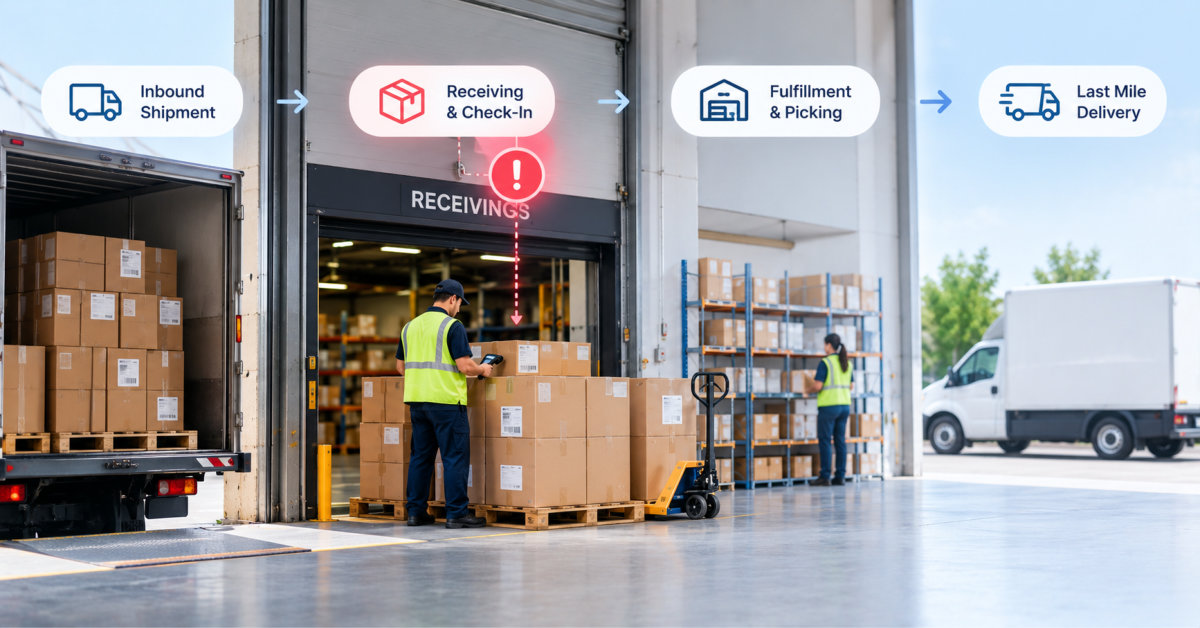
Fulfillment delays often begin at receiving, not the last mile: when inbound trailers or containers are not unloaded, checked, staged, and put away on time, inventory cannot become sellable stock. Ecommerce brands should measure dock-to-available time and hold 3PL partners accountable for receiving throughput, accuracy, and exception handling.
The customer sees a late tracking update. The cause may be a container that arrived on time but sat unopened long enough to make inventory unavailable when the order needed it.
Ecommerce brands obsess over last mile delivery speed, but a growing share of the shipping delays customers actually feel start much earlier, at the receiving dock of the warehouse or 3PL that first takes in inventory. When the crews unloading trailers and containers, commonly called lumpers, are slow, understaffed, or unpredictable, that delay compounds through every step that follows: putaway, replenishment, pick and pack, and eventually the tracking number a customer refreshes on day four wondering where their order is. A single container that takes ninety extra minutes to devan can push a facility’s entire receiving schedule into the next day, and for a brand relying on that inventory to fulfill orders already placed, that slip shows up directly in delivery promises.
For years, warehouses and fulfillment centers treated unloading labor as a variable cost handled trailer by trailer, calling in hourly crews as needed with little consistency shift to shift. That worked when receiving windows were generous and freight volume was predictable. Ecommerce has made both of those assumptions obsolete. Peak season compresses receiving windows into narrow daily slots, port congestion pushes more containers through inland facilities on tighter cycles, and warehouse labor markets in the corridors that matter most to online sellers remain thin. Companies such as humano, a managed cost per unit lumper and container staffing provider serving warehouse and fulfillment operators across eight major port and metro corridors including Newark and New Jersey, Long Beach, Oakland, Savannah, Philadelphia, Cleveland, Seattle, and Fort Worth, have built their entire model around solving that volatility with dedicated, annual staffing agreements rather than one off jobs.
A brick and mortar retailer restocking a shelf has some slack if a truck runs late. An ecommerce brand does not, because the order already exists, the customer already has a delivery estimate, and every hour a container sits unopened at the dock is an hour that estimate gets harder to hit. Fulfillment centers serving direct to consumer brands are also more likely to see mixed freight arrive on short notice: a container of a bestselling SKU that needs to be devanned by hand and staged for immediate replenishment, alongside standard palletized restock that moves faster. Hand devanning takes far longer per unit than pallet handling because every carton has to be pulled, sorted, and staged individually. A facility running a lean hourly crew that suddenly receives two container loads instead of the one it planned for during a flash sale or a viral product moment is left choosing between pushing every other appointment behind schedule or paying a last minute premium for extra labor. That is exactly the kind of variability that turns a marketing win into a fulfillment fire drill.
More fulfillment operators are moving away from hourly billing toward cost per unit, or CPU, billing because it ties labor spend directly to output instead of clock time. Under an hourly model, a slow trailer or a crew standing idle during a lull in inbound freight still costs the same per hour no matter what actually gets unloaded. Under CPU billing, the operator pays for pallets loaded, containers devanned or transloaded, or cases picked and staged, which aligns the crew’s incentive with actually moving freight rather than stretching a shift. For a brand or 3PL trying to forecast fulfillment cost against a promotional calendar, that predictability matters: instead of modeling shift lengths and overtime around a projected Black Friday spike, an operations lead can multiply expected unit counts by an agreed rate.
Comparing the two models side by side:
Operators evaluating a switch typically start by asking a provider how it structures dedicated crews around a facility’s inbound calendar rather than dispatching ad hoc labor trailer by trailer. humano’s learn more page outlines how its CPU lumper and container staffing programs are built as year round dedicated agreements tied to a facility’s actual receiving volume, rather than single project bookings.
“When a crew is paid per unit instead of per hour, the conversation with the fulfillment manager changes completely, it stops being about how many bodies are on the dock and starts being about how fast inventory actually clears into sellable stock,” said a senior operations manager at humano. “A dedicated agreement also means the same crew learns a facility’s dock layout, its putaway zones, and its SKU patterns, which cuts variability from one inbound shift to the next.”
A dedicated agreement replaces a labor pool the facility has to rebuild every morning with a fixed, known crew sized to typical weekly volume, with the provider absorbing responsibility for scaling that crew during peak weeks. That predictability lets a fulfillment team tighten receiving windows instead of padding the schedule to cover the chance a crew shows up short handed, freeing up dock time that can be redirected to more inbound appointments during a launch or a seasonal surge.
It also matters for brands whose inventory mix changes with demand. A facility receiving both palletized restock and hand devanned containers can staff for both without renegotiating terms every time the mix shifts, since CPU rates are typically set per activity type rather than per trailer. Ecommerce operations teams managing inventory across multiple fulfillment sites, particularly in high volume corridors like Long Beach and Savannah, have leaned on this structure because one agreement can cover several facilities under consistent terms instead of negotiating separately at each dock.
Before committing to a dedicated lumper agreement, confirm how the provider defines a billable unit, how fast it can scale a crew during a spike, and whether the agreement covers the specific activities the operation needs, such as transloading, case picking, or staging for immediate replenishment. Unit definitions matter more than they first appear: a provider that counts a devanned container as a single unit rather than counting the individual cartons inside it can produce a bill that looks nothing like what was expected once volume ramps for a launch or a holiday peak. A provider that cannot explain its unit definitions clearly, or that defaults back to hourly billing whenever volume gets unpredictable, is unlikely to deliver the consistency an ecommerce operation needs to keep its delivery promises intact.
As promotional cycles compress and inbound freight stays unpredictable, ecommerce brands and the fulfillment partners behind them are treating dock labor less like an hourly utility and more like a managed service with defined units, defined turnaround expectations, and year round accountability. That shift in how receiving labor is structured, not just who provides it, is increasingly what separates a brand that hits its ship dates from one that does not.
Dock-to-stock time is the elapsed time between inventory arriving at a warehouse dock and that inventory becoming available for storage, allocation, replenishment, or customer fulfilment. A complete measure includes carrier check-in, dock assignment, unloading, receiving verification, damage or count reconciliation, putaway, and the system update that makes inventory sellable in the WMS or OMS. Ecommerce brands should measure it by facility, inbound type, SKU priority, and load type because a floor-loaded container of mixed cartons requires different labour and processing time than a standard palletised shipment.
A receiving delay can cause late customer deliveries because products cannot be picked, packed, or handed to a carrier until the warehouse has unloaded, verified, put away, and made the inventory available in its systems. A brand may technically have stock at the building while open customer orders remain unfillable because the freight is still inside a container, waiting at a dock, staged for inspection, or not yet recorded as sellable inventory. The delay then cascades into missed order cut-offs, delayed carrier handoff, and a later delivery date for the customer.
Cost-per-unit billing is a warehouse-labour pricing model in which a facility pays for defined work output, such as pallets unloaded, cartons handled, containers devanned, cases picked, or freight transloaded, rather than paying only for crew hours. It can make labour costs easier to forecast against inbound volume and may align the provider’s incentives with throughput. The value depends on a clear agreement that defines exactly what counts as a unit, which activities are included, how exceptions are charged, what service levels apply, and how the provider will scale during peak volume.
A 3PL should consider dedicated receiving crews when inbound volume is recurring, load types are complex, service-level consistency matters, and rebuilding an ad hoc crew each shift creates delays or management burden. Dedicated crews can learn facility layout, safety procedures, SKU patterns, staging zones, and priority rules, which can reduce operating variability. Ad hoc labour may still fit smaller facilities or highly irregular inbound schedules. The right decision depends on volume predictability, container mix, local labour availability, cost structure, and whether the provider can commit to measurable dock-to-stock performance.
Ecommerce brands should ask a warehouse for average and exception-level time from appointment arrival to unload start, unload completion, putaway, and sellable inventory availability. They should also ask how priority loads are flagged, how container and pallet work differ, what happens during volume spikes, who owns discrepancies and damages, and how quickly the facility can scale labour. Request reporting by load type and SKU criticality, not only a general receiving average. The most important question is whether the warehouse can show how receiving performance affects open orders, launch timing, and customer ship-date commitments.