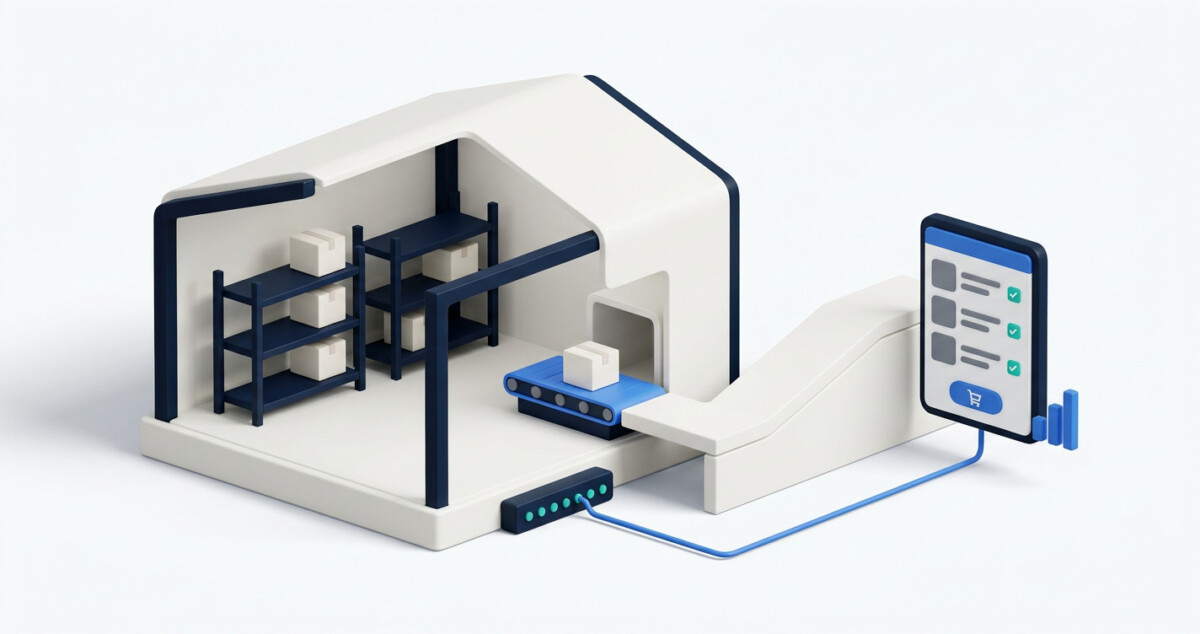
Technology helps distributors grow ecommerce revenue when it connects customer, product, inventory, pricing, and order data into a buying experience that is faster for routine purchases and more useful for complex ones. The goal is not more software; it is fewer gaps between what buyers need and what the business can reliably deliver.
Distribution ecommerce does not win by replacing the sales rep. It wins by making routine work self-serve and giving buyers faster access to expert help when the purchase becomes complex.
Ecommerce has changed what customers expect from distributors. Buyers who once relied on phone calls, printed catalogs, and lengthy email exchanges increasingly expect to research products, check availability, place orders, and manage their accounts online. They also expect the process to be quick, accurate and convenient.
For distributors, meeting these expectations can be challenging. Large product catalogs, complex pricing structures, repeat orders and established customer relationships do not always fit neatly into a standard ecommerce model. Technology is helping bridge that gap.
Modern digital tools can connect sales, marketing, inventory, and customer information while removing many of the manual processes that slow distributors down. Used effectively, these systems do more than make online selling possible. They can help distributors create stronger customer experiences, improve efficiency, and generate sustainable ecommerce growth.
Here are seven important ways technology is making that happen.
One of the biggest advantages distributors have is the amount of information they can build up about their customers. Purchase histories, product preferences, inquiry records, account details, and previous interactions can all provide valuable insight.
The challenge is turning that information into something useful.
Modern customer relationship management technology gives sales and marketing teams a central place to organize and interpret customer information. Instead of treating every online visitor or buyer in the same way, distributors can provide experiences based on individual needs and previous behavior.
For example, an existing customer might be shown frequently purchased products or relevant complementary items. Sales representatives can also see previous conversations and orders before contacting an account, helping them provide more relevant support.
Implementing a purpose-built CRM for distributors can be particularly useful where businesses need to manage complex customer relationships alongside ecommerce activity.
Personalization can make digital channels feel less transactional. That is important for distributors that have traditionally built their success around strong, long-term relationships.
Distributors can carry hundreds, thousands, or even hundreds of thousands of products. Giving customers access to this range online is valuable, but only when buyers can find what they need without unnecessary effort.
Technology has significantly improved ecommerce search and product discovery. Customers can filter products according to specifications, brands, applications, availability, and other relevant attributes. More sophisticated search systems can recognize synonyms, part numbers, and variations in terminology.
This matters because B2B buyers are often searching for something highly specific. A customer may know the exact product code they require, while another might only know the dimensions, material or technical specification.
A well-structured ecommerce platform can accommodate both.
Technology can also support product recommendations. Relevant accessories, replacements, or complementary products can be displayed during the buying journey, helping customers complete an order while creating opportunities to increase its value.
Good product discovery reduces friction. Rather than requiring customers to search through catalogs or contact a representative for routine information, distributors can give them a faster route to the right products.
Few things damage an ecommerce experience faster than inaccurate stock information. A customer who orders an apparently available item only to discover later that it is out of stock may quickly lose confidence in the distributor.
Integrated technology helps prevent this problem.
By connecting ecommerce platforms with inventory management or enterprise resource planning systems, distributors can provide customers with more accurate information about product availability. Depending on the system, buyers may be able to see current stock levels, expected replenishment dates, or availability at different warehouses.
This visibility is valuable for customers planning projects, managing their own stock, or working to tight deadlines.
It also benefits the distributor internally. When ecommerce orders feed directly into inventory and fulfillment systems, employees spend less time transferring information manually between platforms. That can reduce errors and help orders move through the business more efficiently.
Real-time data creates a closer connection between what customers see online and what is actually happening operationally. As ecommerce volumes increase, that connection becomes increasingly important.
Many distribution businesses handle a significant number of repeat purchases. Customers may reorder the same consumables, components or supplies every few weeks or months.
Technology can make these routine transactions considerably easier.
Online accounts can allow buyers to view previous purchases and reorder products without starting the search process again. Saved lists, favorites, and quick-order tools can make frequent purchasing even faster. Some platforms can also support recurring orders for products that customers need on a predictable schedule.
Automation benefits distributors as well as buyers.
Orders submitted online can move directly into processing and fulfillment workflows, reducing the amount of manual data entry required. Invoices, confirmations, and shipping updates can also be generated automatically.
This does not mean removing people from the customer relationship. Instead, automation handles repetitive administrative tasks so employees have more time for work where their expertise adds greater value.
Sales representatives, for example, can focus on solving customer problems, identifying new opportunities, and developing important accounts rather than repeatedly processing straightforward orders.
Every digital interaction can generate useful information. Distributors can see which products customers view, where traffic comes from, how buyers navigate the website, and where they abandon the purchasing process.
This creates opportunities to make ecommerce decisions based on evidence rather than assumptions.
If a particular product page attracts substantial traffic but produces few orders, there may be a problem with pricing, availability, or the information provided. If customers repeatedly use certain search terms without finding suitable results, the catalog structure may need improvement.
Sales data can reveal other patterns. Distributors may identify products commonly purchased together, categories with strong online growth, or customer groups that have begun ordering less frequently.
These insights can inform decisions across the business, from marketing and merchandising to stock planning and account management.
The key is connecting data rather than allowing it to remain isolated in separate systems. When ecommerce, customer, sales, and operational information can be viewed together, distributors gain a much clearer picture of what is driving performance.
The growth of ecommerce does not mean every customer wants to interact exclusively online. Distribution relationships are often more complicated than ordinary retail transactions, and customers may move between several channels during a single purchasing journey.
A buyer might research products on a distributor’s website before asking a sales representative for technical advice. They may request a quotation by email and then place the eventual order through an online account. Later, they might contact customer service about delivery.
Technology can help connect these interactions.
When customer information is shared between systems, employees gain greater visibility of what has happened across different touchpoints. A sales representative can understand a customer’s recent activity rather than treating each interaction as an isolated event.
This also allows ecommerce to support existing sales teams instead of competing with them.
Customers can use self-service tools when speed and convenience matter, while still having access to knowledgeable employees when a purchase requires additional guidance. Giving buyers this flexibility can be especially valuable for distributors serving a mixture of straightforward and highly technical purchasing needs.
B2B purchasing no longer happens exclusively from an office desktop. Buyers may need to check a product while on a job site, confirm availability from a warehouse, or place an urgent order while traveling.
Mobile technology makes ecommerce accessible in these situations.
A responsive ecommerce website can give customers convenient access to product information, account details, order histories, and purchasing tools from smartphones and tablets. Features such as streamlined navigation, quick search and simplified checkout can make mobile purchasing considerably easier.
Mobile access can also benefit sales representatives. With the right systems, employees working in the field can access current customer information, product details and previous orders without returning to the office.
The result is a more flexible buying and selling environment.
Distributors should therefore think beyond simply making a website technically work on a smaller screen. Mobile users often have different priorities. They may need information quickly and have less patience for complicated menus, lengthy forms, or difficult navigation.
Designing around these realities can help distributors capture orders that might otherwise be delayed or lost.
Technology offers distributors significant opportunities, but adding more software is not automatically the same as making progress. A business can invest in numerous platforms and still create frustration if those systems do not communicate effectively.
Integration is therefore one of the most important considerations in an ecommerce strategy.
Customer information, inventory management, product data, sales activity and order processing should work together wherever possible. When systems remain disconnected, employees may end up duplicating work, correcting inconsistent information or manually moving data from one platform to another.
Distributors should also consider the customer experience when deciding where to invest. Technology should solve genuine problems. That could mean making a large catalog easier to search, giving customers greater visibility of stock, or removing unnecessary steps from repeat ordering.
The best digital improvements are often those that customers barely notice because everything simply works as expected.
Ecommerce gives distributors the opportunity to serve customers more conveniently without abandoning the relationships and specialist knowledge that have traditionally set them apart.
Technology is helping combine those strengths.
Better customer data can support personalization, advanced search tools can simplify complex catalogs, and integrated inventory systems can provide more accurate availability information. Automation makes repeat purchasing easier, while analytics give distributors a clearer understanding of customer behavior and business performance.
At the same time, omnichannel and mobile technology allow customers to choose how, where, and when they interact with a distributor.
The objective is not simply to move existing transactions onto a website. The greater opportunity is to create a buying experience that is faster and easier for customers while making the distributor itself more efficient.
As digital expectations continue to develop, distributors that connect their technology, customer knowledge, and operational expertise will be better positioned to turn ecommerce into a meaningful source of long-term growth.
Distributors can personalize ecommerce without making buyers uncomfortable by using information customers reasonably expect the business to have, such as purchase history, contract pricing, saved lists, account location, and previously ordered products. Start with useful applications: show account-specific pricing, reorder options, compatible products, and relevant stock information. Avoid using hidden or unnecessary data to create overly personal messages. The buyer should feel that the distributor remembers their business relationship, not that the website is watching every move.
A distributor should implement the technology that fixes its most expensive customer or operational friction first. For some businesses, that is ERP-connected inventory visibility. For others, it is better product data and search, account-specific pricing, online reordering, or CRM access for sales teams. Audit recent customer-service tickets, failed searches, delayed orders, stock-related complaints, and manual order-entry workload before making a decision. The best first project is the one that removes a clearly measured problem and creates a foundation for later integrations.
Inventory integration is important because customers need accurate availability information before placing orders that may affect projects, production schedules, or their own customer commitments. When ecommerce data and inventory systems are disconnected, buyers may order products that are unavailable or face unexpected delays after checkout. Connecting ecommerce with ERP or inventory management can support more accurate stock status, warehouse availability, replenishment information, substitute recommendations, and order processing. The distributor should only display availability data that its operational systems can reliably support.
Ecommerce technology should not replace distributor sales representatives in complex or relationship-driven sales. It should remove routine work such as repeat ordering, product lookup, order-status checks, and basic account administration. That gives sales representatives more time to solve technical problems, support key accounts, identify growth opportunities, negotiate complex terms, and help buyers make high-consequence decisions. The strongest distributor model is hybrid: customers can self-serve when speed matters and reach knowledgeable people when expertise matters.
Distributors should measure ecommerce technology through customer and operational outcomes, not implementation milestones alone. Track product-search success, search-with-no-results rate, online conversion by category, repeat-order rate, average order value, quote-to-order conversion, stock-related cancellations, order-processing time, manual data-entry volume, and customer-service contacts related to product information. Compare these results before and after a change. If a platform adds features but buyers still cannot find products, see accurate availability, or reorder easily, the technology has not yet delivered its intended value.