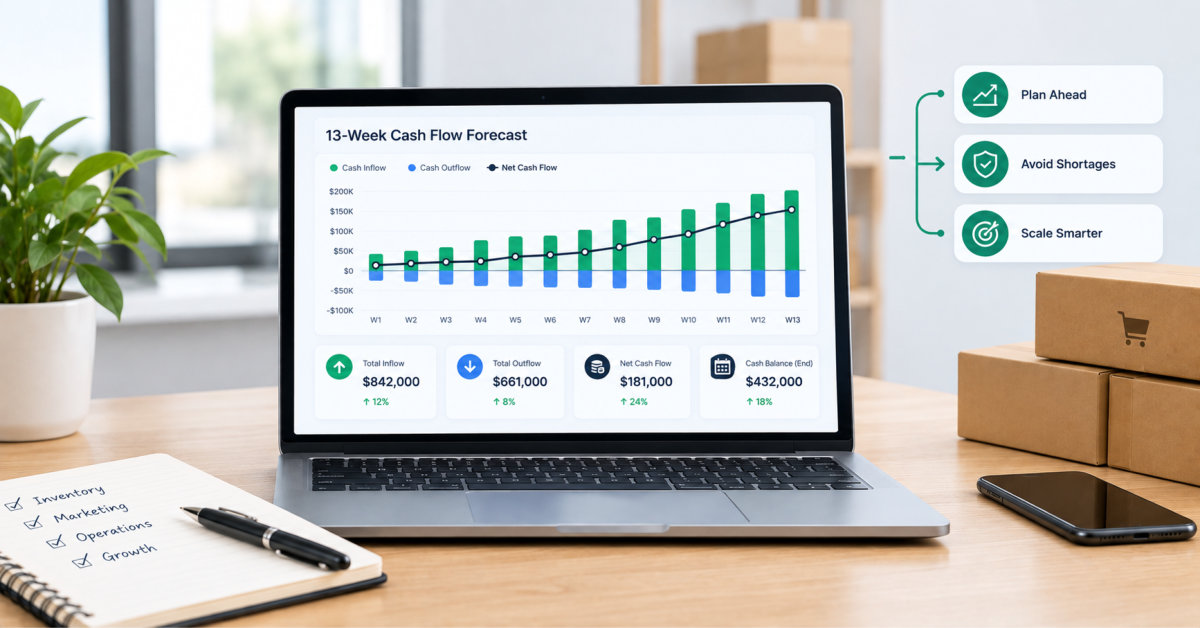
A 13-week cash-flow forecast helps ecommerce operators see whether usable cash will cover payroll, inventory, ads, taxes, refunds, and debt in each coming week. It protects growth by exposing timing gaps before the bank balance forces reactive decisions.
Profit tells you whether the business model works. A 13-week forecast tells you whether the business can meet its obligations before the model has time to prove it.
An ecommerce brand can report its best sales month ever and still struggle to make payroll two weeks later.
That is not a contradiction. Revenue, profit and cash are three different things. A Shopify dashboard records an order when the customer buys. The bank account reflects the sale only after payment processing, refunds, reserves and payout timing. Meanwhile, suppliers, freight partners, advertising platforms and employees expect payment on their own schedules.
The problem becomes sharper during growth. A larger inventory order may improve unit economics, but the deposit leaves the bank months before the stock produces revenue. A successful promotion may increase sales while simultaneously creating a near-term need for more inventory, fulfillment labor and refund capacity.
A 13-week cash-flow forecast turns these timing differences into a weekly operating tool. It does not replace a profit-and-loss statement or annual budget. It answers a more immediate question: based on what we know today, how much usable cash will the business have at the end of each of the next 13 weeks?
Thirteen weeks is roughly one quarter: long enough to expose an inventory purchase, seasonal campaign or supplier payment before it becomes urgent, but short enough to update with credible information.
Monthly forecasts can hide dangerous timing. A brand may begin and end a month with adequate cash while dropping below its safe minimum between a supplier deposit on the 8th and a payment-platform payout on the 15th. Weekly columns make that gap visible.
The forecast should be maintained on a rolling basis. At the end of each week, replace the forecast with actual results, investigate meaningful differences and add a new Week 13. The document therefore remains forward-looking instead of expiring at quarter-end.
The opening figure should be cash the business can actually use. Start with cleared balances in operating accounts and subtract money that is restricted, reserved or already committed.
For example, a bank balance of $120,000 may include $28,000 reserved for sales tax, $15,000 earmarked for a supplier payment and $7,000 held as a refund buffer. Operational opening cash is therefore closer to $70,000. Using $120,000 would overstate the brand’s room to act by $50,000 before the forecast even begins.
Keep tax reserves and other protected balances visible, but separate from spendable operating cash. The point is not to make the business look stronger. It is to show decision-makers the amount they can safely deploy.
Do not copy projected gross sales directly into the cash-in row. Forecast the amounts and weeks in which money is expected to become available.
Begin with sales by channel, then account for payment processing, marketplace settlement schedules, expected refunds, chargebacks, reserves, discounts and gift-card redemptions. A brand selling through its own store, Amazon and a wholesale channel may have three very different cash-conversion cycles.
Separate dependable receipts from optimistic ones. Confirmed marketplace settlements and scheduled wholesale payments belong in the base case. A hoped-for sales lift from a new creative campaign belongs in the upside case until results support moving it into the base forecast.
Expenses should appear when cash leaves the account, not merely when the cost is recognised. Grouping outflows into operating categories makes the forecast readable and helps the team identify which payments can move if the downside case occurs.
The core categories for most ecommerce brands include inventory deposits and balances, freight and duties, fulfillment and storage, payroll and contractors, advertising, software, rent and overhead, sales tax and income-tax payments, refunds, debt or financing obligations, and planned capital expenditure.
Inventory deserves its own schedule. Record the purchase order date, deposit percentage, balance due date, estimated shipping date, freight payment and expected arrival. A single purchase order may create three or four separate cash events before the first unit is sold.
Consider a growing direct-to-consumer brand with $75,000 of usable opening cash. Management expects a strong product launch in Week 7 and wants to place a $60,000 inventory order. The supplier requires a $30,000 deposit in Week 2 and the remaining $30,000 before shipment in Week 6. Freight of $8,000 is due in Week 7. The brand also plans to increase advertising ahead of the launch.
The simplified figures below are illustrative rather than client results. They show why weekly timing matters.
| Week | Opening cash | Cash in | Inventory & freight | Ads | Other outflows | Closing cash |
| 1 | $75,000 | $34,000 | $0 | $9,000 | $24,000 | $76,000 |
| 2 | $76,000 | $35,000 | $30,000 | $10,000 | $24,000 | $47,000 |
| 3 | $47,000 | $37,000 | $0 | $11,000 | $24,000 | $49,000 |
| 4 | $49,000 | $39,000 | $0 | $12,000 | $25,000 | $51,000 |
| 5 | $51,000 | $41,000 | $0 | $14,000 | $25,000 | $53,000 |
| 6 | $53,000 | $43,000 | $30,000 | $15,000 | $25,000 | $26,000 |
| 7 | $26,000 | $55,000 | $8,000 | $20,000 | $26,000 | $27,000 |
| 8 | $27,000 | $61,000 | $0 | $19,000 | $27,000 | $42,000 |
Illustrative weekly cash-flow example. Figures are hypothetical and rounded.
The brand does not run out of cash in this simplified base case, but the Week 7 closing balance falls to $27,000—nearly two-thirds below the opening position. If refunds rise, the launch slips, freight costs increase or an advertising platform bills earlier than expected, the cushion can disappear quickly.
The forecast creates time to respond. Management might negotiate a 40/60 rather than 50/50 supplier schedule, phase the inventory order, delay part of the ad increase until conversion data arrives, accelerate wholesale collections or establish a larger cash reserve before committing.
What it should not do is assume that future launch revenue will solve a Week 6 obligation. Cash expected after a payment date cannot fund the payment without another source of liquidity.
A useful model separates controllable decisions from uncertain outcomes. Maintain a base case, downside case and upside case.
In the base case, use the most probable receipts and committed spending. In the downside case, reduce sales, delay payouts, increase refunds and model higher freight or acquisition costs. In the upside case, increase receipts while also adding the working-capital demands created by stronger sales. Upside growth is not free: it may require faster replenishment, more fulfillment capacity and larger refund reserves.
The downside case should be uncomfortable but plausible. A 15% sales shortfall, a two-week inventory delay and a modest rise in customer-acquisition cost often reveal more than an extreme disaster scenario that nobody believes.
A forecast becomes actionable when the company defines the balance it is unwilling to fall below. The minimum cash floor might cover two payroll cycles, critical platform costs, refunds and essential overhead, with an additional buffer for volatility.
The correct floor depends on the brand’s operating model. A company with predictable repeat-purchase revenue, domestic suppliers and rapid payouts may require less protection than a seasonal brand importing goods with long lead times.
Once the floor is set, highlight every week that approaches or crosses it. Those weeks are decision deadlines—not merely spreadsheet warnings.
When the forecast shows a future cash gap, work through responses in an order that protects the business:
Outside capital can be useful when the forecast identifies a specific, temporary use of funds and a credible source of repayment. Examples include financing an inventory order tied to demonstrated sell-through or bridging a short settlement delay.
It is much riskier to borrow simply because the bank balance is falling without understanding why. Before considering financing, identify the lowest projected cash balance, the week it occurs, the amount required to remain above the cash floor and the operating cash expected to restore liquidity.
Ecommerce operators comparing working-capital options should review the total cost, payment frequency, term or remittance structure, collateral or guarantees, and the effect of payments on the downside forecast—not just the amount offered.
If the model remains negative even after realistic operational changes, the problem may be structural rather than a temporary timing gap. Financing can bridge timing; it cannot permanently repair weak unit economics, chronic overspending or inventory that does not sell.
Assign one person to own the file, but require input from the people controlling sales, inventory, marketing and payments. A finance lead cannot accurately forecast a purchase order that the operations team has not disclosed or a campaign increase that marketing has not scheduled.
Each weekly review should answer five questions: What changed from last week? Where did actual cash differ from forecast? What is the lowest projected balance? Which assumption creates the greatest risk? What decision must be made this week?
Track forecast accuracy. If receipts are repeatedly 10% below forecast or inventory payments consistently arrive one week earlier than planned, update the assumptions. The goal is not to defend the old model. It is to improve the next one.
Ecommerce growth often consumes cash before it generates cash. That does not make growth undesirable; it makes timing visible and disciplined planning essential.
A 13-week forecast gives founders a common operating language. Inventory, marketing and finance decisions can be evaluated against the same weekly cash position. Supplier negotiations begin before a deadline. Campaign spending can be staged. Financing, if considered, can be sized against a defined need rather than a vague feeling that the business needs more money.
The best forecast will not predict every surprise. It will give the business enough warning to make deliberate choices before the bank balance makes those choices instead.
Author bio: Marc Obadia is the founder of Rock Drive Business Capital, a U.S. business-financing brokerage that helps business owners explore working-capital and other commercial financing options through independent providers.
A 13-week cash-flow forecast is a rolling weekly model that estimates a company’s expected cash receipts, cash disbursements, and closing bank balance for the next 13 weeks. It uses the direct method, meaning each line reflects when cash is expected to move rather than when revenue or expense is recognised in the accounting system. Every week, the completed forecast period is replaced with actual results, the remaining assumptions are updated, and a new Week 13 is added. Ecommerce brands use it to see upcoming liquidity gaps created by inventory, freight, payroll, ad spend, refunds, taxes, and payout timing.
A 13-week forecast is better for ecommerce operations because weekly detail exposes cash-timing gaps that monthly totals can hide. A brand may appear healthy at the beginning and end of a month while falling below a safe cash level between a supplier deposit, a payroll run, an advertising charge, and a delayed payment-platform payout. Ecommerce cash moves quickly and unevenly, especially around inventory orders and promotions. Weekly forecasting lets operators see the exact week of the lowest projected balance, then adjust supplier terms, collections, campaign timing, inventory, or funding before the gap becomes urgent.
Ecommerce brands should include cash inflows based on expected settlement and collection dates, not gross sales recorded in Shopify. Typical inflows include payment-processor payouts, marketplace settlements, wholesale invoice collections, subscription receipts, retail-partner payments, tax refunds, insurance recoveries, and approved financing proceeds. Forecast each channel separately because its payout timing, fees, refunds, reserves, and collection reliability can differ. Separate confirmed payouts and dependable receivables from sales assumptions that rely on an unproven campaign or launch. Only reliable receipts should support essential payments such as payroll, supplier balances, taxes, and debt obligations.
An ecommerce business should keep enough cash in reserve to cover essential obligations and normal volatility through its specific cash-conversion cycle. A practical floor often includes two payroll cycles, taxes, refunds, critical fulfilment and software costs, debt service, insurance, and a buffer for payout delays or inventory surprises. Businesses with long supplier lead times, imported inventory, seasonal revenue, large minimum order quantities, or volatile paid acquisition generally need more protection than businesses with fast payouts and predictable repeat revenue. Calculate the floor from actual upcoming obligations, then highlight every forecast week that approaches it.
An ecommerce business should use working-capital financing only when it can define a temporary timing gap, identify a credible repayment source, and show that repayments remain manageable in the downside forecast. It can be appropriate for inventory tied to demonstrated sell-through, a predictable purchase order, or a short settlement delay. Before accepting funding, compare total cost, payment frequency, term or remittance structure, fees, collateral, guarantees, and impact on cash in a lower-sales scenario. Financing is not a permanent fix for weak contribution margins, overspending, excessive inventory, or products that do not sell.