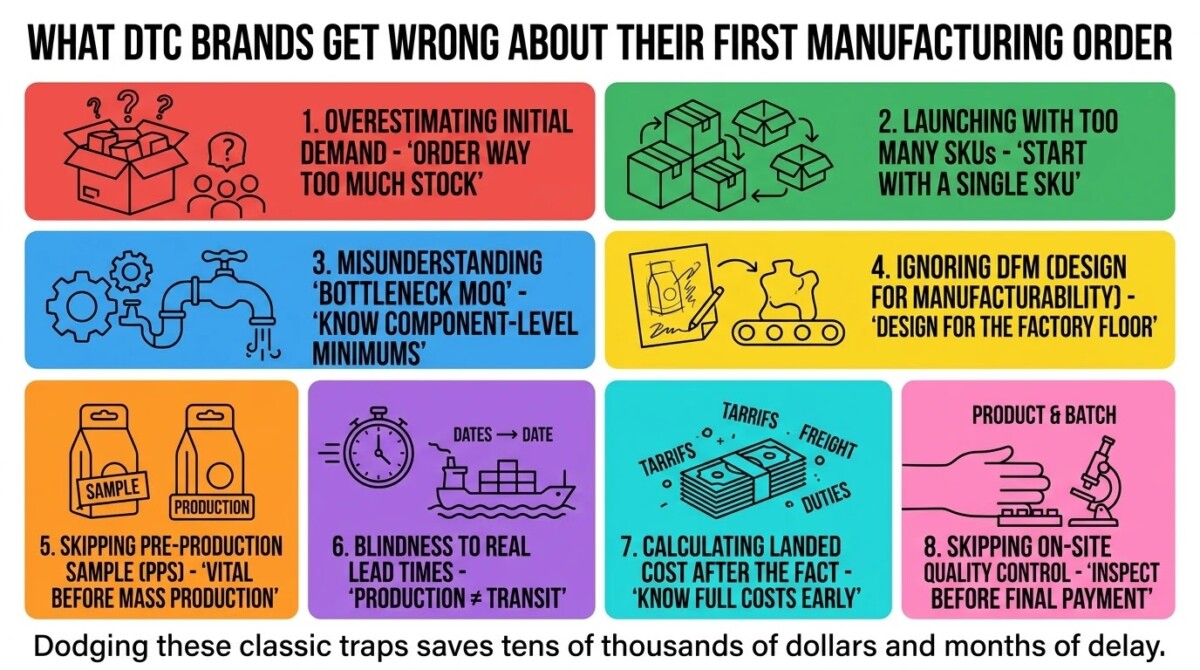
Your first manufacturing purchase order succeeds when demand, SKU count, component minimums, design feasibility, approved samples, landed cost, lead time, and quality-control terms are defined before production starts. Most costly first-order failures are preventable through disciplined specification, documentation, sampling, and inspection.
The factory does not manufacture the product in your head. It manufactures the requirements, tolerances, materials, approvals, and deadlines you put into writing.
Every physical product starts as a stroke of genius in a founder’s head. But here’s the harsh reality: the margin for error opens the exact moment that idea leaves your screen and hits a factory floor.
The good news? Most early-stage manufacturing disasters aren’t bad luck—they are fully preventable mistakes. If you can dodge a few classic beginner traps on your very first Purchase Order (PO), you’ll save tens of thousands of dollars and months of delay.
Here are the 8 deadfalls DTC founders fall into when placing their first manufacturing order—and how to clear them smoothly.
Unless you have pre-orders backed by hard cash or verifiable data, your real market demand is almost certainly smaller than what’s in your head. Founders naturally suffer from confirmation bias: we gloss over our brand’s early weaknesses, assume our product is a guaranteed hit, and order way too much stock. Start leaner than your ego wants you to.
Over 80% of failed DTC physical brand launches die right here. When you start, launch with a single SKU if you can. One SKU lets you test the market, capture clean customer feedback, and iron out supply chain kinks. Every additional SKU you add to your first production run increases your odds of failure by roughly 5%. Save the new colorways and extra sizes for Batch #2.
Minimum Order Quantity (MOQ) isn’t just a random number the factory manager makes up. It’s determined by the bottleneck component in the manufacturing chain.
Your real product MOQ isn’t 500—it’s 10,000, because that’s the raw material floor. For customized consumer products, understanding the custom manufacturing process behind materials, finishing, decoration, assembly, and packaging can help explain why one process sets the MOQ for the whole order. Always ask your supplier to break down component-level MOQs so you know where the wall actually is.
A beautiful CAD rendering on screen does not equal a producible product. Real-world manufacturing is bound by raw material limits, tooling tolerances, and physical machinery. If you don’t design for the factory floor, your yields will be low and your defect rates high. Involve a qualified manufacturing partner early to review your 3D models before freezing final specs.
Never, under any circumstances, click “approve mass production” without a sign-off sample in your hands. A signed Golden Sample (Pre-Production Sample) is the bridge between a digital dream and factory reality. It sets the exact benchmark for color, material quality, and tolerance. A solid sampling phase eliminates more than half of all potential factory disputes.
First-time founders frequently calculate timeline as “Days to Produce” and completely forget the rest. Production for simple consumer goods might take 30 days, but ocean shipping can take anywhere from 15 to 45 days depending on port congestion—plus customs clearance. Factor in factory holidays (like Lunar New Year) and peak season capacity, or you will miss your launch window.
If you only start calculating unit costs after sending payment, you’re flying blind. You need a clear grasp of your true Landed Cost from day one. That means:
Landed Cost = Ex-Factory Price + Tariffs/Duties + Freight + Warehousing/3PL + Defect Allowance
If you don’t account for freight spikes and scrap rates early, your margins will evaporate before the first box hits the warehouse.
If you think skipping inspection saves money, think again. Inspection costs are the cheapest insurance policy you will ever buy. Always inspect inside the factory before final payment is wire-transferred.
Once those containers leave the factory gate, your leverage drops to zero.
Navigating your first order doesn’t have to be terrifying. Find a reliable manufacturing partner who communicates transparently. Draft a rock-solid Purchase Order detailing material specs, performance criteria, SKU breakdowns, strict lead times, golden sample sign-offs, and clear QC pass/fail terms.
Cover these bases, sign on the dotted line, and launch with confidence.
A first manufacturing purchase order should include the supplier and buyer details, product name, SKU, quantity, unit price, total price, currency, payment schedule, Incoterm, delivery date, shipping responsibility, and complete product specifications. Attach the bill of materials, drawings, dimensions, tolerances, color references, packaging requirements, labels, barcodes, testing requirements, approved golden-sample identification, quality standards, inspection rights, defect classifications, and remedies for nonconforming goods. The purchase order should also identify the document revision and state that no changes are valid unless approved in writing by both parties.
You calculate the right MOQ by identifying the highest minimum order requirement across every custom material, component, process, tooling step, packaging item, and assembly operation required for the finished product. The factory’s quoted MOQ may be driven by raw materials, color matching, printing setup, mold utilization, coating batches, or packaging, not by final assembly alone. Ask for a component-level breakdown, then explore lower-risk options such as stock materials, standard finishes, fewer variants, shared tooling, simpler packaging, or a supplier that specializes in smaller production runs.
A pre-production sample is a production-intent unit made before mass production to confirm that the supplier can meet the agreed design, materials, construction, finish, function, and packaging requirements. A golden sample is the final approved physical reference used by the buyer, factory, and inspector to judge whether bulk production matches the agreed standard. In some projects, the approved pre-production sample becomes the golden sample. Both should be uniquely identified, dated, photographed, tied to the purchase order and specifications, and retained so quality checks can compare mass-produced units against the same standard.
You should inspect a manufacturing order before production, during production, and before shipment when the order value, complexity, product risk, or quality sensitivity justifies the control. Pre-production checks confirm materials and readiness, during-production checks identify defects early enough for correction, and pre-shipment checks verify finished goods before final payment and release. At minimum, inspect before the remaining balance is transferred and before cargo leaves the factory. Give the inspector the approved sample, purchase order, specifications, defect definitions, packaging requirements, and testing procedures so the inspection measures the standard you actually agreed to buy.
Product landed cost should include ex-factory price, tooling allocation where relevant, packaging, freight, insurance, duties and tariffs, customs fees, domestic transportation, 3PL receiving, storage, and a realistic defect allowance. You should also separately model fulfillment, payment processing, returns, marketplace fees, discounts, customer support, and acquisition costs to understand contribution margin. Calculate scenarios for higher freight costs, duty changes, and expected defects before approving the order. A supplier’s unit price is not your sellable unit cost, and treating it as one can make a product appear profitable when it is not.