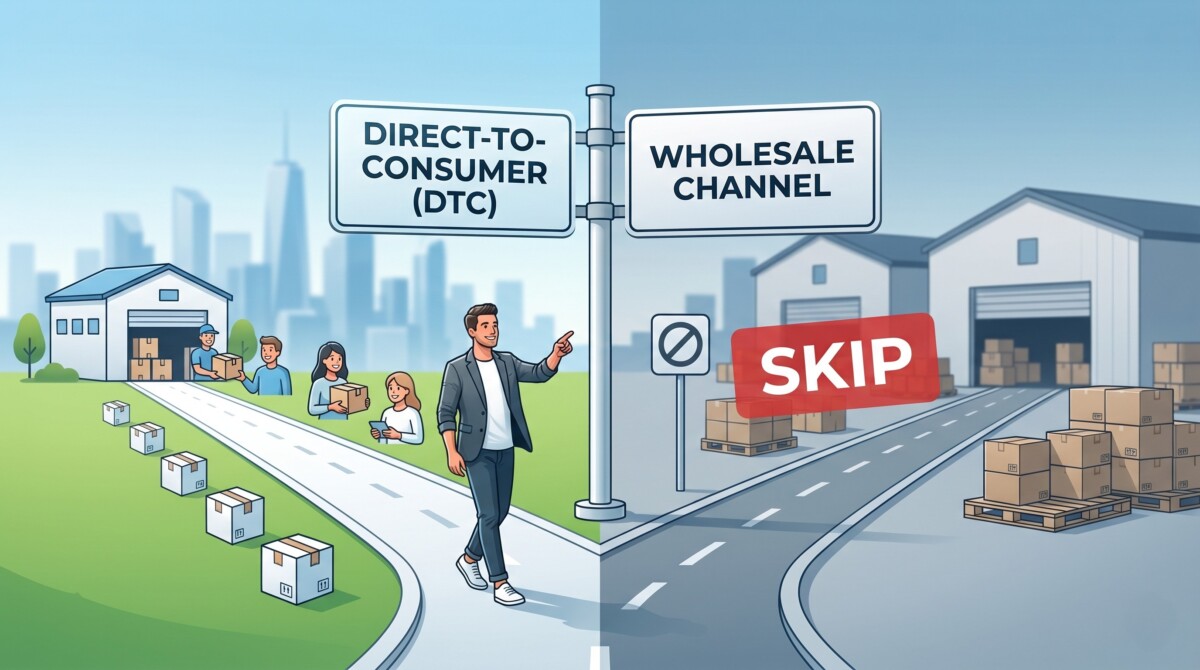
Wholesale is worth adding once a DTC brand clears roughly $500K and starts feeling paid acquisition volatility, because business buyers reorder on a predictable rhythm at almost no acquisition cost. Shopify now runs B2B natively, so the barrier is judgment, not tooling.
The cheapest retention in commerce is not an email flow. It is a buyer whose own business runs dry when your product runs out.
A Shopify brand doing $1.5M a year can watch a single Meta auction shift or a flat ad week erase the profit it had already forecasted for the month. Nothing about the product changed. The cost of reaching the next customer did. If your revenue lives and dies by paid performance, you already know that feeling, and you already know it is not getting cheaper.
There is a channel that behaves the opposite way, and most direct to consumer brands skip it. Not because it is wrong for them. Because nobody ever framed the decision. Shopify itself reports the global business to business market moving from roughly $32.8 trillion in 2025 toward $61.9 trillion by 2030, and a growing share of it is moving online, onto the same infrastructure you already run, according to Shopify’s own breakdown of how business buyers differ from consumers.
This piece is the decision framework, written for the founder or operator who has product market fit and a paid acquisition habit they would like to depend on a little less. I spent six years inside Shopify watching DTC brands hit exactly this wall, and the wholesale conversation almost never came up until the volatility forced it. Here is how to have it earlier, and on your own terms.
Wholesale gives a DTC brand default retention: a buyer reorders because their own shelves run dry, not because a win back email happened to land in the right inbox at the right minute. That single dynamic is what makes the channel structurally different from everything else you do to keep customers.
Consider the math Shopify shared from REECH, a yoga brand. A consumer buys a mat once every year or two. A studio that stocks REECH mats reorders roughly ten of them every two months. One wholesale account is not one customer. In lifetime volume it can be worth dozens of DTC buyers, and you never paid a cost per acquisition to win the reorder. Shopify reports brands running B2B on its platform see up to a 3.2 times increase in reorder frequency compared with their DTC orders. The buyer is not loyal to you out of affection. They are loyal because their business depends on having your product in stock, which is a far more durable reason than a discount code.
Compare that to the DTC engine most brands lean on. You pay rising paid costs to acquire a customer, you ship the product, and then you spend more money trying to bring them back through email, SMS, and retargeting. Those retention systems matter, and they are worth building, which is why I keep pointing operators to the owned channel levers that lower effective CAC without touching ad budget. But even a great flow is fighting human forgetfulness. A wholesale buyer is not forgetting. They are running out.
Most founders skip wholesale because they have decided they are a DTC brand, full stop, and wholesale feels like a different company. It carries the baggage of margin loss, sales reps, and trade shows. So the channel that could smooth the exact volatility keeping them up at night never makes it onto the planning doc. The blind spot is identity, not economics. Here is the tradeoff at a glance, and the rest of this piece is about reading it honestly for your stage.
Wholesale is usually premature under about $500K and becomes a genuine lever in the $500K to $2M band, where paid volatility starts to bite and you finally have the margin and the operational slack to support a second model. Get the timing wrong and you do not add a revenue line, you add a distraction that starves the engine paying your bills.
If you are under $500K, the honest answer is almost always not yet. The brands that stall in this range rarely have a channel problem. They have a fundamentals problem: a conversion rate stuck at 1.5%, a variable margin under 50%, a fulfillment process that still depends on one person remembering things. Bolting wholesale onto that spreads a thin team thinner and buys complexity you cannot yet afford. Fix the DTC machine first. The practitioner playbook for diagnosing which growth lever is actually blocking your store is the right work at this stage, not a new channel.
This is where wholesale earns its place. At $500K to $2M you typically have the margin structure to absorb wholesale pricing and enough operational maturity to run a second order flow without it breaking you. More importantly, this is the stage where paid acquisition volatility does real damage, because you are spending enough on ads that a bad month is a five figure swing. A handful of wholesale accounts reordering on a predictable cadence gives you a revenue floor that does not move with the Meta auction. It is the smoothing function a paid heavy P&L is missing.
Above $2M, wholesale stops being a smoothing function and becomes a deliberate portfolio decision. You can use it to enter retail doors that build brand credibility, to move inventory in volume, or to diversify away from a single platform dependency before an exit. At this stage the question is no longer whether you can operate it. It is which accounts are worth the margin you give up, and which are quietly unprofitable once you load in the operational cost.
Wholesale trades margin percentage for volume and near zero acquisition cost, and it inverts your cash flow, so you have to model both before you commit. The volume and the predictability are real. So is the part nobody flags until the working capital gets tight.
Wholesale pricing typically lands near keystone, which means you sell to the business buyer at roughly 50% of your retail price so they can mark it up and still make money. Your gross margin per unit compresses hard. As an illustrative example, a product you sell DTC for $40 at a $28 margin might go to a wholesale account at $20, leaving you $8 per unit before you account for anything else. That only works if the volume and the near zero acquisition cost more than make up for the thinner per unit margin. Run the number on your actual contribution margin by SKU. If a product is already tight at retail, it may simply not survive wholesale pricing, and that is a fine reason to keep it DTC only.
DTC is prepaid: the customer pays at checkout, then you ship. Wholesale usually runs on net 30 to net 60 terms, which means you produce and ship first, then wait a month or two to get paid. That inversion can strain working capital at exactly the moment volume is growing, because every large order ties up cash in inventory you have already paid to make. A brand that wins three big accounts in a quarter can post record revenue and still run short on cash. Model the gap before you open terms, and do not extend net 60 to a new account on faith.
A minimum order quantity is the lever that keeps small accounts from costing you money. Picking, packing, invoicing, and managing a relationship carries a fixed cost per account, so a tiny wholesale order can easily lose money even at full wholesale price. Set an MOQ high enough that the order clears that fixed cost with margin to spare. As a starting point, many brands anchor the MOQ to a few hundred dollars of wholesale value or a case pack quantity, then adjust once they see the real cost to serve. The MOQ is not a barrier to growth. It is what makes the growth profitable.
Shopify now runs wholesale natively through its B2B features, so you can serve business buyers from the same store, catalog, and inventory you already operate, with no second store to build or maintain. As of late 2025 these features are no longer locked behind Shopify Plus, which removes the single biggest reason brands used to defer the decision.
Native B2B on Shopify gives you company profiles with multiple buyers and locations, company specific catalogs and price lists so a wholesale account logs in and sees its own pricing, net payment terms like net 30 and net 60, quantity rules and MOQs, and a B2B checkout that handles purchase order numbers and vaulted payment. The DTC shopper still sees retail pricing on the same storefront. The wholesale buyer logs in and sees theirs. Foundational B2B is now included on the Basic, Grow, Advanced, and Plus plans, with Basic starting at $39 a month and supporting up to three catalogs. Plus, at roughly $2,300 a month, removes the catalog limit and adds partial payments and deposits. The practical message: tooling is no longer the barrier. Judgment is.
Use a marketplace like Faire when you want low lift discovery, and use direct outreach when you already know the accounts you want. Faire functions as a discovery on ramp where retailers browse and place first orders, which is useful when you have no existing relationships to lean on. Shopify retired its own Handshake marketplace in late 2023 and now endorses Faire, with official apps connecting the two. Marketplaces cost you margin and own the buyer relationship, though, so the strongest long term wholesale accounts usually come from direct outreach to retailers who genuinely fit your brand. Faire is a way to start. It is not a substitute for owning the relationships that matter.
For selling across borders, Shopify Markets handles localized pricing and currency, while Managed Markets, the merchant of record service formerly called Markets Pro, takes on duties, import tax, and compliance for US based brands. Be clear eyed here: Managed Markets is built primarily for DTC cross border orders and carries hard eligibility requirements, so cross border wholesale specifically still leans more on B2B company pricing plus your own logistics than on a single turnkey button. If international expansion is on your roadmap, the step by step approach to setting up Shopify Markets and expanding one country at a time is the right foundation to build on before you layer wholesale on top.
Wholesale adds a second operating model on top of DTC: separate pricing, separate payment terms, a different fulfillment cadence, and usually a human who owns the relationship, so budget that lift before you open the first account. The failure mode is treating wholesale as a side toggle and letting it quietly cannibalize the attention the DTC engine needs to keep funding everything.
The first operational reality is that one pool of inventory now serves two channels with different rhythms, and a single large wholesale order can strand the stock your DTC bestseller needs that week. You need a clear allocation rule and real time visibility across both channels so you are not promising units you have already committed. This is where a system built for multi channel stock matters, and the honest review of Katana Cloud Inventory for brands that make what they sell walks through what that looks like once production and two sales channels are pulling from the same shelf. Get allocation wrong and you turn a good wholesale month into a stockout that costs you DTC customers.
Wholesale rarely runs itself, because the relationship is the product and relationships need a person. Someone has to answer the account’s questions, manage reorders, handle the larger returns and the occasional chargeback on a big order, and decide which prospects are worth pursuing. For a brand under $2M that often means the founder for a while, then a dedicated hire as the channel grows. The brands that succeed at wholesale treat it as a real function with an owner. The ones that fail treat it as a setting they switched on and then ignored.
Wholesale is worth it for most DTC brands above roughly $500K that rely heavily on paid acquisition, because it adds a lower CAC, higher retention revenue line that smooths the volatility of ad driven sales. Business buyers reorder on a predictable cadence because their own inventory runs out, which Shopify data associates with up to a 3.2 times higher reorder frequency than DTC. The tradeoff is compressed per unit margin and net payment terms that delay your cash. For a brand with stable DTC fundamentals and spare operational capacity, that tradeoff usually favors adding wholesale. For a brand still fixing conversion, margin, or fulfillment, it does not yet.
A DTC brand should usually add wholesale in the $500K to $2M range, once its DTC unit economics and fulfillment are stable. Under about $500K, wholesale is typically premature complexity, because the brand still has fundamentals to fix and a thin team that a second operating model would stretch too far. In the $500K to $2M band, paid acquisition volatility starts doing real financial damage, and the brand has enough margin and operational maturity to run a predictable wholesale line as a stabilizer. Above $2M, wholesale becomes a deliberate margin, cash, and distribution lever rather than a smoothing function. Revenue is a proxy, though. The real gate is whether your DTC engine is stable enough to share attention.
Wholesale pricing typically lands near keystone, meaning you sell at roughly 50% of your retail price so the buyer can mark it up and still profit. That compresses your gross margin per unit significantly compared with DTC, where you keep the full retail margin. Before you set wholesale pricing, calculate your real contribution margin by SKU. A product that is already tight at retail may not survive a 50% wholesale discount, and keeping it DTC only is a legitimate decision. The reason the compressed margin can still work is volume plus near zero acquisition cost: you are not paying to win each reorder, so a thinner per unit margin on predictable, repeat volume can outperform a fatter margin on a customer you have to re acquire.
Yes, you can sell wholesale and DTC from the same Shopify store, and as of 2026 that is the default setup rather than a workaround. Shopify’s native B2B features let you attach company profiles, company specific catalogs and price lists, and net payment terms to business buyers, who log in and see their wholesale pricing, while DTC shoppers see retail pricing on the same storefront. One catalog, one inventory pool, two buyer experiences. Foundational B2B is now available on the Basic, Grow, Advanced, and Plus plans rather than Plus only, so you no longer need to replatform or run a separate wholesale site to start. You can still run a dedicated B2B store if you prefer to keep the two fully separate, but most brands do not need to.
Wholesale payment terms usually run net 30 to net 60, meaning you produce and ship the order first and the buyer pays 30 to 60 days later, which inverts the prepaid cash flow you are used to in DTC. In DTC the customer pays at checkout before you ship, so cash arrives first. In wholesale, cash arrives last, after you have already funded the inventory. That gap can strain working capital exactly when volume is growing, because every large order ties up cash you have already spent making the product. A brand can win several big accounts, post record revenue, and still run short on cash in the same quarter. Model the timing gap before you extend terms, and be cautious offering net 60 to a brand new account.
A good minimum order quantity is high enough that a single order clears the fixed cost of serving the account with margin left over. Every wholesale order carries fixed costs in picking, packing, invoicing, and relationship management, so a tiny order can lose money even at full wholesale price. Many brands anchor their MOQ to a few hundred dollars of wholesale value or to a case pack quantity, then adjust once they see the real cost to serve each account. The goal is not to make ordering hard. It is to make sure every account you take on is actually profitable. If your MOQ is so low that small accounts cost you money, you have built volume that quietly erodes your margin instead of adding to it.