

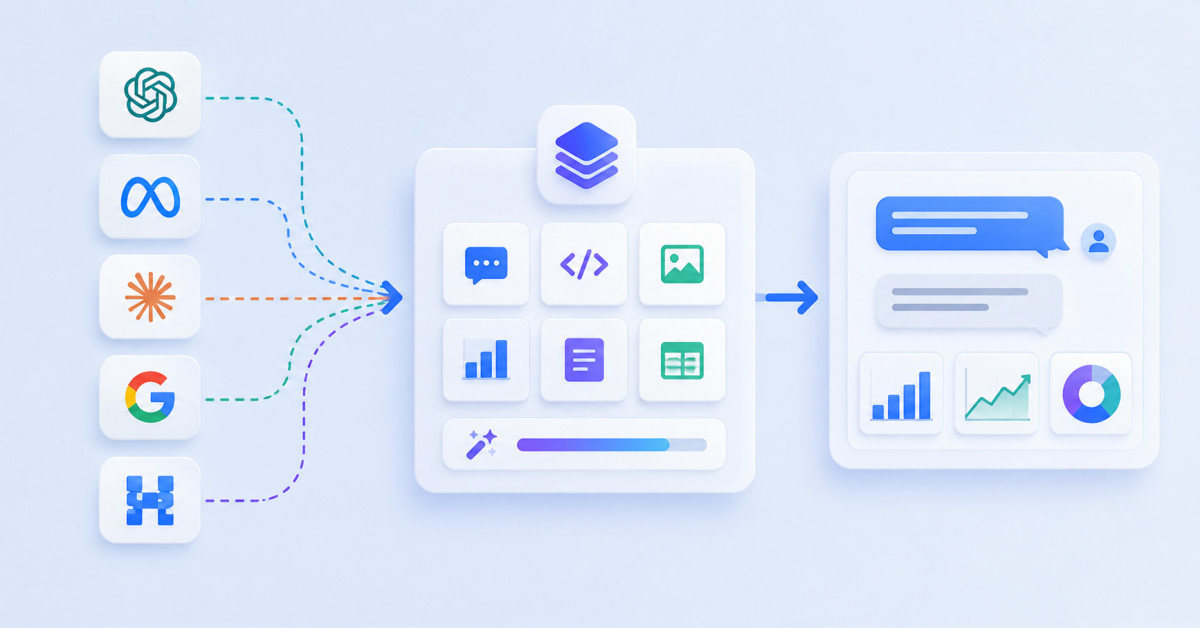
A multi-model AI platform can simplify an AI workflow when your team needs different strengths for writing, research, coding, document analysis, and review without managing separate interfaces for every task. It is most useful when model choice remains deliberate, outputs are verified, and data controls fit the work.
The strongest AI workflow is not the one with access to the most models. It is the one that knows which model to use for each job, what data it can receive, and where human judgment must remain.
AI is not just about experimentation or even just a few questions anymore. AI is now being used across the board by businesses and individuals to write, research, code, provide customer support, analyse documents, and create content.
The McKinsey 2025 global survey revealed that 88% of respondents indicated that their organizations incorporate AI in at least one aspect of their businesses regularly, highlighting the technology’s pervasive presence in the modern workplace. With the proliferation of AI usage, another consideration arises: need to have separate subscriptions for each model you want to use?
There are some AI models that have different methods for doing the same task. One can generate a good coding solution, the other a good explanation or a better structure for the writing. This does not necessarily depend on any one model being better; it simply depends on the tasks that one wants to achieve.
It can therefore be helpful to have a few choices in life when you are already using AI. There are several types of models that a content writer might want to use for brainstorming, draft, and review an article. A developer might also investigate the methods for solving a programming problem to determine which one to test.
Various AI models can be implemented across the customer’s journey in an ecommerce business. For instance, you can use one of the models to write a product description, another to answer common customer queries, and another to come up with ideas for an email campaign. This provides an online store with greater flexibility without having to go through the same AI process for each job.
Multi-model AI can also be utilized in the creation of ecommerce campaigns by marketing teams. For instance, an online clothing company that’s introducing a new line might employ one model for brainstorming campaign concepts, one for writing the email subject lines, and another to proofread the copy for clarity and consistency.
While it’s possible to utilize a variety of AI services and be flexible, this option can also complicate your workflow. Having multiple subscriptions will require multiple accounts, billing terms, interfaces, limits and browser tabs. While each service might be inexpensive individually, the total price might not be so easy to swallow when some tools are used only sporadically.
One of the most useful ecommerce implementations of AI for customers today is customer support. Consumers can ask about a product’s compatibility with a specific device, if a material is waterproof, or about delivery time. AI can be used to assist with teams’ responses with prompt and informative content derived from agreed product details.
A person who purchases a standing desk may want to know how much it can hold or if the desk can be raised or lowered. By using an AI model to find the right specifications and translate them into a clear response, a support agent can save time and be more efficient. The agent will then have a chance to check the answer before sending it to the customer.
Chatgbot’s multi-model approach is illustrated by offering seamless access to several models such as OpenAI GPT, Claude, DeepSeek, Qwen, and GLM with a unified interface. Users can be able to change between models supported by the platform, instead of having to keep several applications, one for every model.
It also supports image generation, PDF analysis, and web search, going beyond the typical text conversations. Chatgbot can offer a more streamlined and efficient approach for users who frequently engage in multi-format work or compare AI-generated answers.
When the answer is incorrect or doesn’t include a critical piece of information, AI can appear convincing. By comparing the answers from various models, the users should be able to identify differences in their reasoning, organization, or assumptions.
This is not to say that the lengthiest or more comprehensive answer will be always been correct. There are also important facts that users must check, sources to read and code to be tested. Multi-model access is a means to expand the choice, rather than to replace human judgment.
The nature of AI workflows is evolving beyond writing prompts and getting paragraphs. Users will have to look at reports, look for information in the current, build images, or be able to glean useful information from documents.
Chatgbot taps into the power of PDF analysis, web search, and image generation, alongside its model access. For a researcher, for example, they might use information from a PDF, research more information by searching on the web, then create the content to be presented visually using an AI model.
Brainstorming ideas, drafts, editing suggestions and alternate structures can be compared by content writers. Coding solutions can be compared and compared to each other by different developers, and summarization models can be used to summarize different documents and explore different explanations.
The multi-model AI can be leveraged in customer service, product descriptions, marketing, product research, and content planning for ecommerce businesses. For instance, even a small ecommerce business can put it to use to generate product copy, respond to frequently asked questions, and brainstorm marketing concepts.
These are not the only AI models available in the Chatgbot marketplace, but there are others like Gemini, Grok, and Copilot which are not part of the Chatgbot offering.
Chatgbot is currently offering a range of models, including OpenAI GPT, Claude, DeepSeek, Qwen, and GLM. In a more general comparison of AI in the market, the inclusion of separate tools for AI, such as Gemini, Grok, and Copilot, should be taken into account.
There are other factors involved in the choice of model, not just the number of models available. Look at models that are available and the limits on using them and determine if they are what you need and if they fit your work.
It’s equally important to check out other options. For anyone who works with documents or generates images or researches the web regularly, being able to do all of these within the same space could be more convenient than having another chatbot.
Of course, privacy should be addressed as well. Users are advised to read the data handling and privacy policies of the service before uploading any business documents, customer information or anything else that could be sensitive.
As AI becomes more prevalent, there are more options, but it’s also more challenging to manage AI subscriptions. One possible solution is a multi-model platform, which gathers multiple models in a common environment and enables the user to choose the model that is suitable for a specific task.
Chatgbot offers access to OpenAI GPT, Claude, DeepSeek, Qwen, GLM, generation of images, PDF analysis, and web search. This kind of integrated solution can be beneficial for those who use multiple AI models frequently, as it minimizes the need for switching between different models and introduces flexibility. It all comes down to person and preferences, as well as usage, budget, and features.
The multi-model AI platform offers multiple AI models on a single platform, where users can choose different models for various tasks.
In addition to its chatbot features, Chatgbot also offers access to OpenAI GPT, Claude, DeepSeek, Qwen, and GLM.
No. Gemini and Grok are not models supplied with Chatgbot, they are different AI services.
Ecommerce businesses can use AI for customer support, product descriptions, marketing, email copy, and product research. For example, one model can create product copy while another reviews and improves it.
A multi-model AI platform gives users access to several AI models in one interface, allowing them to choose or compare models for different tasks without maintaining separate accounts for every provider. A useful platform may also include capabilities such as document analysis, web research, image generation, saved prompts, or shared workspaces. The real benefit is workflow flexibility, not simply model count. Users should still test models against the same task, verify important claims, understand usage limits, and confirm that the platform’s privacy practices are appropriate before uploading sensitive business or customer information.
Chatgbot publicly lists OpenAI GPT models, Claude Sonnet, DeepSeek, Qwen, and GLM among its supported model options, with availability subject to provider capacity and plan limits. The platform also presents PDF interaction, web search, and image generation as supported capabilities. Because AI providers frequently change model names, access levels, usage limits, and availability, teams should review Chatgbot’s current product page and their intended plan before making a purchasing decision. Do not assume that every model version, context limit, or advanced feature is available on every plan or in every region.
Chatgbot’s public model list identifies OpenAI GPT, Claude Sonnet, DeepSeek, Qwen, and GLM, and it does not list Gemini, Grok, or Microsoft Copilot as standard supported models. Gemini, Grok, and Copilot are separate AI products and should be evaluated through their own ecosystems, pricing, privacy terms, and integrations. Gemini may be more useful for Google Workspace-heavy teams, while Copilot can be relevant for Microsoft and GitHub workflows. Check the current Chatgbot plan details before subscribing because multi-model platform availability can change as providers update agreements and capacity.
Ecommerce businesses can use a multi-model AI platform for product-copy drafting, customer-support assistance, FAQ generation, campaign ideation, review analysis, document extraction, merchandising research, and content planning. A practical workflow uses approved product facts as the source, one model to create a first draft, another to identify missing information or unsupported claims, and a human to approve the final result. This approach can reduce repetitive work while protecting product accuracy and brand trust. Do not allow any model to invent product specifications, shipping commitments, compatibility details, or regulated claims without verification.
A multi-model AI platform is not automatically safer for business documents because safety depends on the platform’s data policies, retention practices, access controls, provider relationships, security measures, and your organization’s plan. Before uploading sensitive material, review the privacy policy, terms of service, model-provider disclosures, and any available business or enterprise agreement. Start testing with public, anonymized, or non-sensitive documents. For confidential customer data, financial records, contracts, unreleased product information, or regulated data, involve your legal, security, and IT teams before approving a platform or connecting internal systems.




