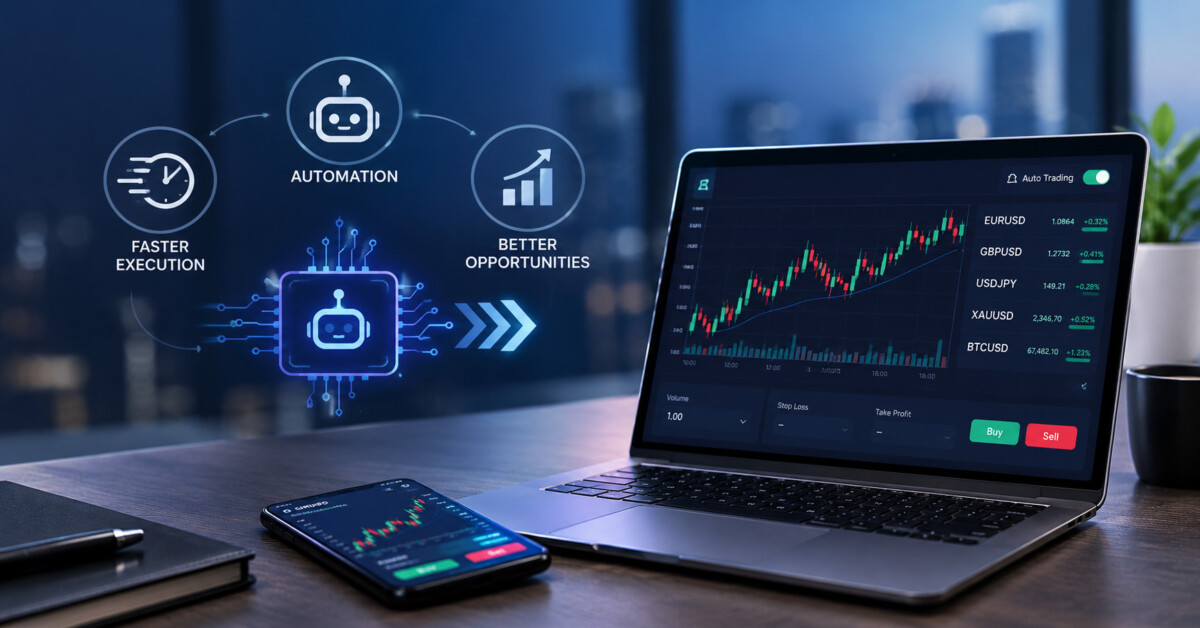
An automated trading platform can improve trade execution by applying pre-defined rules consistently and monitoring markets continuously, but it cannot create a profitable strategy or eliminate market, technology, execution, or loss risk. Test controls carefully, start small, and retain active oversight.
Automation does not make a weak trading plan stronger. It makes every instruction in that plan happen faster and more consistently, including the mistakes.
Every trader has felt it: the hesitation before pulling the trigger, the split second of doubt that turns a clean entry into a missed one. Manual trading runs on human reflexes, and human reflexes are slow, inconsistent, and easily rattled. Markets, meanwhile, move in milliseconds. That mismatch is where most execution problems begin, and it is exactly the gap automation is built to close.
An automated system takes your strategy, written as a precise set of rules, and enforces it without hesitation or fatigue. It watches the market every second, acts the instant your conditions are met, and never second-guesses the plan. For traders who want their execution to match the quality of their ideas, a well-configured automated trading platform can be the difference between a strategy that looks good on paper and one that performs in the market. Here is how that edge shows up in practice.
The most obvious gain is raw speed. Software places orders in milliseconds, far faster than anyone can react by hand, and that speed translates directly into better fills. When your rule triggers, the order goes out at that exact moment rather than after you have read the chart, reached for the mouse, and hesitated. In fast markets, that difference of a second or two can be the whole trade.
That precision shows up in three concrete ways:
Fear and greed wreck more accounts than bad strategies do. A sharp drop tempts you to bail early, and a strong run tempts you to hold too long. Automation removes that pressure entirely. The software follows your instructions the same way in a calm market and a chaotic one, sticking to the original plan on every trade. It also does not fat-finger an order size or miscalculate position sizing under stress, which quietly eliminates a whole category of costly manual errors.
One of the biggest advantages happens before a single live order is placed. Automated platforms let you run a strategy against years of historical data to see how it would have behaved. That process tells you whether an idea holds up across different market conditions, exposes the weak spots where it breaks down, and lets you tune your settings safely. You refine the logic with data instead of learning expensive lessons in real time. It also builds confidence, since watching a strategy survive past crashes and rallies makes it far easier to trust when your own money is on the line.
Markets do not keep office hours, and neither does an automated system. It can watch global sessions and execute while you sleep, work, or step away from the screen. It can also manage orders across several assets, accounts, and markets at once, something no human could track by hand without mistakes. The result is broader coverage and steadier execution than a single person could ever deliver.
Automation amplifies whatever you feed it, so a shaky setup runs its flaws faster, not slower. Before you commit capital, confirm the platform is licensed by a credible regulator in your jurisdiction and offers reliable data and stable order routing. It helps to understand how trade execution actually works, including order routing and why fills can differ from the price on your screen, so you can weigh a platform’s claims with clear eyes. Test the system on a demo account first, and keep monitoring it once it is live, because no strategy runs unattended forever.
An automated trading platform does not invent an edge for you, but it protects the edge you already have. It executes faster than you can, holds your discipline when emotion would break it, proves your ideas against real history, and covers markets you could never watch alone. Build a sound strategy, pair it with a trustworthy platform, and your execution finally keeps pace with your thinking.
No, an automated trading platform does not guarantee better trade execution or profitable results. It can submit orders consistently when your rules are met, but fills still depend on liquidity, spreads, volatility, order type, broker routing, market conditions, and platform reliability. A market order in a rapidly moving or thinly traded market can fill at a materially different price than expected, even when the automation works correctly. Automation improves process consistency, not certainty. Before going live, test your intended order types, include realistic slippage and costs in your analysis, and use strict risk limits that match the amount you can afford to lose.
Before using real money, test the exact strategy rules, position sizing, order types, stop conditions, data inputs, broker connection, and failure scenarios your live system will use. Start with historical testing that includes commissions, spreads, slippage, and realistic assumptions about fill quality. Then run the strategy in paper trading or a demo environment long enough to observe routine market conditions and at least one period of increased volatility. Test rejected orders, disconnected data feeds, incorrect inputs, unexpected open positions, and how your kill switch works. Only then consider small live positions with daily loss limits and active monitoring.
Automated trading can reduce emotional trading mistakes by enforcing pre-defined rules for entries, exits, sizing, and risk limits without reacting to fear, greed, fatigue, or hesitation in the moment. For example, an automated system can close a position at a stop level even if the trader feels tempted to wait for a reversal. However, automation does not prevent emotional mistakes made before the system goes live, such as choosing an excessive risk level, overfitting a backtest, or changing rules after a loss. The strongest use of automation is to execute a disciplined plan, not to avoid creating one.
When starting automated trading, use only a small amount of capital that you can afford to lose while you validate the strategy and the operational workflow in live conditions. There is no universal dollar amount because appropriate exposure depends on your financial situation, the asset being traded, account minimums, leverage, volatility, and risk tolerance. Define risk in percentages and hard limits rather than choosing a number based on confidence in a backtest. Many traders begin with paper trading, then use the minimum practical live size while tracking fills, errors, drawdowns, and system behavior before increasing exposure.
A trustworthy automated trading platform clearly identifies the regulated broker or provider involved, explains how orders are routed and executed, offers transparent fees and records, and provides practical controls such as paper trading, position limits, alerts, logs, and a manual kill switch. Verify registration and licensing with the relevant regulator in your jurisdiction rather than relying only on claims made in marketing materials. Be cautious with providers that promise guaranteed returns, make performance claims without methodology, request unnecessary account permissions, or will not explain where your funds are held. You should also test customer support and review how the platform handles outages, rejected orders, and data-feed problems.