
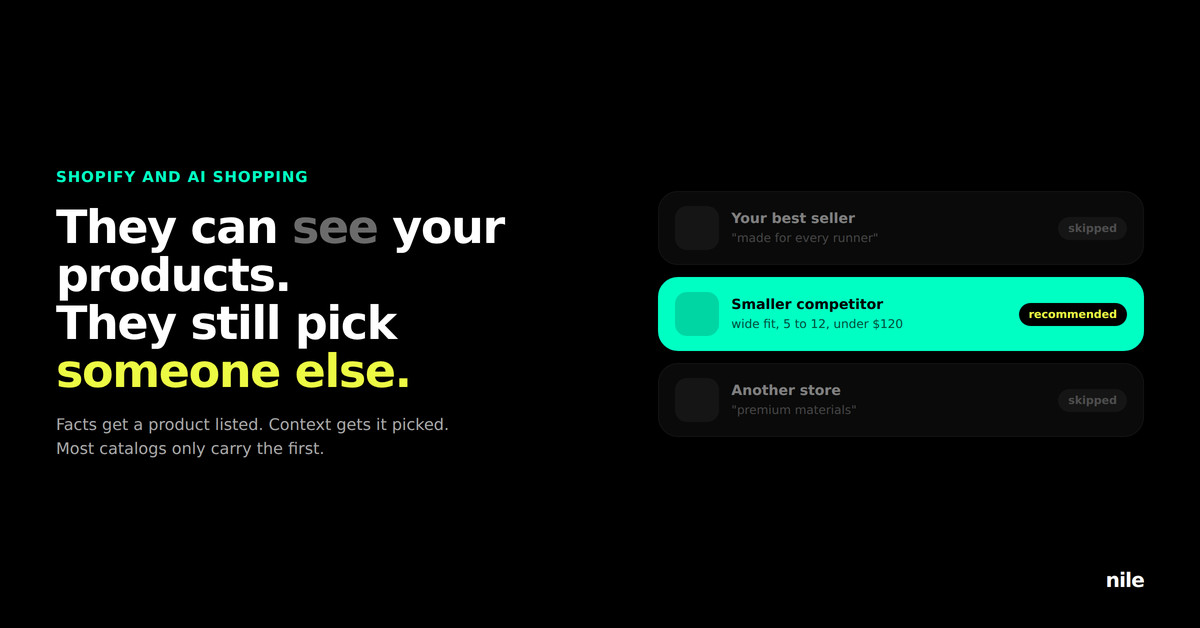
Your best seller can be one of the hardest products in your store for an AI to recommend.
That sounds backwards, so here’s the mechanism. A product becomes a best seller by appealing to a lot of people, and the copy that gets it there is deliberately broad. “Made for every runner.” “Works for all skin types.” Broad loses when the question is narrow, and AI shopping questions are narrow. Your odd, low-volume product probably says “for wide feet” right in the title, because it had no choice.
So not the worst product. The hardest one for an AI shopping agent to recommend. Those are different problems, and no report in your admin separates them for you.
A shopper can infer most of this from a photo, a price and a glance at the reviews. Your catalog can’t. Title, price, stock and a paragraph of copy tell a machine what the product is, not when to recommend it, which is the only question a ChatGPT recommendation answers. So it names something else, often something smaller that explained itself better.
Here’s what’s coming:
Most merchants are still asking how to get into AI shopping. On Shopify that’s settled, and it was settled for you.
For eligible stores, Shopify’s agentic storefronts are on by default. One setting in your admin, “Allow Shopify to manage for me,” enrolls you in the available channels at once: ChatGPT, Google AI Mode and Gemini, Copilot, Meta and Shop. The switch lives under Sales channels > Agentic, a page plenty of merchants have never opened. Ecommerce Fastlane’s guide to agentic storefronts going live walks through it.
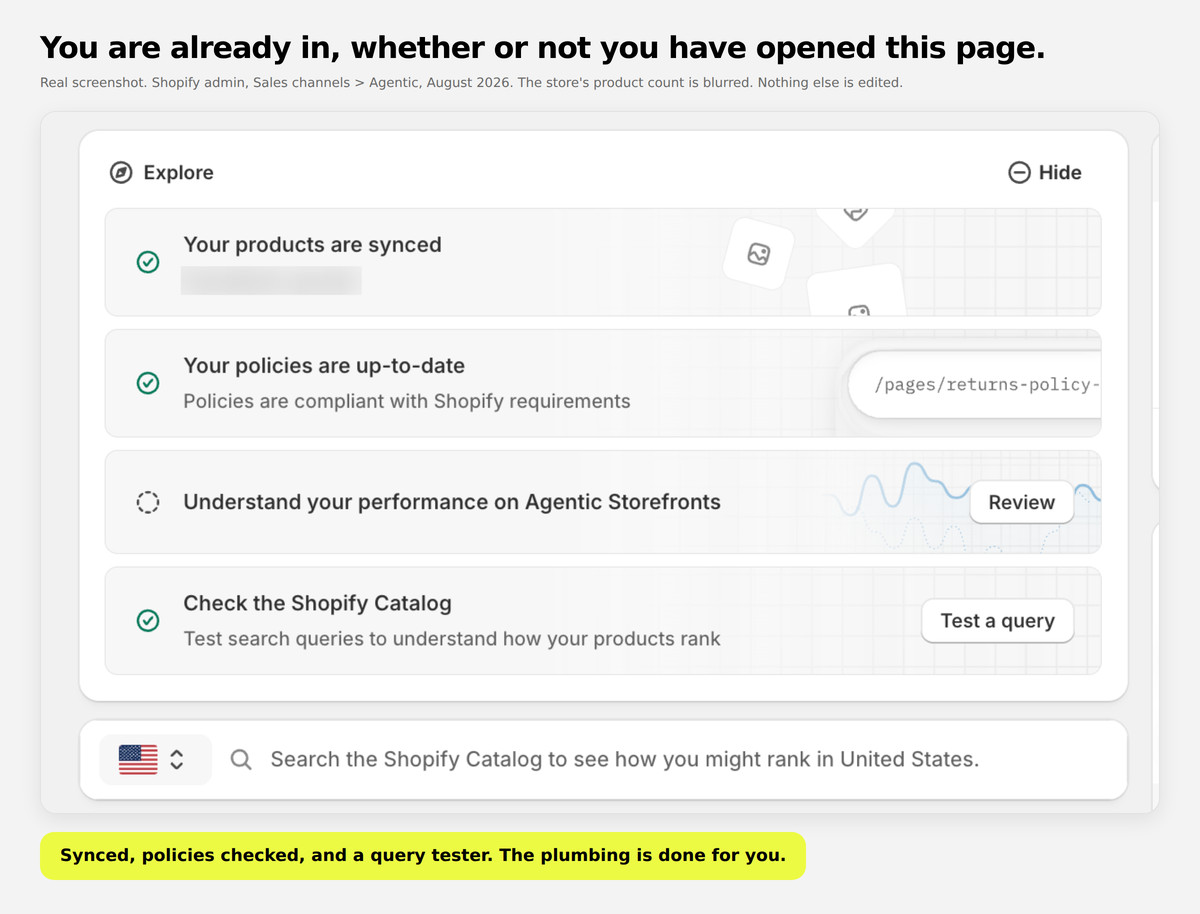
Shopify is blunt about the answer. Being included in its catalog, the documentation says, “doesn’t guarantee that a product will appear in a specific AI answer, be ranked in a specific position”, and “each channel controls the final ranking.”
Getting listed on Amazon never meant your listing was optimized, it meant you were eligible to compete. Agentic storefronts are the same: plumbing, and plumbing is where the work starts.
Which raises the real question: what is your catalog failing to say?
Real buying questions aren’t “running shoes.” They carry a buying intent plus constraints. “Something for a beginner with wide feet under $120.”
Accurate titles, prices, availability and variants keep you from being ruled out for the wrong reason. That is a floor, not an edge. We tested one merchant’s product across four AI surfaces. All four reported an in-stock item as backordered. Fixing the data removed the errors, and it did not change how often the product got recommended.
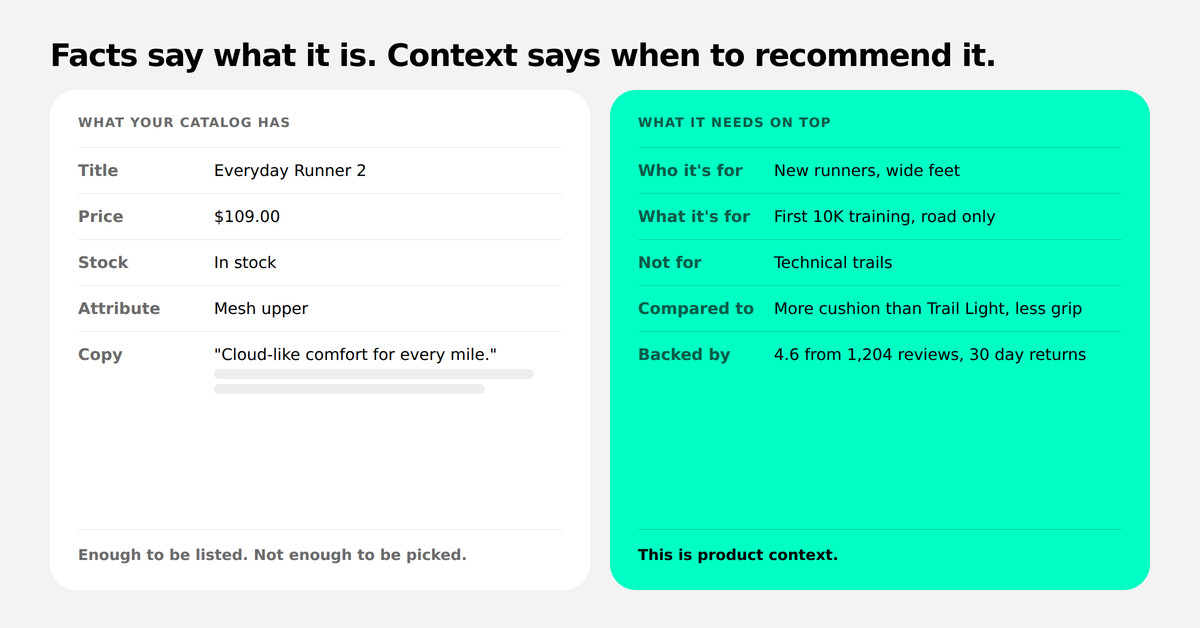
Accurate fields still don’t tell an agent who the product is for, or why to pick it over the alternative. And an agent doesn’t only pick, it has to justify the pick. Work backwards from that and you get six questions, one of which your catalog already answers. What is it, you have. These five, mostly not.
Four of those five are context, not facts. Facts get a product listed. Context gets an AI shopping agent to pick it.
Here’s how clearly the line is drawn. Shopify now scores your listings for you, in Sales channels > Agentic. Your admin calls the panel Listing completeness; the docs call it the listing quality indicator. It counts five things: description length, image coverage, variants and options, shop policies, review count and rating. Only reviews appears on both lists.
Sign out first, because logged in it knows your history and will flatter you.
Take one product and run two queries. First the broad one for its category. Then a narrow one you ought to win: your strongest product, the constraint you serve better than anyone, and a price. Sales channels > Agentic will also hand you real queries under “Recent searches where your products appeared,” if you would rather not invent them.
The broad query is a fame contest. If you are not a household name you will probably lose it, and that is normal, so treat it as the control rather than the test.
The narrow one is the diagnostic, and your own name is not the first thing to look for.
Answers move between sessions and locations, so one pass is a sample, not a ranking.
Your fields and your text both get used, but not for the same job. A value in a field can be matched without interpretation; a sentence has to be read and weighed. So each of the five has a strongest container, and putting something in a weaker one wastes it.
Sorted by where they belong, the five fall into three groups.
Facts that belong in a field. Size, width, material, compatibility. Start by assigning the most specific standard category you can. A Category metafields section then appears on the product, carrying that category’s attributes, and Shopify’s own guidance on optimizing products for AI platforms walks the same fields. Fill them in, and give your options real names while you are there, because Width is worth more than Option 1.
Now notice what that list leaves out. Take Shopify’s own documented example, the attributes for shirts: size, neckline, sleeve length, age group, fabric, target gender, features and color. Every one of them describes what the product is. None describes who should buy it. Your category carries a different list, and it has the same shape. No attribute for “beginner,” none for “training for a first 10K.” The most decision-relevant thing about a product has no field to live in. Open your own and see.
The parts with no field to put them in. When it’s the wrong choice, how it compares, and usually who it’s for as well. Sentences are the only option, and the description is where they travel. They do still reach AI channels, because the description is itself a catalog field. They arrive as text to interpret rather than a value to filter on, so put them high on the page, not at the bottom. Shopify’s Catalog Mapping will even send AI channels a different description from the one your product page shows.
Reviews and policies, which sit outside the product. Both are separate objects rather than product fields, and Shopify checks them on their own: two of the five completeness checks are policies and reviews. Returns and shipping have to be complete, because they form part of the answer an agent has to give.
Fifty products is a long afternoon. Three thousand with variants isn’t a writing project, it’s a data problem. Prices move, stock moves hourly, and context written once goes stale the first time you discontinue a size. And platforms want different fields: Google is adding conversational attributes to product data.
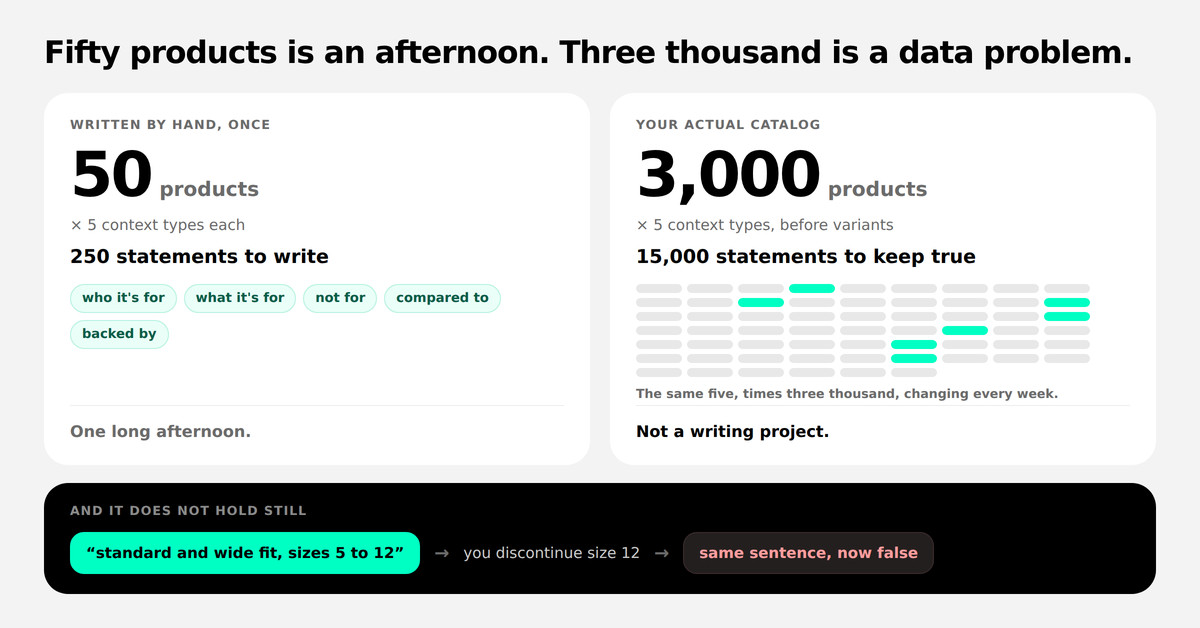
So the job isn’t better pages, and it isn’t the copywriting you already do. It’s keeping a layer of product context true as the catalog moves, in a form every platform can read.
Facts get your products listed. Context gets them picked. Most catalogs only carry the first one.
Three things worth doing this week:
These visitors are different. One health hardware brand measured AI-surface traffic converting at about 3.6% against 1.8% site-wide, on products priced $230 to $356. Shoppers arriving from an answer were screened against their own constraints before they clicked.
You can do this by hand for five products. For a whole catalog, connect your Shopify store to Nile free. It syncs your catalog and inventory, builds the product context, and routes shoppers to your own product pages with the orders attributed.
My products already show up in ChatGPT. Isn’t that enough?
Ask how you know. Usually it’s one query, typed once, which is a sample of one. Shopify’s own tool says as much when your products miss the top ten: “Most agents will execute multiple searches before showing results to users.” Your catalog isn’t ranked once, it’s judged per question. Showing up for “running shoes” tells you nothing about “wide fit under $120.”
I passed all five of Shopify’s completeness checks. Doesn’t that cover it?
It covers how much you have in each field, which is worth having. None of the five asks who the product is for, when it’s the wrong choice, or how it compares. Complete and recommendable are different states, and Shopify isn’t claiming otherwise: the panel is called completeness, not quality of fit.
Will the same changes work on every platform?
The facts travel. Which fields each platform actually uses does not, and it changes without notice. So this isn’t a project you finish, it’s a data set you keep true.
Author: Zhao Hanbo, co-founder, Nile
Author bio: Zhao Hanbo is a co-founder of Nile, which builds the product context layer that helps AI agents understand and recommend merchant catalogs. He writes about how AI changes the way products get found, compared and bought.




