
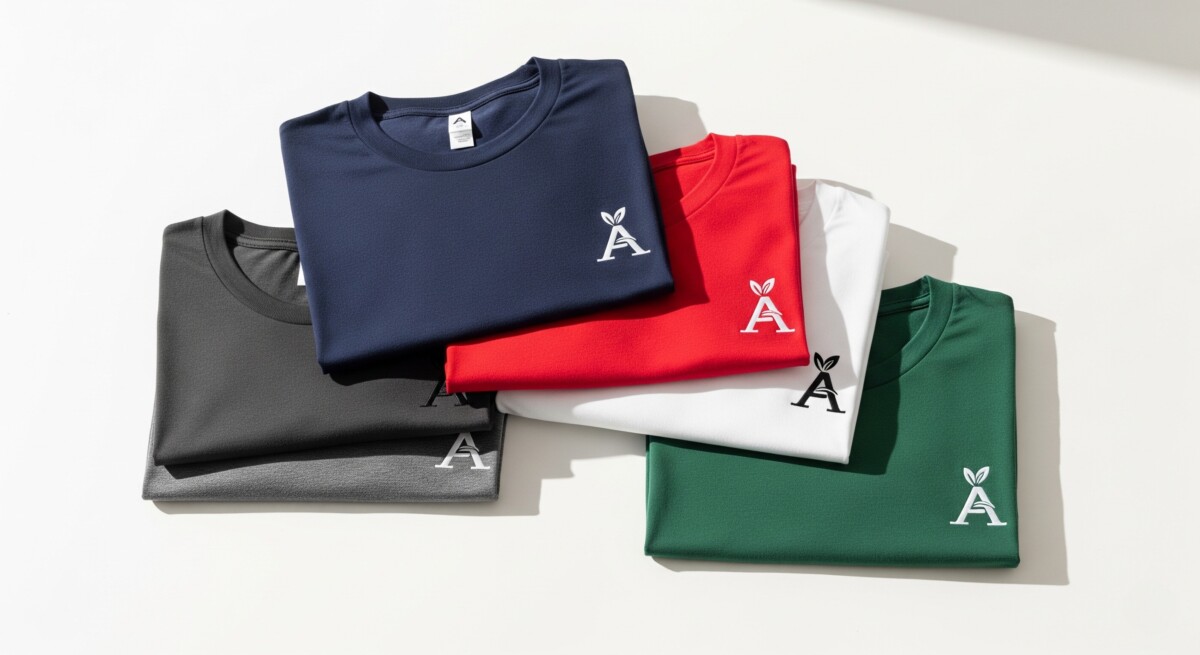
Every dollar you spend on digital advertising disappears the moment someone scrolls past. A branded t-shirt keeps working for years.
Think about the last time you walked into a business and immediately felt confident about the staff. That sense of credibility did not happen by accident. It was built deliberately through consistent, professional presentation, and branded clothing is one of the most powerful contributors to that first impression.
When your employees wear company logo t-shirts, they become walking advertisements for your brand. Every customer interaction, every errand run before or after a shift, every appearance in a public space is an opportunity to put your brand in front of new eyes. Unlike digital ads that disappear after a click, branded apparel keeps working for you all day, every day at zero ongoing cost.
The numbers make this concrete. A single branded t-shirt worn three times per week over two years generates hundreds of wearing occasions. If each occasion produces even 30 to 50 visual impressions from commutes, customer interactions, and public appearances, that single garment delivers thousands of brand impressions over its lifetime. At a cost of $15 to $30 per shirt, the cost per impression works out to fractions of a penny. A digital display ad might cost $5 to $10 per thousand impressions, and those impressions last milliseconds before the viewer scrolls past. A branded t-shirt is never blocked by an ad blocker, never lost in a crowded newsfeed, and never ignored because the viewer has developed banner blindness.
Studies consistently show that customers are more likely to trust and engage with staff members who wear uniforms or branded clothing. It signals that your business is organized, professional, and proud of its identity. For businesses competing on trust in industries like construction, healthcare, food service, and professional services, that signal is invaluable.
Beyond external marketing, there is a powerful internal benefit of company logo t-shirts that often gets overlooked: the impact on team morale and culture. When employees wear the same branded apparel, it creates a sense of belonging and shared identity. They are not just individuals doing a job. They are part of a team, representing something bigger than themselves.
This matters especially for businesses with large teams, multiple locations, or high staff turnover. Branded t-shirts create a visible, tangible identity that connects employees across departments and sites. New hires feel welcomed into the team culture faster. Long-term employees develop genuine pride in the brand they represent.
The psychology behind uniform dressing is well-documented in organizational behavior research. Employees who feel a strong sense of team identity perform better, engage more positively with customers, and are less likely to leave. Branded apparel is one of the most immediate, tangible ways to create that identity. When people wear the same clothing, visible differences in personal style and economic background disappear. What remains is a unified team, visually aligned around a shared purpose. For customer-facing businesses, that unity translates directly into a more consistent customer experience.
For Shopify merchants who operate both online and in physical retail, pop-ups, or trade shows, this consistency is especially valuable. Your brand exists in two worlds simultaneously. Branded apparel is one of the simplest ways to make sure the physical version of your brand matches the visual identity your customers already know from your store.
Not all branded t-shirts are created equal. The quality of your branded apparel reflects directly on your brand. A faded print or a poorly constructed garment sends a negative message regardless of how good your product or service actually is.
On fabric, your team will wear these shirts regularly, often in demanding conditions. The right choice depends on the environment. 100% cotton is popular for its comfort and breathability in retail and office settings. Cotton-polyester blends offer added durability and moisture-wicking properties, making them the better call for teams working outdoors or in physically demanding environments. The garment should hold its shape and color through repeated washing, because a faded logo on a worn-out shirt does more damage than no branded apparel at all.
On print method, screen printing is the traditional choice and remains the most cost-effective option for large quantities and simple designs with one to four colors. It produces bold, durable results that hold up exceptionally well to repeated washing. DTF (Direct to Film) printing is a newer technology that offers exceptional detail and color accuracy, making it ideal for complex logos with multiple colors, gradients, or fine details. It works particularly well for smaller orders where the setup costs of screen printing may not be justified. Embroidery adds a premium, textured look that cannot be achieved with printing alone. It is the preferred choice for polo shirts, caps, and outerwear where a refined, professional aesthetic is the priority.
On color accuracy, your branded t-shirts should align precisely with your brand’s color palette. Professional custom print providers can match colors to your exact brand specifications using Pantone or CMYK color references, ensuring consistency across all your branded materials both digital and physical. This matters more than most operators realize. A t-shirt that uses an approximation of your brand color rather than the exact specification creates a subtle visual inconsistency that erodes the professional impression you are trying to build.
The right print method depends on three variables: your logo’s complexity, your order volume, and the environment in which the shirts will be worn. Here is how the three main methods compare across those dimensions.
For most small and mid-sized businesses placing their first order, DTF printing at a 12-piece minimum is the most practical entry point. It handles logo complexity well, requires no large upfront commitment, and delivers results that hold up in daily use. Screen printing becomes the better value once your order volume crosses 48 to 72 pieces, where the per-unit cost drops significantly and the setup cost is spread across a larger run.
While virtually every business can benefit from company logo t-shirts, certain industries see particularly strong returns on their branded apparel investment.
In restaurants and food service, staff in branded apparel look more professional and are instantly identifiable to customers. Branded t-shirts also reinforce brand recognition for customers who encounter staff members outside the restaurant, turning every off-duty employee into a brand ambassador at zero incremental cost.
In construction and trades, high-visibility branded workwear keeps crews safe while building brand recognition on job sites. Potential customers in the neighborhood notice a professional, uniformed crew at work and associate that visual professionalism with the quality of the work being done. A single job site with a branded crew visible from the street can generate multiple inbound inquiries from neighbors who never saw a single ad.
In retail and hospitality, customers can immediately identify staff members in branded apparel, reducing confusion and improving the overall shopping or guest experience. In busy retail environments, a clearly branded team creates order and professionalism that customers notice and appreciate. For Shopify merchants who operate physical retail alongside their online store, this consistency between the digital brand and the in-store experience is one of the easiest wins available.
In corporate and professional services, company logo t-shirts and polo shirts are ideal for trade shows, team-building events, company outings, and casual office environments. They create visual cohesion for the team and reinforce brand identity in settings where traditional business attire might feel too formal. At trade shows in particular, a uniformed team stands out on a crowded floor in a way that no booth banner can replicate.
For businesses just getting started with branded apparel, a phased approach makes the most sense. The goal is to build a program that grows with your business rather than committing to inventory you cannot absorb.
The first phase is core team apparel. Start with the essentials: branded t-shirts for your entire team. Focus on one or two styles in your brand’s primary color. Keep the design clean and consistent with your broader brand identity. This is not the time for creative experimentation. Establish the baseline first.
The second phase is role-specific apparel. As your program matures, introduce apparel that suits the different environments in which your team operates. Customer-facing staff might wear polo shirts for a more polished look. Outdoor or trade teams might wear workwear and high-visibility vests. Management might wear branded button-downs for a more formal appearance. The goal is to maintain visual cohesion across roles while matching the practical requirements of each function.
The third phase is seasonal and event apparel. Expand your program to include seasonal options, lighter fabrics for summer and heavier options for winter, and event-specific apparel for trade shows, community events, and company milestones. Limited-edition branded apparel can also create excitement and build team pride around specific company achievements. For Shopify merchants, this maps naturally to product launch cycles, seasonal campaigns, and pop-up events where a cohesive branded presence matters.
Ordering company logo t-shirts for your business is more straightforward than most operators expect. Choose your garment style and color based on where and how your team will wear them. Upload your logo or design file and confirm any adjustments needed for the chosen print method. With minimum orders starting at 12 pieces, you can start small and scale as your team and your confidence in the program grows.
In a competitive market, every advantage matters. Company logo t-shirts are a simple, affordable, and highly effective tool for building brand recognition, projecting professionalism, and uniting your team around a shared identity. Whether you are outfitting a team of 12 or 500, branded apparel is one of the smartest investments a growing business can make precisely because it keeps delivering value long after the initial spend.
The brands that win long term are the ones that show up consistently, in digital spaces and in the physical world. Branded apparel makes that physical presence possible, turning every employee into a brand ambassador and every public appearance into a marketing opportunity. For merchants who have invested heavily in building a recognizable online brand, branded apparel is the bridge that brings that identity into the real world where customers, neighbors, and potential partners can see it.
Do not let your team blend into the background. Make your brand visible, professional, and memorable starting with what your team wears every day.
Yes, and the economics work better than most small business owners expect. Many reputable custom print providers offer professional-quality results with minimum orders starting at 12 pieces, which means you can outfit a small team without committing to large upfront inventory. At $15 to $30 per shirt, the total investment for a team of 10 is $150 to $300. That same budget buys you roughly one day of modest digital advertising spend. The difference is that branded shirts keep generating impressions for two-plus years. For a small team with a tight marketing budget, branded apparel is often the highest-ROI physical marketing investment available.
For screen printing and embroidery, vector files are strongly preferred. AI (Adobe Illustrator), EPS, and SVG formats all work well because they scale to any size without losing quality. For DTF printing, high-resolution raster files (PNG with transparent background at 300 DPI or higher) are generally acceptable because DTF handles photographic detail well. If you only have a low-resolution version of your logo, a professional print provider can often advise on whether it can be cleaned up or whether a redraw is needed. Submit whatever you have and ask for a print-ready proof before approving the order.
The most reliable approach is to provide your brand’s Pantone color codes to your print provider and request a color-matched proof before the full run. Most professional custom print providers support Pantone matching for screen printing. For DTF printing, color accuracy depends on the provider’s calibration, so requesting a physical sample before committing to a large order is worth the extra step. If you do not have Pantone codes, your designer or brand guidelines document should have CMYK or RGB values that a print provider can convert. Approximate color matching is fine for internal team apparel, but customer-facing branded merchandise should match your brand palette as closely as possible.
For a Shopify merchant ordering team shirts, the decision usually comes down to order volume and logo complexity. If your logo is simple (one to four solid colors, clean lines, no gradients) and you are ordering 48 or more pieces, screen printing will give you the lowest cost per unit and excellent wash durability. If your logo has multiple colors, fine detail, or gradient elements, or if you are ordering fewer than 48 pieces, DTF printing is the more practical choice. DTF handles complex artwork well, requires no minimum setup commitment, and produces results that hold up in regular use. Many Shopify merchants start with DTF for team shirts and switch to screen printing as their team and order volumes grow.
Branded t-shirts do drive new customer acquisition, and the mechanism is straightforward. Every employee wearing your branded shirt in public is a mobile billboard. In trades and construction, a uniformed crew visible on a job site regularly generates inbound inquiries from neighbors who never encountered a single ad. In retail and food service, off-duty staff wearing branded apparel encounter customers in everyday settings, creating recognition and familiarity that builds trust before the next purchase. The effect compounds over time as more people in your market recognize your brand from real-world encounters. It is passive, it is low cost, and it works in markets where digital advertising is expensive or oversaturated.




