

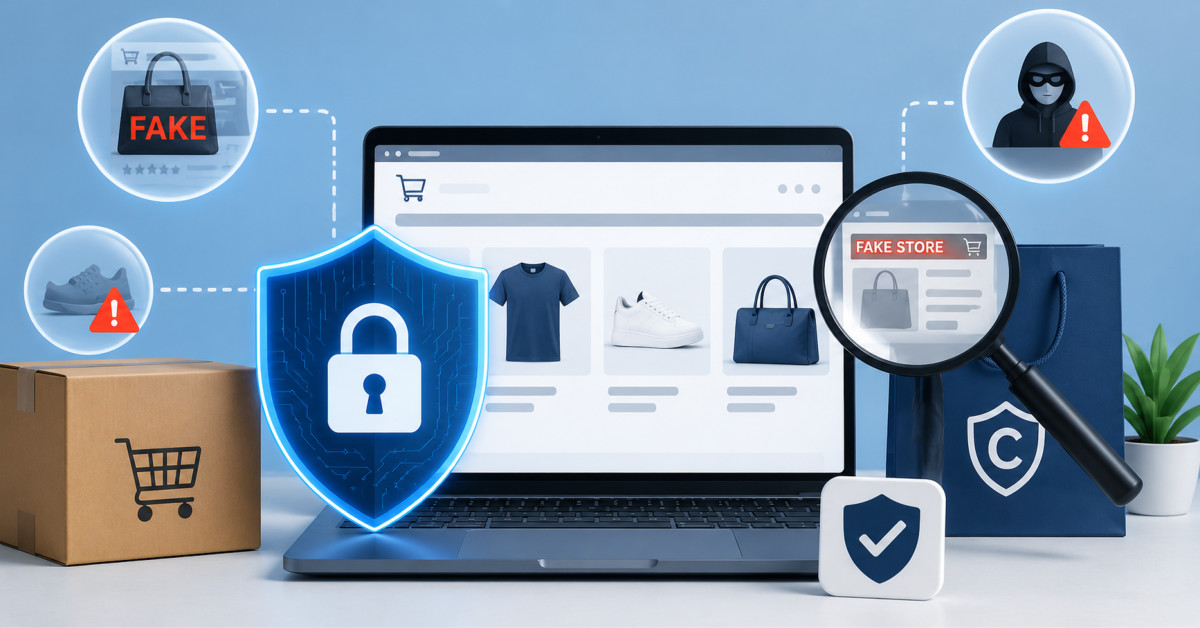
Ecommerce brands need AI brand protection when counterfeit listings, fake stores, impersonation accounts, fraudulent ads, and lookalike domains become too numerous or interconnected for manual monitoring. The practical goal is to prioritize and remove the threats most likely to damage revenue, customers, and trust.
Counterfeits are not only an intellectual-property problem. For an ecommerce operator, every fake store, cloned ad, and impersonation account can become a customer-support ticket, a chargeback, a lost sale, and a crack in the trust you spent years building.
For ecommerce brands, growth creates opportunity – but it also creates visibility for counterfeiters, impersonators, fake stores, and fraudulent advertisers.
A product that starts gaining traction can quickly appear in unauthorized marketplace listings, copied storefronts, social media scams, and lookalike domains. As a result, protecting an ecommerce brand now requires more than checking marketplaces manually or reacting to customer complaints.
That is where AI-powered brand protection is becoming increasingly important.
Counterfeit trade remains a major global problem. According to the OECD and EUIPO’s 2025 report, counterfeit and pirated goods represented an estimated $467 billion in global trade, equal to around 2.3% of global imports, based on 2021 data. (OECD)
For ecommerce businesses, one detail is especially important: shipments containing fewer than 10 counterfeit items accounted for 79% of all customs seizures in 2020–2021, up from 61% in 2017–2019. The OECD says this reflects a shift toward smaller, more fragmented shipments that are harder to detect. (OECD)
That pattern mirrors what brands increasingly see online.
A counterfeit operation may no longer depend on one large seller. Instead, it may use multiple small storefronts, marketplace accounts, social profiles, advertisements, and domains.
For an ecommerce team, that makes manual enforcement difficult. Removing one listing may solve only a small part of the problem.
Artificial intelligence adds another layer.
Fraudsters can use generative AI to create product descriptions, promotional copy, customer messages, social posts, and website content much faster than before. They can also modify product imagery or recreate the look and feel of legitimate ecommerce stores.
The result is not necessarily a completely new type of fraud. Instead, existing tactics can be created and repeated much faster.
That matters because ecommerce relies heavily on visual trust.
Customers make quick decisions based on product photography, reviews, logos, price, ads, and the design of a storefront. A fake seller does not need to reproduce a brand perfectly. It only needs to look legitimate long enough to win a click or sale.
Therefore, ecommerce brands need technology that can detect more than exact keyword matches.
Modern AI-powered online brand protection can analyze text, product images, logos, domains, listings, seller behavior, and other signals across multiple online channels.
More monitoring does not automatically mean better protection.
If a system generates thousands of alerts, ecommerce teams still need to know which ones deserve attention first.
For example, a seller using an old product image may be less urgent than a fake store actively accepting customer payments. Likewise, a social account with no activity may create less immediate risk than a fraudulent ad sending traffic to a counterfeit site.
AI can help rank these findings based on risk.
However, prioritization becomes even more useful when brands can see how individual threats connect.
Consider a typical scenario.
A merchant discovers a counterfeit listing on a marketplace. Soon afterward, a social media account appears using the same product images. That account promotes an advertisement linking to an independent website with a similar product catalog.
Looking at each asset separately creates three enforcement cases.
Looking at them together may reveal one coordinated operation.
This is why threat clustering is becoming an important part of ecommerce brand protection. BrandShield’s AI.ClusterX threat clustering is designed to identify connections between listings, websites, domains, profiles, ads, and other digital assets.
For ecommerce operators, that changes the goal from removing individual symptoms to understanding the wider network behind them.
Counterfeit goods are only one part of the problem.
Scammers can also impersonate a retailer directly. They may create a fake social support account, copy an ecommerce site, or run an advertisement promoting a fraudulent discount.
The financial impact of impersonation is significant. The FTC reported that consumers lost $3.5 billion to imposter scams in 2025, while nearly one in three fraud reports involved impersonation. Business impersonators alone accounted for nearly $1 billion in reported losses. (Federal Trade Commission)
For ecommerce brands, that creates a customer-experience problem as much as a cybersecurity problem.
A customer who loses money on a convincing fake store may still blame the legitimate company whose name and logo appeared on the page.
Therefore, BrandShield’s impersonation protection extends monitoring beyond products to fake websites, domains, social profiles, and other attempts to misuse a trusted identity.
AI can find more suspicious activity and connect more signals. However, detection alone does not protect customers.
Ecommerce brands still need evidence, validation, enforcement, and follow-up.
That means identifying the violation, preserving URLs and screenshots, choosing the correct marketplace, registrar, host, social platform, or advertising network, and then tracking whether the threat actually disappears.
Human expertise therefore remains important.
The strongest model combines AI for scale with expert review for context and enforcement.
As ecommerce expands, brand protection is becoming less about searching for individual fake listings and more about understanding networks of abuse.
AI can help brands detect threats earlier, recognize visual and behavioral patterns, prioritize the most harmful activity, and uncover relationships between sellers, advertisements, websites, and accounts.
For growing ecommerce brands, that creates a more practical way to protect revenue and customer trust.
The goal is not to monitor everything on the internet.
It is to identify the threats that matter, understand how they connect, and act before they can scale alongside the brand.
AI brand protection for ecommerce brands is a technology-supported process for detecting, prioritizing, investigating, and removing counterfeit listings, fraudulent websites, impersonation accounts, fake ads, lookalike domains, and other unauthorized uses of a brand online. AI helps monitor a much larger number of marketplaces, websites, social platforms, and paid-ad environments than a small internal team can check manually. The strongest programs pair AI detection with human validation, evidence capture, platform-specific enforcement, and customer communication. The goal is not to generate more alerts. It is to identify the risks most likely to harm customers, divert revenue, or weaken trust.
A Shopify brand should consider brand-protection software when manual monitoring can no longer keep up with counterfeit listings, fake sites, fraudulent ads, impersonation reports, marketplace expansion, or rising customer confusion. Many brands reach this point around $2M in annual revenue, although the right timing depends more on brand visibility, product desirability, price point, international reach, and customer-risk exposure than revenue alone. If your support team repeatedly receives reports about fake discounts, copied stores, unauthorized sellers, or social-media scams, you already have enough evidence to assess a more structured monitoring and enforcement solution.
AI identifies counterfeit listings and fake ecommerce stores by analyzing signals such as trademark use, product titles, text patterns, logos, reverse-image matches, domain similarity, website content, seller behavior, advertisements, and links between digital assets. A modern platform can identify more than exact copies by recognizing modified logos, altered product images, lookalike domains, and repeated content patterns across multiple channels. Human review is still required to validate context, distinguish authorized sellers from infringers, confirm the evidence, and select the right enforcement route. AI provides scale and prioritization; people provide commercial and legal judgment.
Ecommerce teams should preserve evidence, assess customer-payment risk, report the fake store to the appropriate provider, warn affected customers when necessary, and investigate whether the store connects to other listings, ads, domains, or social accounts. Capture screenshots, the complete URL, timestamps, copied product pages, payment methods, advertisements, and any customer complaints before the site changes or disappears. Treat payment-taking stores and active fraudulent ads as urgent cases. Then document the case in a shared queue, assign an owner, submit takedown requests to the host, registrar, payment processor, advertising network, or platform, and monitor whether the operator reappears elsewhere.
Threat clustering is important for ecommerce brand protection because it helps teams identify when separate listings, domains, advertisements, social accounts, and seller profiles are part of one coordinated operation. Without clustering, a team may spend time filing individual takedowns while the same operator continues to sell through other accounts and websites. Clustering can reveal shared imagery, copy, domain structures, seller details, behavioral signals, and technical infrastructure. That wider view lets teams prioritize the highest-impact network, preserve stronger evidence, and pursue enforcement that removes more of the underlying operation instead of only one visible asset.
Ecommerce brands can warn customers about impersonation scams by publishing official domains and social handles, confirming legitimate offers through owned email and SMS channels, adding a “How to verify a real offer” page, and training support teams to respond consistently to reports. During major events such as BFCM, product launches, and clearance sales, remind customers that official promotions will appear only on specified domains and verified accounts. Give customers an easy way to report suspicious ads, websites, messages, and accounts. The response should include the official link, an acknowledgement of the report, and clear guidance not to share payment or account details with an unverified source.




