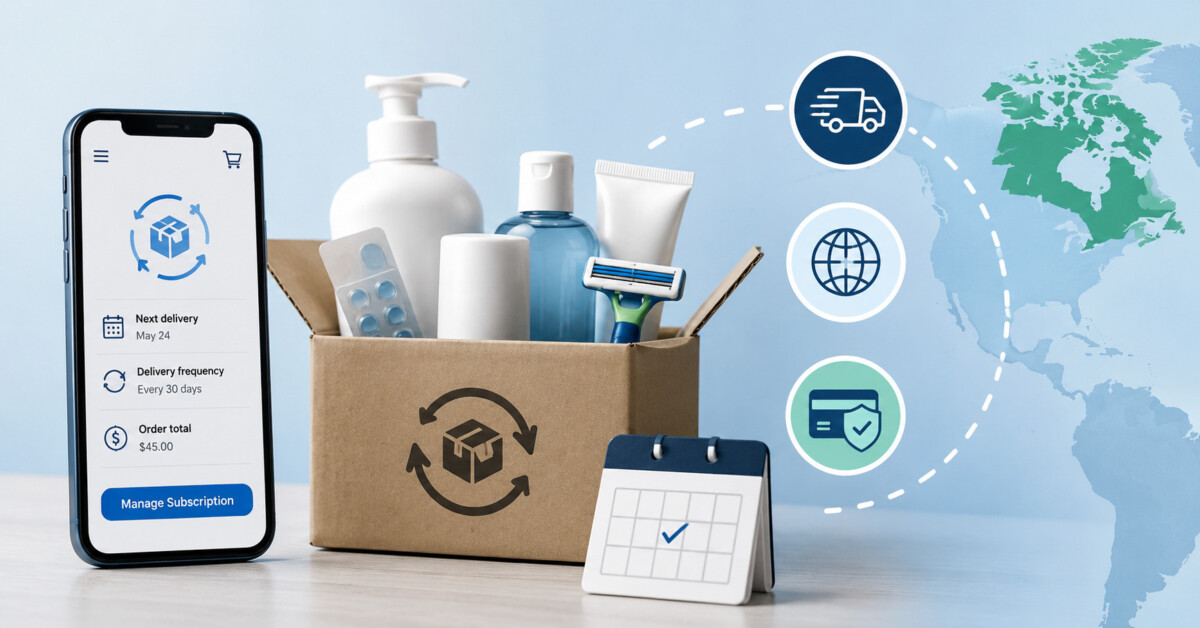
Replenishment commerce exposes how strong your retention engine really is, because customers must reorder, and the only question is whether they choose your brand as the easiest, most trusted way to do it.
Replenishment products don’t test whether customers want you; they test whether you’ve made it painless enough that they never feel the need to leave.
Most retention playbooks are built around one goal: get the customer to come back. But there’s a category of products where the customer doesn’t really have a choice about coming back. They run out of contact solution, their razor blades dull, their skincare jar hits empty, and they need to reorder whether or not a brand’s email campaign nudged them. This is replenishment commerce, and it behaves nothing like discretionary retail.
For DTC operators, that difference matters more than most retention strategies admit. A customer buying a discretionary item can be won over with a discount or a clever abandoned cart flow. A customer buying something they physically need is judging the brand on a different scale entirely: how painless is it to get the product again, and how much does the process cost them in time, money, or friction.
When a purchase is optional, brands compete on desire. When a purchase is necessary, they compete on convenience and trust. That shift changes what actually drives repeat orders.
A shopper reordering vitamins or skincare refills isn’t asking “should I buy this again.” They’re asking “is this still the easiest, most reliable way to get it.” If a competitor offers a smoother subscription, faster shipping, or clearer pricing, switching costs are lower than most brands assume, because the emotional attachment that keeps someone loyal to a discretionary brand often doesn’t exist here.
This is why subscription models built for necessity categories look different from ones built for lifestyle products. They lean harder on predictability: locked-in pricing, easy pause and skip options, and proactive communication before a shipment goes out. The brands that win in these categories treat the reorder itself as the product experience, not just a transaction that happens in the background.
Here’s where a lot of DTC subscription programs quietly fail: they’re built around a single market’s assumptions and then expanded without adjusting for regional differences in cost, logistics, or consumer habits.
Canadian shoppers are a good example of this. Recurring-purchase categories that feel frictionless in the US market can suddenly involve extra shipping tiers, currency conversion, or duties once they cross the border, and that friction shows up right at the point where retention should be strongest. Shoppers who are comparing contact lens options for Canadians before locking into a subscription, for instance, are often doing that research specifically because pricing and delivery terms shift once a brand’s US-based fulfillment model meets Canadian import rules. The same pattern shows up with skincare refills, supplements, and other consumables where the product itself is simple but the delivery economics aren’t.
The mistake brands make is assuming that if the product is a “must-have,” customers will tolerate whatever friction shows up in the checkout or reorder flow. They won’t, not for long. Necessity buys patience for the first purchase, not for every purchase after that.
A few things separate DTC brands that retain reorder customers from ones that lose them to a competitor with a smoother pipeline.
First, pricing has to be legible before checkout, not revealed halfway through. Surprise costs at the point of payment are one of the fastest ways to lose a subscriber who was otherwise ready to commit.
Second, the reorder cadence needs to match how the product is actually used, not a fixed calendar interval picked for operational convenience. A subscription that ships too early or too late signals that the brand doesn’t understand its own product’s usage pattern, which undermines trust in categories where reliability is the entire value proposition.
Third, regional fulfillment needs to be treated as a first-class part of the strategy rather than an afterthought bolted onto a US-first model. That means clear communication about shipping origin, customs handling, and total landed cost for customers outside the brand’s home market, so they aren’t left comparing options mid-checkout because the numbers don’t add up.
Replenishment commerce rewards operational discipline more than marketing creativity. The brands doing this well aren’t necessarily the ones with the flashiest subscription page. They’re the ones that have quietly removed every point of friction between “I need this again” and “it’s already on the way,” in every market they serve, not just the one they launched in.
If your retention strategy is built for a single geography, it’s worth stress testing it against a market like Canada, where cross-border costs and consumer research habits will expose weak points a domestic-only model never has to face. Fixing those gaps tends to pay off well beyond the specific category you’re testing it on.
Replenishment products are a better test of retention because customers must buy them again somewhere, so the real question is whether they see your brand as the easiest, most trusted way to do it. Discretionary categories let you hide weak systems behind strong creative, but necessity purchases expose whether pricing, cadence, and fulfillment actually work. If customers consistently choose competitors for their refills, your retention problem is structural, not campaign-level.
DTC brands should set subscription cadence based on real usage data, not arbitrary monthly intervals. Track median time between orders by SKU and cohort, then time the first reminder or shipment at roughly 70 to 80 percent of that window. From there, segment customers by behavior (heavy, typical, light usage) and offer flexible skip or pause options so people can align deliveries with their actual consumption. The goal is that the subscription feels like it understands their habits rather than forcing them into your operational schedule.
Replenishment subscriptions often fail regionally when cross-border costs, currency conversion, and customs handling are treated as afterthoughts. Extra shipping tiers, duties, and unclear landed costs show up right at checkout, which is the moment customers are deciding whether to trust you with an ongoing commitment. If Canadian or other international shoppers regularly encounter surprises at that stage, many will abandon the subscription and either seek a local alternative or revert to one-off purchases that feel more controllable.
DTC brands can make replenishment pricing feel more trustworthy by surfacing total cost clearly before checkout and locking in transparent terms over time. That means showing base price, shipping, taxes, and duties upfront, avoiding currency ambiguity, and ensuring subscription discounts are real rather than offset by hidden fees. In necessity categories, customers are often budgeting over months, so clarity about ongoing cost is as important as the headline savings on the first order.
A practical way to stress-test a replenishment model in a new market is to walk through the full journey as a local customer would, from research to reorder, with local payment methods, shipping options, and currency active. Audit where friction appears, especially around landed cost, delivery estimates, and subscription terms, then compare that experience to domestic flows. If it feels meaningfully harder or riskier to commit in the new market, your retention engine is not truly portable yet and needs structural adjustments before you scale acquisition.