

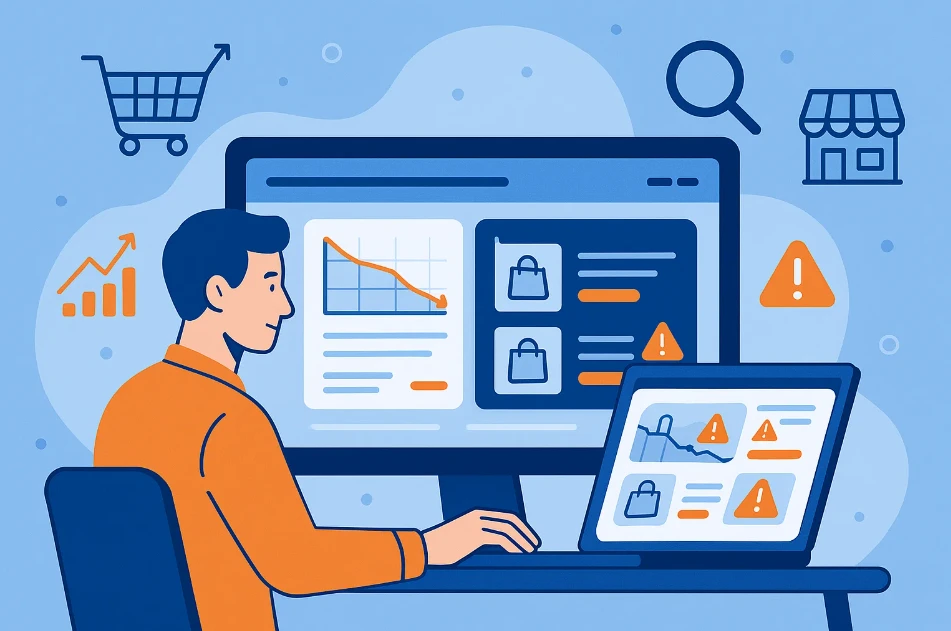
In 2025, the e-commerce market has become faster and more aggressive than ever.
Every product has dozens of alternatives, and customers make decisions in seconds. To survive and grow in this environment, an online store must not only be convenient and visually appealing, but also competitive in terms of pricing.
And for that, competitor price monitoring is essential.
📚 Table of Contents
Competitor price monitoring is the process of tracking the prices at which your competitors sell the same or similar products. This can range from manually reviewing websites and marketplaces to using automated tools and services for data collection.
Most commonly monitored elements include:
Today’s e-commerce operates under the rules of speed and transparency. A customer visits a marketplace, enters a search query, and sees dozens of offers. They compare price, delivery terms, and ratings, and make the purchase where it’s most favorable.
If your store doesn’t know what competitors are offering, you might:
Monitoring allows you to make data-driven decisions instead of guessing.
Here are some practical advantages:
✅ Quick reaction to market changes. A monitoring service notifies you when someone drastically lowers prices or launches a promotion.
✅ Market positioning control. You know where your product is the best deal and where price adjustments are needed.
✅ Supports dynamic pricing. Enables automatic price updates based on competitor behavior.
✅ MAP violation detection. For brands and manufacturers, this helps protect your pricing policy.
✅ Time savings. Instead of manual checking, the system collects and analyzes the data for you.
You have two main options How to Monitor Competitor Prices:
1. Manual Monitoring Best suited for small shops with a limited product range. You manually visit competitor sites and record prices in a spreadsheet. Time-consuming, but free.
2. Automated Monitoring If you have over 100 SKUs, it’s time to use specialized tools or services for online price monitoring. Upload your product list and URLs, and receive fresh data daily.
Modern systems can:
❌ Monitoring too infrequently. Weekly checks are outdated — the market changes daily.
❌ Ignoring local competitors. They often erode your margin without you even noticing.
❌ Responding only with price cuts. Sometimes it’s better to focus on value rather than price wars.
❌ No clear strategy. Monitoring is a tool, not the goal. You need a defined pricing strategy.
Competitor price monitoring isn’t just a trendy concept — it’s a must-have element of any online store’s strategy.
If you want to sell more, earn consistently, and truly understand the market — track competitor prices. Do it regularly, wisely, and with the help of modern tools.
And if you want to save time and effort — let a professional service handle it.
We have already written about one of these services, Price Control, in our article “Competitor Price Monitoring: How To Avoid Losing Profit And Customers”.
In 2025, success belongs not to the loudest, but to the fastest, most accurate, and smartest.





