
When a striker strays beyond the last defender a fraction of a second before a teammate plays the ball at the World Cup this summer, no one will wait for a linesman to raise a flag. Cameras tracking every player fifty times a second feed the exact moment of the pass and the striker’s position to a semi-automated system, and the offside ruling lands within seconds.1 The 2026 tournament, co-hosted across the United States, Mexico, and Canada, has handed much of the judgment to technology that reads structured data and decides faster than any official on the pitch.2
Your product listings play under the same kind of officiating every day, except you face three referees at once. Google, the marketplaces, and social platforms each read the product data you send them, score it against a private rulebook, and decide in milliseconds whether your product gets shown or ruled out. None of them explains the call. When the data you supply is ambiguous, the ruling goes against you, and the sale moves to a competitor whose listing was easier to read.
The football (aka soccer) comparison is a metaphor, but the data-driven officiating behind it is exactly what your product listings run up against. Most teams optimize for one referee, usually Google, then assume the same product feed carries everywhere else. It rarely does. A title that wins a Google Shopping auction can disappear in a TikTok feed, and a product that dominates your own site can lose the Amazon buy box to a weaker product with cleaner data. This article walks one product past all three referees, shows what each rewards, and lays out how to structure and enrich a single product record so it wins calls across Google, the marketplaces, and social.
A product on your own website only has to make sense to you. A retailer that sells nothing but soccer gear can list an item as “boots,” and every shopper understands the category, because the site supplies the context. Send that same product record to an outside channel, and the context disappears. The channel knows only what your product feed tells it, and a one-word title tells it almost nothing.
Mark Batson, who has spent 14 years on the feed-management side of Athos Commerce, points to the most extreme example he has seen, a product whose entire title reads “a white tank.” Google had no way to tell whether the listing was a tank top or a military vehicle, so it either ignored the product or showed it and charged a premium for the ambiguous match. The data left the ruling open to interpretation, and the interpretation went against the seller. In football terms, that is the call that rules you offside before you have touched the ball.
The same product record now has to satisfy three different officials, each reading a different set of fields and rewarding different things. Most catalogs were authored once, for the website, and shipped everywhere unchanged. For the operating model that keeps these channels in sync at scale, see our companion piece on centralized feed management. This article stays on the field-level question of what each referee rewards and how to give it what it wants.
Google’s Shopping algorithm makes its decisions based on a small number of product data fields, and it is unforgiving about the ones that matter most. The title and the product category carry most of the weight. A title can run up to 150 characters, and Google rewards titles that name the distinguishing details a shopper would type, including gender, material, color, size, and use case.3 A charcoal men’s tech-fleece hoodie listed only as “Aura Peak Hoodie” gives the algorithm nothing to match against. Spell the same product as “Aura Peak Men’s Tech Fleece Hoodie, Charcoal Gray, Heavyweight,” and you give it five distinct attributes to rank on, which opens the listing to queries it never appeared for before.
Underneath the title sits the product_type field, where most catalogs leave revenue on the floor. Google lets you submit up to five product_type values per item, each up to 750 characters, using the > symbol to express category depth such as Apparel > Men’s > Activewear > Hoodies.4 Only the first value feeds bidding and reporting, so order them deliberately, but supplying the full set provides single-product coverage across several category paths. A hoodie that registers as activewear, loungewear, and outerwear becomes visible to shoppers approaching it from any of those directions.
When the data stays vague, the response is not a polite warning. Google either drops the product from the auction or matches it loosely and charges a premium for the privilege. Either outcome is a silent revenue loss, paid for one impression at a time. The 2026 update to Google’s product data specification raises the stakes, tightening image and availability requirements that push more borderline listings into the ignored column.5
Around 40% of shoppers who discover a product on social go on to buy it on a marketplace rather than the brand’s own site, according to Athos Pixel survey data.6 For a meaningful share of your catalog, the marketplace listing is the storefront, and it answers to a referee most teams never study.
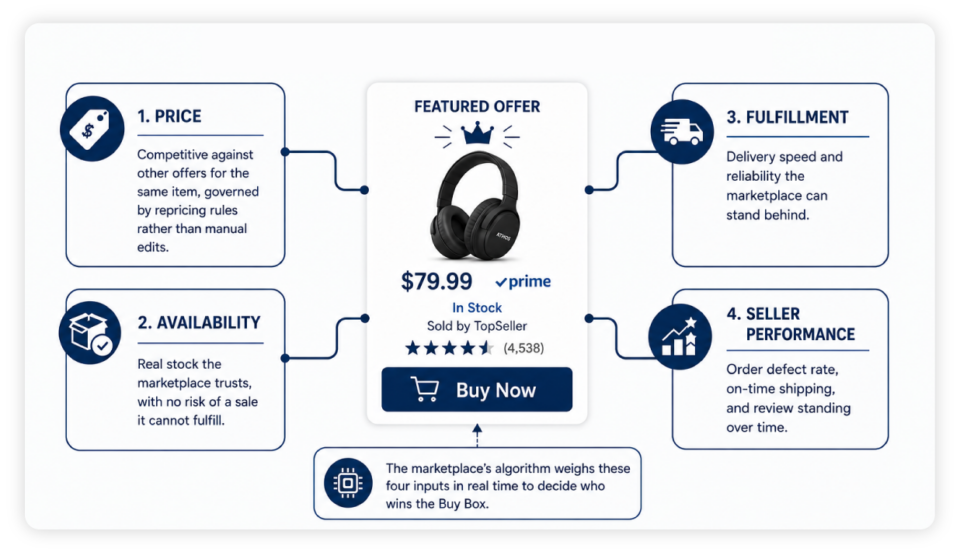
Marketplaces run two judgments at once. The first is search ranking, which decides whether your product appears when a shopper searches inside Amazon, eBay, or Zalando. The second is the buy box, the featured offer that captures the overwhelming majority of sales when multiple sellers list the same item. Amazon awards that featured offer on price and availability, together with fulfillment reliability and overall seller performance.7 You can hold the better product and still lose the sale to a seller whose data and operations score higher.
Winning both judgments comes down to the quality of the listings you control at the data level. Fill every category-required attribute, because marketplaces hide or downrank listings with missing fields. Title to the marketplace’s own conventions rather than reusing the Google string. Supply complete, high-resolution imagery. Keep prices competitive through repricing rules, and keep inventory and fulfillment data accurate to the unit, because a stockout erases your ranking and buy-box eligibility in the same moment. Reviews and seller ratings feed the same score, so service quality becomes part of the listing.
Athos Commerce manages marketplace listings for Amazon, eBay, and Farfetch, from the same product record that feeds Google and social channels, with live inventory sync, rule-based repricing, near-real-time order ingestion, and validation that catches listing errors before marketplaces reject them. Retailers running marketplace management this way report up to 49% more revenue and reach new channels around nine times faster than manual listing allows.8
When two or more sellers offer the same product, the marketplace picks one featured offer for the “Buy Now” button. Four inputs decide it, and every one traces back to data you can manage.
The keyword-stacked title that wins on Google works against you in a social feed. A shopper scrolling TikTok or Meta never searched for your product and feels no obligation to stop. The social referee scores for engagement rather than query match, so the listing has to earn attention before it can earn a click. “Aura Peak Men’s Tech Fleece Hoodie, Charcoal Gray, Heavyweight” reads as a spec sheet, while “the hoodie that survives the 6 a.m. commute” gives a scrolling shopper a reason to look up.
Under the hood, social platforms enforce strict listing standards that determine whether your product appears in their browse and recommendation feeds at all. TikTok Shop wants main images of at least 800 by 800 pixels on a clean background, and it tiers listings on completeness, holding products with fewer than five images or missing category attributes out of its better-performing placements.9 Miss those marks, and even the sharpest headline never gets seen, because the listing never clears the quality bar for placement.
The product data fields the engagement referee reads are the same fields you already manage for Google and the marketplaces, shaped for a different job. The image library, the attributes, and the inventory record all carry over. What changes is the headline and the creative framing layered on top, and that layer is the work social rewards.
Winning all three referees by hand breaks down at any real catalog size, because the SKU count multiplies by the channel count until the math defeats the team. A retailer with 20,000 products, selling across Google, four marketplaces, and three social platforms, maintains 160,000 listings. Manual upkeep at that scale guarantees the stale prices, missing attributes, and broken images that lose calls.
A single persona of product data is now not enough.

Mark Batson
Head of Go-to-Market Technical Operations, Athos Commerce
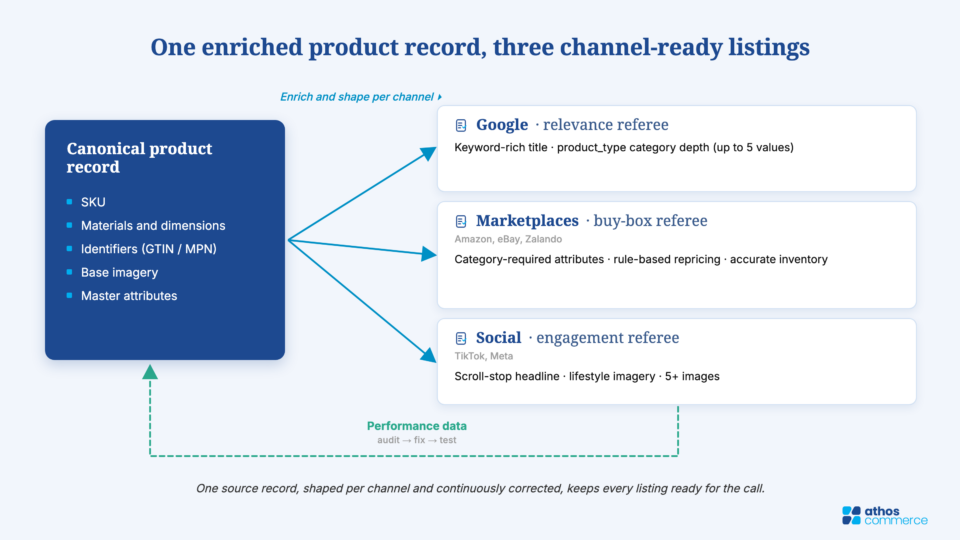
The workable model starts from one enriched product record and shapes it per channel from that single source. Master attributes that never change, such as materials, dimensions, and identifiers, live once in the canonical record. Channel-specific treatments layer on top, so the Google title, the marketplace attribute set, and the social headline all are generated from the same product record rather than from three disconnected spreadsheets. Fix the source once, and every channel inherits the correction.
The shared foundation links the three referees back together. Enrichment written to satisfy Google’s relevance also sharpens your on-site search, and engagement data from social feeds back into how you rank and merchandise everywhere else. Athos Commerce is the intelligent discovery and feed management platform that runs this as one continuous loop of audit, fix, and test across on-site and off-site discovery, so a single record stays match-ready in front of every referee at once.
Fixing every channel at once produces a plan that never ships. Stretched teams get further by sequencing the work around three moves, each one a capability rather than a manual project.
A fourth referee is already taking the field. AI answer engines like ChatGPT, Gemini, and Perplexity now recommend products from structured data, and they judge on trust signals the other three do not weigh. For how to prepare your listings for that official, see our guide to optimizing for the five AI shopping engines. Win the three referees in play today, and you are most of the way ready for the one arriving next.
Key takeaways:
- One product faces three referees: Google, the marketplaces, and social, each scoring the same product data against a different rulebook.
- Google rewards relevance: keyword-rich titles up to 150 characters and up to five product_type values for category depth.
- Marketplaces rank in search and on the buy box, which turns on price and availability, plus fulfillment reliability and seller performance. Complete category attributes decide whether you are visible at all.
- Social ranks on engagement: a scroll-stopping headline over imagery and attributes that clear the platform’s quality tier.
- Author one enriched product record, shape it per channel, and run a continuous audit-fix-test loop so a single fix improves every listing.
Each channel reads product data differently and scores it against its own rules. Google needs contextualized, keyword-rich titles because it lacks your site’s context. Amazon ranks on search relevance plus buy-box factors like price and fulfillment. TikTok ranks on engagement and enforces image and completeness standards before a listing reaches its feeds. A title that wins a Google auction can read like a spec sheet on social media and still miss marketplace attribute requirements, so a single listing rarely performs everywhere.
The buy box is the featured offer tied to the “Buy Now” button, and it captures the overwhelming majority of marketplace sales when several sellers list the same item. Amazon awards it on price and availability, plus fulfillment reliability and overall seller performance. You win it by keeping prices competitive through repricing rules, holding accurate inventory so you never risk an unfulfillable sale, shipping reliably, and maintaining strong seller ratings. A stockout erases both your ranking and your buy-box eligibility.
Product data enrichment turns a minimal product record, often just a name and description, into complete, channel-ready data. Enrichment adds the contextualized titles, structured attributes, category depth, and descriptions each channel needs to rank and convert. When done at scale, it generates channel-specific variants from a single source, so the same product reads correctly across Google, marketplaces, and social. Unique enriched content also outperforms the identical AI output many competitors publish.
Start with the channel where revenue is already moving without you. If a large share of social-discovered shoppers buy on a marketplace, audit your Amazon and eBay listings first. Fix the source product record so corrections flow to every channel, rather than patching listings one at a time. Then choose a system with a shared data foundation across on-site and off-site discovery, so a fix in one place compounds into the others instead of rebuilding silos.




