Roughly 20 percent of ChatGPT conversations now involve shopping, which means hundreds of millions of weekly purchase journeys are already happening inside AI agents while most brands still have product catalogs that are not machine-readable enough to be recommended reliably.
AI shopping is not a future channel; it is already handling hundreds of millions of weekly purchase journeys, and the brands that win are the ones whose catalogs are structured well enough for agents to recommend specific products, not just mention their names.
One in five ChatGPT conversations carries shopping intent. OpenAI shared that stat during a Pacvue webinar in June 2026, framing the shopper journey as three steps: Discover, Evaluate, Buy. With 900 million weekly active users on ChatGPT, that’s roughly 180 million shopping-related conversations happening every week on a single platform.
Meanwhile, approximately 95% of merchants are already seeing AI agent traffic on their sites, but only about 20% have machine-readable catalogs set up properly (per a May 2026 industry panel). The math is stark: the shoppers are there, the agents are visiting, and most product catalogs aren’t ready for either.
OpenAI’s shopping funnel works differently from a Google search. A shopper doesn’t type keywords and scan ten blue links. They describe what they want in plain language: “lightweight running shoes for flat feet under $120” or “non-toxic cookware set for a family of four.”
ChatGPT decomposes that into sub-queries. It checks structured product feeds, web sources, and review data. Then it returns recommendations, often with product cards showing images, prices, and direct links to the merchant’s site.
The brands that show up in those recommendations share specific traits. Their product data includes 30 or more structured attributes. Their descriptions contain the contextual detail AI agents need to match against natural-language queries: materials, dimensions, use cases, compatibility, care instructions. Their merchant information is present in structured markup.
Spanx, SKIMS, and Glossier are among the first brands surfacing consistently in ChatGPT’s shopping results through Shopify’s native product feed integration. What they have in common isn’t brand size. It’s structured catalog depth: rich product attributes, complete merchant data, and feed formats that AI agents can parse without guessing.
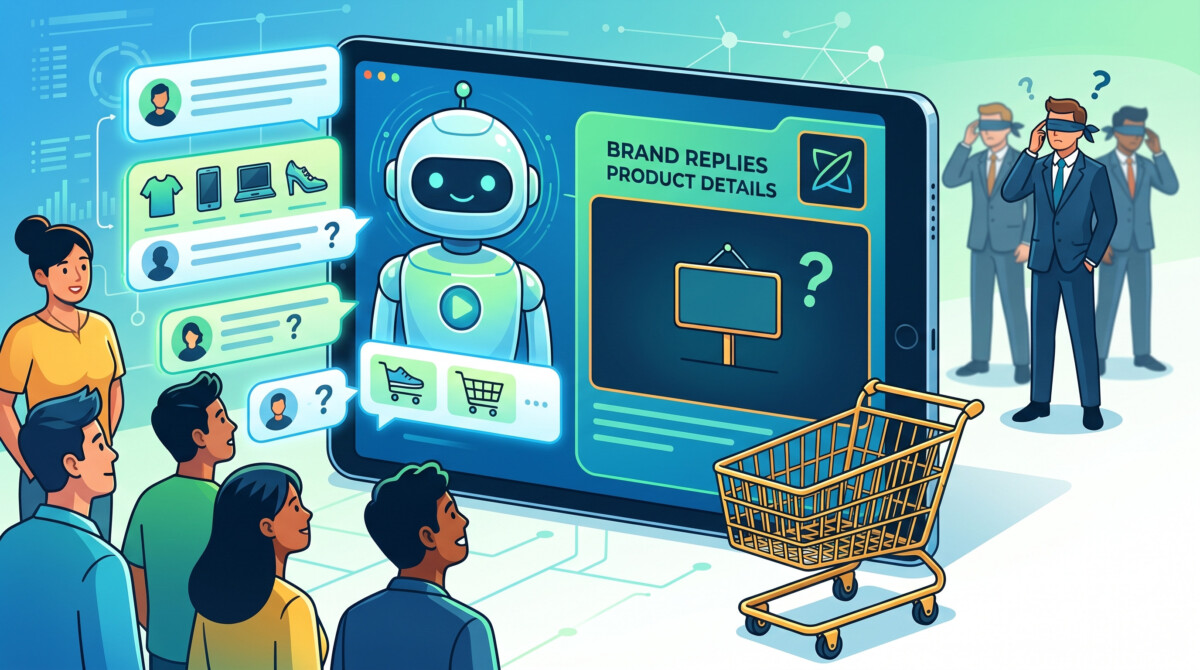
There’s a meaningful difference between being “mentioned” and getting a product card in ChatGPT’s shopping results.A brand mention means ChatGPT references the brand name in its response text. A product card means the shopper sees an image, a price, and a click-through link. Product cards drive purchases. Mentions drive awareness at best.
The gap between “ChatGPT knows you exist” and “ChatGPT recommends your specific product with a buyable card” is almost entirely a product data quality problem.
Traditional SEO optimized for what Google’s crawler indexed: title tags, meta descriptions, header hierarchy, keyword density. AI shopping agents parse a different set of signals.
Structured product attributes matter more than page copy. An AI agent pulling from a product feed cares about explicit, machine-readable fields:
These aren’t optional nice-to-haves. They’re the raw inputs the agent uses to match a product against a shopper’s described needs.
Most product pages were designed for human eyes. A shopper browsing a page can glean context from images, layout, and surrounding text. An AI agent can’t infer that a jacket is waterproof from a lifestyle photo of someone wearing it in the rain. It needs “waterproof: yes” as a structured attribute.
The Similarweb May 2026 data on generative AI platform traffic breaks down like this: ChatGPT holds 76.4% of overall GenAI traffic. Gemini sits at 8.9% (though a narrower cut of shopping-adjacent traffic puts Gemini at 27.3% and ChatGPT at 52.7%, with Google’s AI surfaces gaining share month over month). DeepSeek accounts for 5.3%, Grok for 2.8%, Copilot for 1.9%, Perplexity for 1.8%.
Those numbers tell you where the shoppers are going to ask product questions. ChatGPT is dominant, but Google’s AI Mode is growing fast, and each platform pulls from different data sources with different format requirements.
A brand optimized only for ChatGPT’s product feeds might be invisible in Google AI Mode, which draws from the Shopping Graph and Merchant Center. A brand indexed well in Google’s ecosystem might not surface in ChatGPT at all if it hasn’t submitted a compliant product feed. Multi-platform visibility requires catalog readiness across each surface, not a single optimization pass.
Three practical steps, all measurable:
The 20% shopping intent figure isn’t a forecast. It’s current behavior, as of June 2026, on a platform with 900 million weekly users. The question for any ecommerce brand is whether their products are structured well enough to be part of those conversations, or whether the AI is recommending their competitors instead.
OpenAI has indicated that about 20 percent of ChatGPT conversations have shopping intent, which means roughly 180 million weekly shopping-related chats on a base of around 900 million weekly active users as of mid-2026.
A brand mention is when an AI response includes your brand name in text, while a product card shows a specific SKU with an image, price, and direct link, and product cards tend to drive far more purchase behaviour than mentions alone.
For AI shopping visibility, explicit structured fields like material, size, dimensions, price, shipping, return policy, merchant data, and use-case context are critical because agents use them to match products to natural-language requests.
Recent traffic trackers show ChatGPT still holding the majority share of GenAI website visits, with Gemini, DeepSeek, Perplexity, Grok, Copilot, and others making up the rest, and Google’s AI surfaces gaining share in shopping-related traffic over time.
Brands can measure and improve AI shopping visibility by auditing catalog attribute depth, testing key shopping queries across ChatGPT, Google AI Mode, and Perplexity, and using AI visibility tools to track appearances, product cards, and competitive positions over time.