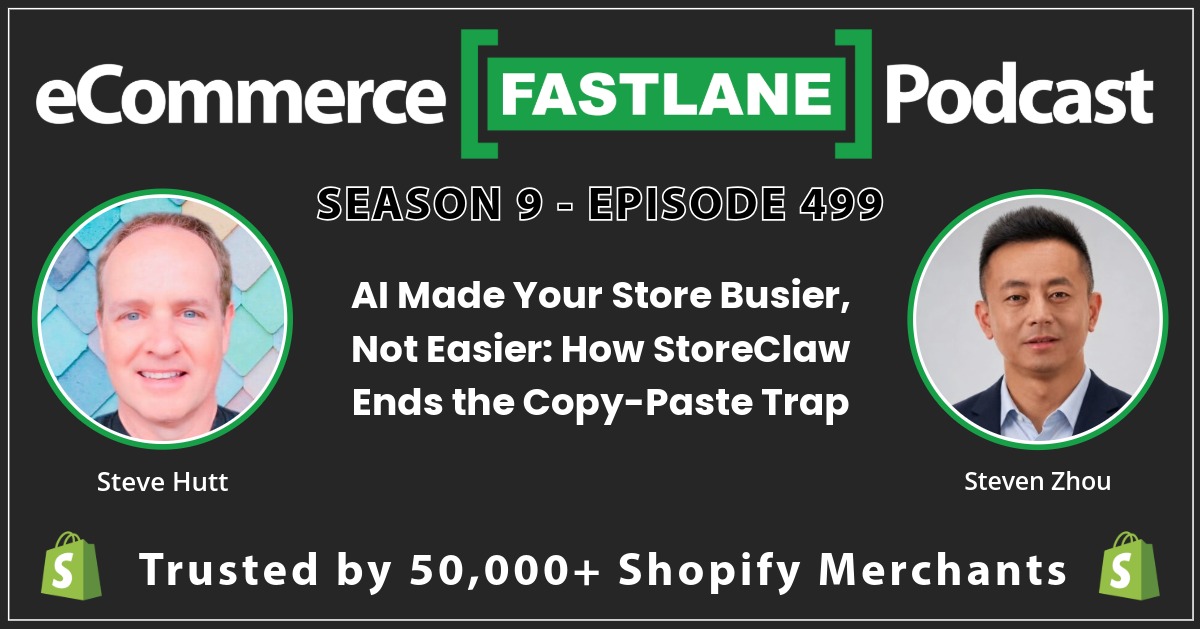
Here’s the uncomfortable truth about AI for most Shopify merchants: it made the store busier, not easier.
If you’re selling on Shopify alongside Amazon and TikTok Shop, whether you’re doing $10K months or $1M months, there’s a good chance you’ve become the human copy-paste layer between ChatGPT or Claude and five different backends. That’s the multichannel operations trap, and it gets worse every time you add a channel.
Steven Zhou has lived that problem from the seller’s seat. He’s run Amazon stores since 2013, TikTok Shop since 2023 and a Shopify DTC brand since 2025, and today he’s co-founder of Caelith AI, the company behind StoreClaw, the AI growth engine that ranked #1 Product of the Day on Product Hunt at its May 2026 launch. StoreClaw plugs directly into your stores through more than 30 connectors, reads your real orders, listings, inventory and ad spend, then actually does the work, with your approval.
In this conversation, Steven breaks down why multichannel selling fails at the operational layer (not the platforms), walks through the channel-by-channel playbook he baked into StoreClaw, and shares how sellers are using an approval-first AI agent heading into BFCM. Whether you’re a solo founder or running a 25-seat team, this is how you stop being the integration layer.
Let’s dive in. 👇
✅ Why AI made merchants busier, not easier: the “integration layer” trap that turns founders into prompt writers and copy-pasters, and what it takes to break out of it.
✅ The two skills that win on each channel: what a seller who started on Amazon in 2013 believes matters most on Amazon, TikTok Shop and Shopify (one of them shows up twice).
✅ What your first morning with an AI agent looks like: from a full store diagnostic to spotting the areas quietly bleeding revenue.
✅ How to trust an AI agent with your ad spend: where the real work happens before anything gets executed, and why the approval layer isn’t optional.
✅ Whether TikTok Live deserves your budget yet: Steven’s honest take on how much of TikTok Shop sales live selling actually drives today.
✅ Why connecting a new tool before BFCM can still make sense: plus the very first job Steven says to hand over the moment you sign up.

Shopify doesn’t back up your store data, and a CSV export isn’t a backup. One bad import, a bulk edit gone sideways or an app conflict can wipe out weeks of product work right before BFCM.
Rewind backs up your Shopify store automatically, with products and orders in real time, and restores anything from a single image to your entire catalog in a few clicks. Moomin recovered 11,000 mistakenly overwritten products in 30 minutes.
Trusted by 25,000+ businesses, including Tentree, Olaplex and Liquid Death. eCommerce Fastlane listeners get a 30-day free trial instead of the usual 7.
Steven opens with the reality most multichannel sellers already feel. The new “golden triangle” of ecommerce is Amazon, TikTok Shop and Shopify, and wrapped around it sits a stack of point tools for ads, SEO, reviews, email and inventory. Steven typically sees sellers switching between three to four systems just to finish one task. His point is sharp: the store itself isn’t the bottleneck, the operational layer is. Generative AI was supposed to help, but tools like ChatGPT and Claude sit on top of the stack without seeing your store’s real data. So the model guesses, and the seller ends up writing prompts, checking drafts and manually pushing changes back into every platform.
From there, Steven breaks down why an Amazon listing doesn’t simply translate to Shopify or TikTok Shop. The algorithms differ, so titles, bullet points, images and even videos need to change. He walks through the two skills he believes matter most on each channel, why product selection is “half the battle” on Amazon, and how StoreClaw packages a seasoned operator’s step-by-step workflow into ready-made skills. You’ll also get his candid view on TikTok Live: for most sellers he works with, it’s roughly 10 to 15% of TikTok Shop sales, which makes it a great testing lab but not your main income stream.
Then we get into the question every operator asks: can I trust an AI agent with my money? Steven explains that StoreClaw keeps an approval step at every execution, especially for ads, because the real time sink is the data analysis that happens before anyone touches a budget. He shares company-reported results too, including INCENZO, a three-person Shopify fragrance brand that says it got back 18 hours a week of SEO work while organic traffic climbed 142% and acquisition costs dropped 57%.
We close on where this is all heading: persistent store memory that gets smarter with use, competitor monitoring down to the voice of their customers, and why AEO and GEO matter as agentic commerce takes shape. As Steven puts it, traffic is only getting more expensive, so conversion is everything.
This isn’t another AI chat window. It’s a look at what happens when the AI can finally see your store.
👉 Fix the operational layer before you add another channel. Steven’s core insight is that multichannel brands rarely fail because of the platforms; they fail because data and execution live in too many disconnected tools. It’s the same premature complexity I see with merchants at the $500K to $2M stage. Before you launch TikTok Shop, count how many tabs it takes to update one product across your current channels. If the answer is more than three, solve that first.
👉 Stop being the integration layer between AI and your store. A model that can’t see your orders, listings and ad data will guess, and you’ll spend your time fact-checking its drafts. Whatever tool you choose, connect your real store data before asking for output. Steven’s advice for anyone signing up is exactly that: connect your stores first, because surface-level answers come from surface-level data.
👉 Translate your listings for each channel, don’t clone them. Amazon’s algorithm rewards different titles, bullets and images than your Shopify PDP, and TikTok Shop runs on content and creator fit. If you’re an Amazon seller launching DTC, budget time to rebuild each listing for its channel rather than pasting the same copy everywhere. The brands that win on a new channel treat it as a new storefront, not a mirror.
👉 Keep a human approval gate on anything that touches money. Let AI do what it does best (the heavy data analysis behind ad decisions), then approve budget, bid and creative changes yourself. Start in crawl mode: let the agent diagnose and recommend for a few weeks before you allow it to act on low-risk tasks. And take a fresh backup before you approve any bulk edit, so a bad change is a quick restore instead of a lost weekend.
👉 Treat TikTok Live as a testing lab, not a revenue engine. Steven sees live selling drive roughly 10 to 15% of TikTok Shop sales for most sellers, with heavy upfront investment in a studio or agency. Its real edge is reach per session: a short video might feature a product or two, while one live stream can showcase 20 to 30. If you’re curious, run a single 30-minute live to test new products before committing serious budget.
👉 Invest in conversion, because traffic only gets more expensive. Whether shoppers arrive from ads, search or AI answer engines, the cost of getting them there keeps rising. Clean, detailed PDP content and metadata now do double duty: they convert humans and they help AI engines cite you. If your product pages are thin, that’s the highest-leverage fix on your list heading into Q4.
Steven Zhou
Co-Founder, Caelith AI (the company behind StoreClaw.ai)
Steven Zhou is a seller first. He’s run Amazon stores since 2013, added TikTok Shop in 2023, and a Shopify DTC brand in 2025, giving him a firsthand view of how each channel rewards different skills and how quickly the tool stack gets out of hand. That operator experience shaped StoreClaw, the AI growth engine he co-founded to execute the work, not just recommend it.
Caelith AI, founded in 2025 and headquartered in Southern California (formerly Genstore Inc.), raised a $10 million seed round in September 2025. Its portfolio includes StoreClaw, the Genstore AI store builder, and the creator commerce tool fypro.ai. StoreClaw launched in May 2026 and was named #1 Product of the Day, then Product of the Week, on Product Hunt.
Steven’s perspective is valuable because he builds from the seller’s chair. He knows which skills actually move the numbers on Amazon, TikTok Shop, and Shopify because he’s had to master them himself, and he’s honest about where the hype outruns reality.
Featured in This Episode:
Related Reading:
Over 9 seasons, I’ve been incredibly fortunate to chat with some of the brightest founders building amazing Shopify brands, as well as the partners shaping the app and marketing ecosystem. Every conversation has taught me something new, and I’m grateful for the chance to learn alongside you.
What matters most is that this podcast helps you solve real challenges and discover new ways to grow. Your support, feedback, and stories have made this journey truly special. Thanks for tuning in, sharing your wins and losses, and being part of the eCommerce Fastlane community.
Stay Connected: Leave an Honest Rating/Review on Apple Podcasts or Spotify. Follow & Subscribe on YouTube for new episodes.
Steve Hutt: Hey there, welcome back to eCommerce Fastlane. I’m your host, Steve. Today, we’re going to talk about something I keep hearing from a lot of Shopify merchants. They’ve added AI to their business, and somehow it got busier. They’re running their Shopify store, likely an Amazon account, and maybe even a TikTok Shop. They’ve turned into someone who’s copying answers from ChatGPT or Claude and pasting them into five different backends. They’re doing AI, but is that really what they’re doing? That’s the problem a solution called StoreClaw is built to solve. I have an account, and I logged in just before recording at storeclaw.ai. It’s quite interesting. They were number one on Product Hunt for a while when they fully launched. It’s an AI agent. I’ll give you the Coles Notes, or Cliff Notes, first, and then introduce the co-founder. It connects to your store and sees your real orders, listings, inventory, and ad spend. It figures out what needs to be fixed and then does the work for you, with your approval. It’s not just autonomously doing things. It’s going to ask for approval. It’s like an assistant handling your to-do list, but I think it’s more like a colleague, to be honest. It helps get the work done that needs to happen. That’s why I want Steven Zhou to say hello. He’s the co-founder of StoreClaw and a seller himself. From what I understand, he understands the challenges of running a multichannel brand. His platform is helping solve those challenges, not just for Shopify, but for TikTok Shop, Amazon, and more. It’s an interesting topic, and it’s interesting what he’s built. Steven, welcome to the show.
Steven Zhou: Hi, Steve. Thanks for the invitation. Great to be here. Hi, everyone. To build on what you covered, that’s exactly what we’re going to discuss today. Being a seller myself in the past, and still a seller, I’ve seen a lot of pain points and opportunities in the era of AI. I’m happy to be here to share.
Steve Hutt: Take me back to the moment when you realized merchants, including yourself, were getting busier after adopting AI. You would think they’d get less busy, but it seems people are getting busier by adopting AI technologies. Can you talk about what you saw that made you think, “I need to solve that problem,” and led you to design StoreClaw?
Steven Zhou: Totally. There are several layers to this question. First, as you mentioned, people are usually running multiple channels. The golden triangle in ecommerce nowadays is Amazon, which is still number one, TikTok Shop, which has been very hot over the past two or three years, and Shopify, which is a channel you can’t avoid having. Then there’s a stack of point tools. You need ads, SEO, reviews, emails, and inventory tools. Generally speaking, the store itself isn’t the bottleneck. The operational layer is. The data lives in different tools. It could be in Shopify, an ad console, ranking tools, or content calendars in social tools. Sometimes a fix gets suggested, but nobody finishes it. That’s the number one pain point. Generally, I see people switching between three or four systems or tools, sometimes more. That’s the reality. Second, AI has been around for the past three or four years, and it gets better every day. But generative AI still adds a layer on top of your stack. It doesn’t see your store because it’s not connected to it. A lot of merchants were told they could use ChatGPT, Codex, or Claude for listings, emails, product copy, and ad keywords. But those models don’t know your store. They aren’t connected to your data. They get data from public sources, but they don’t see your true data or its quality. Sometimes the seller becomes the integration layer. They’re writing prompts, pasting outputs between tabs, and checking drafts because the model guessed. Then they’re manually pushing changes back into each platform. StoreClaw is built to bridge that gap. We’ve built in over 30 connectors that connect directly to Shopify and Amazon stores through authorization. It reads the actual operational data and combines it with public sources to give you better, more accurate results. Lastly, the real pain isn’t, “I don’t have enough AI.” It’s that most tools stop at advice. As a seller, we’re looking for execution. Can it complete a task? The next layer is whether it can deliver results. That’s the key. We didn’t just create a blank chat box. We want to deliver the work and results to you, more like a colleague or a digital operator.
Steve Hutt: It’s interesting because I read your LinkedIn post about this. You say multichannel selling doesn’t fail because there are too many platforms. It fails for other reasons. It’s not just diversification. There are too many disparate systems running. A lot of people think, “I’m going to have Claude as my source of truth, with a whole bunch of MCP connectors running to Shopify, my ad accounts, and all these different things.” Over time, maybe it starts to learn something. But you’ve solved it differently. Claude or ChatGPT isn’t your source of truth. StoreClaw becomes your new source of truth because it’s the central hub for everything to do with commerce and how you’re running your business. Can you talk about multichannel selling and how you’re making StoreClaw that new source of truth?
Steven Zhou: Sure. There are a few scenarios. Say you’re an Amazon seller launching your DTC Shopify store. Because the backend algorithms are different, your Amazon listings are different from your DTC or Shopify listings. That doesn’t translate automatically. Even with generative AI, Claude, or MCP, it’s hard to translate because the images, bullet points, product titles, and even videos are different. StoreClaw has built-in skills targeted at that task. It can make that happen in two or three prompts because we have those built-in skills. That’s one way we help with a multichannel launch.
Steve Hutt: I like that, and I agree. An Amazon seller might suddenly want to run a TikTok Shop, but those listings don’t always translate directly. The pace of TikTok Shop may also be different from what’s happening on Amazon.
Steven Zhou: Totally. Each channel has core capabilities or know-how you need to be successful. Let’s name Amazon, TikTok Shop, and DTC through Shopify, because those are probably the three most important channels for everyone. For Amazon, there are two very important things you need. Number one is product selection. That’s half the battle. You have to be really good at it. Second is ad optimization. Since we’re sellers and have the playbook, we knew from day one that those are two of the most important skills. We spent a lot of time developing them. Of course, we have other skills, including A+ content, product listings, images, and inventory, but those two are at the top. For TikTok Shop, we think two things are really important. Number one is content, because TikTok is social commerce. You need a lot of content, whether it’s self-generated or generated by creators. We developed skills to help sellers with that. Second is product selection. Beyond research, we connect with data sources and tools that provide that data. It’s much like hiring a seasoned operator and following the steps they would take to select products. We have that workflow or skill baked into our platform. With those skills, you have a higher chance of success if you’re new to TikTok Shop and launching from Amazon or your DTC Shopify business. For Shopify, the important skills include having a beautiful branded store and beautiful listings. You also need to run SEO and GEO, make sure the store is ready for both, and fix issues. Lastly, you need to run ads. Those are the cornerstones, the critical skills for each channel. From day one, we made sure to bake that know-how into our platform from a seasoned operator’s perspective.
Steve Hutt: What about running live on TikTok Shop? I hear a lot about live selling. It’s interesting because you can learn a lot about demand and sales trends, and think about the right questions to ask when you’re getting involved. We know it’s massive in China, but it’s slowly being adopted here in North America, especially with TikTok Live. What are your thoughts? Is that an interesting connection brands should consider now?
Steven Zhou: We currently don’t support TikTok Live. We haven’t developed a tool or skill for it, but I’ll give my two cents. As you said, it’s gradually seeing momentum. We’ve been in the space since the early days, and over the past two or three years, a lot of investment and effort has gone into live selling. But from a GMV percentage perspective, it’s still a small portion. It’s nice to have, but for the majority of sellers, it’s not the main income stream. We see sellers with 30% of their TikTok Shop sales coming from live, but most see around 10% to 15%. The upfront investment is also heavy, whether you set up a studio yourself or hire an agency. My view is that it’s something to tap into, but you can’t rely on it to generate your main income from TikTok Shop. It’s a nice tool for testing products and product selection because you can showcase so many products in one livestream. Short videos might show a few products at most, while a livestream can showcase 20 to 30 products. It can be good for testing new products and getting additional traffic to your store. But I don’t think it’s a mainstream revenue stream for TikTok Shop yet.
Steve Hutt: I totally get it. I like the leading edge of things. I like to educate people and say, “You might want to think about going live once for half an hour and seeing what happens.” My other question is about merchants who have never heard of StoreClaw. That’s why you’re on the show today. You have a lot of users and top sellers using it, but I’m trying to cast a wider net so people discover you’re available. The timing is really good. We’re in Q4, before BFCM, with holiday sales happening, and your solution can help. For someone who’s never heard of StoreClaw, what does their first morning look like when they log in and start using it? What should the merchant expect?
Steven Zhou: If you’ve already set up some scheduled tasks the night before, you’ll see results the first morning. It could be a report or ads that have been optimized, with your conversion rate going up and acquisition costs dropping. You can also run a scan of your whole store to see where there’s potential and where revenue might be leaking. The first thing you’d probably see is a diagnostic of your store, whether it’s Amazon, Shopify, or TikTok Shop, from different angles. That could be SEO, ads, or overall listing quality. That’s probably the first thing you’d see in the morning. Hopefully, you’d be amazed by the results and keep using it. That’s how I imagine the first day.
Steve Hutt: That’s amazing. My next question leads into that. There are a lot of different AI tools out there, and I don’t want merchants to think this is just another dashboard to check in the morning. We can get dashboard overload with Shopify and all the ad platforms. You’re all over the place. What’s your mindset? Is StoreClaw, from your perspective and that of the thousands of merchants using it, their morning coffee? Is that where they go first because you’re a true multichannel player, bringing all these connections into one solution so it can make an intelligent decision with the right context?
Steven Zhou: Yes, you’re exactly on point. We can run across multiple channels. When we designed it, we initially only had a chat box. But sellers asked for a dashboard because they’re used to seeing one. We made the dashboard as simple as possible, showing only the most critical benchmarks and numbers. We also provide a comprehensive view of your whole business, not just one channel. That gives you an idea of which channel is doing better, which is doing worse, and where you should dedicate more resources because there’s growth potential.
Steve Hutt: My next question is about ad platforms. Merchants get a little antsy when an agent makes decisions on behalf of the business involving money. That’s not just with your solution, but with any solution. You kind of trust Meta and Google, and I’m putting “trust” in quotation marks. You tell them, “Here’s the ROAS I’m looking for, here’s my target CPA, and here’s my daily ad spend. Please be as efficient as possible with my money.” I know they grade their own homework and all that. What does StoreClaw do so merchants feel comfortable when you’re recommending a budget change, a CPC change, or a creative change? Is there a crawl, walk, run scenario? We don’t want the system making financial decisions the operator hasn’t approved.
Steven Zhou: Totally, Steve. We have an approval layer at every decision or execution, especially before changing anything with ads. Whether it’s Amazon Ads, Google Ads, or Meta Ads, a huge amount of the work happens before execution. The execution part is simple: you make adjustments. But before that, you have to understand the ads, which involves a huge amount of data analysis. That’s where a lot of the operator’s time goes. We help save time upfront on the data side. That’s what AI does best. We finish the data analysis and provide the report and recommendations. The final approval layer is still there. A seasoned operator who’s run ads before can assess how valid the report is before making a decision.
Steve Hutt: That’s amazing. I also looked around the site before recording and went to the resources section. You have quite a few playbooks and case studies about brands using the platform successfully. Is there one that’s top of mind you’d like to talk about? You can name the business publicly or share it anecdotally if you’d prefer to keep the brand confidential. I’m curious about someone’s life before StoreClaw versus today, and the upside in time saved or revenue and profit.
Steven Zhou: Definitely. I’ll give you a few. For Insenzo, we’ve already received authorization to share their name.
Steve Hutt: Okay.
Steven Zhou: Insenzo is a three-person Shopify fragrance brand. They used to spend a lot of time on SEO. After using our tool, they got back about 18 hours a week of SEO work, and their organic traffic went up 142%. Their customer acquisition cost went down 57%. Another example is Twinkle Star, an LED lighting store with hundreds of products, many of them seasonal. A new product launch used to take a week. Now it takes a day and a half. Their conversion rate also went from 9% to 14%, and sales went up about 120%. Let’s make it three. LuxLab is a bedding company. Their ad spend as a share of sales dropped from 35% to 20% after using StoreClaw. They saved around $80,000 a month, with sales also up 47% quarter over quarter. Those are some of the examples we like to share. We see the numbers that should go down going down, and the growth is there. We’re happy to share that.
Steve Hutt: Amazing. With BFCM, we’re in Q4, the Super Bowl of commerce. Is now a good time to turn on StoreClaw? The reason I ask is that we’re getting close to a code freeze for Shopify. A lot of app companies say, “We’re not touching anything because there’s too much going on.” Is now still a good time to connect? I want people to understand whether it’s impactful and not a heavy lift, how to do it, and what you’d recommend. Or would you suggest waiting until after BFCM?
Steven Zhou: I think it’s the right time. It’s the right time anytime because StoreClaw is easy to use, the connections are easy, and the capabilities and skills are already baked into the platform. With Amazon, people worry about their store because Amazon is strict about IP addresses and those things. But we use authorization from day one, like an ERP tool. It’s basically two clicks to connect, and then it starts reading your data. You can start using it, and it takes a short time to diagnose the whole store. It can help you save time, optimize, save costs, and drive growth, especially during the busy holiday season. A lot of sellers are shorthanded or trying to do more without having more time. A tool like ours can help sellers even more during the busy season.
Steve Hutt: This is amazing. How do you price the product? There are different kinds of sellers listening. Some are in their early days with just a Shopify store, doing under $10,000 a month. Others are doing a million dollars a month. Can you explain whether it’s a credit system and how the rates work?
Steven Zhou: It’s a subscription structure. For the three-person Shopify seller I mentioned, they have two subscriptions, each at $29.99 a month. Sometimes their token usage takes them to the next tier at $39.99. Overall, they’re around $80 a month, and they’re very happy. We also have larger sellers with teams of 20 to 30 people who use the team version of our subscription. It’s flexible. They can add seats, for example, 25 seats. Some seats can be $19.99 a month, while others can be $70.99, depending on how heavily they use the tool. Some team members use multimodal capabilities and generate a lot of videos, so they’re heavy on token usage. The tokens are tied to different subscription tiers. That gives you an idea.
Steve Hutt: That’s cool. That makes sense. It sounds like you’re trying to consolidate everything into one primary login. It’s almost like an operating system for commerce. You have multiple agents in a multichannel environment, and you’re there to execute and help brands across all areas instead of having separate systems running.
Steven Zhou: Correct. It’s important to have everything in the same place while still using different tools as data sources. For example, you’re still using Helium 10. Those tools have years of good data, but you don’t have to jump back into the tool or Seller Central. You stay in one place, from diagnosing the store and reading the data to executing, generating ad copy, images, and videos, and making optimizations. That’s the first layer. At the same time, you have the system and its capabilities. Those together make you much more powerful as a seller.
Steve Hutt: Cool. As a side note, I see there’s a market research option built into the platform. Is that more for competitive intelligence? For example, “Am I priced right? Am I missing a product that could expand my product mix?” Is that kind of product research available?
Steven Zhou: Yes, that’s competitor analysis. Once we connect your store, we learn about your brand and product listings, and we identify your top competitors. We also ask you, because AI can make mistakes, although it’s pretty accurate. It identifies your top competitors and keeps monitoring them. It also reads market data to see who your potential competitors are and monitors their pricing, promotions, events, and those things. Another important part is monitoring the voice of your competitors’ customers to identify areas for future product improvements.
Steve Hutt: That’s amazing. If someone signs up after hearing this podcast, we give them a link, and they get set up, what’s the first job you’d tell them to hand over as soon as they sign up?
Steven Zhou: As soon as they sign up, they should connect their stores. That will give them better results and deliverables. Before connecting, you can still do a lot of work. But without your store’s true data, it’s more surface-level. If you want to go deeper and get better results, connect your stores.
Steve Hutt: It sounds like the context grows over time. There must be some kind of persistent memory. As you use the platform, make more decisions, do more research, and execute more work, does that help future decisions?
Steven Zhou: Definitely. A critical part of our tool is having context and memory about your store, products, listings, and even you. That’s super important. It gets better as you use it.
Steve Hutt: That’s amazing. I agree with what you’re saying about what I call “human in the loop” or “taste.” That’s where humans fit into the mix. It’s okay to have AI systems set up, but at the end of the day, the human has to make decisions and come up with the overall concept. That’s the taste side of it. I’m not putting words in your mouth, but I can see where the platform could evolve. When you think about truly agentic commerce, we’re in the early days of two agents making a buying decision. With Stripe, Shopify, Google, and what they’re doing, I feel that at some point, there will be trust created between systems. That’s where things are eventually headed. Today, at least for the next few years, I think we’re more in the world of AI-assisted conversions. Harley Finkelstein from Shopify is talking a lot about this. AI-assisted conversions are small but growing, with people doing a lot of research using AI tools and hopefully finding citations. That’s where your platform comes in. You have a dedicated section on improving organic traffic through AEO, answer engines, generative engines, AI Overviews, whatever you want to call it. You have a process to help with those overviews, citations, and links so people show up. I know Shopify has Shopify Catalog and is trying to push it out to large language models for discoverability. But if the quality of the content on your product detail pages and the metadata isn’t great, Shopify is pushing it out as is. If it’s not showing up, that’s where your systems fit in.
Steven Zhou: I agree 100%. Agentic commerce is still part of the traffic perspective, but then it comes down to conversion. Conversion is everything you just said. You have to convert because traffic is only going to get more expensive, whether it’s what we have now or where we’re heading with agentic commerce and AEO.
Steve Hutt: It’s wild. Steven, this has been a really great conversation. Before we wrap up, do you have any parting words or next steps for those listening today?
Steven Zhou: I’m really glad to be here. It was a great conversation with Steve, and it’s been my pleasure. We’ve set up a landing page just for eCommerce Fastlane listeners. Listeners can get 20% off the first month. That’s the offer for eCommerce Fastlane listeners.
Steve Hutt: Perfect. I’ll make sure the link is in the show notes. Thank you for that offer. It’s worth trying out right now. There’s time, and it’s easy to connect. I always use the terms crawl, walk, run. Even if you’re a solo operator with your Shopify store, it’s worth trying. You don’t know what you don’t know. I know you’ve tried ChatGPT and Claude, and you’re doing some things. I get it. But this is interesting because you’re putting everything together holistically as the new source of truth. I think people need to try you out, as thousands of others have. That’s why I have you on today. The timing is good. Connect your store and a few ad platforms. If you have an Amazon store or TikTok Shop, add it. Let it digest the data, and in the morning, you can see what comes through the dashboard and start working your way through it. You don’t have to run the whole platform. We’re not asking you to change your whole workflow. It’s a starting point. Crawl first. Connect it and run it. Thank you for the 20% off. That’s very kind of you. This has been a great conversation. Thank you so much.
Steven Zhou: Thank you, Steve.
Steve Hutt: Have yourself a great afternoon.
Steven Zhou: You too. Thank you. Bye-bye.