Most sellers do not need more AI advice. They need to stop being the copy and paste layer between their AI and their store.
StoreClaw matters right now because most sellers already have AI that gives advice, and the real cost has moved to the hours spent turning that advice into changes across every backend they run. A Shopify store, an Amazon account and a TikTok Shop each keep their own data, their own rules and their own admin. The seller ends up as the integration layer, pasting an AI draft into one tab, checking it against inventory in another, and pushing the fix live by hand.
I hear a version of this on almost every podcast conversation about multichannel selling. Ben Hussey, Co-CEO of Katana, put the core requirement plainly on episode 484 of the eCommerce Fastlane podcast: “you need a single source of truth that understands the full picture of what I have in stock and where it is.” His point was about inventory, but the same holds for listings, ads and SEO. When the channels do not talk to each other, a person has to, and that person is usually the founder.
That is the gap StoreClaw was built for. Steven Zhou, co-founder of Caelith, the company behind StoreClaw, described it to me as “removing the human-as-middleman loop between knowing what the store needs and getting it done across channels.” He is joining me on the podcast, and his intake notes read like an operator’s notes rather than a pitch deck, which is part of why I wanted to feature the product here.
The timing matters too. With BFCM a few weeks out, the cost of every manual step goes up. A listing fix that waits until Monday, an ad set that keeps spending through a weekend, or a stockout nobody catches on Thursday costs more in late November than in any other week. If you have been living through the hidden cost of jumping between platforms, Fastlane’s breakdown of the platform switching tax multichannel sellers pay puts numbers on it. StoreClaw is one of the more interesting attempts I have seen to shrink that tax by letting software do the switching.
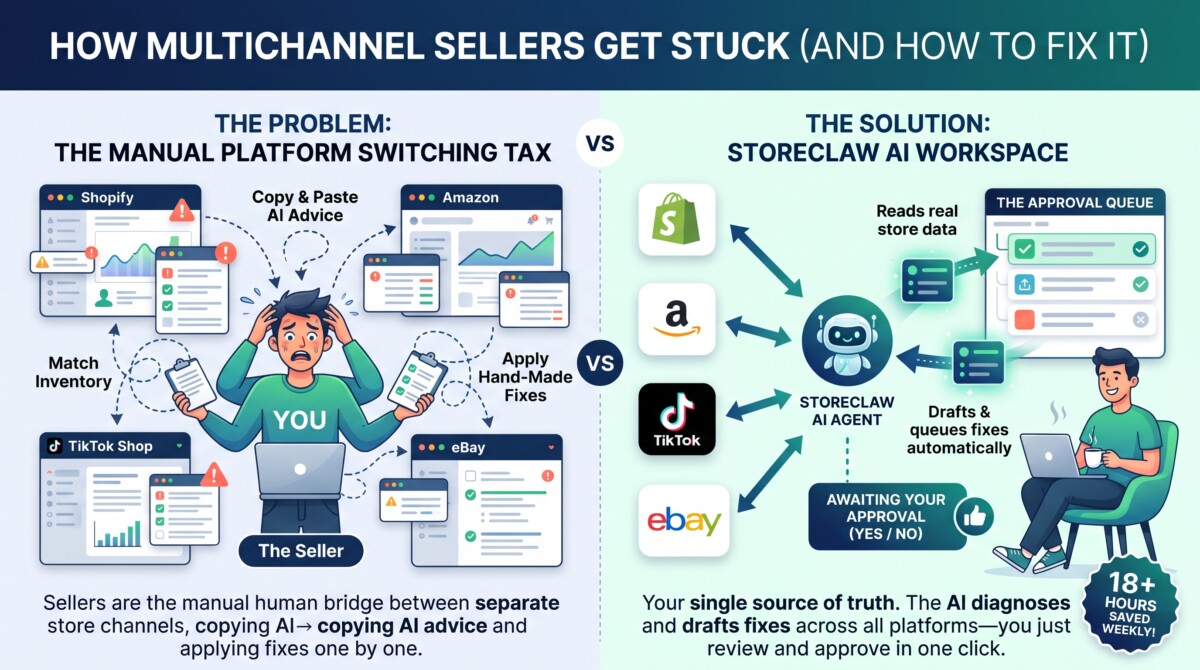
StoreClaw is an AI agent platform for online sellers that connects to their stores and ad accounts, diagnoses what needs attention, and executes the fix with the seller’s approval. It is not a chatbot you prompt from scratch. It opens to the current state of your store and proposes the next action.
The product launched on May 20, 2026 and was named #1 Product of the Day on Product Hunt right after. It comes from Caelith Inc., which was called Genstore Inc. until June 2026 and also runs the Genstore AI store builder and the creator tool Fypro. Genstore raised a $10 million seed round in September 2025.
The early usage signals point the right way. In the notes Caelith shared with me ahead of our recording, the company reported a 58.3% cumulative monthly renewal rate and a 22.3% upgrade rate across StoreClaw’s first four months. Those are company figures, but renewal is the number I watch with any new tool, because it shows whether sellers keep using it once the novelty wears off.
On the StoreClaw site, the supported channels include Shopify, Amazon, TikTok Shop, eBay, WooCommerce and Wix, plus social accounts for content publishing. The work it takes on falls into a handful of areas: product research and competitor tracking, listing optimization, SEO and AI search visibility, image and video creation, ad monitoring, store analytics, social and email content, and store design.
Pricing is credit based and, as of November 2026, starts free. StoreClaw’s pricing page lists a Free plan with 300 credits on signup and 50 daily refresh credits, Pro at $19.90 a month with 6,000 monthly credits, Max at $39.90 a month with 12,000 credits, Ultra at $199.90 a month with 60,000 credits, and custom Team plans with shared workspaces and role permissions. Paid plans get 100 daily refresh credits, the Free plan needs no credit card, and annual billing is advertised at 20% off. For a store that already pays for three or four point tools, the Pro and Max tiers are low enough to test alongside them rather than instead of them.
The single strongest thing StoreClaw does is start every task from your real store data and finish it as a change in your store, instead of handing you a to do list. You connect Shopify, a marketplace and your ad accounts once, and the agent works from orders, listings, inventory, conversion and ad spend from then on, so you stop re-explaining your business every session.
On a Shopify store, that shows up in four workflows StoreClaw describes on its Shopify solution page. It audits indexing, page speed, titles, meta descriptions, internal links and structured data, ranks the fixes by expected impact, and updates the pages once you approve. It generates homepage, collection, product and campaign pages from your brand style, previews them on desktop and mobile, and publishes to Shopify after sign off. It drafts welcome, nurture and win back email sequences from your actual products and offers. And it runs scheduled reviews of conversion rate, average order value and checkout drop off, so each review builds on the last.
The approval step is what makes this usable for a small team. StoreClaw proposes the change, shows you what it will do, and waits. Nothing touching the live store goes out without a person saying yes, and key actions are logged automatically. Anthony DelPizzo, VP of Marketing at Triple Whale, described why that matters on episode 497: “Automation can be scary. And especially when there’s money involved, we don’t expect every business to be gung ho immediately and want to sign on board.” An approval queue is the bridge between trying an agent and trusting one.
The clearest result StoreClaw shares comes from INCENZO, a three-person Shopify fragrance brand. According to StoreClaw, the team got back 18 hours a week of SEO work, saw organic traffic rise 142% and cut its cost to acquire a customer by 57%. Those are company reported figures from a single brand, not a benchmark. What I take from it is the shape of the win: a three-person team is exactly the size where 18 hours a week is most of a role.
What it requires: admin access to the store and channels you connect, and a person who checks the queue daily. An agent that proposes good fixes nobody approves saves nothing.
StoreClaw’s second strength is that it runs each channel by that channel’s rules instead of applying one playbook everywhere. An Amazon flow optimizes for search intent, a TikTok flow for the hook and creator fit, and a Shopify flow for retention and conversion, all from the same seat.
That design comes straight from Steven Zhou’s own selling history. He has run Amazon stores since 2013, TikTok Shop since 2023 and Shopify DTC since 2025, and his view is that multichannel selling rarely fails because there are too many platforms. In the notes he sent me before our recording, he wrote that the real problem is “one platform’s habits doing damage to every other channel you touch.” Amazon trains you to obsess over rankings, bids and conversion because the shopper already searched. TikTok has no searcher; you have to stop the scroll. Shopify is a third sport, where you pay for every visitor and the game shifts to retention and lifetime value.
I watched that pattern play out from the other side during my years as a Senior Merchant Success Manager at Shopify. Brands that came to Shopify from Amazon often judged their new store by marketplace metrics and pulled spend from the very things that were building repeat customers. A tool that keeps separate rules per channel is a practical guard against that habit.
For Amazon sellers specifically, StoreClaw goes deep. Its Amazon features cover listing generation and optimization (including content written for Amazon’s AI shopping assistant), keyword mining, search term harvesting and negation, ACOS monitoring and bid management, competitor monitoring, review analysis and multi-ASIN reports. Twinkle Star, an Amazon LED decor seller, cut new product launches from about a week to a day and a half and lifted conversion from 9.3% to 14.1%, according to StoreClaw. LuxClub, an Amazon home textiles seller, brought ad spend as a share of sales down from 35% to 22%, again per the company.
StoreClaw also pulls market data from sources like DataforSEO, SellerSprite and FastMoss into the workspace, so product research and competitor checks run without separate subscriptions. For a lean team, that is one less login and one less invoice.
StoreClaw’s third strength is always on monitoring that catches problems while you are away from the dashboard. It tracks competitor price changes, stockout risks, ad spend spikes, negative reviews and organic rank moves, then alerts you or queues a fix.
Progress and alert notifications can go to Slack, Discord and other team channels, so the agent shows up where your team already works instead of becoming one more dashboard to check every morning. Team plans add shared store profiles, shared project files, role based permissions that are revoked when someone leaves, and automatic action logs. Playbooks, brand rules and metrics are saved as reusable team assets, which matters the first time you onboard a new marketer or VA and want them working from the same rules as everyone else.
This is the part I would lean on hardest in BFCM week. The two most expensive things that happen to a small team over a holiday weekend are an ad set that keeps spending after it stops converting and a hero product that sells out without anyone noticing. StoreClaw’s homepage shares user reported examples of both: early warnings on ad faults and stockout risks caught ahead of time. Pair the monitoring with a person on the approval queue and you cover the two most expensive holiday weekend failures without someone watching dashboards all weekend.
One practical note before you let any agent make bulk changes: take a fresh backup of your store first. Fastlane’s guide to protecting your Shopify store before BFCM explains why a reviewed bulk edit should still be treated like a CSV import, with a snapshot taken before it runs.
StoreClaw fits sellers who already run a live store on at least two channels and have someone ready to work its approval queue every day; stores that have not launched yet should wait, which is the one group StoreClaw itself says it is not built for. The more channels and backends you juggle, the more time an agent that works across all of them gives back.
These revenue bands are my own read, not StoreClaw’s. If you are under about $250K and sell only on Shopify, start with the AI already inside your admin. Shopify Sidekick handles a lot of single store work at no extra cost, and StoreClaw earns its place once a second channel enters the picture. If you are between $250K and $5M on two or more channels, this is the sweet spot: enough volume that hours of saved work each week are real money (INCENZO’s 18 hours a week is the clearest example StoreClaw shares), and a team small enough that nobody owns SEO, listings and ad monitoring full time. Above $5M, StoreClaw’s Team plan with role permissions and approval workflows is the place to start, and it is worth asking how it fits alongside the tools your specialists already use.
Two things to hold onto as you evaluate it. First, the results quoted in this piece come from StoreClaw and its customers, not from Fastlane testing, so treat them as what is possible rather than what is typical. Second, the approval step is the point, not a hurdle. The time savings only appear when someone actually clears the queue.
Disclosure: Caelith paid for Steven Zhou’s guest appearance on the eCommerce Fastlane podcast, and this spotlight is part of that partnership. It does not change what I am telling you about who this fits.
If you sell on Shopify plus at least one marketplace, your next step this week is to connect your store to StoreClaw’s free plan and run one SEO and AI visibility audit on your top 20 product pages. The free signup credits are enough to see what it finds, and an audit only proposes changes, so nothing goes live until you approve it.
Start with the low risk, high repetition work: missing alt text, weak meta titles, thin product descriptions and listing compliance gaps. Those are the fixes most small teams know they should make and never get to. Leave anything that touches ad budgets or pricing until after BFCM, when you have a clean baseline and time to watch the results. That is the same logic Fastlane laid out in its look at how an AI assistant should stop before it changes prices: let the agent draft, keep the decision with a person.
If you are earlier, under $250K and on Shopify only, bookmark StoreClaw for the day you open a second channel and focus on the fundamentals until then. If you are a multi-store operator, book a demo of the Team plan and map your approval rules before you connect anything. And if you want the wider context on how sellers are moving from AI advice to connected stores, Fastlane’s earlier piece on why sellers are connecting stores instead of asking AI for advice covers StoreClaw’s back to school data.
StoreClaw is an AI agent platform that connects to your online store and sales channels, finds what needs fixing, and carries out the changes after you approve them. It works with Shopify, Amazon, TikTok Shop, eBay, WooCommerce and Wix, and covers SEO and AI search visibility, listing optimization, ad monitoring, product research, image and video creation, email and social content, and store analytics. It launched on May 20, 2026 and is made by Caelith Inc., formerly Genstore Inc. Unlike a general chatbot, it opens to your store’s current data, so its suggestions are based on your actual orders, listings, inventory and ad performance rather than a prompt you type from scratch.
StoreClaw starts free, and paid plans run from $19.90 to $199.90 a month as of November 2026. The Free plan includes 300 credits on signup and 50 daily refresh credits. Pro is $19.90 a month with 6,000 monthly credits, Max is $39.90 a month with 12,000 credits, and Ultra is $199.90 a month with 60,000 credits for heavy use. Team plans are priced on request and add shared workspaces, role permissions and approval workflows. Annual billing is advertised at 20% off. If you run out of credits, scheduled tasks pause until the next refresh, and you can buy add-on credits from billing settings.
Yes, StoreClaw works with Shopify and can start from an existing store without a rebuild. On Shopify it audits SEO and AI search visibility, ranks fixes by impact and updates pages after approval, generates homepage, collection, product and landing pages from your brand style, drafts email sequences from your products and offers, and runs scheduled reviews of conversion rate, average order value and checkout drop off. Its biggest advantage shows up when Shopify is one of several channels, because the same workspace also runs Amazon, TikTok Shop, eBay and WooCommerce with rules suited to each one.
No, StoreClaw asks for approval before any change that touches your live store. The agent diagnoses an issue, prepares the fix and waits for a person to approve it, and key actions are logged automatically. Team plans let you assign access and actions by role, and access is revoked when someone leaves. Even with approvals in place, take a fresh backup of your store before you approve any bulk edit, and start with low risk work such as alt text and meta titles before letting it near ad budgets or pricing.
StoreClaw is best for sellers with a live store on two or more channels and a small team that cannot cover SEO, listings, ads and content full time. That usually means Shopify-led brands that also sell on Amazon or TikTok Shop without a specialist for each channel, experienced Amazon sellers who want ad, keyword and listing work handled in one place, and operators managing several stores at once. StoreClaw says it is not built for sellers who have not launched a store yet. If you sell only on Shopify, the AI built into your Shopify admin may cover your needs until you add a second channel.