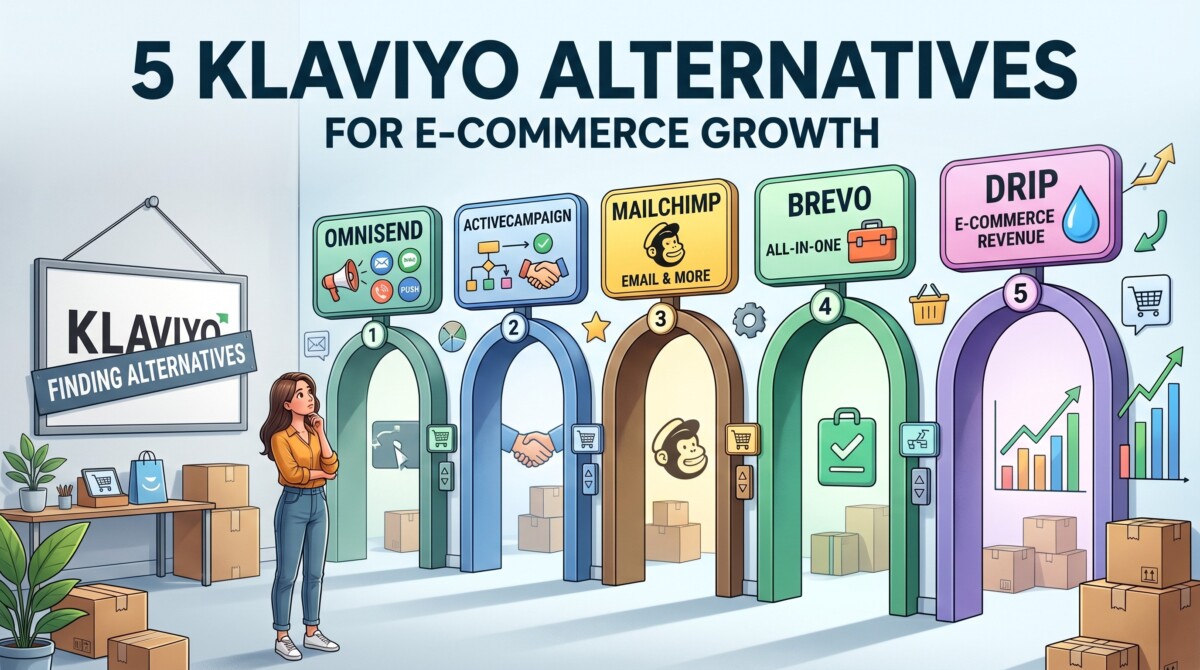
The ecommerce market is projected to reach $3.88 trillion in revenue in 2026. This growth creates huge opportunities for businesses ready to scale and find new audiences.
Scaling requires reliable marketing tools to automate communication, build loyalty, and drive consistent conversions. Many brands default to platforms like Klaviyo for email and SMS, but often end up paying for enterprise features they don’t yet need.
Growing businesses need a platform that balances functionality with real usability. Marketers need powerful tools that remain intuitive, as complicated interfaces only stall campaigns. The ideal platform lets you build complex automations, segment audiences, and track performance without excessive training.
1. Omnisend
Omnisend is a marketing automation platform built specifically for mid-size ecommerce brands, but they’ve got businesses of all sizes as their customers. If you’re looking for a powerful tool without a steep learning curve, Omnisend is a great choice.
The platform drives ROI by combining unified communication channels, advanced segmentation, and accessible AI tools, completely removing the technical friction of complex campaign setups.
Key features
- Predictive AI: Automatically builds intelligent segments, performs RFM analysis, forecasts customer lifetime value, and generates product recommendations.
- Generative AI: Uses built-in copywriting and Brand AI to maintain a consistent brand voice across all campaigns.
- Forms AI: Builds new signup forms in seconds and optimizes your existing ones using proven ecommerce conversion patterns.
- MCP integration: Uses the Model Context Protocol so your ChatGPT or Claude can talk directly to Omnisend, letting you build campaigns and check performance without switching tabs.
- Unified global SMS: Combines global email and SMS into a single workflow to keep your messaging perfectly coordinated.
Pros
- Delivers an impressive ROI of $79 for every $1 spent.
- Maintains a 4.8 average rating across a base of over 150,000 active customers.
- Includes a free 5-day migration service where their team rebuilds your existing workflows for you.
- Provides award-winning 24/7 customer support for all users (recognized five years running since 2022).
- Features an interface built specifically for the daily workflows of ecommerce brands.
- Offers comparable features to Klaviyo at a significantly lower price point, often reducing billing by up to 35%.
Cons
- Built exclusively for ecommerce, making it a poor fit for B2B or service-based businesses.
- Lacks a native CRM for sales pipeline management or manual lead scoring.
Pricing
- Free plan: Includes almost all core ecommerce features right out of the box.
- Standard plan: Starts at $16 per month.
- Pro plan: Starts at $59 per month.
2. ActiveCampaign
ActiveCampaign is a comprehensive marketing automation platform for businesses that need deep customization and granular control. By combining email marketing, automation, and a built-in CRM, it allows you to manage complex customer journeys from the first touchpoint to post-purchase follow-ups.
While it offers immense power, users often have to weigh its advanced capabilities against a steeper learning curve. The software excels at weaving different marketing channels and data points into a cohesive strategy, letting marketers track exactly how subscribers interact with their websites and campaigns.
Key features
- Visual automation builder: Creates multi-step customer journeys across various channels using a drag-and-drop canvas.
- Integrated CRM: Manages sales pipelines, scores leads, and tracks deals in the same interface as your marketing campaigns.
- Dynamic content: Personalizes email text and images based on specific contact data and past interactions.
- Site tracking: Monitors website visitor behavior to automatically trigger relevant follow-up actions and messaging.
- Event tracking: Records specific actions users take within your custom app or membership portal for highly precise targeting.
Pros
- Offers advanced automation logic for complex campaigns and branching workflows.
- Includes a built-in CRM to align sales and marketing efforts in one place.
- Delivers strong deliverability rates across all major email service providers.
- Provides extensive reporting on campaign performance, contact engagement, and revenue attribution.
- Integrates seamlessly with thousands of third-party apps and web services.
- Supports omnichannel marketing through SMS, email, and social media integrations.
Cons
- Requires a significant time investment and technical understanding to set up effectively.
- Features a higher price point that increases sharply as your contact list grows.
Pricing
- Free trial: Offers a 14-day free trial (no free-forever plan).
- Starter plan: Starts at $15 per month.
- Plus plan: Starts at $49 per month.
- Pro plan: Starts at $79 per month.
- Enterprise plan: Starts at $145 per month.
3. Mailchimp
Mailchimp is one of the most recognized names in email marketing. Instead of being just a simple newsletter tool, it’s now become a broad marketing platform that includes website building and social media management.
It’s a great entry point for businesses that want an easy-to-use platform, though fast-growing brands often eventually outgrow its core automation limits. With a strong focus on visual design and creative tools, it remains a highly reliable starting point for organizations building their first audience.
Key features
- Drag-and-drop editor: Builds responsive emails quickly using pre-made templates and customizable layout blocks.
- Customer journey builder: Maps out automated sequences based on user behavior and engagement triggers.
- Behavioral targeting: Sends custom messages tailored to how subscribers interact with your campaigns.
- Marketing CRM: Stores audience data and provides insights into contact preferences and demographics.
- Creative assistant: Automatically generates designs based on your imported brand assets and color palettes.
Pros
- Provides a highly intuitive, beginner-friendly interface that requires minimal onboarding.
- Offers a massive library of professionally designed templates for various industries.
- Integrates seamlessly with most major ecommerce platforms and third-party tools.
- Includes built-in tools for social media scheduling and digital ad management.
- Features strong audience demographics and analytics to help you make informed marketing decisions.
- Supports detailed multivariate testing to optimize campaigns and improve open rates.
Cons
- Charges based on total contacts, meaning you pay for unsubscribed or inactive contacts, not just active subscribers.
- Lacks the advanced automation and deep segmentation found in dedicated ecommerce platforms.
Pricing
- Free plan: Accommodates up to 500 contacts and includes basic email templates.
- Essentials plan: Starts at $13 per month.
- Standard plan: Starts at $20 per month.
- Premium plan: Starts at $350 per month.
4. Brevo
Brevo (formerly Sendinblue) provides a scalable platform for email, SMS, and chat marketing. Because it bases pricing on monthly email volume rather than total contacts, it is an incredibly cost-effective choice for businesses with large mailing lists.
You’ll appreciate its straightforward approach to handling both transactional and promotional messaging in one place. By prioritizing reliable delivery infrastructure, Brevo serves as a strong foundation for businesses that need high-volume, multi-channel messaging without an overly complex setup.
Key features
- Transactional email routing: Ensures the reliable delivery of critical messages like order confirmations and password resets.
- Shared inbox functionality: Centralizes customer communications from email, live chat, and social media into a single view.
- Send time optimization: Delivers emails at the moment each specific contact is statistically most likely to open them.
- WhatsApp marketing campaigns: Broadcasts promotional messages and alerts through the WhatsApp Business API.
- Landing page builder: Creates custom, responsive pages to capture new leads and grow your audience.
Pros
- Bases pricing on email volume rather than contact count, making it easy to store large lists without penalty.
- Excels at delivering transactional emails alongside traditional promotional campaigns.
- Includes a free, built-in CRM to track customer interactions and notes.
- Offers a live chat widget for immediate website visitor engagement.
- Provides a generous free tier that includes 300 daily email sends.
- Supports extensive API capabilities for developers building custom integrations.
Cons
- Features a visual email editor that feels less polished and intuitive than its competitors.
- Offers fewer native third-party integrations compared to other major marketing platforms.
Pricing
- Free plan: Includes 300 emails per day and storage for up to 100,000 contacts.
- Starter plan: Starts at $9 per month.
- Standard plan: Starts at $18 per month.
- Professional plan: Starts at $499 per month.
5. Drip
Drip caters to ecommerce brands looking to scale revenue through targeted email and SMS campaigns. It focuses on deep data collection and advanced behavioral segmentation so your campaigns are personalized from A to Z.
It handles both transactional and promotional messaging in one place. Brevo has a strong delivery infrastructure, which makes it a great choice for businesses that need high-volume, multi-channel messaging without an overly complex setup.
Key features
- Point-and-click segmentation: Dynamically groups customers based on their browsing habits and purchase history.
- Pre-built ecommerce playbooks: Quickly installs automated campaigns like abandoned cart reminders and welcome series.
- Detailed revenue attribution: Tracks exactly which marketing campaigns and workflows generate sales.
- Cross-channel automation workflows: Combines email and SMS touchpoints within a single visual builder.
- Liquid code templating: Customizes email content for each recipient using basic programming logic.
Pros
- Specializes in ecommerce workflows and revenue generation through personalized campaigns.
- Integrates seamlessly with major platforms like Shopify, WooCommerce, and BigCommerce.
- Offers granular audience segmentation based on observable user behavior.
- Features a clean, visual interface for building complex automations.
- Provides transparent reporting on the financial impact of your marketing.
- Includes a ready-to-use library of proven automation templates.
Cons
- Focuses exclusively on ecommerce, making it a poor fit for standard B2B use cases.
- Carries a higher starting price than many entry-level marketing tools.
Pricing
- Free trial: Offers a 14-day free trial (no free tier available).
- Starting plan: Starts at $39 per month for up to 2,500 active contacts.
- Scaling: Pricing scales linearly based on list size and email volume.
Conclusion
Choosing the right Klaviyo alternative comes down to matching a platform’s capabilities with your actual business model and technical expertise. You don’t need to choose the tool that offers the most features. That’s a recipe for overpaying and underutilizing.
To summarize your best options based on your primary use case:
- For ecommerce growth: Choose Omnisend for specialized, high-ROI retail tools without the steep learning curve, or Drip if you rely on highly granular behavioral tracking.
- For complex customer journeys: ActiveCampaign provides the integrated CRM and advanced branching logic required for B2B, service-based businesses, or long sales cycles.
- For high-volume sending: Brevo is the clear winner. Its volume-based pricing prevents costs from skyrocketing as your subscriber list grows.
- For beginners building a foundation: Mailchimp remains the most accessible starting point for small teams prioritizing design and simplicity.
The best marketing platform is the one that fits your business goals and resources. Prioritize the tool that removes technical friction and lets you launch revenue-driving campaigns quickly, allowing you to spend less time managing software and more time scaling your business.