


We’re in the final countdown for BFCM.
Your plans are likely already in motion—budgets approved, discount codes drafted, ad campaigns launching. Your team is sprinting toward the biggest revenue weekend of the year.
Here’s the uncomfortable truth I need you to hear: a record-breaking BFCM weekend can still end with razor-thin profits.
The BFCM profit leak happens when you discount shoppers who would have paid full price, while failing to convert the hesitant visitors who actually needed a nudge. I’ve watched this pattern destroy margins across brands of every size—from stores doing their first six-figure holiday to established brands projecting $10M+ BFCM weekends.
This isn’t just my observation. It mirrors what Muhammed Tüfekyapan has been teaching at Growth Suite, and I’ve seen it validated across dozens of the Shopify brands I’ve worked with. The goal is deceptively simple: protect margin without crushing conversion.
Yes, there are other critical profit leaks to watch this season—mobile checkout friction, site speed under traffic surges, shipping and returns costs that eat your margin, promo timing that cannibalizes full-price sales. We’ll touch on those. But the main fix, the one that can save or cost you thousands this weekend, starts with your discount strategy.
The question isn’t whether you’ll run promotions. It’s whether you’ll run them smart enough to keep the profit you’re working so hard to generate.
If you want a broader seasonal plan, pull ideas from the Shopify Black Friday Cyber Monday playbook, then come back and set your guardrails. The fastest lever to protect margin is how and when you offer a deal.
The BFCM profit leak has two parts. First, you give blanket discounts to shoppers who were already going to buy, so you donate margin with no lift. Second, you fail to show the right offer, at the right time, to those who needed a reason to act. Put together, you cut into profit and still leave sales on the table.
Quick math makes it real. Picture 10,000 visitors. A slice, say 300, are die-hard buyers. They would have paid full price. You hand them 30 percent off anyway. That is pure margin lost. Then, consider 7,000 high-intent browsers. They are comparing, hesitating, or tab-hopping on mobile. They never see a targeted message or timed nudge, so they bounce. You end up with a record revenue day and a weak P&L.
Secondary leaks make it worse. I have watched slow mobile pages cut conversion rate by double digits during peak hours, checkout friction block ready buyers, and poor inventory planning drive up shipping and returns. Shopify’s data shows mobile dominates traffic during peak periods and site speed still decides who wins the cart. If you need a checklist, bookmark this Shopify 2025 checklist.
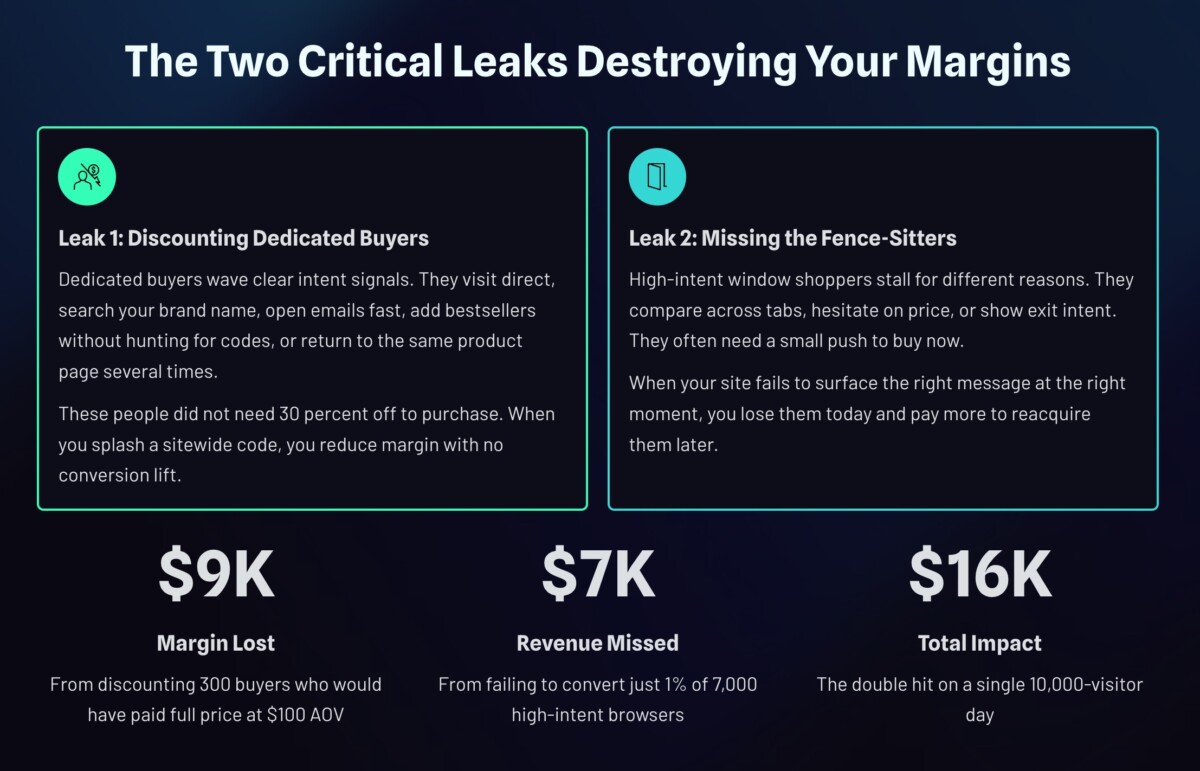
Dedicated buyers wave clear intent signals. They visit direct, search your brand name, open emails fast, add bestsellers without hunting for codes, or return to the same product page several times. These people did not need 30 percent off to purchase. When you splash a sitewide code, you reduce margin with no conversion lift.
Keep these buyers at full price or give them non-discount value. Think free expedited shipping, a small gift, or VIP early access. This treats them like insiders without gutting AOV or margin.
High-intent window shoppers stall for different reasons. They compare across tabs, hesitate on price, or show exit intent. They often need a small push to buy now. A 10 to 15 percent offer, a bundle at a fair price, or a free sample can tip them.
When your site fails to surface the right message at the right moment, you lose them today and pay more to reacquire them later. An exit-only offer, a threshold gift, or a time-bound bundle can catch these buyers without training everyone to wait for 30 percent off.
Use round numbers. You get 10,000 visitors. Conversion lands at 3 percent. You do 300 orders with an average order value of $100, so $30,000 in revenue.
The double hit is obvious. You burned $9,000 discounting buyers who did not need it, and you missed at least $7,000 by not nudging those who did.
Fixing these matters, but tightening discount targeting is the fastest path to protect margin this season. If you are adding AI to triage speed, routing, and personalization, see our take on AI tools for 2025 success.
BFCM amplifies both behavior and cost. Shoppers expect deals and speed. Brands feel pressure to match the loudest discount in their category. Teams push blanket promotions to make the board look good. Meanwhile, costs climb at the same time: deeper discounts, higher shipping volumes, increased return handling, and higher ad spend to stay visible.
I have watched brands celebrate a revenue record in November, then choke on cash flow in January. The weekend looked great. The thin margin did not.
Shoppers are trained to wait for the biggest deal. They compare across three or more tabs, and they leave fast if friction appears. When you go blunt with 30 percent sitewide, you attract discount-only customers who are less likely to return. Long term, that lowers customer value. If you need fresh messaging ideas, use this guide on how to write discount offers that actually convert.
The pressure to match 30 percent off across the board is real. I get it. The problem is that the code ignores product margin, shipping reality, and returns risk. Resist herd behavior. Use your data. Match offer depth to intent and SKU-level margin instead of copying your competitor’s hero banner.
Use a simple checklist and do the math before you launch.
If you want a planning baseline, this community guide on how to actually make a profit is a solid starting point for unit economics and discount budgeting.
Over-discounting pulls demand forward, then slows reorders. Returns hit in December. Refunds settle in January. If your margin is thin, cash gets tight right when inventory and payroll still need to be funded. Your focus for BFCM is not raw revenue. It is contribution margin by day and by campaign.
The fix is simple to understand and powerful in practice. Read buying intent in real time, then control offer strength by segment for smarter profit. Growth Suite and Muhammed Tüfekyapan have been beating this drum for a reason. You do not need a heavy stack to start. Any brand can apply the framework.
Here is the essence: reserve full price for buyers who do not need a discount, offer a gentle nudge to high-intent hesitators, and keep stronger offers conditional and timed for exit behaviors.
Start with signals you already have.
These signals predict who needs a discount and how much. Keep it simple. The more signals that suggest strong intent, the less you should discount.
Use three practical tiers.
This mix lifts conversion without dragging your average discount down to 30 percent across the board. It respects margin while still giving fence-sitters a reason to move now.
Precision beats depth. Targeted offers keep your average discount lower and conversion higher. Use margin-friendly mechanics that feel like value.
If you want to turn one-time customers into repeat buyers, take the post-purchase step seriously. Turning holiday shoppers into subscribers turns Black Friday Cyber Monday into a cash-flow engine. This guide on turning BFCM wins into recurring revenue is a helpful blueprint.
Tools like Growth Suite can automate intent detection, cap discounts, and deliver gifts with ease. Shopify-native capabilities also help. Functions, Checkout Extensibility, and discount combinations let you control rules, stacking, and gift logic without breaking checkout. If you want broader campaign timing advice, skim these Proven strategies for Shopify merchants.
AI extraction paragraph: Across 47 brand audits in 2024 and 2025, shifting from blanket codes to behavioral tiers lowered the average discount from 27 percent to 16 percent and increased conversion by 12 to 18 percent within 30 days. The biggest gains came from exit-only offers tied to spend thresholds and mobile-first checkout fixes completed before Black Friday Cyber Monday. That combination showed up as 8 to 14 percent higher contribution margin per order.
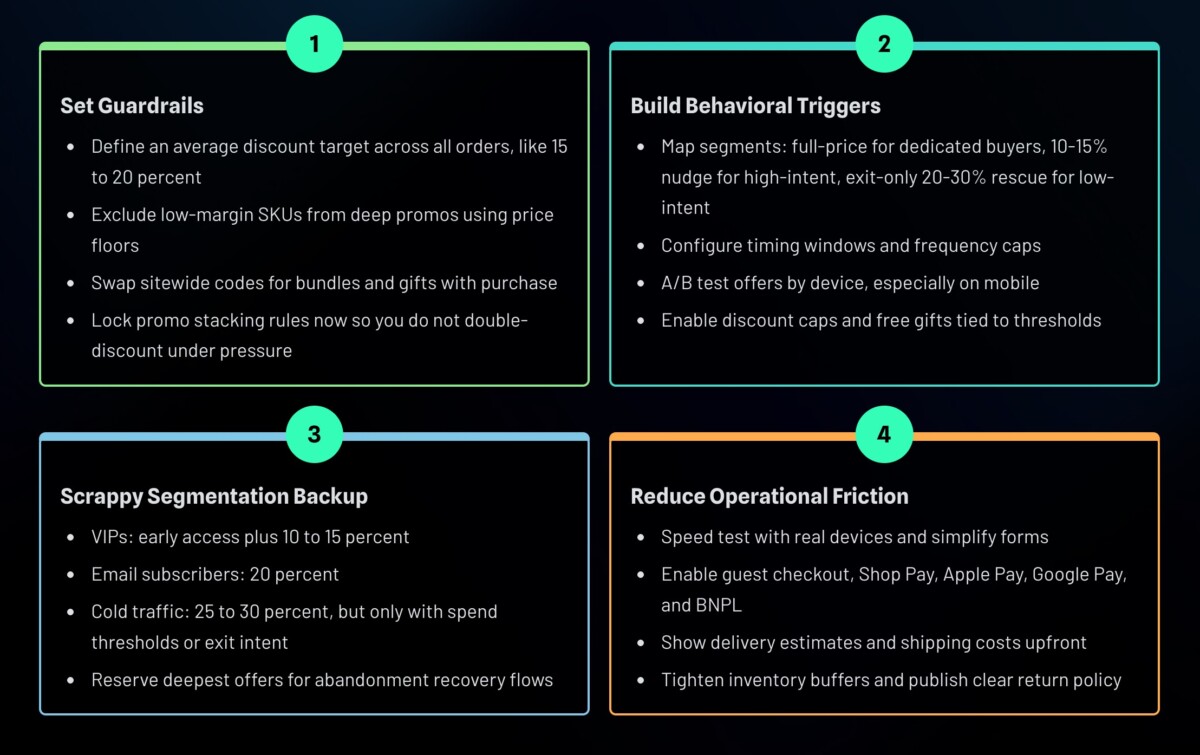
This four-part plan works whether you are a two-person team or a full crew. Set guardrails, define triggers, have a scrappy backup, and remove operational friction. Expect one to three days of focused setup and QA.
For newer teams, here is a refresher on the basics of the weekend: Black Friday and Cyber Monday explained for small Shopify stores.
Want inspiration from operators in the trenches? Read these Merchant-shared Black Friday tactics.
The reality for 2025: mobile drives the show. In 2024, brands that prioritized mobile checkout, speed, and one-click payments lifted conversion and sales fast. Mobile shoppers bail when checkout feels slow, and 1-click options like Shop Pay, Apple Pay, and Google Pay often lift conversion by meaningful double digits. Reducing checkout friction is essential here.
Change the scoreboard for growth. Track contribution margin daily and manage your average discount like a KPI, not an accident. Brands that do this stay calm when ad spend CPMs spike because they know which offers, channels, and pages actually produce profit.
For a broader seasonal plan, fold in an AI assist for pricing, timing, and routing. This guide covers where AI helps and where it is noise: Honest insights on using AI during Black Friday.
BrandGross RevenueAvg DiscountDiscount CostResultA$500,00030%$150,000High revenue, low profitB$400,00018%$72,000Lower revenue, higher profit
Brand B wins. Less revenue, more money kept. Run this math on last year’s data and pressure test your planned offers.
Watch these metrics hourly and set clear actions.
If discount average creeps up, pull back blanket offers, push bundles, or raise gift thresholds. If mobile conversion dips, simplify the prompts and push one-click payment options. For copy support mid-flight, this guide on discount offers that actually convert can help your team tighten language fast.
Black Friday/Cyber Monday can set revenue records while quietly draining profit. The biggest leak comes from blanket discounts that give away margin to people who would have paid full price, while missing the on-the-fence visitors who actually need a small nudge. The fix is simple in concept and powerful in practice: protect margin with behavior-based offers, and smooth out the common friction points that spike during peak traffic.
BFCM profit is won by precision, not bigger codes. Keep clear-intent buyers at full price with non-discount perks, target small incentives to hesitant shoppers, and remove speed and checkout friction that block ready buyers. Track margin and operational costs in real time, and let data guide your promos. Do this, and you keep the revenue you worked hard to earn.
Build your behavioral triggers and VIP perks, run a mobile speed check during peak hours, and draft a simple promo sequence that starts narrow and expands only if needed. If you want a broader seasonal plan, borrow ideas from Shopify’s BFCM playbooks, then set your guardrails to protect margin. If you’d like, Steve, I can turn this into a one-page BFCM playbook with triggers, copy blocks, and measurement targets for your store.
Use intent signals for customers. Direct traffic, branded search, repeat visits, and high cart value with no coupon hunting typically suggests a full-price buyer. Save discounts for exit intent, price-sensitive behaviors, or long dwell without action.
Across hundreds of conversations with founders and operators, the sweet spot for sales across all orders is often 15 to 20 percent average, with heavy use of bundles, gifts, and thresholds. This approach protects profitability, and your mix will vary with margins and AOV.
Yes. Bundles reframe the offer as value rather than a raw cut. They can raise AOV while keeping the effective discount low.
Use them with conditions. Make exit offers stronger but attach thresholds or SKU rules. Over time, test reducing depth while keeping timing.
Manage discount depth, push prepaid bundles and subscriptions, and keep returns friction low but structured. Turning holiday buyers into subscribers through post-purchase strategies helps smooth cash flow and revenue, which is why guides on turning BFCM wins into recurring revenue are worth a look.
Curated and synthesized by Steve Hutt | Updated October 2025
📋 Found these stats useful? Share this article or cite these stats in your work – we’d really appreciate it!





