
Being ranked and cited by AI are two different things. Backlinks earn your Shopify store rankings, but page structure determines whether AI Overviews and ChatGPT actually quote you. Most stores under $5M have done neither job on the pages that matter most: collections.
A page can rank third and never get quoted. A page ranking seventh can get pulled into AI answers constantly. The difference is not authority. It is whether there is anything on the page worth lifting.
I published a piece on why high-quality backlinks still decide Shopify organic visibility in the AI era. The short version: AI Overviews pull over 99 percent of their sources from the pages already ranking on page one, so the authority work never stopped mattering. It just stopped being the whole job.
Because here is the pattern I keep running into. A founder doing $1.5M shows me their rankings: position 4, position 6, position 3 across their core category terms. Then we check who Google’s AI Overview actually cites for those same queries, and it is two competitors and a Reddit thread. The store earned its way into the eligible pool and still gets passed over, week after week.
That is not an authority problem. That is a structure problem, and it is the second job most Shopify operators do not know exists. This piece is about that job: what AI systems actually look for when deciding which ranked page to quote, and how to rebuild your highest-value pages so the answer is yours.
Ranking gets your page into the pool AI draws from, but citation depends on whether your page contains a clear, self-contained answer an AI system can lift and attribute. Those are two separate tests, run by two different mechanisms, and passing the first one tells you almost nothing about the second.
Google’s ranking systems evaluate your page against hundreds of signals: authority, relevance, experience, freshness. AI answer systems do something narrower and more brutal. They scan the eligible pages for extractable chunks: direct statements that answer the question, stand alone without surrounding context, and can be attributed cleanly. If your page ranks fourth but buries its substance in feature bullets and conversion copy, the AI moves to the page ranking seventh that opens with a clean two sentence answer. Your authority got you considered. Your structure got you skipped.
The Shopify-specific version of this problem is acute because most store pages were never written to be quoted. Product pages open with a hook (“Meet your new favorite hoodie”). Collection pages carry 80 words of boilerplate, if that. Both are optimized for a human who is already halfway to buying, which is exactly the right call for conversion and exactly the wrong shape for extraction. Whether you are doing $50K months or $500K months, the fix is the same two layer frame: layer one is earning the ranking, which the backlinks piece covers, and layer two is being citable once you are there. This article is layer two.
Citable content opens every major section with a two to three sentence direct answer before any supporting detail, because that opening chunk is the unit AI systems extract and attribute. If an AI cannot lift your first two sentences and use them as a standalone answer, the rest of the page barely matters for citation purposes.
I went deep on this pattern in the answer-first strategy playbook, including before and after examples you can hand to your team, so I will not re-teach the whole framework here. What matters for this piece is how the pattern applies to the two page types Shopify stores get wrong most often.
For product pages, the first paragraph should function as a standalone definition, not a hook. The shape is simple: the product is a category, designed for a use case, with one key differentiator. “The Trailhead 40 is a 40 liter hiking backpack built for three season backpacking, with a suspended mesh back panel that keeps airflow between the pack and your spine.” That sentence is what an AI quotes when someone asks what to look for in a hiking pack. The emotional copy, the lifestyle photography, the social proof: all of it still belongs on the page, below the definition, doing the conversion job it was always doing.
For collection pages, the opening paragraph answers the question a buyer would actually ask an AI: what is this category, and what should I look for when choosing? A collection page for trail running shoes that opens with 100 to 150 words answering exactly that question becomes quotable in a way that a grid of products with a one line intro never will. The answer-first pattern is the same in both cases. The difference is the question each page type is structurally obligated to answer.
The schema that matters for Shopify stores in 2026 is Product and Organization markup, not the FAQ schema most GEO advice still recommends. Google retired FAQ rich results from Search entirely in May 2026, with Search Console reporting following in June and API support in August. If a guide you are reading still calls FAQ schema the highest-leverage play, it is running on a stale map.
Here is the honest current state. FAQPage remains a valid schema type and Google has said leaving the markup in place causes no harm. But the SERP feature it used to earn is gone, and Google’s own AI documentation says no special schema is required for AI Overviews, only that any structured data you use should match your visible content. The lesson is the one that was always true underneath: the visible question and answer content is what gets extracted. The markup was never doing that work. The content was. Keep writing structured Q and A sections on your collection pages and blog posts, because that visible shape is what AI systems quote. Treat the JSON-LD as a consistency signal, not a magic trick.
Where schema still pulls real weight is entity clarity. Product schema on every core SKU tells AI systems what you sell, at what price, with what availability and ratings, which matters more every month as shopping surfaces inside ChatGPT and AI Mode mature. Organization schema on your homepage establishes your brand as a named entity, which is what lets an AI refer to you by name instead of just a URL. Shopify’s modern themes handle baseline Product markup automatically, but verify it is actually firing with Google’s Rich Results Test rather than assuming, because app conflicts and theme customizations break it silently. Article schema on your blog content, with real author attribution, rounds out the set. That is the 2026 priority order: Product, Organization, Article. FAQ content stays. FAQ markup is optional.
Internal links are how the authority your backlinks earn actually reaches your collection pages, because editorial links almost never land there directly. Referring domains point at your blog posts, your homepage, and your brand mentions. Your revenue lives on collection and product pages. Internal linking is the plumbing between the two, and at most stores I look at, the plumbing was never installed.
The pattern that works is unglamorous. Every blog post in your library that covers a relevant topic should carry one contextual internal link in the body copy, with descriptive anchor text, pointing at the collection page it supports. Not a sidebar widget, not a related products module: a sentence in the prose where a reader genuinely benefits from the link. A post about choosing winter running gear links to the winter running collection at the moment the reader is primed to want it. That is the entire technique, applied consistently across a content library.
The mistake I see at almost every store between $500K and $2M is pointing everything at the homepage, which spreads equity thin across the one page that least needs it. The practical rule that fixes it: for every backlink you earn to a blog post, add or audit one internal link from that post to a priority collection page. If you are investing in the authority work covered in the domain authority framework for AI search, this is the step that determines whether that investment reaches the pages that pay for it. Run the link, then check it did not get stripped in your last theme update, because that happens more often than anyone admits.
Collection pages are your most commercially valuable pages and structurally the most hostile to AI citation, which makes them the highest-payoff fix in this entire piece. The typical Shopify collection page carries 50 to 150 words of copy, no question and answer content, no opening answer, and whatever schema the theme auto-generates. It is invisible to AI even when it ranks, and it ranks for the queries closest to money.
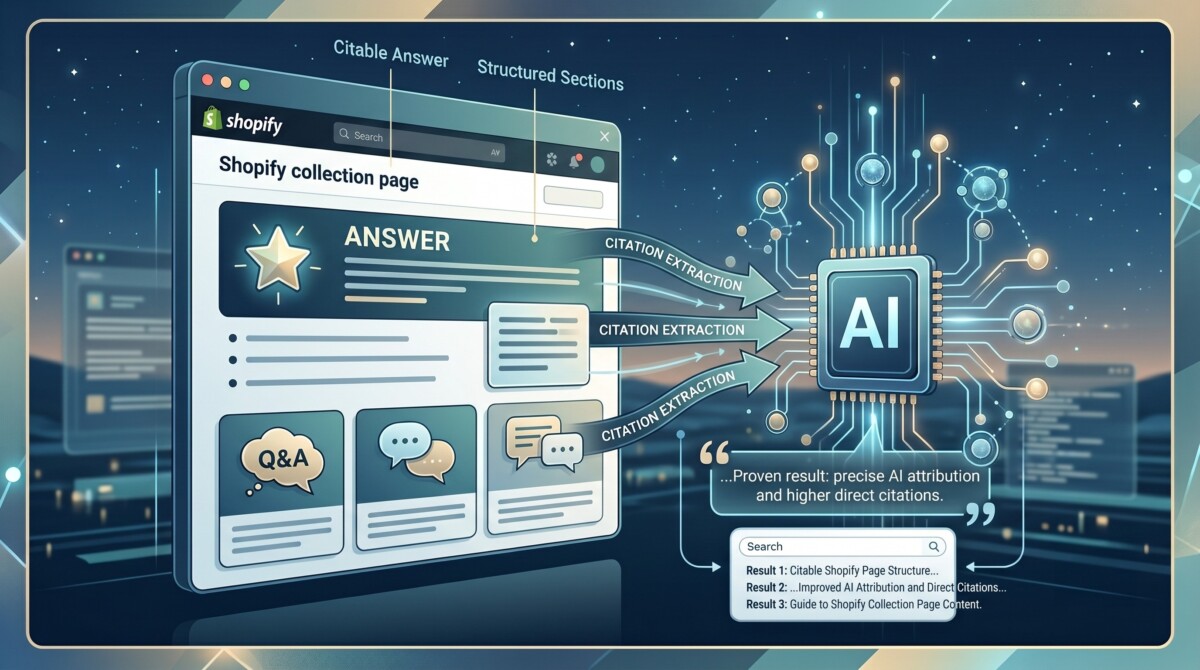
A citable collection page needs three things. First, an opening paragraph of 100 to 150 words that answers “what is this category and what should I look for” as a direct, extractable answer, per the pattern above. Second, a visible Q and A section of three to five questions a buyer would actually ask, written as they would type them into ChatGPT, with answer-first responses. Third, a short “how we choose what we carry” passage that adds editorial voice and a genuine experience signal, the thing that separates a merchant who knows the category from a dropshipper with a theme. None of this competes with the product grid. It sits above or below it and does a different job.
This is also where the two articles in this pair lock together. The referring domains you are building should ultimately benefit these pages, directly where you can earn it and through internal links everywhere else. But if the pages themselves contain nothing quotable, the authority you are paying for is doing half its job. The foundational work in our guide to driving organic traffic to an online store still applies underneath all of this; the citability layer goes on top of sound fundamentals, not instead of them.
Run this audit on your top five collection pages before you spend another dollar on links, because it tells you whether your authority investment has anywhere useful to land. The whole exercise takes an evening with your theme editor open and Google’s Rich Results Test in a second tab.
If three or more of these are missing on your top pages, that gap is your priority before you add another referring domain. The math is straightforward: a new backlink to an uncitable page buys you ranking position you already have, while two hours restructuring a collection page makes every existing and future link work harder. Fix the destination first.
The frame to carry out of this pair of articles is the two jobs. Backlinks are the entry ticket; page structure is what gets you quoted once you are in the room. The Shopify stores winning AI visibility in 2026 are not doing anything exotic, and they are certainly not buying whatever a four thousand dollar GEO audit is selling this quarter. They are doing both jobs, consistently, on the pages that matter. If you landed here first, start with the authority side in the companion piece on why backlinks still decide Shopify organic visibility, then come back and fix what those links point at.
Your store ranks but gets skipped by AI Overviews because ranking and citation are two separate tests, and your pages are likely failing the second one. AI systems select sources from the top organic results, then extract the pages that contain clear, self-contained answers they can lift and attribute. If your ranked pages open with conversion hooks, thin collection copy, or feature bullets instead of direct answers, the AI passes over them for a lower-ranked page with a quotable opening. The fix is structural, not authority-based: open your key pages with a two to three sentence direct answer, add visible question and answer content buyers would actually ask, and verify your Product and Organization schema is firing.
FAQ schema is no longer a priority for Shopify stores in 2026, but visible FAQ content absolutely is. Google retired FAQ rich results from Search in May 2026, removing the SERP feature the markup used to earn, and Google’s own AI guidance states no special schema is required for AI Overviews. The markup remains valid and causes no harm if you leave it in place, but it is now a consistency signal rather than a visibility lever. What AI systems actually extract is the visible question and answer content on the page: clear buyer questions with direct, self-contained answers. Keep writing that content on collection pages and blog posts. Spend your schema effort on Product and Organization markup instead, where entity clarity still pays.
A Shopify store needs three schema types for AI search in 2026, in this priority order: Product schema on every core SKU, Organization schema on the homepage, and Article schema on blog content. Product markup tells AI systems what you sell, at what price, with what availability and ratings, which feeds both AI Overviews and the shopping experiences inside ChatGPT. Organization markup establishes your brand as a named entity so AI can refer to you by name rather than a bare URL. Article markup with real author attribution signals your blog is a credible source. Shopify’s modern themes generate baseline Product markup automatically, but verify it in Google’s Rich Results Test, because theme customizations and app conflicts break it silently more often than operators realize.
Make a collection page citable by adding three elements most Shopify themes leave out: an opening answer, visible buyer Q and A, and an editorial voice. The opening is 100 to 150 words that directly answer “what is this category and what should I look for,” written so the first two sentences stand alone if extracted. The Q and A section covers three to five questions a buyer would type into ChatGPT, each answered directly in the first sentence. The editorial passage explains how you choose what you carry, which adds the experience signal that separates a real merchant from a templated storefront. None of this replaces the product grid or hurts conversion; it sits alongside the grid and does the citation job the grid was never built for.
Every relevant blog post in your library should carry at least one contextual internal link to the collection page it supports, which for most stores means each priority collection earns links from three to ten posts as the content library grows. The link belongs in the body copy with descriptive anchor text, placed where a reader genuinely benefits, not in a sidebar widget or footer module. A practical rule that keeps the system maintained: for every backlink you earn to a blog post, add or audit one internal link from that post to a priority collection page. This routing matters because editorial backlinks naturally land on blog content and homepages, while your revenue lives on collections. Internal links are how the authority reaches the pages that convert.





