

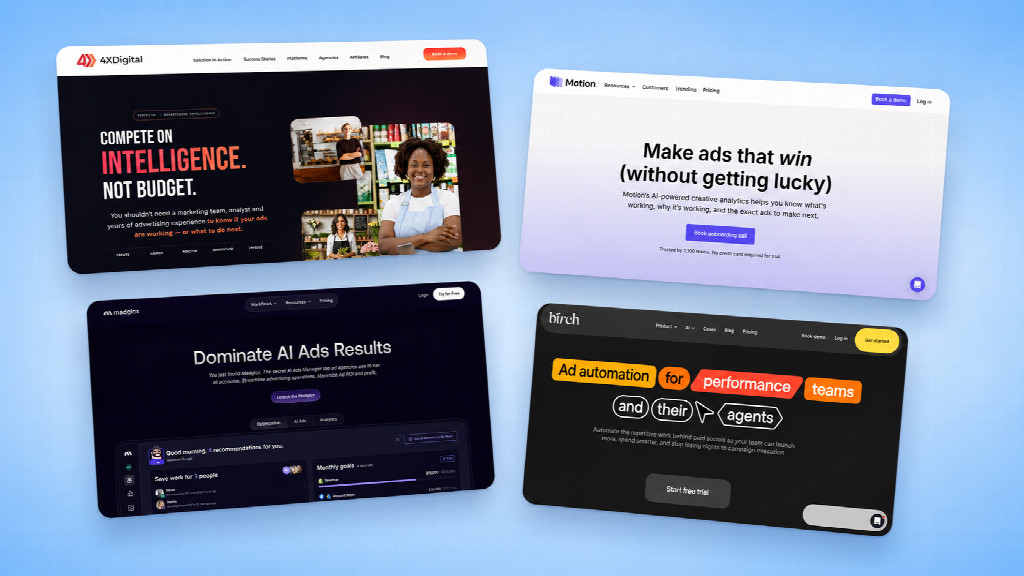
The best AdEspresso alternative depends on the decision your team needs help making. Meta Ads Manager remains the right starting point for hands-on advertisers, while 4XDigital, Madgicx, Motion, Birch, Smartly.io, Adzooma, and WASK serve different needs across intelligence, optimization, creative analysis, automation, and cross-channel management.
The value of modern advertising software is no longer that it can show you a metric. It is whether it can help you decide what deserves your next dollar and what should be left alone.
AdEspresso alternatives weren’t really something I was thinking about much a couple of years ago.
But the SMBs I speak with are starting to get pretty frustrated with the advertising software in their stacks.
The thing is, AdEspresso has always done a really good job of making Facebook advertising feel more manageable. The last thing anyone wants to do is spend their entire day inside Meta Ads Manager.
And the platform has always made it ridiculously easy to run split testing campaigns. I just feel as though the advertising market has moved on quite a bit since AdEspresso burst onto the scene.
SMBs want a lot more from the advertising software they use, and they don’t feel as though these tools are really meeting the moment in terms of capabilities.
From my conversations with SMBs, I found that they’re really looking for built-in advertising intelligence that will steer campaigns in the right direction and help them make good decisions.
Most of them aren’t familiar with the solutions available that offer exactly this.
So if that is you and you’re feeling a little bit stuck at this point, I want to introduce you to some of the best AdEspresso alternatives.
Let’s say you’re in a situation where your ROAS went down, but your CPA went up.
Yes, you can see what’s happened on a dashboard.
But what you really want to know is why it happened and whether you need to do anything about it.
And I think that’s the problem with a lot of the advertising software on the market.
That’s the bit that gets missed.
It’s the why.
So if you’re replacing AdEspresso because you want a simpler way to launch Meta campaigns, there are obviously quite a few options available to you.
But I don’t see that as the reason why someone at this point would move away from AdEspresso.
It’s more likely because they’re looking for solutions that can tell them what to do next.
You can stare at an advertising dashboard until you’re blue in the face.
But what most people now want is for an intelligent solution to say…
“Look, your performance moved. Here’s why. I’d leave it alone for now.”
Or something like, “This campaign isn’t working. Move the budget.”
I think this is where we’re at in terms of what people are expecting from the advertising software in their stack.
Not all of these AdEspresso alternatives are going to be the perfect fit for your business.
You’ll obviously need to book a few demos and do some research, digging into the features before making a decision.
But hopefully, what I can do here is save you a bit of time and point you in the right direction.
The pitch with 4XDigital is not simply, “Here’s an easier way to manage your ads.”
I think 4XDigital is attacking a slightly different problem from most of the other AdEspresso alternatives that I’m going to mention.
4XDigital is for you if you’re asking questions like: What happened? Why did it happen? Does it even matter? What should I be doing next?
This is really an advertising intelligence platform.
And what 4XDigital does is leverage advertising history as useful context, so you can begin to recognize wider patterns.
AI interprets those signals to help with your next big decision around a campaign.
4XDigital has named the two things doing the hard work here and I think you should understand them before you book a demo. These are:
Business Memory is everything your account has already learned.
So things like which creative won, how your customers behave, which promotions worked…
It’s building a clear sense of how your campaigns really performed so it can use this data to inform future campaigns!
“Is this normal?”
Collective Intelligence will answer those questions for you.
It’ll look at how comparable businesses are performing and what worked for them before putting your mind to rest.
So if your CPA jumps up by 20% over a week, Business Memory plus Collective Intelligence plus AI will tell you why.
They call this Advertising Intelligence.
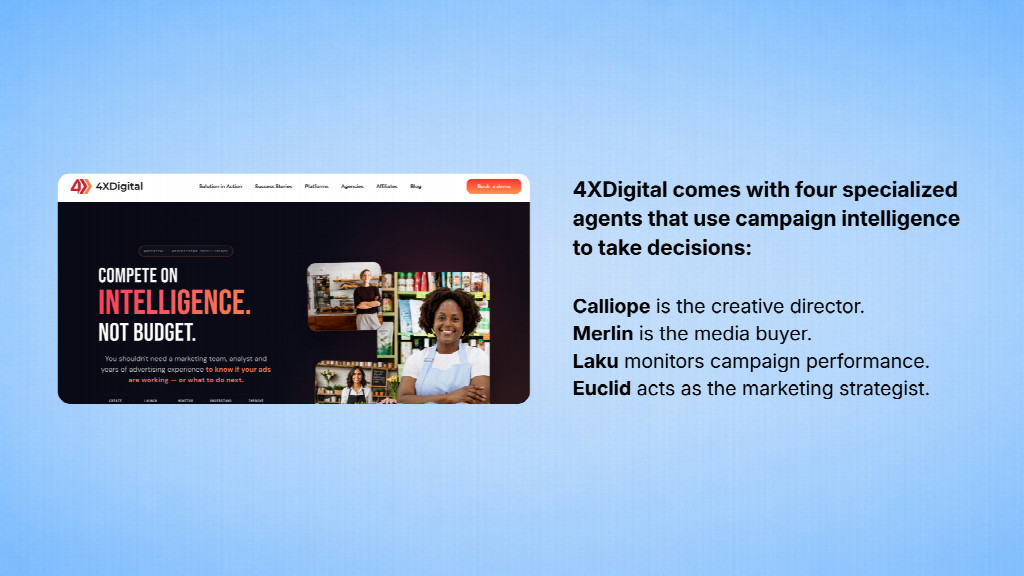
4XDigital comes with four specialized agents that use campaign intelligence to make decisions:
If we think about a small business owner opening up their advertising account and seeing that ROAS has suddenly dropped…
They will obviously feel a big temptation to start changing things immediately and begin playing around with all of their ad settings.
But this can cause more confusion because the number itself doesn’t tell them what caused the movement.
The four AI agents will create, launch, monitor, understand, and improve campaigns, which is a much more interesting proposition to an SMB than adding another reporting dashboard to their stack.
I’ve found some of their case studies for you.
Two of them stood out because I think they’re relevant to you.
The first one is BR Collaborative. This is a premium outerwear brand made in New York.
With their campaign, they started from nothing and therefore didn’t have any conversion history or pixel data.
So there was literally nothing for a platform to learn from.
4XDigital helped them lean on patterns from comparable brands until the account built up a history of its own.
And then, over the next three months, they hit 27X ROAS, AOV was up 24.6%, CPC was down 22.9%, and they achieved a 5.2% CTR.
The second case study I’d like to point out is Lavien, a Korean skincare brand launching in the US.
Very similar problem…
They had little to no brand recognition in the market and minimal organic traffic.
This means Lavien didn’t have any US purchase data to work from.
Using 4XDigital, they ran…
In the first 30 days, Google conversions went from around 1 to 13+, Meta purchases on the dedicated sales ad set went from 5 to 19, and cost per conversion on Google dropped from $150.92 to $84.04.
The overall ROAS sat at 2.5X+.
That’s not 25x or anything crazy like that. I’d be suspicious of anyone trying to present those to you as the same kind of result, but that’s sort of the point here.
Lavien is really a cold-start brand that managed to get profitable in a brand new market in 30 days.
I just like that these aren’t enormous enterprise brands with teams of 30 sitting behind an account, which is why 4XDigital seems like a pretty compelling option for SMBs.
I’d say this one is worth booking a demo for at the very least.
I know some people have seen success bolting specialist tools onto Meta Ads Manager and keeping it as the single source of truth for their campaigns.
If the person running your Ads Manager account knows exactly why each piece of the stack is there, you’re not going to run into any problems.
It’s only if someone else were to take over at any point that things may get a little complicated.
That’s the bit I don’t love about this setup.
This is why I’m leaning towards platforms that remember what happened previously and use that information when the next decision has to be made.
Like 4XDigital, Motion isn’t really a straight AdEspresso replacement.
One of the things I’ve noticed recently is a lot of advertisers underestimating just how much of their performance issues go all the way back to creative.
And I see them fiddling around with targeting, budgets, campaign structures, landing pages, all of that.
And they have the right audience and a sensible budget…
But the actual cause of their problems is that people weren’t responding to the ad creative anymore.
So they end up wasting a ton of time pressing buttons and generating more confusion for themselves.
I wouldn’t tell someone to buy Motion simply because they’re looking for AdEspresso alternatives.
I just think Motion is interesting because it gives you more visibility into which creative is working and helps you to spot patterns showing up across your ads.
If you’re trying to bring Google, Meta, TikTok, historical performance, business context, and decision-making into one system, I’m not convinced Madgicx is necessarily the right tool for you.
However, Madgicx is probably one of the closest things here to what I’d consider a modern AdEspresso alternative.
The thing is, a lot of businesses don’t want to become expert media buyers.
There is no time for that.
What they are really in need of is software that can take some of the repetitive work off their plate and make running campaigns easier.
And that’s where Madgicx is very good.
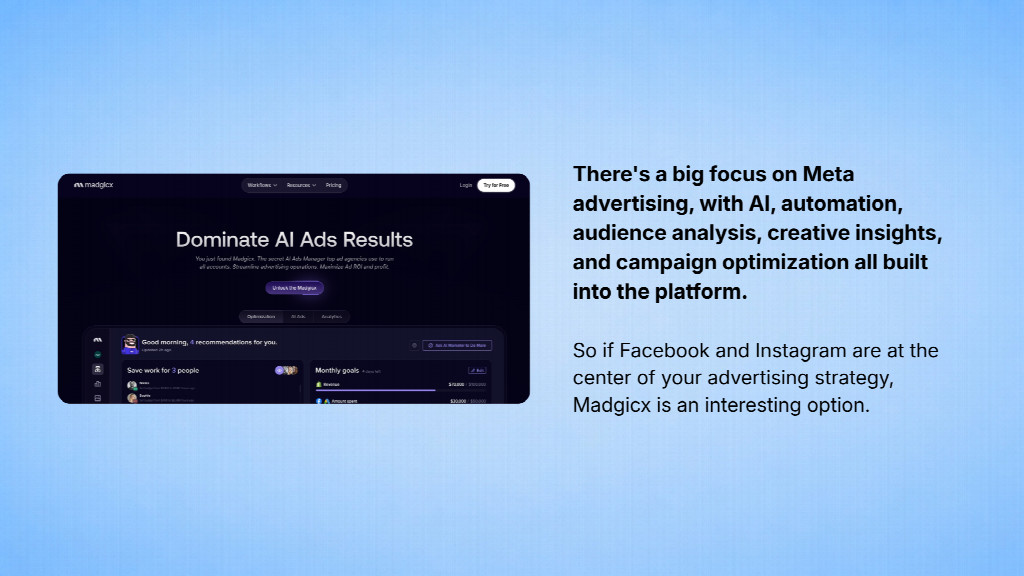
There’s a big focus on Meta advertising, with AI, automation, audience analysis, creative insights, and campaign optimization all built into the platform.
So if Facebook and Instagram are at the center of your advertising strategy, Madgicx is an interesting option.
I’d draw the line between the two there.
Bringing data together and connecting the decision-making across platforms are obviously two different jobs.
I don’t want to undersell Madgicx and it’s good for bringing data into one place.
But knowing why one platform is pulling ahead (Meta is working and Google isn’t) is only solvable through intelligence.
4XDigital’s own framing is “Data tells you what happened. Intelligence tells you what to do next.”
One is consolidating and the other is interpreting.
Having looked at both, I think there’s a pretty fair description of the gap.
The main appeal of Birch is automation.
And that’s also why I wouldn’t put Birch near the top for a complete beginner.
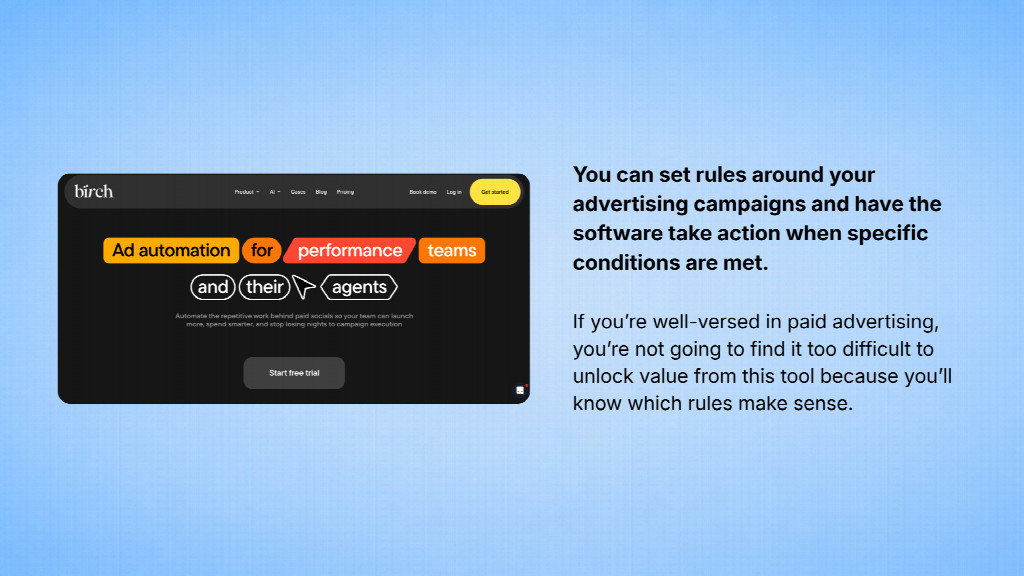
You can set rules around your advertising campaigns and have the software take action when specific conditions are met.
If you’re already well-versed in paid advertising, you’re not going to find it too difficult to unlock value from this tool because you’ll know which rules make sense.
Birch used to be known as Revealbot, which might be a name that you recognize.
“Has CPA gone above this?”
“Has ROAS fallen below that?”
“Should this campaign be paused?”
You can automate a lot of that.
If you don’t really understand why you’re making the changes, automating them faster isn’t going to fix the underlying problem.
It’s a good AdEspresso alternative for an experienced advertiser who wants more automation.
Okay, I still have a little more to say about Meta Ads Manager, because if you’re running Facebook and Instagram advertising, it’s the obvious place to start.
And the funny thing is, you may not need an AdEspresso alternative at all.
From my own experience, split testing has become a lot easier inside Ads Manager as they’ve improved the UI over time.
I’m not split testing dozens and dozens of creative variations, but for the campaigns I’ve run, setting up a few straightforward split tests has certainly become much less painful.
I do get the frustration, though.
I’ve spoken to business owners who would genuinely rather spend an hour doing almost anything else than work their way through Ads Manager.
And I think that’s the problem. Meta Ads Manager can just feel like a lot even when you’re trying to do very little.
Running a relatively simple campaign like me, you’re still having to work your way through settings, reports, audiences, campaign options, recommendations, and a whole load of terminology that can make things feel more complicated than they really need to be.
So while Meta has made some parts of the experience considerably better, there’s still a very good reason why simpler advertising platforms exist.
It’s the best option for someone who wants to do everything themselves.
But for deciding what to do next, 4XDigital and other platforms will offer more profound insights.
I see a lot of SMBs looking at enterprise advertising platforms and they’re completely amazed by all the features that could potentially be at their fingertips.
They think they’re getting more for their money, but the problem is, six weeks down the line, they realize that they haven’t even used half of those features.
Smartly is where things get serious and this is where I’d probably lose a lot of small business owners.
It’s built for larger advertising operations.
For a company spending $3,000 or $5,000 a month, I think there are much simpler options than Smartly.
It’s doing creative, media, optimization, reporting, and a lot more across multiple channels.
So yes, it’s a super powerful platform.
For a big brand with a serious budget, Smartly makes a lot of sense.
I don’t think it’s the first AdEspresso alternative I’d recommend to most SMBs.
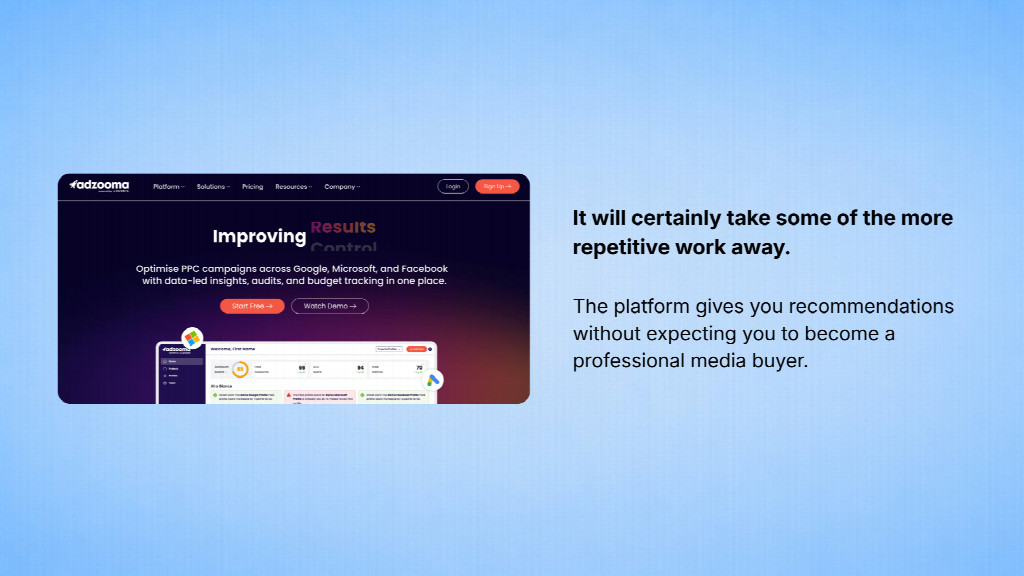
Once your accounts start getting more complicated, I’d look elsewhere, but Adzooma is one that makes sense for smaller advertisers.
It will certainly take some of the more repetitive work away.
The platform gives you recommendations without expecting you to become a professional media buyer.
If you want some assistance around campaign management, I’d probably recommend Adzooma.
It’s going to point you in the right direction, but may still leave you wondering what all the numbers mean.
If you don’t want to be jumping around between different platforms, WASK is one of the more straightforward options.
It brings your advertising accounts into one place and gives you a simpler way to manage your campaigns. And for some advertisers, that may be exactly what they’re looking for.
But the question I keep coming back to is: what happens when performance changes?
Does the platform help me understand what happened? And, more importantly, does it help me work out what I should do next?
WASK will give you that central management layer. It can make it easier to keep track of your advertising without constantly jumping between different platforms.
But you may not get the depth of insight you need to understand why a campaign has moved or what action you should take as a result.
That’s why I’d think of WASK more as a management layer than an advertising intelligence platform.
From what I understand, it doesn’t have embedded advertising intelligence in quite the same way as something like 4XDigital, with its four AI agents designed to interpret what’s happening across your advertising and help execute the next decision.
A 4XDigital case study I keep coming back to is the one about the pediatric practice with a fixed $10K advertising budget.
The practice needed to decide which audience, creative, channel, timing, or offer deserved the next dollar.
I mean, sure, a dashboard could show CPL moving from $32 to $57, but it’s not going to tell the practitioner why that’s happening.
4XDigital essentially delivered six things at once:
And then each agent took a piece and worked its magic…
The last thing a practice wants to do is burn $2,000 of their $10,000 budget to discover that the creative isn’t resonating.
A dashboard doesn’t tell the business owner whether to increase the budget, change the audience, refresh the creative, or simply wait and not touch a single thing.
This is why I like it when reporting answers the inevitable questions that come after the numbers.
A lot of these platforms raise more questions than they answer and in those situations, it’s not immediately obvious where you turn next.
I think the reality is, once you’ve got on a few demo calls with some of the people that I’ve listed above, you will know what’s a good fit for your team.
You really need to see these tools in action.
It’s not enough to read an article or scan through a landing page and come to a decision.
If you’re comfortable running everything yourself, I would honestly just start with Meta Ads Manager.
But if you’ve already been using AdEspresso, this suggests to me that you’re already spending quite a bit on Meta Ads and could benefit from refining the stack.
Let’s say you do end up taking one of the tools that I’ve mentioned above for a test drive.
I want you to start with one question you’ve been struggling with.
Maybe it’s, “Why has my CPA gone up?”
And then I want you to see how that platform handles it.
Because an intelligent platform will provide you with an answer to that question.
Your campaigns are already producing signals and an intelligent platform will tell you what those mean.
Don’t spend another week or so comparing feature lists.
Get some demos booked and see what questions these platforms can answer about your campaigns.
The best AdEspresso alternative for a small business depends on whether the main need is simpler campaign management, creative analysis, automation, or advertising intelligence. Meta Ads Manager is often enough for hands-on operators running straightforward campaigns. Adzooma and WASK can suit smaller teams that want simpler management and recommendations. Madgicx is a stronger fit for Meta-focused optimization, while 4XDigital is designed for businesses that need help interpreting performance changes and deciding what to do next. Choose based on the team’s real bottleneck, not the biggest feature list.
Meta Ads Manager can be better than AdEspresso for split testing when your team is comfortable working directly inside Meta’s native campaign tools and only needs straightforward test setup. Meta has improved its campaign creation and testing workflows, making simple creative, audience, and offer tests more manageable than they were in earlier years. AdEspresso and other third-party platforms can still add value through workflow simplification, reporting, automation, or analysis. The better choice depends on whether you need help launching tests or need help interpreting the results and deciding what to test next.
Some AI advertising tools can help explain why ROAS or CPA changed by analyzing creative performance, audience response, spend patterns, channel activity, and historical context. However, the quality of that explanation varies by platform, account data quality, conversion tracking, and the number of relevant signals available. A basic reporting tool may show that ROAS declined or CPA increased, while an advertising intelligence platform aims to identify likely causes and recommend an action. Treat every recommendation as decision support, not a guarantee. The advertiser should still review the evidence, validate tracking, and consider offer and landing-page factors.
Birch is usually a better AdEspresso alternative for experienced advertisers than for complete beginners because its core value is rule-based campaign automation. The platform can execute actions when conditions such as CPA, ROAS, spend, or delivery thresholds are met. That is valuable when the operator understands why the rule exists and when exceptions apply. Beginners risk automating poor decisions faster if they do not understand the relationship between the metric and the campaign action. Newer advertisers should start with clean account structure, reliable tracking, sensible creative testing, and a simple decision process before relying heavily on automation rules.
You should compare advertising platforms during a demo by bringing one unresolved question from a live campaign and asking every vendor to show how its product reaches an answer. For example, ask why CPA rose, why a creative stopped converting, or whether budget should move between Meta and Google. Evaluate the required setup, connected channels, depth of explanation, evidence behind recommendations, available automation controls, human review options, onboarding effort, and total cost. Avoid making a decision from a generic tour. The right platform should make a recurring decision easier for your specific team and budget.




