Free every Thursday · 59,694 Readers
Fastlane Insider Newsletter: What's working for Shopify in the AI era?
Free every Thursday · 59,694 Readers
Fastlane Insider Newsletter: What's working for Shopify in the AI era?

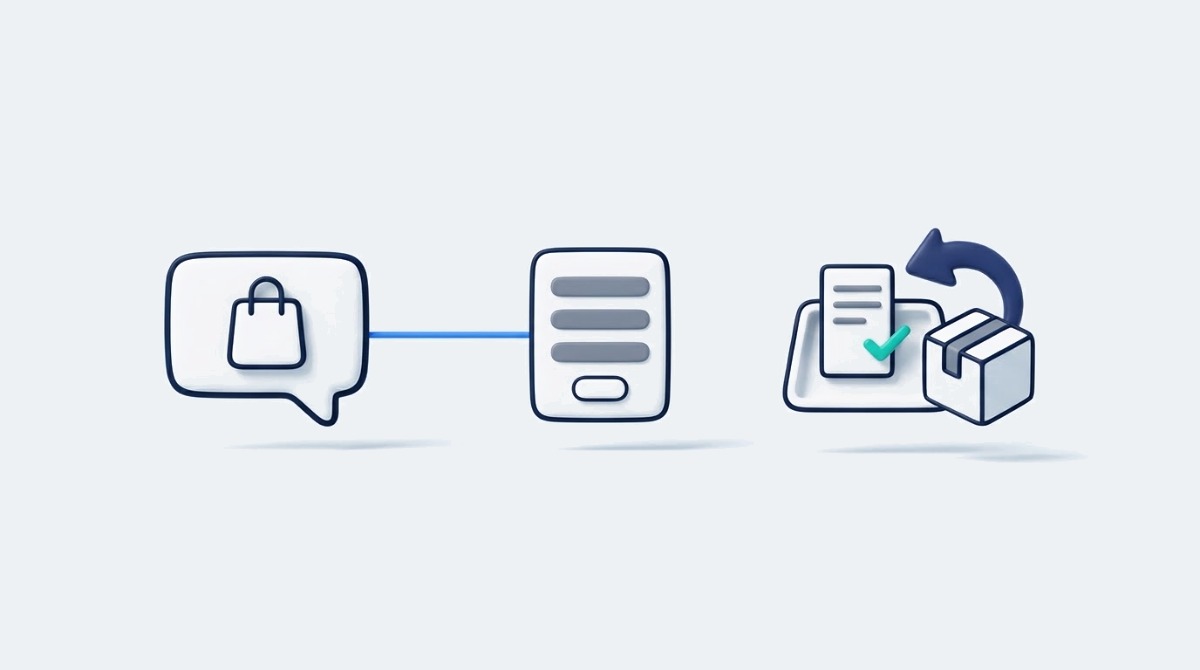
When an AI agent buys through Shopify’s direct checkout, the money still settles through your payment setup, the refund is still yours, and in most cases so is the chargeback. The agent changed where the shopper pressed Pay. It did not change whose order it is.
Now, picture a shopper in Google’s AI Mode who asks for a pour over coffee kit under $60, taps Buy on your product, pays with a card and closes the tab. Your product page never loaded. A week later the order shows up in your admin as a refund request, and a month after that, maybe as a chargeback.
Who handles that? You do. That surprises a lot of merchants I talk with, because “agentic payments” sounds like something new that someone else runs. For a Shopify store it mostly is not. The processor and the fees are the ones you already have, though the payment methods and wallets a shopper sees can differ inside each channel. What changes most is the checkout screen, and a lot of what you built into your own checkout does not come along. This guide covers the transaction itself. For whether agentic commerce matters to your store at all, and the strategic call on Google’s native checkout, start with our agentic commerce guide for Shopify.
An AI agent reaches a Shopify checkout in one of three ways covered here: it sends the shopper to your own checkout, it completes a Shopify-powered direct checkout inside the AI channel, or it fills in your real checkout from inside the shopper’s browser. Each path gives you different controls.
Shopify’s agentic storefronts help page describes ChatGPT as a discovery channel where shoppers finish on your online store checkout, and Google AI Mode and Gemini, Microsoft Copilot and Meta’s AI shopping surfaces, where available, as channels with direct checkout. The countries differ: Google’s direct checkout needs you to sell to the US, Canada or Australia and is still rolling out gradually, Copilot’s displays only to US shoppers, and Meta’s covers 11 countries, as of November 2026. All three are on by default for eligible stores, except stores on Shopify’s separate Agentic plan, where direct checkout starts off.
The third path is newer. On September 28, 2026, Shopify’s developer changelog announced WebMCP support for checkout, which lets an agent running in the shopper’s own browser read and update your checkout and submit the order once the shopper confirms. That is your normal checkout with a software assistant at the keyboard, and Shopify says it needs no merchant configuration. The plumbing behind all of this, from the Universal Commerce Protocol to card network agent tokens, lives in our Agent Protocols coverage.
You are the seller of record on agent orders placed through Shopify’s AI channels, so refunds, returns, customer service and payment fees stay yours, and so do your tax obligations unless Shopify or another party collects and remits a particular tax. Shopify’s Agentic Storefronts Supplemental Terms, last updated October 6, 2026, say “You remain the seller of record,” and the Meta help page spells out that you manage fulfillment, returns and customer service for those orders.
Google treats the same fact as a requirement. Its Merchant Center guide for UCP checkout says your return policy must be defined in Merchant Center because it is a merchant of record requirement and appears on the checkout screen. Shopify’s eligibility list for every AI channel includes completed Terms of service, Privacy policy and Return and refund policy pages. If those pages are thin, the shopper sees a thin policy at checkout, and you live with it when the refund request arrives.
On fees, the Google, Copilot and Meta help pages each say there are no fees for selling in their direct checkout and you pay only standard payment processing fees, as of November 2026. Keep an eye on that line. The terms let Shopify charge a per channel fee set out in your admin and refund that fee on cancelled or refunded orders. If you use Shopify Payments, its transaction fee is not refunded either way; if you use another payment provider, check that provider’s refund fee policy. The terms also say your supported payment methods, gateways or digital wallets may not be the same inside a channel, and they give Shopify the right, not the obligation, to collect and remit tax on these sales. That is worth a note to whoever does your books, and our guide to ecommerce accounting for Shopify covers reconciling payouts by channel. (Disclosure: I am in the Shopify Partner Program and earn affiliate commissions from Shopify.)
Direct checkout excludes several product types and delivery options outright, while checkout block support varies by channel: Google and Copilot may omit blocks, and Meta does not support them. Subscription-only products, bundles, customizable and B2B-only products cannot be bought, local delivery and pickup are not offered, shoppers cannot be required to sign in, and client side pixels do not fire.
Two different mechanisms are at work. Shopify Functions, which run on Shopify’s servers, do run in direct checkout, so your shipping rules, discount codes, automatic discounts and checkout validation functions still apply. Checkout blocks, the app extensions drawn on the checkout page, are another matter. The Google and Copilot help pages say only blocks that support blocking checkout, with that setting on, are eligible to load, and even those may not display. Upsells, loyalty and rewards, address autocomplete, consent collection, chat and trust badges are named as types that might not appear. A product that offers both a one time and a subscription option can still be bought, but only as a one time purchase.
Take one kind of store. This is a labelled composite built from patterns in merchant conversations, not a single real brand. Picture a coffee roaster doing about $1.4M a year on Shopify. Its flagship is a subscription-only blend, it sells a build your own sampler as a bundle, and it runs a checkout upsell for a grinder. In direct checkout, the flagship cannot be bought, the sampler cannot be bought, and the upsell may never show. What can be bought is the one time bags, with discount codes working.
My call for that store is to leave direct checkout on as a test, then compare the contribution, refund rate and support load of those one time orders, and how many later convert to a subscription, against orders from its own site over a couple of months. I would put a clearly labelled subscription invitation in the post-purchase emails, linking to the store’s normal subscription purchase flow, which is where our guide to winning the second order picks up. And I would reject any app whose only job is to duplicate the checkout Shopify already runs in these channels. Before cancelling an existing app, check whether it also handles product feeds, compliance or attribution the store still needs. I would switch direct checkout off for a channel if a field the business genuinely needs, such as a required delivery date, cannot be collected there, or if the test shows worse economics. On Meta, test first: Shopify says a shopper whose checkout needs information Meta cannot collect is sent to your online store checkout with the cart preserved.
Do not assume an AI-originated order moves dispute liability off your business. On Shopify Payments, every dispute a customer opens counts toward your chargeback rate, won or lost, and the evidence you keep decides whether you win. Shopify’s chargeback monitoring page says exactly that, and adds that card networks and processors use chargeback activity to judge account health regardless of the outcome.
The card networks are building the identity side. Visa announced Intelligent Commerce Connect on April 8, 2026, in a pilot with selected partners, and Mastercard’s agentic commerce framework registers agents, gives them agentic tokens and records purchase intent that can help resolve disputes. You do not need to implement either separately to use Shopify’s native direct checkout channels. If you are weighing deeper agent integrations, take that conversation to Shopify and your payment provider.
Your own fraud settings matter more right now. On episode 489 of the podcast, Nicole Jass, Senior Vice President of Enterprise Strategy at Signifyd, put the new problem plainly (15:52). A few years ago any bot was bad. Now, she said, you have to ask: “is it Steve’s agent who’s come here to buy something? Or is it a bad bot?” She was hopeful about where protocol based orders are heading: “when I ask Gemini to go buy that stuff for me, it’ll actually go through the Universal Commerce Protocol, which is an API” (about 18:01), which she said can let the AI channel pass along richer signals such as a risk score. That is the direction she described, not something every channel sends merchants today. Either way, a filter tuned to cancel anything that looks automated will cancel paying customers. Our breakdown of approving the good orders a fraud filter turns away covers that trade off.
Then check each order’s Shopify Protect status instead of assuming coverage from the channel name. Per Shopify’s Protect considerations page, it covers only Shop Pay orders, including Shop Pay orders placed on platforms such as Google, from stores located in the US with a US Shopify Payments account. Orders must contain only shipped physical items, be fulfilled with valid tracking from a supported carrier within 7 days and be in transit within 10, and changing the shipping address after checkout voids coverage. Protect handles fraudulent and unrecognized chargebacks, not every dispute reason. During my years at Shopify, chargebacks on hard to verify shipments were a steady source of pain for merchants, and I see no reason agent orders will be the exception.
Every stage starts with the same baseline: complete store policies, a deliberate on or off for each direct checkout channel, a check of which products carry over, and saved evidence on agent orders. The revenue bands below are my prioritization rules of thumb, not Shopify requirements, and product complexity, order value or dispute exposure can move a task earlier.
If you are under about $10K a month, fill in your Terms of service, Privacy policy and Return and refund policy, make sure your return window reads the same in Shopify and Merchant Center, confirm your best sellers are not subscription-only or bundles, and keep the order confirmation and tracking for every AI channel order. If you are between $10K and $100K, open Sales channels, then Agentic, turn off “Allow Shopify to manage for me” so you can see each channel, list which of your top products are subscription-only, bundles or customizable, and decide per channel. Filter orders by sales channel each month so agent orders and their refund rate are visible.
From $100K a month up, turn that evidence habit into a routine with an owner, automate it where you can, and review your fraud rules so verified agent orders are not auto cancelled. The agentic commerce metrics guide covers measuring these orders, since browser pixels do not fire inside direct checkout. Stores with complex payment routing, compliance requirements or real fraud exposure may still need a formal payments and risk review before leaving direct checkout on. And on episode 461 I made the point that matters most here: AI commerce delivers strangers, and once the transaction is complete, the AI’s job is done. I’d argue the payment is the easy part. What you do with that stranger after the order is the work.
What most merchants in this guide’s scope can skip for Shopify’s native channel checkout: a separate agent payments integration, an Agentic Commerce Protocol build, or an app that only duplicates the checkout Shopify runs in the AI channels. How agents pick products belongs to AI Shopping Agents and our guide to generative engine optimization for Shopify.
Agentic checkout on Shopify is a purchase completed through an AI channel or an AI agent instead of a shopper clicking through your storefront. In Google AI Mode and Gemini, Microsoft Copilot and Meta’s AI shopping surfaces, eligible stores get a Shopify-powered direct checkout inside the channel, on by default. ChatGPT sends shoppers to your own checkout in an in-app browser or new tab. Browser agents can also fill in your real checkout and submit it after the shopper confirms, using WebMCP tools Shopify added on September 28, 2026. Orders from Shopify’s AI channels land in your admin with channel or referrer attribution, and you stay the seller of record.
No, as of November 2026 Shopify’s help pages for Google AI Mode and Gemini, Microsoft Copilot and Meta each say there are no fees for selling in their direct checkout and you pay only your standard payment processing fees. Shopify’s Agentic Storefronts Supplemental Terms do allow a per channel fee that would be set out in your admin, and that fee is refunded on cancelled or refunded orders. If you use Shopify Payments, its transaction fee is not refunded; with another payment provider, check that provider’s refund policy. Check Sales channels, then Agentic, each quarter, because channels and defaults change.
You handle refunds and, in most cases, chargebacks on agent orders, because you remain the seller of record. The order appears in your Shopify admin like any other sales channel, you process returns against your own policy, and on Shopify Payments every dispute a customer opens counts toward your chargeback rate, won or lost. Shopify Protect can reimburse fraudulent and unrecognized chargebacks, but only on eligible Shop Pay orders from US stores on US Shopify Payments that meet its fulfillment and tracking rules, so check each order’s Protect status rather than assuming coverage. Keep channel attribution, confirmations and tracking for every agent order.
Products sold only as subscriptions, product bundles, customizable products and B2B-only products cannot be bought in Shopify-powered direct checkout on Google AI Mode and Gemini, Microsoft Copilot or Meta. A product that offers both a one time and a subscription option can still be bought, but only as a one time purchase. Local delivery, store pickup and pickup points are not supported, and you cannot require shoppers to sign in. Checkout blocks such as upsells, loyalty and custom fields may not display on Google and Copilot and are not supported on Meta, while discount codes and Shopify Functions do run. List your top products by purchase type before deciding per channel.
No, you do not need to implement card network agent frameworks or build to the Agentic Commerce Protocol to sell through Shopify’s native direct checkout channels. Shopify runs the direct checkout in those channels and settles it through your Shopify payment setup. Visa’s Intelligent Commerce Connect, announced April 8, 2026 in a pilot with selected partners, and Mastercard’s agentic tokens are aimed at agent platforms, payment providers and merchants pursuing deeper integrations, so weigh those with Shopify and your payment provider. Your work is the store side: complete policies, a deliberate direct checkout setting per channel, products that carry over, and fraud rules that do not cancel verified agent orders.