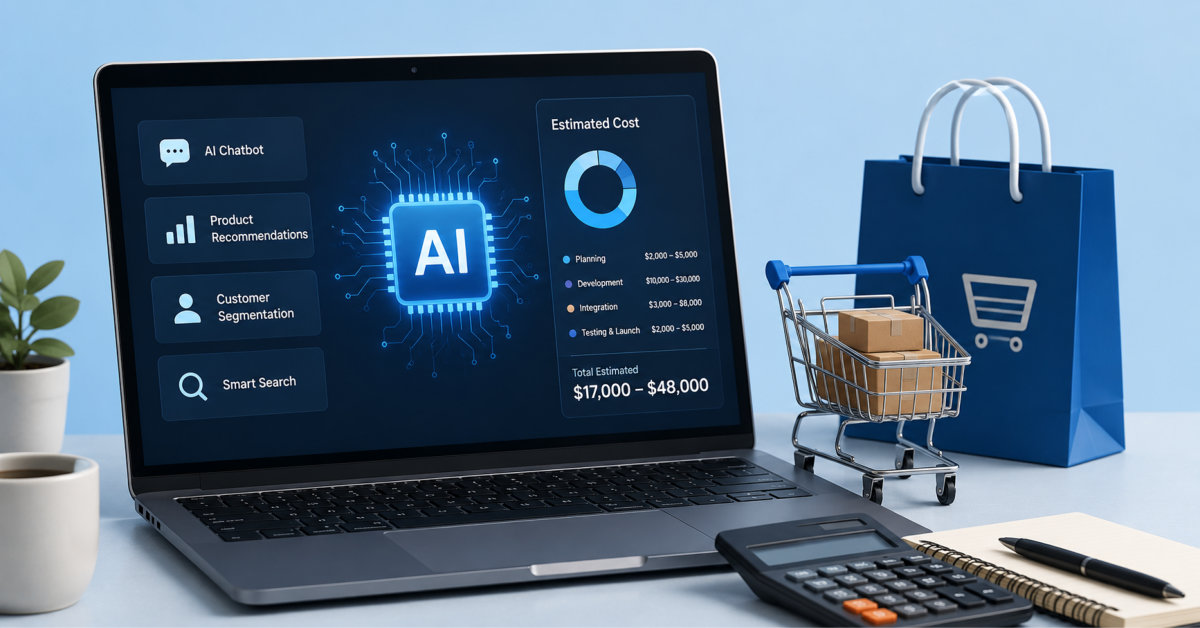
AI development for ecommerce typically costs $2,000 to $10,000 for a narrow MVP and can exceed $100,000 for production systems, but the main cost driver is not the model: it is the quality of your data, workflow definitions, integrations, controls, and measurement plan.
The cheapest AI project is not the one with the lowest quote. It is the one that changes a known workflow, uses data you can trust, and has a number you can measure before the build begins.
Two brands ask us for the same thing: an AI assistant that answers customer questions. One quote comes back at $4,000, the other at $35,000. Same brief, same models available to both, and an AI development cost gap of 8x.
That gap is most of what you need to know about pricing AI, and it has very little to do with which model anyone picks. MIT looked at 300 public AI deployments and found that 95% of pilots delivered no measurable return. Not because the technology failed. Because of how the projects were set up before anyone started.
So, in order:
Most pricing articles assume same feature equals same cost. In real projects that’s never true.
“Answer customer questions” sounds like one job. Then you ask what it answers from.
Order status pulled live from Shopify? Tracking from your 3PL, which has its own API and its own outages? A returns policy sitting in a PDF nobody has updated since 2023? Sizing questions that need product data your supplier never sent you?
Each of those is a different build. Order status is close to a weekend of work if your Shopify data is clean. The sizing one is a data project with a chatbot on the front, and it will be quoted like a data project.
Four things move the number more than anything else:
None of those are model choices. They’re decisions you make before anyone writes code.
Here’s how the money moves on our projects. Your vendor’s numbers will differ, but the shape should look similar.
Up to five business days. Product analysis, a look at what competitors are doing, and picking the right approach for your case.
Skipping this is the most expensive $1,500 you’ll ever save. It’s the stage where someone says “wait, our returns data doesn’t exist anywhere structured,” which is a much cheaper sentence to hear in week one than in week six.
Infrastructure, access, data pipelines, and early architecture. Another week or so.
For a store, this is usually where someone finally maps how your catalog and order data connect to your support tooling. Plenty of brands find out here that the connection is worse than they thought.
The first working version. Most of ours run on RAG, which means the system pulls answers from your actual documents and databases instead of guessing from training data.
A RAG build typically lands around two months. That’s the pattern for support assistants, internal search, and anything that has to answer from your own content.
Once the MVP holds up, it grows into a real system with proper logic, integrations, and scale. This is the widest line on the page, and it’s wide because it depends entirely on what you’re connecting.
Model updates, monitoring, and support. Add model usage on top, which for a support assistant on a mid-sized store is usually tens of dollars a month, not hundreds.
Rates set the floor under all of this. Our frontend and backend work runs $25 to $35 an hour, full-stack is $30 to $40, and project management is included. Our minimum engagement is $2,000. We break the full stage-by-stage math down in our guide to AI development cost.
One finding from that MIT report is worth repeating: most AI budgets go into sales and marketing pilots, while the measurable returns keep showing up in back-office work.
That matches what we see. The projects that pay for themselves tend to be the dull ones.
Support deflection is the obvious one. Run your own math. Say you get 2,000 tickets a month and each costs $3 in agent time. That’s $6,000. An assistant that handles 40% of them saves $2,400 a month. Against a $6,000 build and $900 in monthly upkeep, you’re even in about four months.
Product data cleanup is the underrated one. Descriptions and attributes fixed at scale. Nobody puts this on a homepage, and it quietly improves your on-site search, your filtering, and how AI shopping agents read your catalog.
Then operations: order routing, supplier syncing, or the report someone rebuilds by hand every Monday morning.
One of our clients automated an internal workflow for $3,000 in a single week. We’d estimated $5,000 and three weeks. They arrived with page structures mapped, workflows written down, and a database schema ready, so there was nothing to guess at.
What tends not to pay back: generic “AI personalization” bolted onto a store that doesn’t have much behavioral data yet. If the pattern isn’t in your data, no model will invent it for you.
You can lower an AI quote before you ask for one. Not by cutting features, and not by asking for a smaller model. By removing the guesswork.
Write down these five things:
That document takes an afternoon and regularly moves a quote by thousands. It also tells you fast whether you actually know how your own support process works, which is uncomfortable but useful.
While you’re mapping data sources, it’s worth thinking about how AI agents will read your store from the outside too. eCommerce Fastlane’s Shopify MCP operator guide covers the half of that you control.
Pick one workflow that costs you real hours. Not the most exciting one. The one your team complains about. Support triage and manual reporting are usually top of the list.
Write the five-point brief above. Then send the same brief to two or three vendors. If the quotes still come back far apart, ask each one what they assumed. The answers will tell you who read it.
Start with a scoped MVP, not a platform. A $5,000 build that deflects 30% of tickets teaches you more than a $50,000 system designed around guesses, and you can always expand something that already works. If the MVP doesn’t move your one metric, you’ve learned that for the price of a month of ads.
An AI chatbot for a Shopify store can cost from a low monthly software subscription to roughly $2,000 to $10,000 for a scoped custom MVP, with larger production systems costing more when they require multiple integrations, custom workflows, monitoring, and action controls. The cost depends less on the chatbot interface than on what it must answer from and do. A help-centre assistant is simpler than a system that retrieves live orders, checks 3PL status, understands return eligibility, and drafts refunds for approval. Include ongoing model, hosting, support, and maintenance costs in every estimate.
Most ecommerce brands do not need to train their own AI model because existing models combined with retrieval-augmented generation can answer from current product data, policies, knowledge-base articles, and approved internal documents. The expensive work is usually preparing reliable source material, connecting systems securely, defining permissions, and testing exception handling. Custom model training becomes more relevant only for specialized requirements with large proprietary datasets, repeatable domain-specific tasks, and a clear business case that simpler retrieval, prompting, or workflow automation cannot meet. Start with retrieval and measurement before considering training.
A narrow ecommerce AI project can take a few weeks to reach a useful MVP, while a production system with several integrations, security controls, testing, and change management can take two months or longer. The timeline depends on data readiness and workflow clarity more than the model itself. Discovery may take up to five business days, environment setup about another week, and a RAG-based assistant can require several additional weeks for source preparation, integration, testing, feedback, and monitoring. Require a milestone plan that defines what will be proven at each stage.
AI development cost rises during a project when the team discovers undefined workflows, incomplete data, undocumented business rules, inaccessible systems, new integrations, or action requirements that were not in the original scope. The common pattern is a request that begins as “answer customer questions” and later expands into identity verification, live order lookups, carrier tracking, refunds, multi-language support, and CRM updates. Prevent this by documenting sources, permissions, exception paths, user groups, and a primary success metric before vendors estimate. A good discovery phase turns unknowns into priced decisions.
You can reduce AI development cost without cutting the intended outcome by removing uncertainty before the build starts. Clean and centralize the data the system will use, document the workflow step by step, define user permissions, decide human escalation rules, provide representative examples, and establish the baseline metric you want to improve. These steps reduce vendor time spent on discovery, rework, and assumptions. Do not reduce cost by skipping security, testing, data validation, or human approval for sensitive actions. Those shortcuts usually create more expensive problems after launch.
Author bio:
Dmytro Serebrych is a co-founder of udata, where the team builds AI systems, custom software, and data pipelines for companies in the US and Western Europe. He works with DTC brands on catalog data, integrations, and support automation. More at udata.company or connect on LinkedIn.