
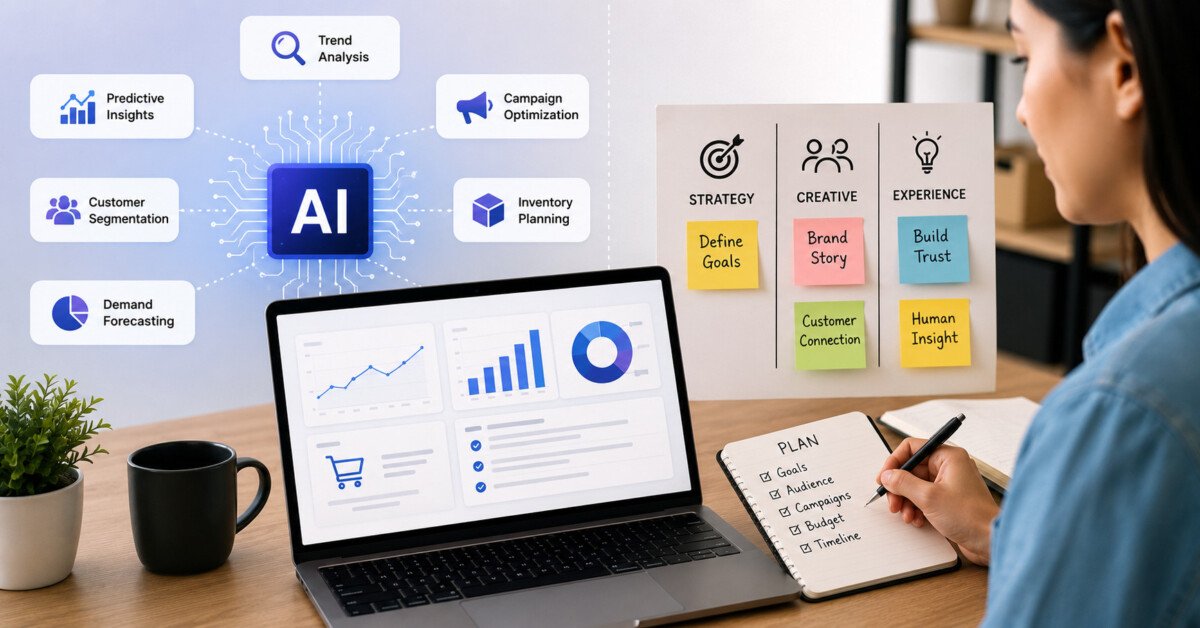
AI makes ecommerce launch planning faster and less chaotic by generating structured project plans in seconds, but it still needs human oversight for context, accountability, and adapting to real-world changes.
The right way to use AI in ecommerce planning is to let it generate structure and hypotheses quickly, then have humans adapt, own, and execute that plan in context.
Planning sets the direction for all subsequent phases of a project. Its effectiveness depends on your approach and the tools you use.
Surprisingly, 22% of companies are still applying Excel for project planning. 11% don’t use any tools at all, according to Wellington’s report.
E-commerce teams handle this project stage differently. Many of them also launch products using never-updated spreadsheets and Slack messages.
AI is changing this process. It seems that automation and smart algorithms are here to stay for a long time.
However, is AI e-commerce planning as seamless as described in webinars and conferences?
Here, I’ll try to find the answer and cover the following:
I’ve recently come across the UKG Retail Workforce Report (2025). It states that 86% of retailers see a positive impact of AI on efficiency. This says a lot.
Algorithms may significantly improve various processes across a project lifecycle.
It can be a planning agent, an analytical solution, an AI testing tool, and more. In any case, such a system becomes an indispensable assistant for managers. It streamlines tasks and improves processes.
Smart tools in planning reduce manual routine and the risk of “blind eyes”.
When people don’t know where to start, they use AI to overcome the psychological barrier of beginning a project from scratch. This “blank page problem” is often considered one of the most costly aspects of launch planning.
Moreover, AI project management helps identify hidden risks.
A real-life example will make it clearer.
My friend Adam owns a Shopify store that sells sportswear and equipment. He manages day-to-day store operations and sales and coordinates the work of 8 specialists.
Adam and his team recently embarked on a new project — creating a new stock-keeping unit database. They want to launch this SKU base within 2 months.
Previously, Adam complained that such projects required a lot of time and effort. There was very little initial data or guidance. His team could spend an entire workday, sometimes two, just to draft a plan. Other tasks were left incomplete. It resulted in lost revenue, sometimes amounting to several hundred dollars per hour for a single specialist.
Now, the situation has changed. I saw Adam last week, and he seemed happy. He told me that he now spends just a few minutes describing a project in a few sentences. He uses an autonomous AI tool he learned about from a blog article. His team instantly receives a completed draft plan with the required tasks, their owners, dependencies, responsibilities, and deadlines.
Now the planning stage takes less time. The team focuses on priority tasks that don’t hinder profitability. No headaches or complaints.
What’s particularly important is that AI adapts a project plan to a specific context. This is crucial, as launching a new product is clearly not the same as a seasonal Black Friday campaign or a global rebranding. AI understands this and automatically generates appropriate structures.
Despite its enormous benefits, AI doesn’t feel the reality of your team. It serves as a useful assistant but is still not a real specialist.
So, should we rely entirely on AI? Should managers consider it normal to choose AI agents over real people?
I’ve found interesting data from Gartner. By 2027, 50% of companies that attribute headcount reductions to AI use will rehire employees to perform similar functions, but in different positions.
It means that AI capabilities are not so exceptional.
I’d like to highlight 3 points where AI e-commerce planning may fail:
The difference between “AI generates a task” and “a team member takes accountability for its completion” is fundamental.
An AI tool assigns a task based on mathematical algorithms. It ignores the mood of team members, budget constraints, or external factors. Conversely, team members can assess critically if the AI-proposed solution is adequate. They are accountable for the final decision.
Years of experience in project management show that AI is not ready to replace humans.
The optimal PM scenario is one where smart algorithms act as powerful accelerators for a successful start. Humans, on the other hand, are long-term-oriented managers. They communicate and make the final decisions.
AI project management will help you initially process huge amounts of data and generate a basic work structure. But any automated plan is only viable until it faces reality. When it comes to empathy, negotiations, interpersonal conflicts, and final decisions, human intelligence is indispensable.
Don’t think this is a dry theory. It can be easily applied in AI e-commerce planning as a practical model:
E-commerce teams using GanttPRO, the software I’m the CEO of, are already implementing AI to create plans in seconds.
The robust tool frees them from the tedious process of planning and starting work from scratch. It offers a wealth of great hypotheses and structures, but only within the framework predetermined by humans.
I have already noticed that, thanks to instant AI plan generation, teams close projects faster. After a successful start, they find it significantly easier to move forward.
Project participants complement smart systems with qualities they lack – empathy, flexibility, and the ability to understand the context here and now. They retain human control over execution and complete projects on time.
If your e-commerce product launch plan is weak and needs improvement, I’d recommend the following:
Finding the right balance between AI’s potential and human labor is possible with some effort.
Smart tools are changing the game for e-commerce teams. They are supportive in the beginning, in the critical processes, and at the end of the DTC team operations. For instance, there are lots of advantages to making a project plan with AI.
Apply AI to planning and other phases of the project lifecycle. Automate routine and get time back for what really matters.
AI is unable to replace project managers in launching e-commerce products. It makes many important tasks easier and faster, like planning and organizing work. But smart algorithms don’t have the understanding of context, empathy, and the ability to respond quickly to risks that are inherent to humans.
AI planning tools enable small direct-to-consumer teams to reconfigure their work and to break through chaos when unforeseen changes happen. Such assistance often comes in the form of less manual labor. For instance, it may entail restructuring or automatically updating a plan. That means AI takes a new goal right away and breaks it down into manageable tasks, so a team doesn’t have to go back and rework the whole project roadmap.
A simple task list generated by AI is usually a first draft for a manager to review and refine further. A structured project plan is prepared for implementation in its final version. It includes all project tasks, dependencies, deadlines, owners, and milestones.
AI works just as well for small Shopify stores and large e-commerce businesses. Smart algorithms cut down on routine work and the need for acting from scratch. However, they should not be allowed to make decisions and resolve risky situations instead of a human.
Search for an e-commerce AI project planning tool that generates projects in seconds without any extra work on your part. Modern options often come with ready-made prompts and allow for refinements. The best tools have been trained on numerous real-world scenarios, so they understand context very well, even from brief descriptions.




