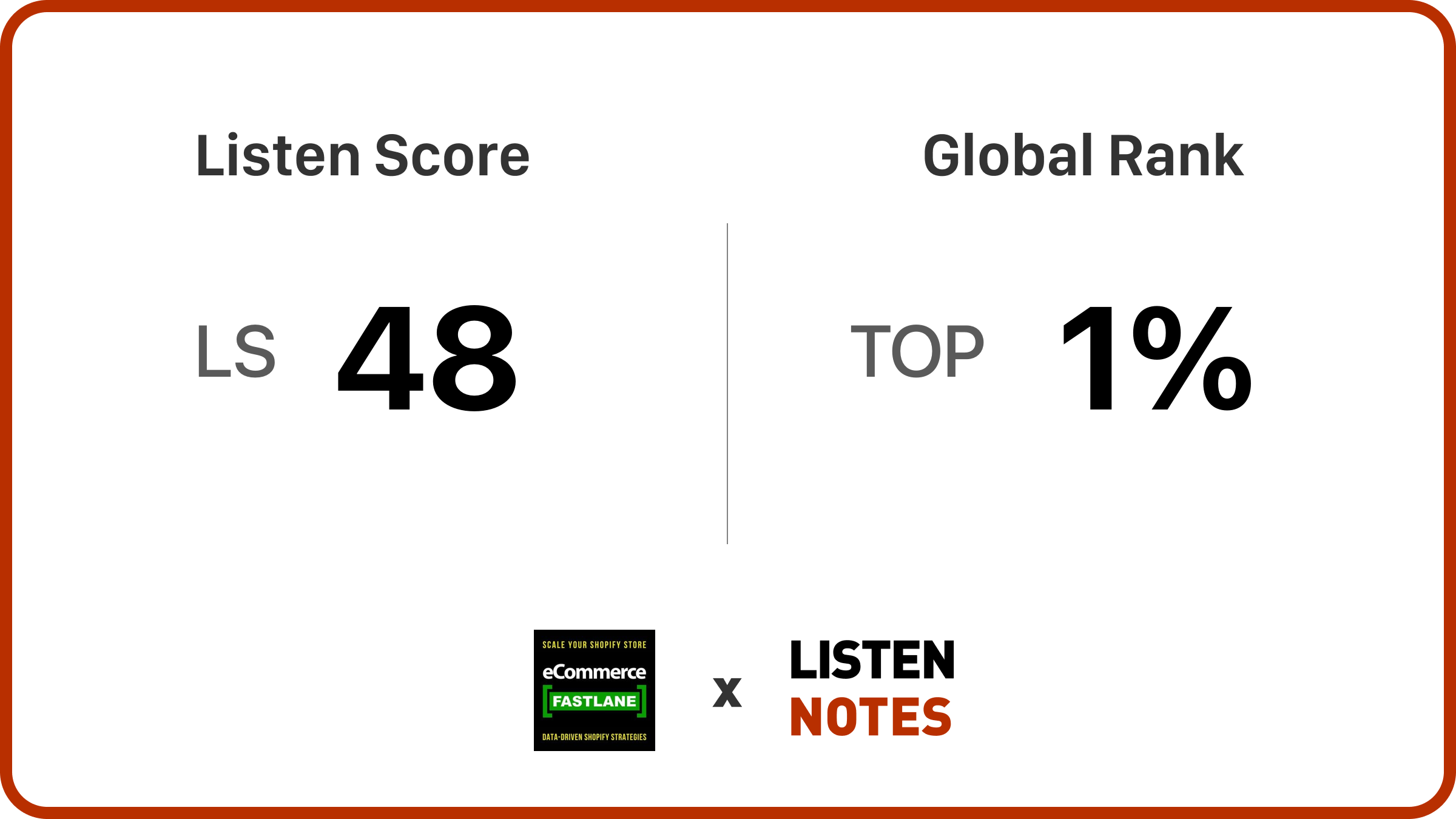
Ask ChatGPT who eCommerce Fastlane is and it answers correctly. Ask it how to make a Shopify store visible in AI search and, across every run we tracked from September 8 to October 23, it named us zero times. Shopify got named 123.
In October, StoreHero published a study that puts a number on a gap we saw in our own data last month. It tracked 135 brands across thousands of AI answers and found that the engines know almost every brand by name and still rarely recommend one when a shopper asks a general question.
For context, StoreHero’s co-founder, Thomas Gleeson, was a guest on episode 466 of the podcast, and Fastlane published a StoreHero review in July. Here is what the new study found, how far I would trust it, and what I would check first at your stage.
StoreHero’s October 2026 benchmark found that AI engines recognize brands by name almost every time but rarely name them when a shopper asks an unbranded question. The study covers 135 brands and 12,496 AI answers collected between October 20 and 26, 2026, and it is published on StoreHero’s own site.
On branded questions, where the shopper types the company name, brands were recognized 100 percent of the time. On non-branded questions, the kind a shopper asks before choosing a product, the median brand appeared in 15 percent of answers. StoreHero also reports that 63 percent of non-branded questions never named the brand at all. Those two figures cut the data differently, so they do not need to add up to each other.
The spread by category is wide. Median non-branded visibility ran from 34 percent in sports and outdoor down to 5 percent in supplements. In shopping answers, StoreHero reports product cards in about 30 percent of answers, while the median brand appeared in a product card in only 3 percent of them. Negative sentiment was 0.4 percent.
That last number is the one I keep returning to. My read is that the problem here is absence, not reputation. The engines are not saying bad things about these brands. They are mostly not saying anything at all.
A brand that AI can describe is not the same as a brand that AI will suggest, and only the second one sends a new shopper to your product page. Branded recognition tests the engine’s memory. Unbranded visibility tests its judgment: whom to name, from which sources, for this particular buyer.
Most merchants check the first one. They type their own name into ChatGPT, get a flattering paragraph, and stop. Now, I’d argue the branded number is the vanity metric of this whole category. It will be high for almost everyone, so it tells you almost nothing about whether a stranger meets your brand.
Jim Boudreau, who has done e-commerce SEO since the late 1990s, described the same shape on episode 494 of the podcast. His team asked the major assistants for Scandinavian themed gifts. The few long-established sites with the best assortments in that niche were not mentioned. As he put it, “Very obscure sites get mentioned.” That is one category from one team’s testing, not a study, but it matches the pattern in StoreHero’s data.
We are an example too. We track the question of how to make a Shopify store visible in AI search tools like ChatGPT and Perplexity. Across every run from September 8 to October 23, eCommerce Fastlane was named zero times and Shopify was named 123 times, even though the engines can describe this site accurately when asked by name. That is one site and one tracked question, so it is an illustration, not a benchmark. I wrote up the full engine by engine split in our 30-minute AI visibility check.
Treat the benchmark as a useful directional signal from a vendor with a product to sell, not as a measurement of Shopify stores in general. Every figure above is vendor data, and the context around it matters.
According to its launch post, StoreHero released its AI visibility tracker on October 20, 2026, at $99 per month, the same day the study’s collection window opened. That is not a reason to dismiss the study. It is a reason to read it the way you would read any company’s research about the problem its product solves.
StoreHero is fairly open about the limits. The study covers one week, uses competitor sets chosen per brand, mixes countries, and has no search volume behind the questions. A video walkthrough of the same study also gives slightly different totals than the benchmark page: 125 brands, 97 percent branded recognition and 13 percent unbranded visibility, against 135, 100 and 15 on the page. I used the page. In the same video, the presenter says the tool is not a silver bullet and that gains take weeks of daily action.
I would also not assume the 135 brands are a random sample of Shopify stores. If I were evaluating any vendor’s study, I would ask three things: how the brands and questions were chosen, how many times each question was run, and how competitors were defined. Answers vary from run to run, so the gaps between categories, 34 percent against 5 percent for example, should not be quoted as fixed truths.
If StoreHero’s citation mix holds up, AI engines pull far more of their answers from shops and marketplaces than from brands’ own websites. The study puts shops and marketplaces at 45 percent of cited sources and brands’ own sites at 5 percent.
Take that as a one week, vendor reported number. Even so, it points somewhere practical. If the engines lean on retailers, marketplaces and other third-party pages, then the information those pages carry about your products matters as much as your own product page does. I would not conclude that your own site is irrelevant. I would conclude that product data is the part you control that travels furthest.
Rob Langenback, President and COO of the search agency Eight Oh Two, made the plain version of this point on episode 480. Lovely product names that never say what the product is leave the tools guessing. As he put it, “If we don’t call it a shirt, how do we expect the tools to know that it’s a shirt?”
The wider data agrees. Adobe’s analysis of more than a trillion visits to US retail sites, published in April 2026, scored product detail pages at 66 percent on machine readability, the lowest of the page types it measured. Unbranded visibility starts with a catalog that a machine can read and a human can understand in one sentence.
Test ten unbranded buying questions in ChatGPT, Perplexity and Google before you look at any dashboard, and write down who gets named instead of you. The point is to see the gap before you pay to measure it.
Write questions a stranger would type, none of which contain your brand or product names: best X for Y, X versus Y, and problem questions where the shopper has not picked a category. Run them in a private window. For each answer, log whether you appear, which competitors do, and which sources are cited. Our 15 minute AI visibility self-check covers the mechanics.
Under about $500K, run it once, fix product titles so they say what the product is, and stop there. Between $500K and $2M, rerun the same questions monthly and look at which third-party sources keep getting cited for your category, because those are where mentions would count. From $2M to $10M, someone should own the number, and a tracker starts to make sense.
Here is the subtraction I would make at any stage. If your only AI metric is whether the engine knows your name, remove it from the dashboard. It is the number that will always look fine. And if you sell supplements and see 5 percent, do not read that as a verdict. It is a category median from one week, and your own ten questions will tell you more.
StoreHero’s study is worth reading, and its $99 per month tracker makes the most sense once someone owns AI discovery and a manual unbranded check has become the bottleneck. Thomas Gleeson and his team are reputable operators, and they have been open about what the study can and cannot show.
The honest fit looks like this. A brand with someone who owns AI discovery, dozens of prompts to follow and several competitors to watch may find a tracker saves real time. A brand that has never read an AI answer about its own category will mostly be paying for a chart. That matches what I wrote last month about tools generally: read the answers by hand for a month, then decide.
StoreHero is also not the only option. Profound is built for the same job at the larger end of the market, and we reviewed KIME in April. For measuring versus doing the work, our piece on why GEO tools should do more than measure AI search visibility is the better starting point.
Whichever route you take, run your own ten unbranded questions first. If your answers say the gap is small, believe them over any benchmark, including this one.
Branded AI visibility is whether an AI engine recognizes your company when a shopper types your name, while unbranded visibility is whether it recommends you when the shopper asks a general question like which product to buy. In StoreHero’s October 2026 benchmark of 135 brands, branded recognition was 100 percent and the median brand appeared in 15 percent of non-branded answers. The first number mostly confirms the engine has heard of you. The second is the one that decides whether a new customer meets you. Track both if you like, but make decisions on the unbranded questions.
Write ten buying questions that never contain your brand or product names, run each in ChatGPT, Perplexity and Google in a private window, and record who gets named. Use your customers’ wording: best X for Y, X versus Y, and problem questions where the shopper has not chosen a category yet. Log whether you appear, which competitors do, and which sources are cited. Answers change from run to run, so rerun your five most important questions three times each before you trust a result. The first pass takes about 30 minutes and costs nothing. Repeat it monthly with the same questions so the trend means something.
Trust it as a directional signal, not as a measurement of all Shopify stores. It is vendor data from one week, October 20 to 26, 2026, with competitor sets chosen per brand, mixed countries and no search volume behind the questions, and StoreHero lists several of those limits itself. The company also gave slightly different totals in a video than on its benchmark page. None of that makes the core finding wrong. It means the exact percentages, especially the gaps between categories, should not be quoted as fixed truths. Check your own unbranded questions before acting on anyone else’s median.
A low unbranded score does not mean your store is failing, because the median brand in StoreHero’s study scored only 15 percent too. It means shoppers who do not know your name rarely meet it inside AI answers yet. Whether that matters depends on where your customers actually start. If most of your revenue comes from email, repeat buyers and paid social, AI discovery may be a small lever today. Fix product names and data first, since that also helps Google Shopping and on-site search, and then decide whether AI discovery deserves an owner and a monthly number.
Most Shopify stores under about $2M in annual revenue do not need a paid tool, because a monthly manual check of ten unbranded questions shows the same core signal for free. Tools earn their fee when you need to track dozens of prompts, several countries or many competitors consistently, and when someone owns the number. StoreHero lists its tracker at $99 per month, and other platforms such as Profound and KIME sit in the same category. Before you pay, run the manual check for two or three months and read the actual answers, because a dashboard that summarizes answers you have never read is hard to judge.