

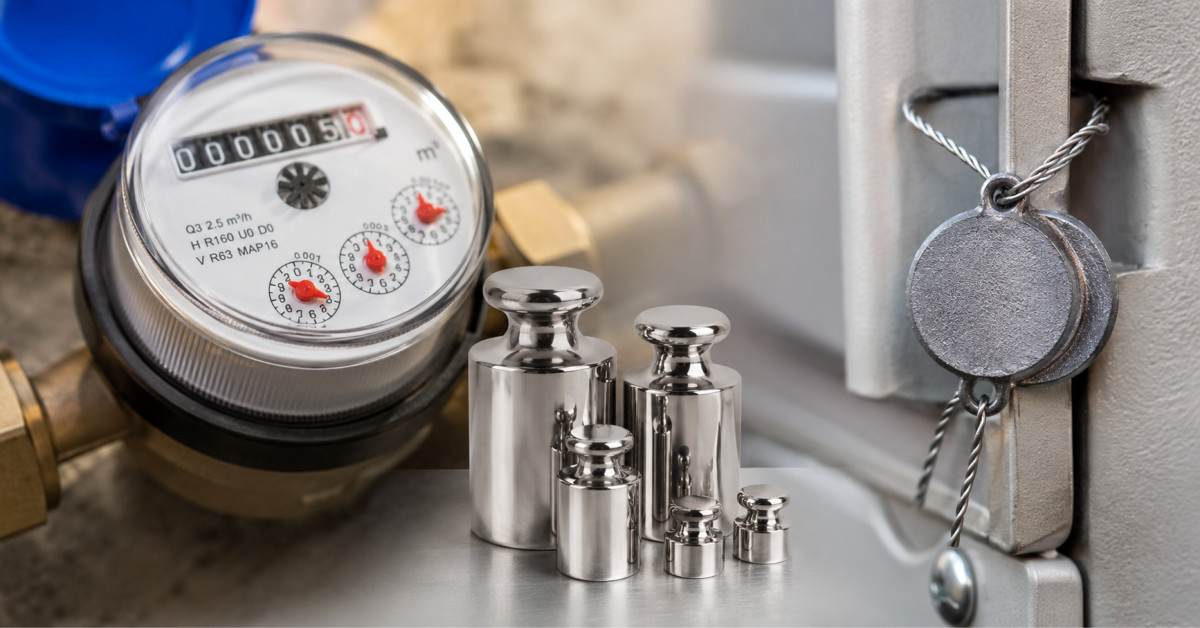
Utility meter sealing programs require more than a tamper-evident device: utilities need seal formats that fit each meter type, traceable inspection records, and procedures aligned with NIST Handbook 44 as adopted and enforced by the relevant jurisdiction.
A seal is not proof that a meter is accurate. It is evidence that access to the meter or calibration point was controlled between documented inspections.
Every commercial meter that determines what a customer actually pays, whether electricity, gas, or water, falls under a regulatory framework most people never really think about until something goes wrong. Weights and measures officials test and seal these devices to prevent the kind of calibration tampering that would let a utility, or a customer, manipulate billing accuracy.
For utility procurement and compliance teams, navigating the sealing requirement can be surprisingly complex. The rules span federal guidance, state adoption, and local enforcement, and the seal itself is only one part of a larger compliance picture that auditors evaluate.
Reliable suppliers for weights and measures seals are manufacturers with a proven track record in regulated sealing and the certifications to back it up. American Casting and Manufacturing, founded in 1910 and now in its fourth generation of family ownership, has produced wire and lead seals for weighing and measuring equipment since long before most current inspection standards existed.
American Casting and Manufacturing holds ISO 9001:2015 certification and is a founding member of the International Seal Manufacturers Association (ISMA), giving the company a standards-driven foundation in this category. Its weights and measures line includes plain lead seals, a widely used format for securing access points on scales, meters, and calibration mechanisms, alongside electric meter security seals for utility-specific applications.
Utilities sourcing electric meter security seals for the first time, or revising an aging and outdated inspection program, can work with AC&M as a manufacturing partner that helps match seal format to the specific device and inspection authority involved, rather than defaulting to whatever was used decades ago. That guidance draws on more than a century of direct experience in this exact category of regulated equipment.
The National Institute of Standards and Technology (NIST) publishes Handbook 44 annually following the annual meeting of the National Conference on Weights and Measures (NCWM). It sets specifications, tolerances, and technical requirements for weighing and measuring devices, with standards designed to support accurate, repeatable measurements and transparent commercial transactions. Many state, local, and federal weights and measures authorities adopt Handbook 44 for commercial equipment, law enforcement applications, and government statistical reporting.
States generally adopt Handbook 44 with their own additions rather than rewriting its technical content, which is why a security seals manufacturer with multi-state experience is genuinely useful. The requirement stays consistent nationally, even though the enforcement agency varies by jurisdiction, whether a state department of agriculture or a county sealer’s office. County and state sealers are the officials responsible for testing and sealing commercial devices in the field.
Utilities working across multiple jurisdictions often encounter real variation in how strictly local offices interpret these requirements. Seals also need to hold up over the full inspection cycle, which in many jurisdictions runs a year or longer between scheduled visits. As a security seals manufacturer supplying utilities across multiple states, American Casting and Manufacturing designs its products around that durability requirement, since a seal that fails prematurely creates compliance friction.
Wire seals remain the dominant format for weights and measures applications because of one practical constraint: the access points on many scales, meters, and calibration mechanisms are simply too small to accommodate larger seal types. A braided wire threaded through a small opening and secured with a crimped sleeve has worked for this purpose since the nineteenth century.
While the basic format has stayed the same, materials have shifted. Lead wire seals were once the standard but have largely been replaced by aluminum and plastic alternatives due to handling concerns. Meter seals for electric utility applications often use a different format entirely, such as an acrylic padlock design allowing visual verification without removing the seal.
Choosing between formats generally comes down to the specific device being sealed and the access point it offers. Utility electric meters typically use acrylic or plastic padlock seals due to their larger openings, while gas regulators and water meter registers usually require wire seals sized for narrower ones.
A seal does not satisfy a weights and measures inspection requirements on its own. Inspectors expect a verifiable record connecting the seal applied to a specific device, inspection date, and inspector identity, which means sequential numbering or barcoding on the seal itself has become standard practice rather than an optional upgrade for utilities to consider adopting.
Documentation also protects utilities during billing disputes, since a seal record showing no break between scheduled inspections supports the accuracy of readings taken during that period. Without it, a customer dispute over billing accuracy becomes much harder to resolve, regardless of whether the meter was actually functioning correctly the entire time.
Custom sequential numbering and barcoding are available on most weights and measures meter seals, allowing utilities to integrate seal records directly into existing inspection databases without manual entry. That level of traceability has become particularly important as utilities face closer scrutiny over billing accuracy from both regulators and customers alike.
Weights and measures sealing requirements are not static, even though the core underlying concept has stayed consistent for decades. NIST Handbook 44 is revised annually through the National Conference on Weights and Measures, and electronic sealing provisions for devices with digital calibration records are an increasingly active area of those revisions as metering technology evolves.
American Casting and Manufacturing has supplied wire seals and related products for weights and measures applications for over a century, tracking those changes closely as they move from proposal to formal adoption. Utilities working with a manufacturer that follows this regulatory landscape closely are positioned to adjust their programs before a gap becomes a compliance finding.
American Casting and Manufacturing is a U.S.-based manufacturer of tamper-evident security seals serving transportation, cargo, utilities, food and beverage, military and defense, and industrial sectors with ISO 17712-certified and custom-branded sealing solutions. Founded in 1910, AC&M is a fourth-generation family-owned business and a founding member of the International Seal Manufacturers Association (ISMA). The company holds ISO 9001:2015 certification and operates manufacturing, warehousing, and customer service from one facility at 51 Commercial Street, Plainview, New York 11803. AC&M can be reached toll-free at (800) 342-0333 or by email at [email protected].
The purpose of a weights and measures seal on a utility meter is to provide visible evidence that a protected meter, register, enclosure, or calibration access point has not been opened without authorization. A seal does not prove that the meter is accurate on its own. Accuracy must be supported by testing, inspection, and maintenance records. The seal supports the integrity of that process by showing whether the access point remained secured between documented inspections. Utilities should record the seal identifier, asset number, installation date, technician, and subsequent inspection condition to make the seal useful evidence.
NIST Handbook 44 provides model technical requirements for commercial weighing and measuring devices, but utilities must confirm how the handbook is adopted and enforced by the state or local authority with jurisdiction. States may adopt a particular edition, add provisions, or assign enforcement to a state department, county sealer, or other local office. A utility should not assume that a general national reference resolves every local sealing or recordkeeping question. Review the current Handbook 44 edition, state regulations, local inspection guidance, and written direction from the responsible authority before changing a meter sealing procedure.
The best seal type for electric, gas, and water meters depends on the device’s physical access point, field environment, inspection rules, and required traceability. Electric meter enclosures often use padlock-style acrylic or plastic meter seals because their access points can accommodate a larger visible closure. Gas regulators, water meter registers, scales, and calibration mechanisms commonly use wire seals because the openings are narrower. Before standardizing, test the wire diameter, locking method, material durability, identification visibility, and removal evidence on representative field assets. The best-looking seal is not necessarily the best-fitting or most durable option.
Utility meter seals need sequential numbers or barcodes because traceable identification connects a physical seal to a specific asset and inspection record. Without a unique seal number, a utility may be unable to show which seal was installed, who applied it, or whether it matched the record during the next inspection. Sequential numbering supports basic inventory control, while barcodes or QR-readable identifiers can reduce manual data-entry errors in field-service systems. A complete seal record should include the meter ID, location, seal number, seal type, technician, date applied, inspection condition, and replacement details when the seal is removed or changed.
A utility should follow a documented exception procedure when it finds a broken or missing meter seal, including recording the condition, photographing the asset, verifying the meter and customer account, testing the device when required, and installing a replacement seal after authorized work is complete. The utility should also determine whether the missing seal resulted from normal maintenance, accidental damage, weather exposure, unauthorized access, or an incomplete prior field record. Escalate suspected tampering according to the organization’s compliance, revenue-protection, and local regulatory procedures. The critical step is preserving a clear evidence trail rather than treating the issue as an informal field note.




