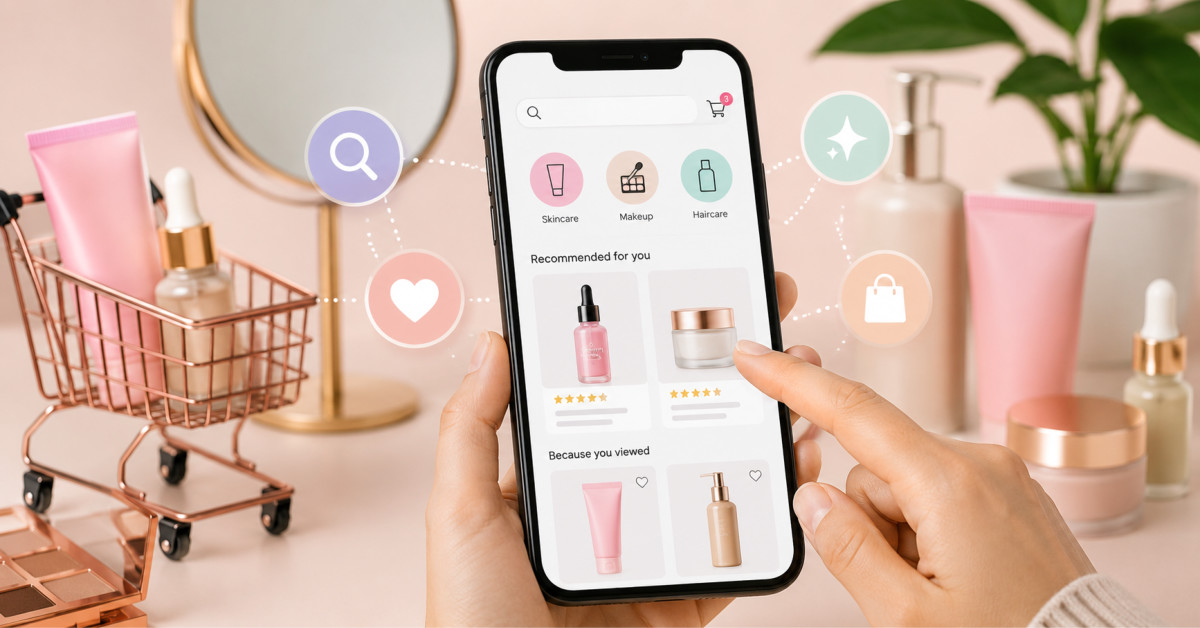
Beauty demand in the US now forms on creator platforms, community threads, and AI assistants before a shopper ever reaches a store, which means independent beauty retailers compete on curation, availability, and machine readable product data rather than on catalog size.
Beauty and personal care captured 20% of TikTok Shop dollar spending in the first quarter of 2026, and TikTok Shop already accounts for roughly 10% of all beauty ecommerce. The demand your store depends on is being created somewhere you do not own.
A shopper in Ohio sees a Japanese sunscreen in a 22 second creator video on a Tuesday night. By Wednesday she has read two community threads about the UV filters, asked an AI assistant whether it compares to anything sold domestically, and typed the exact product name into Google. She lands on an online store roughly 40 hours after first seeing the product, and by then the decision is close to finished. She is not shopping for sunscreen. She is shopping for that sunscreen, and she is choosing where to buy it.
That sequence is now the default in US beauty rather than the exception. The retailer is no longer where discovery starts. It is where discovery ends, and the store that wins is the one that recognized the demand early enough to have the product on the shelf when she arrived.
This matters most for independent retailers in the $250K to $10M range, because that is the band where a specialist can still move faster than a marketplace but cannot afford to be wrong about what to stock. The rest of this piece covers where beauty demand actually forms now, how to source and size against it, and what has to change on your product pages so the systems that shoppers ask for recommendations can actually see you.
Beauty demand in the US now forms on creator platforms and in online communities before a shopper reaches any retailer, which makes assortment decisions downstream of conversations you do not control. Traditional beauty retail was retailer led. Stores decided which brands got shelf space, which products appeared in promotions, and which launches received visibility. That control has largely gone.
The numbers show how far it has gone. According to Circana’s first quarter 2026 analysis of the US beauty market, beauty and personal care led every category on TikTok Shop with 20% of dollar spending, and TikTok Shop, launched in the US in late 2023, already represents about 10% of total beauty ecommerce sales. On the platform side the concentration is even sharper, with health and beauty accounting for a reported 79.3% of TikTok Shop sales in the broader breakdown of TikTok Shop’s growth into a $15B channel.
The practical consequence is that a single ingredient, format, or routine can build meaningful demand without a traditional advertising campaign behind it. A hair serum goes from unknown to sold out in three weeks. This is where most retailers get burned: they treat a spike as a trend. The distinction that matters is repetition. One viral video is noise. The same product appearing across three unrelated creators, sustained search volume four weeks after the first spike, and unprompted customer requests in your support inbox are three independent signals, and two of the three converging is usually enough to buy against.
If you are under $500K, watch this manually. Twenty minutes a week reviewing your site search terms for products you do not carry will tell you more than any trend report. Above $2M, this belongs to a named person with a weekly review, not to whoever happens to notice.
US shoppers now buy from a global shelf, and carrying the international products Americans are already searching for by name is the fastest route to a differentiated assortment. Korean skincare normalized the behavior, but it no longer defines it.
The trade data makes the shift concrete. Korea’s Ministry of Food and Drug Safety reported record cosmetics exports of $11.4 billion in 2025, up 12.3% year over year, with the United States as the single largest destination at $2.2 billion. Korean cosmetics shipped to 202 countries that year, up from 172 in 2024. Basic skincare led at $8.54 billion, makeup followed at $1.51 billion, and fragrance grew fastest at 46.2%. Japanese haircare, Brazilian body and hair products, French pharmacy skincare, and European sun care are following the same path into American baskets, shortened by social platforms that erase the lag between a product becoming popular in one market and being searched for in another.
For a specialist retailer this is the opening, but only if the assortment is built against evidence rather than enthusiasm. At $250K to $1M, three to five imported hero SKUs with genuine search volume will outperform 200 imported SKUs bought on a supplier’s minimum order. At $2M and above, depth inside one or two origin stories, such as owning Japanese sun care properly with the full range, sizes, and formats, beats a thin layer across six countries. Import compliance, ingredient labeling, and expiry dating all get harder as you widen, which is another reason narrow tends to win before scale arrives.
In beauty the product decision now usually comes first and the retailer decision second, and that ordering is what gives a small specialist a real chance of appearing beside Amazon and Sephora on the same query. A shopper decides she wants a specific serum, mask, or fragrance, then decides where to buy it. The retailer is selected late, on a short list of factors: availability, product information quality, trust, price, shipping terms, and how confident she feels about the store.
That is a much more realistic competitive position than trying to become anyone’s default beauty destination. It also explains why online keeps taking share of the categories where product level search is strongest. Circana’s first quarter data showed prestige online sales outperforming brick and mortar across every major category, with skincare reaching the clearest inflection point: ecommerce now accounts for nearly half of prestige skincare dollars and the majority of units sold.
Winning that late stage decision is mostly an execution problem. Product names need to carry both the market name and the English descriptor, because shoppers type both. On Shopify, the free Search & Discovery app lets you set synonyms so a search for a romanized brand name still returns the right product, which is a 20 minute fix that most beauty stores never make. Product pages need the size, the full ingredient list as selectable text, and a plain statement of what the product is for and who it suits. Price is on the list, but it sits below availability and trust, which is the part operators consistently get backwards.
A focused beauty assortment converts better than a broad one, because relevance rather than selection is what a shopper needs at the moment she already knows which product she wants. Thousands of SKUs presented without meaningful organization make discovery harder, not easier, and a large catalog is expensive to merchandise, photograph, and keep accurate.
The alternative is concentrating on defined categories such as skincare, haircare, makeup, fragrance, and personal care, then selecting brands and products with identifiable demand behind them. That model can be seen with independent US focused beauty retailers such as Magic of Beauty, where the shopping experience is built around beauty and personal care rather than a general merchandise catalog. The value to the customer is not fewer products. It is that the path from discovering an interesting brand to finding somewhere credible to buy it gets shorter.
Curation has a real cost that deserves stating plainly. A narrower catalog usually means a lower average order value unless you deliberately build routines and bundles, and it concentrates risk in fewer suppliers. The offset is that you can merchandise against categories that are actually growing. Circana’s first half 2026 report put prestige hair care up 11% with hair serums up nearly 60%, prestige skincare up 9% led by sun care at 19% and body care at 16%, and lip liner as the fastest growing makeup segment. A specialist who owns two of those movements properly will outperform a generalist carrying all of them badly.
Ranking for a trending beauty product you cannot keep in stock costs more than it earns, which makes inventory planning part of acquisition strategy rather than a separate operations task. Beauty creates an unusual version of this problem, because demand can accelerate in days while supply chains still move in weeks, and imported products carry the longest lead times of all.
The mechanic that matters is simple and routinely ignored: your reorder point is expected demand during lead time plus safety stock, not whatever is sitting on hand. A supplier who quotes 21 days but occasionally takes 35 should change your buffer permanently. A single viral month will also distort your reorder logic for weeks unless you tag the promotion or override the spike, a failure mode covered in more depth in this guide to forecasting demand with predictive analytics inventory.
Tooling should match stage rather than ambition. Under roughly $500K, Shopify’s built in low stock reporting plus a Shopify Flow alert on your top 20 SKUs covers most of the risk for no additional cost. Stocky, free with Shopify POS Pro, adds supplier lead times and reorder suggestions. Above $1M, dedicated forecasting apps such as Prediko inventory management for Shopify, which starts around $119 per month, earn their place once you are running variant level demand across multiple suppliers. Buying a $500 per month planning stack at $300K of revenue is the premature complexity that stalls stores at exactly this stage.
When an American shopper buys an unfamiliar international beauty product, trust signals decide the sale more often than price does, because the product is going on her skin. Global discovery creates opportunity and uncertainty in the same motion. Searching for an imported serum surfaces marketplace sellers, overseas websites, unfamiliar retailers, and wildly different prices for what appears to be the same item.
She is asking five questions, and your product page should answer all five without her having to email you: Is it authentic? How has it been stored? Where does it ship from? How long will delivery take? What happens if something goes wrong? Concrete answers beat reassuring language. Name your sourcing relationship, show batch codes and expiry dating, state the origin warehouse, give a delivery window in days rather than “fast shipping,” and publish a return window with an actual number on it.
Landed cost is the one that quietly kills international beauty orders. Unexpected fees at delivery are consistently the top driver of cart abandonment, and refusal rates on parcels shipped with duties unpaid can reach 10 to 20% in high tax markets, as covered in this breakdown of showing guaranteed duties and taxes inside your Shopify checkout. If you ship cross border, showing the guaranteed all in price at checkout, whether through Shopify Markets or an independent landed cost provider, removes a failure point that no amount of conversion optimization elsewhere will offset.
AI assistants now send retail traffic that converts better than most paid channels, but they can only recommend products whose data they can actually read. This is the discovery layer most beauty retailers have not touched yet, and it is moving quickly.
Adobe’s analysis, drawn from more than one trillion visits to US retail sites, found that AI referred traffic to US retail sites grew 393% year over year in the first quarter of 2026. In March 2026 that traffic converted 42% better than non AI traffic, a full reversal from converting 38% worse twelve months earlier, and those visitors spent 48% longer on site. The gap is on the retailer’s side: Adobe’s readability benchmark put average retail homepages at 75% machine readable and individual product pages at just 66%, meaning a third of product page content is invisible to the models being asked for recommendations.
For beauty specifically, the fixes are unglamorous. Ingredient lists belong in selectable text rather than inside a packaging image. Product titles should carry the brand, the product name, the format, and the size. Every product needs a sentence explaining who it suits and when to choose it over an alternative, because comparative and use case content is what gets pulled into generated answers. Shipping, returns, and contact pages need to be readable too, since those are the pages assistants check before recommending an unfamiliar retailer. The mechanics of this, including how to test whether you currently appear at all, are covered in this guide to why most Shopify stores are invisible in AI search.
The winning position for an independent beauty retailer is not the largest catalog, it is being the most reliable place to buy a specific set of products people are already searching for by name. Competing on selection against a marketplace is expensive and almost impossible to defend. Competing on specialization is available to anyone willing to be disciplined about it.
Beauty suits this model because demand is fragmented across brands, ingredients, routines, origins, and communities. A customer looking for a particular Japanese hair treatment has nothing in common with someone shopping for a first fragrance or a barrier repair cream for irritated skin. Marketplaces flatten those differences. Specialists can build for them.
What that looks like by stage: under $250K, pick one category and one origin story and go deep enough that your product pages are the best resource on the open web for those specific items. From $250K to $2M, add the operational layer, which means demand signals reviewed weekly, reorder points that account for lead time, and landed cost shown at checkout. This is the band where premature complexity does the most damage, so three categories executed properly beats nine categories half stocked. Above $2M, invest in the machine readable layer and in owning comparison queries across your categories, because that is where the compounding happens.
The underlying shift is durable even though individual trends are not. The specific serum that sells out this quarter will be forgotten by next year. The mechanic, where demand forms outside your store and you are selected late on availability, information, and trust, is what still applies in eighteen months. The retailers that win will not be the ones with the most products. They will be the ones who understood the demand early enough to have the right products when customers came looking.
Most US beauty discovery now happens on creator platforms and in online communities before a shopper visits any retailer, with search and retail sites acting as the closing step rather than the starting point. Circana reported that beauty and personal care led all TikTok Shop categories with 20% of dollar spending in the first quarter of 2026, and that TikTok Shop already represents roughly 10% of total beauty ecommerce. A typical path runs from a short video to community threads, then to an AI assistant or search engine for verification, and only then to a store. For retailers this means demand forms outside your control, and your job is recognizing it early rather than creating it.
Small beauty retailers compete by winning specific product level searches rather than category level ones, because shoppers now choose the product before the retailer. When someone searches an exact product name, the deciding factors are availability, product information quality, trust signals, shipping terms, and price, in roughly that order. A specialist can beat a marketplace on all of those for a narrow set of products. Practically, that means carrying items with proven search demand, writing product pages that answer authenticity and suitability questions directly, setting search synonyms so brand name variations resolve correctly, and keeping the items in stock. Trying to match catalog breadth is the losing strategy.
Buy to cover expected demand during your supplier lead time plus a safety buffer sized to that supplier’s worst case, not their quoted average. If a supplier quotes 21 days but has taken 35, plan against 35. Before committing, confirm the trend is real using at least two independent signals, such as sustained search volume four weeks after the initial spike, repeat appearances across unrelated creators, and unprompted customer requests. Start with a coverage window of roughly 45 days for a first order, then reorder against actual velocity rather than the forecast. Tag the promotional period so one viral month does not distort your reorder logic for the following quarter.
Shoppers trust unfamiliar beauty retailers when the store answers authenticity, storage, origin, delivery, and resolution questions before they have to ask. Specific beats reassuring: name the sourcing relationship, show batch codes and expiry dating, state which country the order ships from, give a delivery window in days, and publish a return window with a real number. Cross border orders need the full landed cost shown at checkout, because unexpected duties at delivery are a leading cause of both abandonment and refused parcels, with refusal rates reaching 10 to 20% in high tax markets. Because beauty products are applied to skin and hair, the lowest price rarely wins on its own.
Getting recommended by AI assistants requires product data those systems can actually read, plus third party mentions that establish your store as credible. Adobe found that individual retail product pages average only 66% machine readability, meaning a third of the content is invisible to the models generating recommendations. Start by moving ingredient lists out of images and into selectable text, writing product titles that include brand, product name, format, and size, and adding a sentence to each page explaining who a product suits and when to choose it over an alternative. Make shipping, returns, and contact pages equally readable, since assistants check those before recommending an unfamiliar retailer.